Fear Street Part One: 1994

Loosely based on the young adult horror books written by R. L. Stine during the 1990s, the first installment of the Fear Street adaptation achieves a good deal of success in capturing elements of Stine’s writing while gearing the production for an audience now well into adulthood. Though likely to draw a new audience unfamiliar with the source material, this movie was produced to appeal to those who might have grown up reading Stine’s books for younger readers and young adults. While the Fear Street books were more violent and gory than a lot of Stine’s writing geared toward a younger audience, this movie amplifies that element quite nicely.
A killer is on the loose in Shadyside, but this isn’t the first time. In a town with a history of mysterious plagues of madness and murder, can Deena and her brother Josh hope to discover the secret behind these horrors before they–and all of their friends–are slain?
On the surface, it’s a color-by-number slasher flick complete with Shadyside High School students as fodder, but more backstory and mythology is forming the substrate than is typical in slasher fare. With an obvious fondness for the slasher flicks of the 1990s, one can’t help but see ample homage to such borderline classics as Scream, I Know What You Did Last Summer, and Urban Legend. Fear Street: 1994 goes beyond the superficial slasher characteristics, however, and incorporates a tale of witchcraft, and a town cursed for centuries into the narrative, setting the stage for the subsequent two volumes of the series.
The deaths are often fantastic, brutal, and gory–I doubt anyone will look at an industrial bread-slicer the same way again–and the story flows nicely at a fast pace, balancing suspense and jump scares as well as one could hope for.
The characters don’t consist solely of two-dimensional ciphers, as has become the meme for these types of movies, but they almost couldn’t be if the series is expected to span three movies. I found them largely likable and sympathetic.

Midsommar (2019)

Ari Aster’s Midsommar doesn’t receive the credit it deserves within a lot of the horror communities I interact with. The same goes for his previous film, Hereditary.
To some extent, I think it’s simply a matter of taste…some people seem to have little patience for more atmospheric horror, and Midsommar relies heavily on atmosphere much as movies like It Follows and Session 9 previously did. Similarly, there are psychological and symbolic elements scattered throughout the narrative, both subtle and overt. This is very much a movie for those who enjoyed Hereditary’s relatively slow burn horror and drip-fed revelations.
In both movies, the overall focus is that of cult activity, albeit framed quite differently from Hereditary to Midsommar. In this one, the communal religious sect from Sweden is quite upfront about their existence and adherence to old rituals and practices. Speaking of those rituals and practices, Aster did a fair bit of research into mythical traditions as well as actual practices within the prehistoric Nordic cultures to cultivate a plausible framework for the cult’s beliefs and activities. Mingling that blend of fact and fiction with the supernatural allowed him to craft an unsettling, tense, and phantasmagorical experience with this movie.
Florence Pugh puts forth an excellent performance as the emotionally and psychologically fragile, Dani. Her breadth of expression and emotive display is stretched about as far as a single performance could manage. On the opposite side of the central relationship, we have Jack Reynor’s performance as Christian which, while no less impressive, leans more toward emotionally distant and confused throughout the tale. Watching the relationship deteriorate from the already well-eroded substrate at the beginning is both heartbreaking–as we feel sympathy for Dani–and satisfying–as we feel increasing contempt for Christian.
The rest of the cast is no less impressive in their respective roles, but they all take a backseat to the dominant spotlights of the movie…the crumbling relationship between Dani and Christian, and the increasingly disturbing unveiling of the nightmare the outsiders have wandered into as guests/sacrifices.
Comparisons with The Wicker Man (1973) are certainly appropriate. The same element of outsiders being manipulated into playing preordained parts in a larger, primitive ritual is present in both movies. The same sort of disquieting undercurrent runs beneath the surface in both movies, though it certainly seems to breach the surface far more frequently and earlier in the film in this case. In fact, if you took The Wicker Man and blended it with a splash of Believers (2007), a dash of Shrooms (2007), and just a touch of Rosemary’s Baby (1968), you would have something quite similar to Midsommar.
It’s best to sit down and just experience this movie as it all plays out before you. There’s certainly gore (though the movie doesn’t rely on it as the backbone of the story), nudity, and psychological aspects that might be disturbing for some viewers…but there’s also a compelling story taking place.

Willy’s Wonderland (2021)

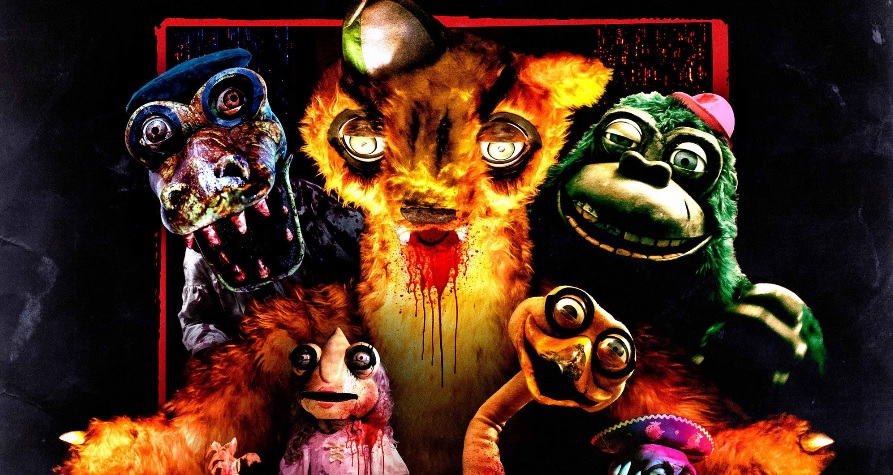
Willy’s Wonderland comes closer to being an adaptation of Five Nights At Freddy’s than The Banana Splits Movie managed a couple of years ago. I loved them both, but I have to say Willy’s Wonderland succeeds in surpassing The Banana Splits Movie in almost every way one could imagine. This could easily be one of the best horror/comedy flicks I’ll ever see.
Nicolas Cage, as the unnamed janitor, does more with over-the-top expressions and action than many actors could pull off with a full script of dialogue. There’s a sort of hilarity to the total and complete lack of dialogue from the actor and the focus on a face that conveys exaggerated grimaces and sneers with such ease. We learn nothing about the janitor’s life before unfortunate circumstances led to his being locked in the dilapidated Willy’s Wonderland building overnight. Dog tags dangle from the rearview mirror of his car, hinting at possible military service in the past, but that is the extent of our protagonist’s backstory.
That’s ok, though.
We learn enough to know that if we ever need a janitor who can excel with a virtually impossible job on their plate and constant distractions, this guy is our man. If this were a video resume, I’d hire the dude for his work ethic alone…though he does appear to be a bit inflexible concerning when he takes his breaks.
We learn plenty of backstory regarding the town of Hayesville and the history of Willy’s Wonderland itself. A Chuck E. Cheese-like establishment owned and operated by a serial killer who hired other serial killers to work as the staff. There’s something about a Satanic suicide ritual that allows the murderers to inhabit the animatronic bodies of the various cartoonish hosts of the place, and an uneasy bargain struck with the town’s inhabitants to keep the evil contained to the building itself.
It’s absurd, gory, and ridiculously violent…and it is, in my opinion, a must-see for anyone who enjoys the Five Nights At Freddy’s games or any sort of ludicrously violent movies where teenagers and other people are slaughtered and oil replaces blood splatter as animatronic monstrosities are dismembered by the best janitor the world will ever see.

The Ripper (2020)

After disappointing documentaries focused on Richard Ramirez and the Elisa Lam disappearance at the Cecil Hotel, I was hesitant to sit down for another Netflix true-crime documentary.
I’m pleased to say The Ripper more than makes up for the frustration of those other two recent documentary series from the streaming service. Gone is the transparent, painful hero-worship of the police involved in the investigation I found so agonizing to sit through during the Ramirez documentary. Similarly missing is the fixation on incompetent, repeatedly detrimental “contributions” from amateur sleuths in the Cecil Hotel documentary. What we’re left with is a straightforward documentary about the crimes of Peter Sutcliffe, the appropriately named Yorkshire Ripper, and the difficulties plaguing those attempting to investigate the crimes (difficulties often produced or amplified by the investigators involved).
The most interesting aspect of this documentary is that it showcases just how awful the people leading the investigation were at their jobs. The Yorkshire Ripper title applied to the unknown killer seemed to have intensified a series of biases held by these men, nudging them down dead ends and imaginary lines of inquiry. In the minds of those in charge, this man was simply another prostitute killer like the Whitechapel ripper of a century before…even though there was little to no evidence supporting numerous early victims being associated with prostitution at all…beyond the assertions of the investigators speaking to the press.
Latent and widespread misogyny, refusal to look beyond anything that fit a pet theory, and fixation on letters and tapes supplied by someone wasting their time directly and unambiguously led to more murders being committed by Sutcliffe than he would have successfully committed if they’d simply worked with the facts they had in front of them rather than distorting their perception of the facts to fit the preconceived notion of who the killer was and why he was committing these terrible atrocities.
It’s fascinating to see this investigation from the outside, in retrospect, because there’s no reason the case couldn’t have been closed years earlier than it ultimately was. Sutcliffe had been interviewed by investigators a total of nine times during the investigation and one of the cops involved was concerned at just how well Sutcliffe matched a sketch of the assailant from one of the attempted murders. Instead, his superiors ignored his report because there was a single-minded fixation on a certain accent the killer was expected to speak with.
Where the Ramirez documentary spent so much time praising the superstar detectives involved in bringing The Night Stalker to justice, The Ripper spends a lot of time following the case only to finally display just how botched and bungled the investigation was when they finally had their man in custody. It was a matter of a good cop acting on a hunch–a cop who was not associated with the investigation–that brought Sutcliffe to justice.
This one is worth watching.
It delves into the lifestyles and living conditions of post-industrial England and the underlying conditions that made it not only possible but perhaps even easy, for Sutcliffe to perpetrate the crimes he committed. Similarly, it provides a fantastic argument against linkage-blindness and confirmation bias in these sorts of investigations.

The Empty Man (2020)

I’ll start this off by saying that I’ve never read the Boom! Studios graphic novels by Cullen Bunn and Vanesa R. Del Rey that this movie was adapted from. Having seen this movie, I might need to change that…but I went into the movie blind. I’d seen a couple of trailers, but those serve as minimal preparation for what this actually is.

It took me a short while to build up the motivation to sit down and watch this one, in large part due to the more than two-hour runtime. It isn’t always easy to find that much free time to dedicate solely to watching a movie. I wish I’d found the time to do so much sooner. The trailers I’d seen led me to expect something potentially unoriginal. I suspected I’d be in for an amalgam of the movies The Bye Bye Man and Wes Craven’s (in my opinion, underrated) My Soul To Take. This was not at all the case.

What we have with The Empty Man is a highly original horror film that succeeds in providing an exploration of the nature of reality, memory, and cults within a deeply unsettling, atmospheric narrative. This is one of those stories that will stick with you long after the final credits begin rolling. It’s challenging to discuss anything about this movie without giving away elements that are best left a surprise for those coming into the experience fresh, as I did.

The movie begins with a group of four hikers ascending the Himalayan mountains of Bhutan in 1995. With a storm approaching, they seek shelter but discover something terrible instead. After this lengthy introduction to the supernatural/extradimensional nightmare seeking to bridge its way to our world, we experience a time jump to the modern-day, where a traumatized former cop finds himself investigating the apparent disappearance of a teenage girl. The mystery revolving around that disappearance leads him down a path of confusion, occult intrigue, and death. The exploration of a sinister cult intrinsically connected to the events at the beginning of the story calls into question the very nature of the reality we perceive and the reliability of memory.

To say that this was a heavy piece of fiction is to offer up a bit of an understatement. There’s so much densely packed into this movie that it’s probably worth watching two or three times.

Freaky (2020)

Freaky succeeds in being the perfect response to the Wheel of Fortune before-and-after puzzle, “Freaky Friday the 13th.” My personal favorite before-and-after remains my brother’s “Zyklon Bea Arthur,” but that would make for a far less interesting movie when you think about it. That’s neither here nor there.
If you enjoyed Happy Death Day, The Hunt, and other Blumhouse productions with a horror/comedy bent…there’s nothing disappointing about this one. A mousy, grieving high-school girl swaps bodies with a notorious local serial killer after he fails to kill her with an ancient sacrificial dagger. I mean, what could be wrong about that?
In a strange sense, it’s a coming-of-age tale about mourning and family…only with self-aware stereotypes and meta commentary on the usual slasher tropes. There are some interesting and gruesome kills throughout the movie, beginning with a play on my favorite kill from a slasher movie prior to this one, which was the wine bottle scene from Sorority Row (the 2009 remake of 1982’s House On Sorority Row).
Vince Vaugh was spectacular as both the killer and as the high-school girl trapped in an adult man’s body. Seriously, it’s the best performance I’ve seen from him. Kathryn Newton was pretty impressive as well, transitioning from being a virtually invisible teenage girl to being a bloodthirsty murderer in a young woman’s body.
As much as I enjoyed this one, I will say that it doesn’t tread any new ground and there’s nothing particularly surprising about it (beyond the quality of the performances and the graphic nature of some of the kills). It’s a fun movie for the sake of being a fun movie.

Night Stalker: The Hunt for a Serial Killer

With the title being what it is, I should have expected more of a focus on the investigations that led to the ultimate arrest and conviction of Richard Ramirez. They say it right there in the title, “The Hunt for a Serial Killer.” It was still disappointing to see what the documentary turned out to be.

Ramirez is one of the more fascinating characters from the annals of American serial killers, so it stood to reason they might have spent a bit more time focusing on who Ramirez was and what he did. Instead, I ended up sitting through three hours of police hero worship. Strangely, I would have preferred if it had been three hours of that bizarre hero worship that some people devote to serial killers…it would have been far more interesting, at the very least…also a touch more disturbing.

Some elements of the investigation were interesting enough, but certainly not sufficiently captivating to keep me from wanting to stop wasting my time at various points. The crime scene photos were largely things I’d been familiar with from various books and other documentaries over the years, as were many of the first-hand accounts from surviving victims and those who were close to the victims who were not so lucky. There wasn’t much by way of new material being covered with respect to Ramirez himself or the things he did.

There was one point in this circle jerk of police aggrandizement when a detective admits to punching a known acquaintance of Ramirez in the face, being mocked for the weakness of the blow, and when the officer threatens to punch the individual again he cowers and gives up what he knows. I don’t believe that account from the officer. I suspect what really happened is far more sinister and far less in accordance with proper behavior of police officers. My assumption is that the detective withdrew his sidearm and threatened to shoot Ramirez’s acquaintance after learning that he–as Robert De Niro in Raging Bull might have put it–throws a punch like he takes it up the ass and that his machismo and badge simply weren’t enough to get his way. That is, of course, just my impression of the segment in question. I could be wrong, but the story told by the detective simply wasn’t internally consistent and didn’t ring true at all.

The one thing I can say about Night Stalker: The Hunt for a Serial Killer is that it does reaffirm my contempt for Dianne Feinstein. How she handled things as Mayor of San Francisco was short-sighted and counterproductive. Her actions may have directly led to Ramirez avoiding capture long enough to ruin more lives. How she continued being voted for after that boggles my mind.

I can’t say that I’d ever be able to recommend this documentary to anyone. It’s tedious, sometimes mind-numbingly boring, and nowhere near as shocking or graphic as I was led to believe. It’s heavy handed in its overwhelmingly favorable depiction of law enforcement and largely neglects to tread any new ground.

https://www.netflix.com/title/81025701

Synchronic (2020)

Though Synchronic is not the eagerly anticipated follow-up to Resolution and The Endless that I’ve been hoping for from the writing/directing duo of Justin Benson and Aaron Moorhead, there’s absolutely no way to consider this movie a disappointment as a fan of their previous work.
It’s refreshing to see this movie was shot and edited with the same blend of hyperreal cinematography and surreal ambiance one might expect from previous work like Spring, Resolution, and The Endless. The ever-improving technical skills and artistic flourishes of Benson/Moorhead and the crews they assemble are readily on display.
Telling the strangely coherent tale of a designer drug that has the capability of transporting users through points in time through influence on the pineal gland could hardly be considered a simple task, but Benson and Moorhead have never shied away from challenging stories and non-linear progressions in the past. Their risk has paid off once again, sharing a story that’s as much a dizzying science fiction narrative as it is an intimate portrait of a man coming to terms with death, the different paths one’s life might take, the lengths one might go to in order to save a friend, and the strain extreme circumstances can take on all types of relationship (specifically friendship, romantic, and working). In short, this movie (like any of their work in the past) succeeds in being simultaneously a perfect combination of its components and more than the sum of its own parts.
This movie nails every conceivable element I could hope for; complete with fantastic performances by Anthony Mackie, Ramiz Monsef, Ally Ioannides, and Jamie Dornan, beautiful choices for filming locations, and a terrific score that reinforces but doesn’t overpower.
The only thing I might have changed is in the writing. I don’t know that I could have avoided shoehorning in just one extra pill for Mackie’s character Steve…because of Hawking.