Gods of the Dark Web by Lucas Mangum

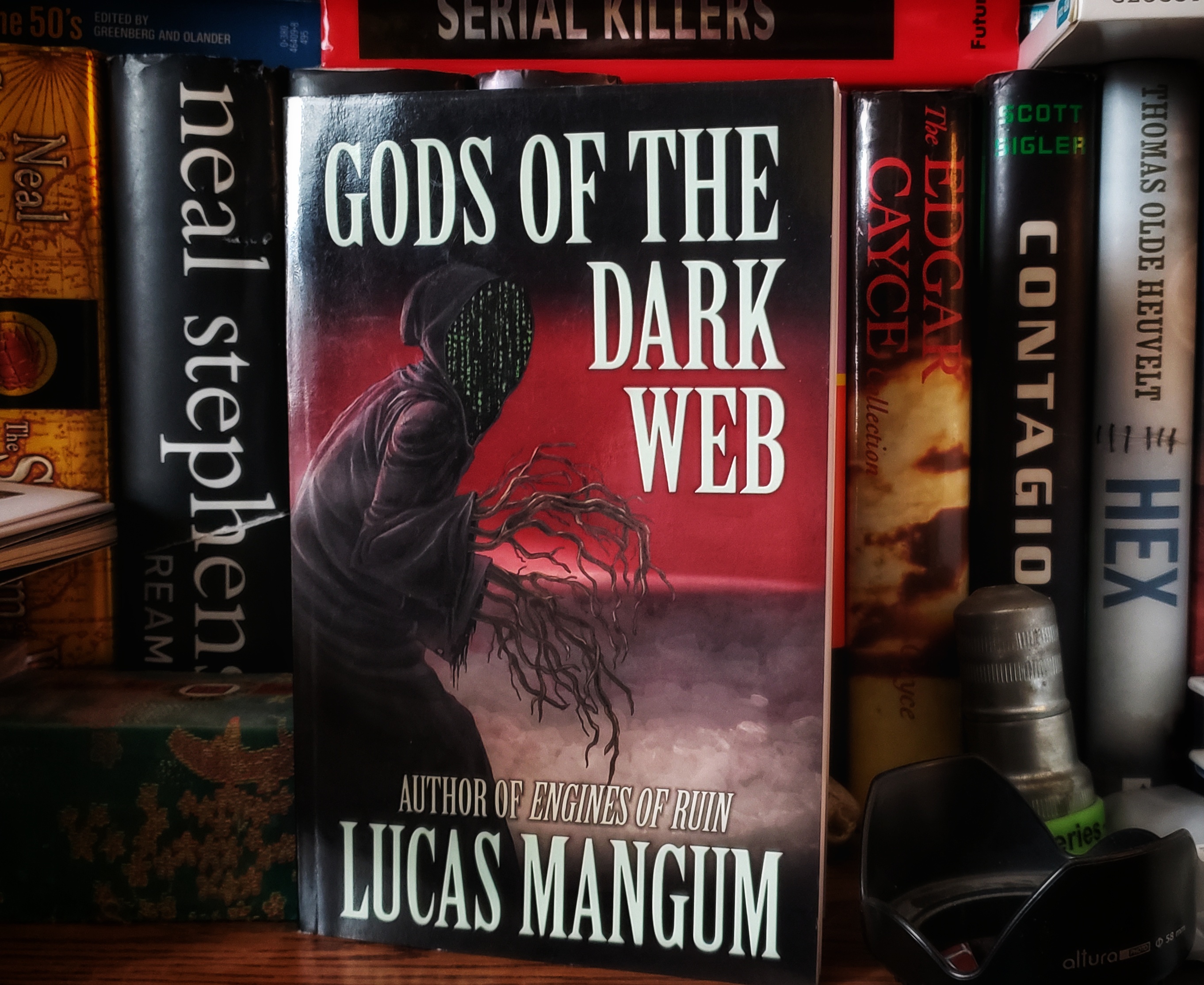
This one is a fast-paced and frenetic descent into horrors that lurk just below the surface of our reality, much as the dark web lurks just below the surface of the conventional, everyday internet of Google, Facebook, Twitter, and such. There are some fascinating parallels to be discovered in this story because of that mirroring aspect.
Most of the novella focuses on true-crime novelist Niles Highsmith and his search for a missing younger brother, Leon. Through Leon’s friends, Niles soon learns that his brother had recently been searching the dark web in hopes of obtaining a firearm for protection–only to be diverted along the way–witnessing perversions and unsettling horrors instead, just before he disappeared.
With no other avenues of inquiry available to him, Niles dives into the dark web as well, unaware of the attention he’s drawing to himself. Fans of the author will be pleased to find references to other works within the story as Niles explores the dark web for himself.
The story, while captivating, takes a backseat to the intense, graphic visuals that Mangum conjures in his writing. If one were to toss the paintings of Zdzislaw Beksinski, Salvador Dali, and H.R. Giger into a blender, they might come up with something approximating what Mangum describes in parts of this narrative.

The God Provides by Thomas R. Clark

The newest book from Thomas R. Clark hits the ground running and never lets up.
Beginning with a series of gruesome murders, The God Provides spins the reader a grimly beautiful tale rooted in old-world folklore and modern monster mythology. The blend of fantasy and horror is so perfectly combined as to produce something that transcends both categorizations. What you end up with is a narrative that feels like the modern-day retelling of a forgotten epic masterpiece. At the same time, Clark manages to craft a thrilling tale that feels like something fresh and new that only now sees the light of day.
Delving into the McEntire family’s history–which isn’t at all what it might initially seem–we discover a community in rural upstate New York where ancient gods, witches, werewolves, fae, and other supernatural creatures thrive. All of this in plain view of any who might pass through the region…assuming they aren’t the sacrifices provided by the titular god.
Take one part The Wicker Man (the original, not the god awful remake) and Midsommar, another part The Howling, and toss in some Macbeth and Beowulf for flavor, and you’ll have a recipe that might bring you within spitting distance of this story. You’ll also want to borrow a smidge of the considerable literary prowess Clark brings to the table.
If splatter-folk is a genre…this is the introduction to that world.

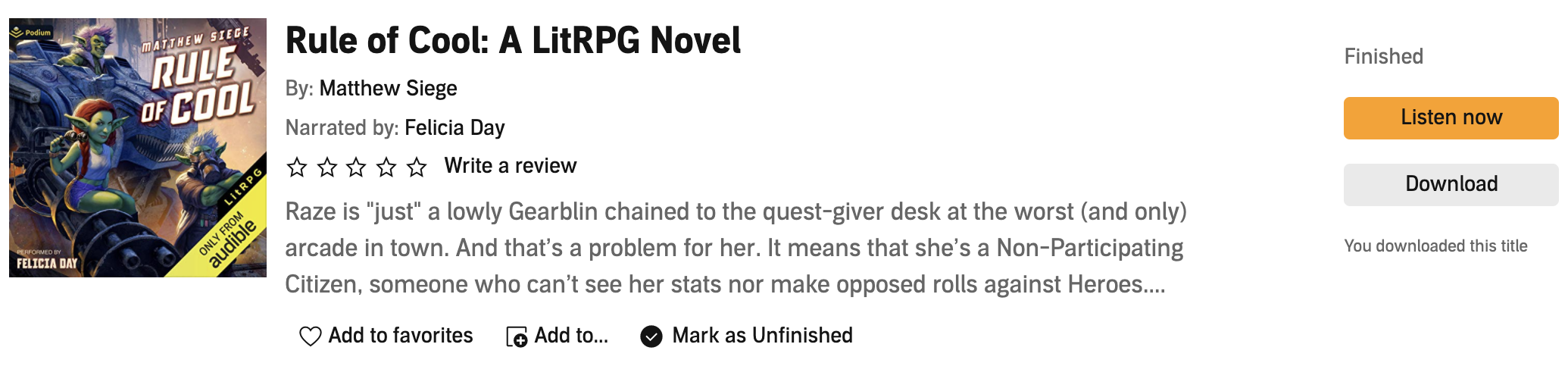
Rule of Cool by Matthew Siege: Narrated by Felicia Day

From a literary standpoint, Rule of Cool is certainly not the best example of the LitRPG genre…but it is far from the worst. I don’t expect epic fantasy literary prowess from LitRPG novels–because I’m not a complete idiot–but there are plenty of books within the genre that successfully combine skilled storytelling, captivating characters, and ample humor. This one had a fair bit of humor, some slightly worthwhile characters, and a story that could have been assembled from a story-in-a-box plot development application.
Personally, I prefer the stories where there’s some explanation–even a flimsy one–as to why we (and the characters) are exposed to stats, rolls, and other such RPG-oriented elements. Otherwise, it seems like a poor attempt to simply pad and shoehorn a story–decent or not–into a niche genre hoping to ride the coattails of those who came before. Combine all of that with a healthy dose of the fan service and the almost desperate geek appeal of Ready Player One, and you’ll have a good feel for Rule of Cool.
A story focused on life within an RPG world from the perspective of a bitter, moody NPC has a lot of potential. Sadly, Matthew Siege couldn’t bring that potential to life the way the concept deserved. The world itself is nonsensical. Rule of Cool is centered on a starter town, Hallow, where prospective heroes begin their journey to obtain levels and make names for themselves. For some inexplicable reason, Hallow is filled with detritus from the real world for no apparent reason, except that it somehow slipped from our world into this fantasy realm through a rift that is never adequately explained nor explored. It struck me as a poorly conceived ploy to justify random pop culture references littering the narrative, much the same way that damaged electronics and toys from our world litter the realm where Hallow’s located.
It’s not all bad. Don’t get me wrong.
This is a fun, albeit generic zero-to-hero tale centered around a trio of gearblins (a hybrid of goblin and gremlin) struggling to take their home back from the heroes who have been grinding them into the muck for generations. There’s social commentary embedded in the plot that–while unsubtle–appeals to me in a Marxist workers’ revolt sense.
The best aspect of Rule of Cool was that I listened to the audiobook edition. Felicia Day’s narration is fantastic, sufficiently so that it drags the story–kicking and screaming the whole way–to a higher level of quality than it would have had if I’d simply been reading the book.
I can’t recommend reading this book, but I would recommend the audiobook because the superb narration makes other aspects of the story far more tolerable than they probably deserve to be.

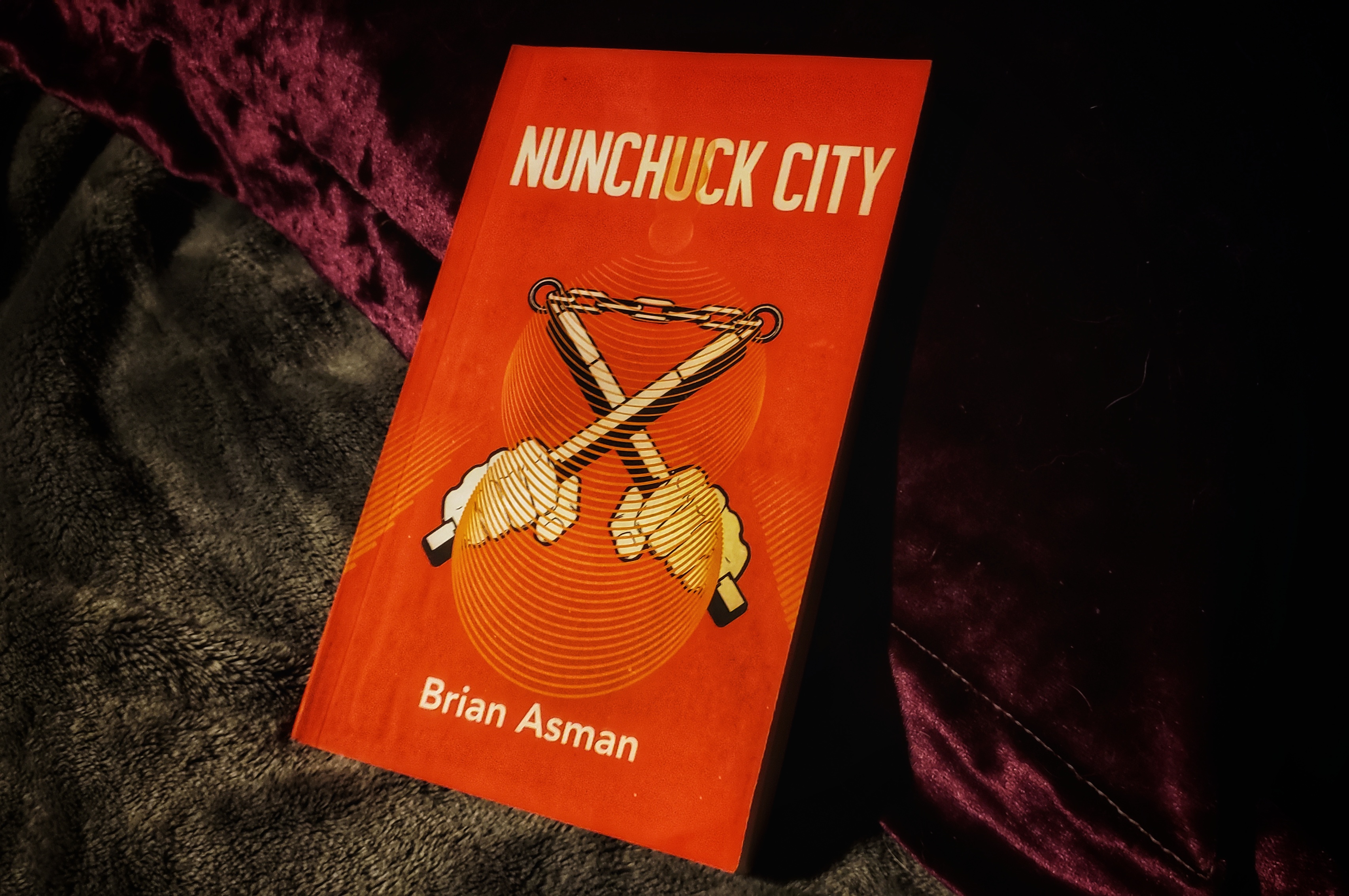
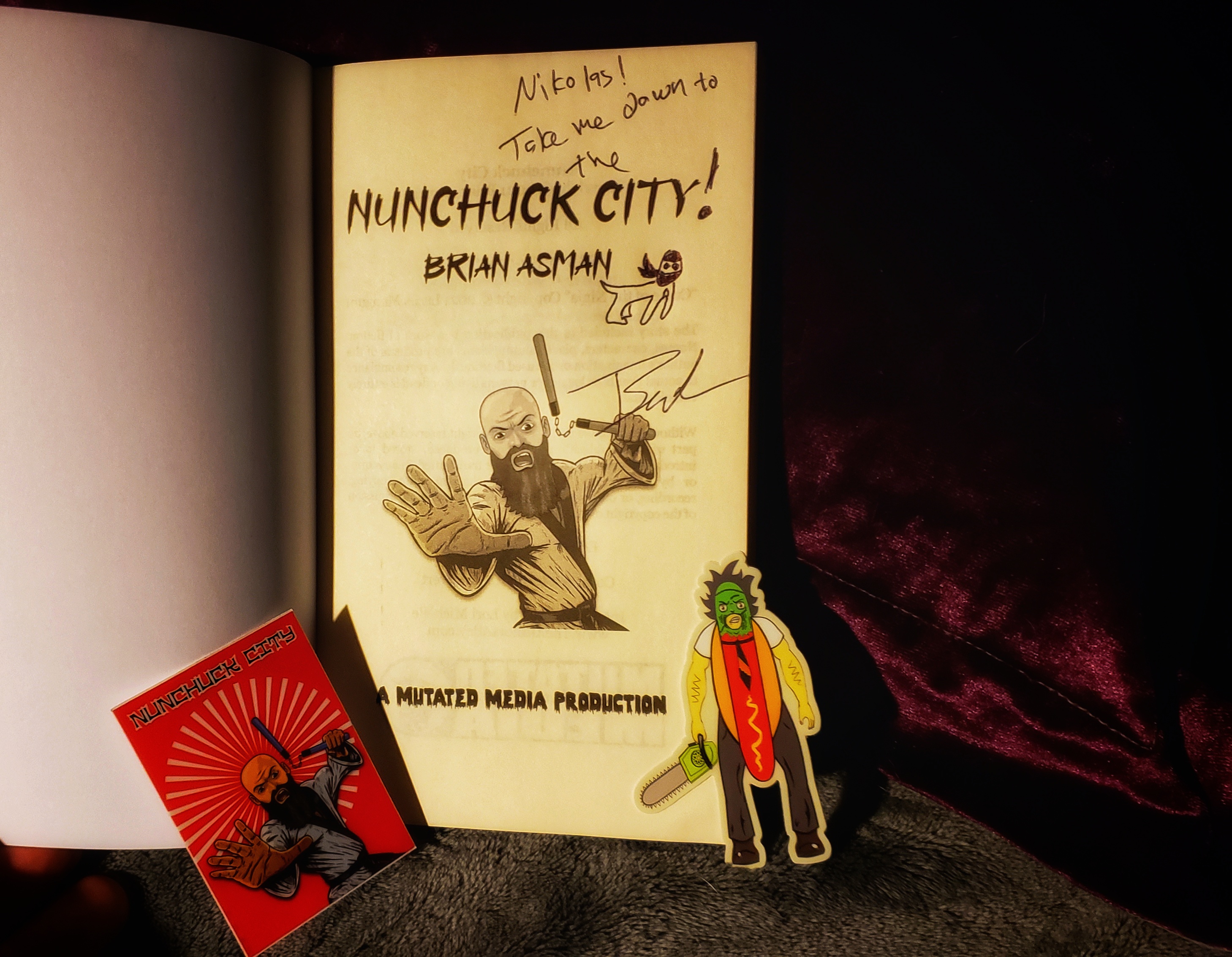
Nunchuck City by Brian Asman

Certainly, someone out there found themselves wondering what it might be like if Terry Pratchett had taken the time to focus his considerable talents toward writing an action-packed, ultraviolent ninja story.
Or maybe not?
Either way, Brian Asman’s Nunchuck City provides us with a glimpse of what that story might have been. This book is imbued with the same irreverent wit and hilariously meandering narrative elements one might have hoped for from just such a tale.
If you’ve ever wondered what could have been, if only David Wong (Jason Pargin) had written the screenplay for American Ninja…you need look no further because this would surely be the novelization of that magnificent piece of absurd cinema.
The story begins with Skip Baxter, a middle-aged, delusional sensei who proclaims himself to be The Most Dangerous Man In Turbo City. Imagine that kid from middle school, the one who bragged about being a black belt and how his hands were deadly weapons…now age him a solid 30 years or so, and you have Skip Baxter.
Now, imagine Skip Baxter beaten senseless and hospitalized without even putting up a feeble effort to defend himself.
That’s ok.
This story isn’t really about him. You’ll see him again, though.
This story is about Nunchuck “Nick” Nikolopoulis, a former ninja with a dark past. Nick is a man who studied under two masters, first, to become a formidable ninja and second, to become a stunningly proficient master of fondue.
All he needs to do is get a signature from the Mayor of Turbo City, and his dreams of establishing a fondue restaurant, Fond Dudes, with Rondell (his only friend in Turbo City) will come true.
Nunchuck City would be a painfully short book if it was that simple.
Suddenly, a specter from Nick’s past throws the city into turmoil, unleashing devastation and kidnapping the Mayor for the express purpose of beating him in combat and usurping the title for himself.
With another unexpected visitor from his past, Nick must find a way to save the Mayor–and the city–or admit that he failed to get the business license for Fond Dudes filed…and Nick isn’t one to accept failure.
Stay tuned after your feature presentation for Lucas Mangum’s Curse of the Ninja, a terrific short story about Catholics, ninjas, and exorcism…something you probably don’t know you need just yet, but I assure you that you do.

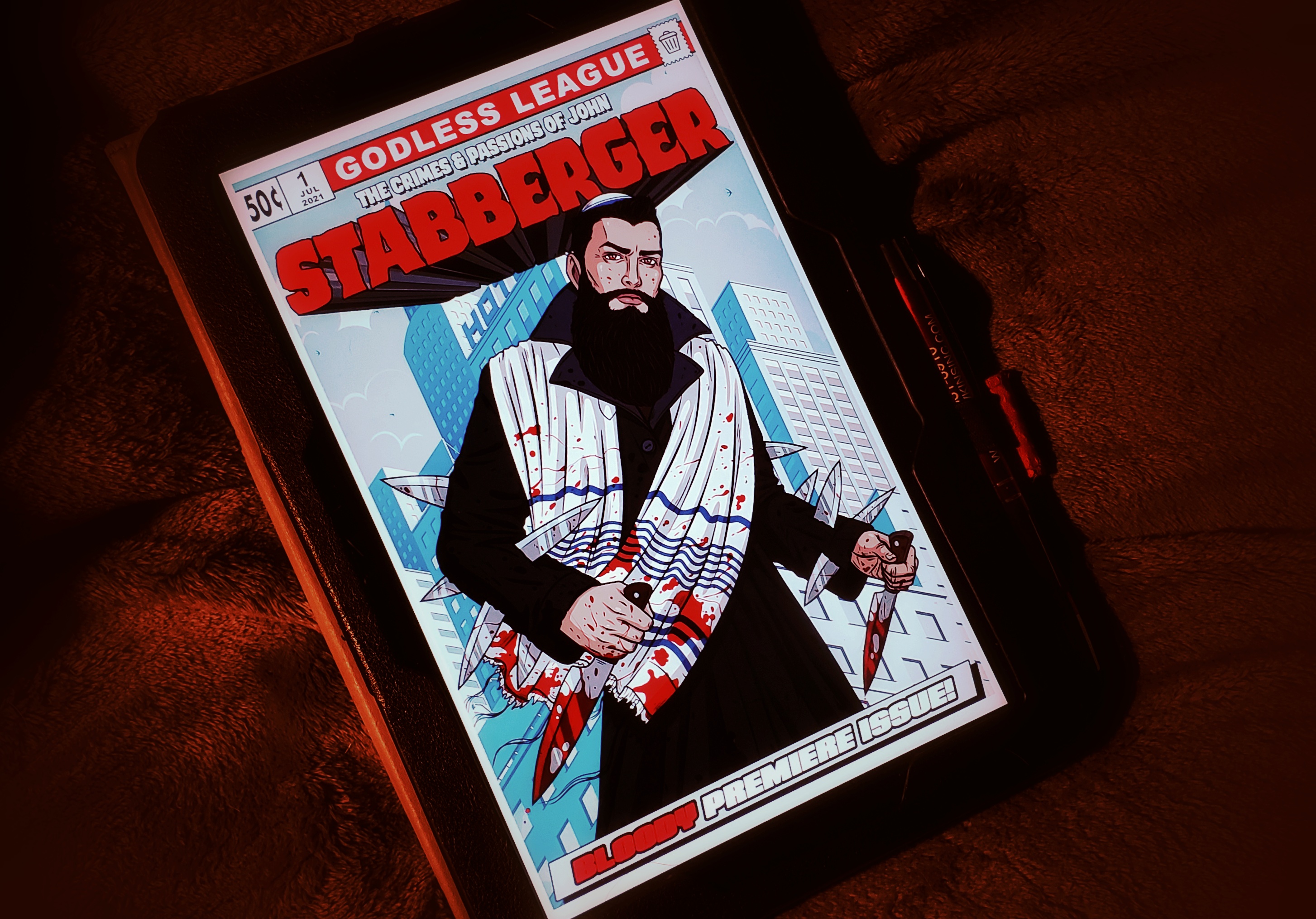
The Crimes & Passions of John Stabberger by John Baltisberger

If you’ve ever seen Green Room–a fantastic flick–you’ll recall the thrill you probably felt as the fictional band, The Ain’t Rights, begins performing “Nazi Punks Fuck Off” (covering the epic Dead Kennedys track) from the stage of a neo-Nazi skinhead bar. You’re going to feel the same sort of thrill reading the scene at the trailer park as John Stabberger carves his way through a crowd of skinhead punks. Unlike Green Room, the story doesn’t go sideways for the protagonists, and Stabberger keeps on ramping up the violence until he’s–literally–ramping a motorcycle up a crane to board a fucking dirigible to slaughter more Nazi pricks.
Like a golem fashioned from flesh and blades, Stabberger is single-minded and fueled by rage, not to be deterred from his bloody business.
As the first installment of the Godless League series of stories, this one hits it out of the park in a big way. This story is full tilt, no holds barred, unrelenting violence perpetrated against the most deserving victims.

You can pick up your own copy from www.godless.com at the link below. I absolutely recommend that you do so.

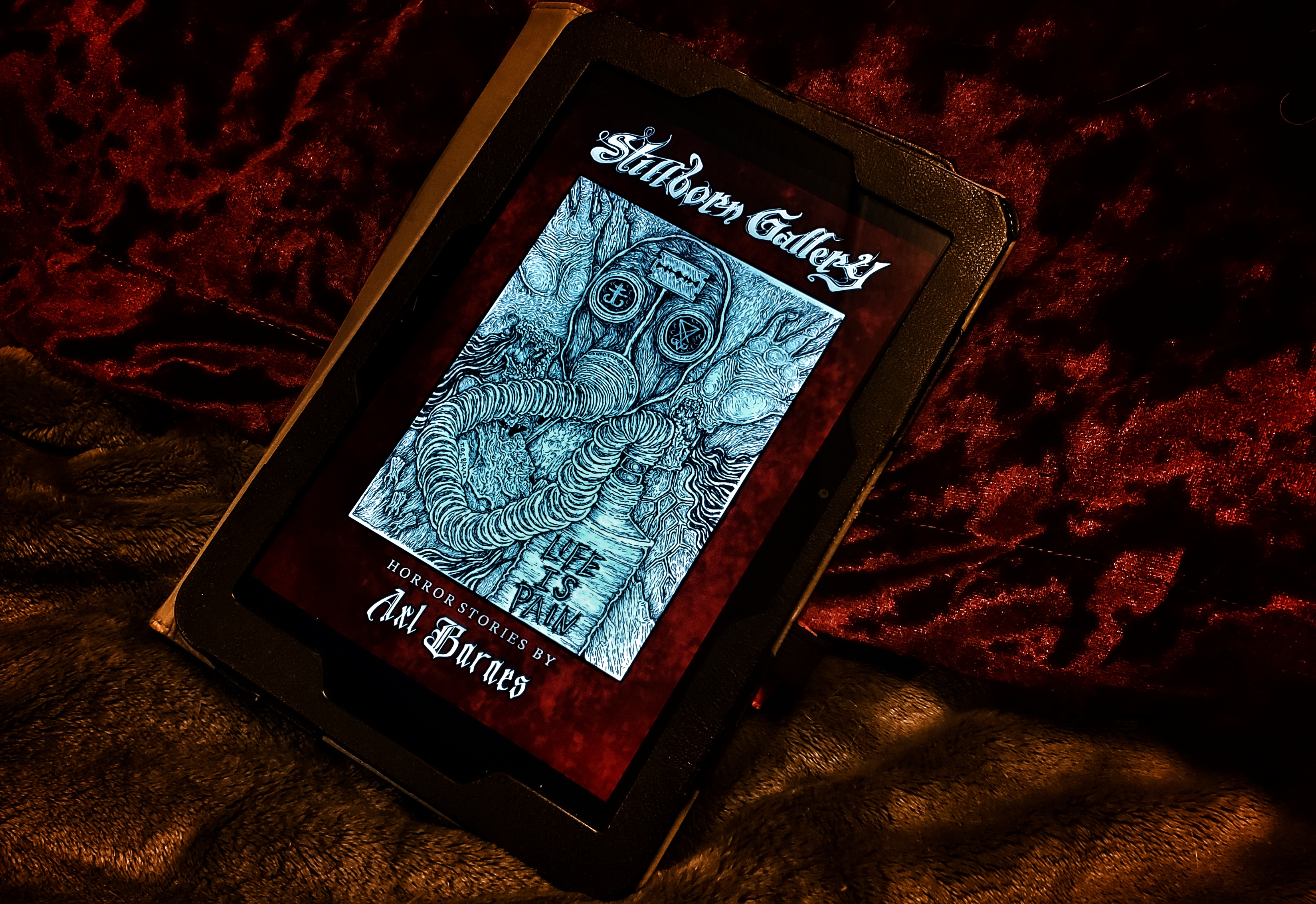
Stillborn Gallery by Axl Barnes

The nine stories collected in Barnes’s Stillborn Gallery make for an almost uniformly bleak, nihilistic deep dive into the horrors of banality, the depths of depression, heavy metal, and suicide. If you’re familiar with Axl Barnes, you shouldn’t be altogether surprised by any of that.
Barnes utilizes almost poetic prose at times, almost exclusively when applied to the most awful of things. He has a knack for painting vivid and breathtaking pictures of things the reader might not want to see, and it makes for a fantastic experience.
There’s a great deal to look forward to, for the discerning reader, from the almost Kafka-esque “Numbskull” to the morbidly romantic “Sunday Exit” in these pages.
For me, “A Perfect Day” sort of sums up the whole experience. We get to witness a day that is going smoothly for our protagonist, a man who has a vacation on the near horizon that he’ll be sharing with a clearly devoted lover. Suddenly he begins fixating on an experience from his childhood, wherein a doctor had to lance an infected wound. This fixation does nothing to spoil his mood–the way I’m about to spoil this single story–but he proceeds to kill himself in a graphic, single-minded act…perhaps because it’s best to leave on a high note.
The illustrations provided by Thomas Stetson are captivating, bringing to life a certain grimy, filthy element that flows naturally with the stories provided by Barnes.

Bobcats by Matthew Weber

Matthew Weber’s Bobcats succeeds as a coming-of-age horror tale not altogether unlike Ketchum’s Hide and Seek and King’s IT. In fact, if one were to mix those two books together with a dash of the King novella, The Body, and just a smidge of Deliverance for flavor–as well as a touch of Friday the 13th–one might have a good starting point for the story that Weber’s put together.
Joey and his four compatriots in the Bobcats–a small fraternal outdoors troop not altogether unlike BSA–plan to hike The Gauntlet, a trail that weaves through the wilderness of Black Oak Mountain. The adventure is the boys’ plan to honor the legacy of Joey’s father, the foundation of The Bobcats, who recently died of cancer. More than that, it’s a rite of passage into manhood for the five adolescent boys.
As a powerful thunderstorm rolls into the area, the expedition becomes true to its name, becoming more a gauntlet than it already might have been. Sadly, nature is only the beginning of the challenges the boys face.
Black Oak Mountain is home to more than the expected wildlife, and for the Bobcats, it’s one of the inhabitants of that dark forest that changes their lives forever. The Cleaver soon has the five boys in his sights, and no amount of preparation and survival training could have adequately qualified the Bobcats to deal with an inhuman monster who makes his living slaughtering people for money with his cruel, handcrafted blades.
Weber does not shy away from the harsh reality of precisely how an encounter like this would turn out. Bobcats is not a feel-good story with a tidy, cheerful ending replete with plot armor and reliance on suspension of disbelief. To learn how it ends–or whom it ends–you’ll have to read it for yourself.
Matthew Weber deserves additional points for hinting at a history of mysterious occurrences on and near Black Oak Mountain without delving into them and erasing the mystery. It seems like a sequel could be in order, as there’s plenty more to fear in the night than solely The Cleaver.

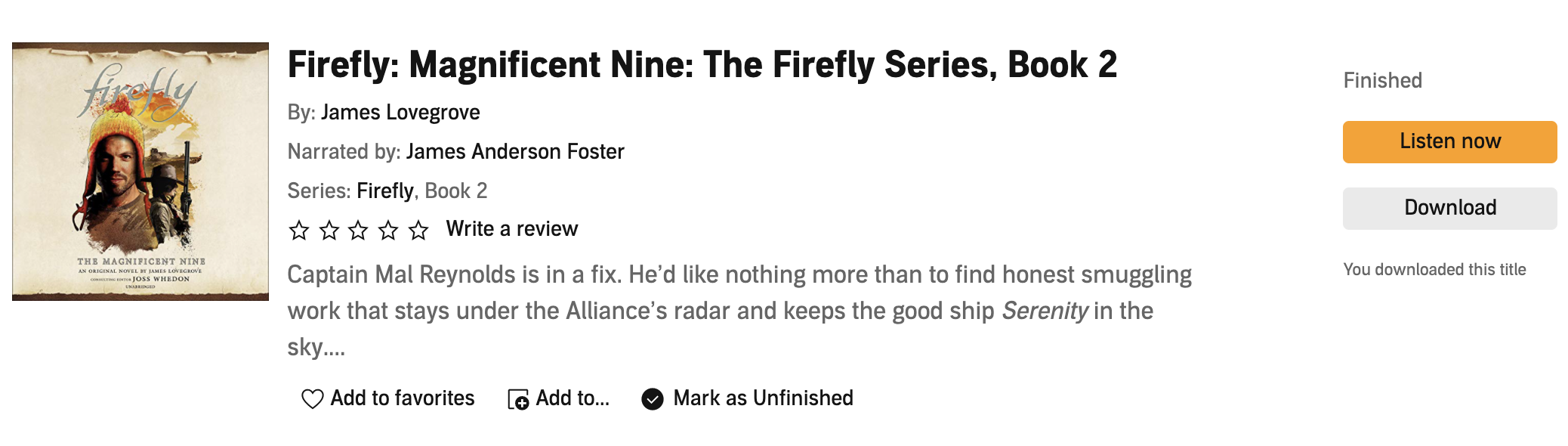
Firefly: The Magnificent Nine by James Lovegrove: Narrated by James Anderson Foster

The Magnificent Nine confirms the placement of these Firefly novels–or at least this particular installment–as falling between Objects In Space and the Serenity motion picture. The previous book hadn’t made any specific mention of the events in that episode and thus could have fallen before or after that final episode of the tragically short-lived series.
The crew of Serenity is floating adrift, between jobs and looking for work to keep themselves afloat when a message arrives from an old friend of Jayne’s. There’s trouble on the distant, dry–almost desert–world of Thetis. Jayne’s former lover, Temperance, is desperate to find help for her small village. A cruel, savage bandit going by the name of Elias Vandal threatens the survival of all residents of Thetis who won’t bow to his reign or join his cultish band of raiders and criminals.
Though there’s no money in the job, it’s the right thing to do, and the crew of Serenity naturally makes their way to Thetis. This group of nine mismatched compatriots is hardly the collection of soldiers or heroes Temperance was expecting, but they might be precisely the heroes the planet needs.
While the previous installment, Big Damn Heroes, provided us with a fair bit of additional backstory for Captain Malcolm Reynolds, this book supplements what we know of Jayne Cobb before his time with the crew of Serenity.
It’s a satisfying story that could have made for a pretty fantastic episode or two of the series.
The narration from James Anderson Foster is just as good as it was for the previous book–and hopefully will be for the remaining handful of Firefly supplemental novels.

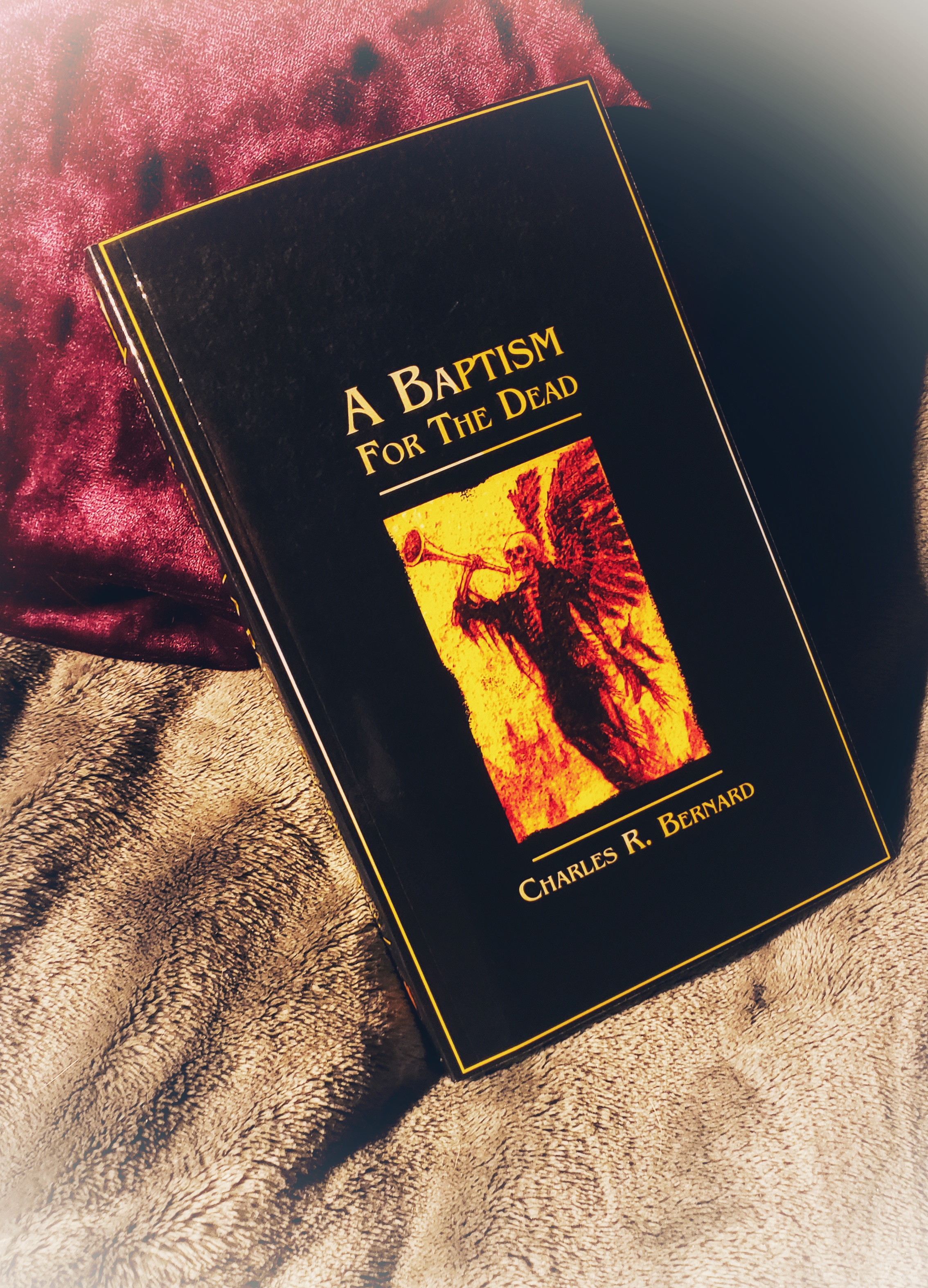
A Baptism for the Dead by Charles R. Bernard

Charles R. Bernard has crafted an immersive piece of historical fiction with A Baptism for the Dead. Spanning the decades between the 1840s and the 1870s, we experience snapshots of the expansive fields of unsettled Nebraska on the approach to the South Pass through the Continental Divide in what would become Wyoming, raging blizzards in Northern Michigan, and the early years of Salt Lake City…and those snapshots feel three dimensional.
Throughout the story, we occasionally follow Left Hand, an indigenous woman who has the unfortunate path in life of hunting monsters. The introduction to her character is a fascinating glimpse of a forest haunted by ghosts and a cavern of sickness and monstrous residents.
The bulk of the story begins as we witness Leonidas Pyburn and his two sons–following the fateful path previously taken by the Donner-Reed Party–headed West to embrace the call of Manifest Destiny in the form of the emerging gold rush in California. Encountering a frantic, haunted sexton along the way, their own journey takes a turn not altogether better than that experienced by the previously mentioned Donner Party.
The survivors of that grisly, horrific encounter go drastically separate directions, both in life and in a cartographic sense. While Leonidas continues West to seek fortune and power, his son determines that his fate awaits him to the North, with the Mormons who passed through the region previously.
As secrets and magic bring the father and son together again, two decades later, we learn that there are more than carrion-eating ghouls to be afraid of in this vision of the American West.
Bernard succeeds in blending occultism, conventional spirituality, social commentary, history, and family drama into a captivating novel that contains more than enough gore and Western aesthetic to appeal to fans of the Splatter Westerns being published by Death’s Head Press.

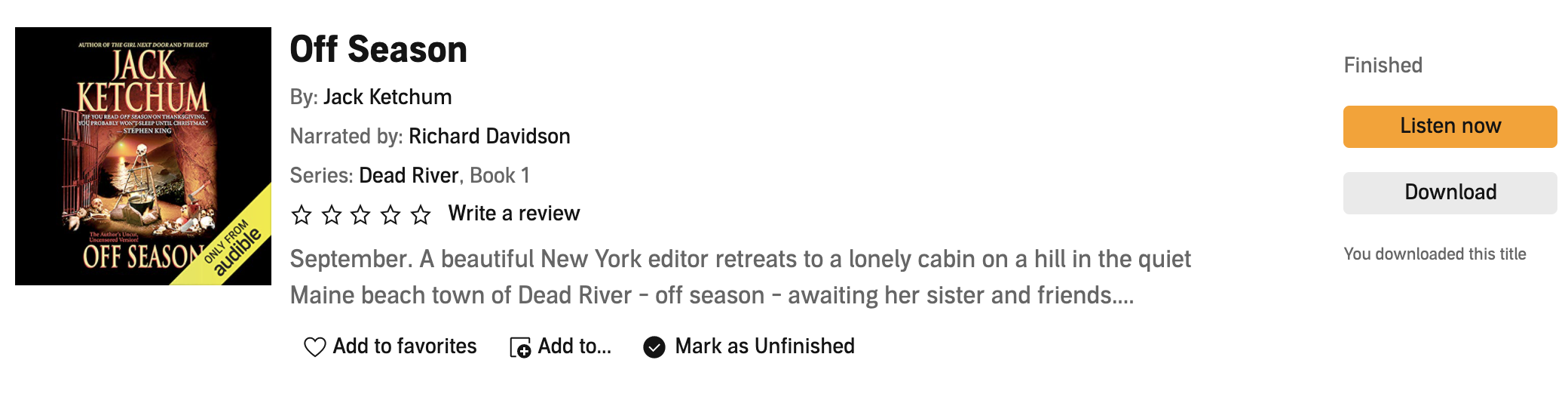
Off Season by Jack Ketchum: Narrated by Richard Davidson

I was a teenager when I first read Jack Ketchum’s Off Season in an already used paperback edition I’d found in a second-hand store or at a flea market. At the time, the book seemed truly graphic and bleak in a way most horror novels didn’t approach. Of course, most of my reading up to that point had been Stephen King, Peter Straub, Robert R. McCammon, Dean Koontz, Clive Barker, Anne Rice, and other more commercially accessible authors. Of those authors, Barker and McCammon were the two who most closely approached what I was reading from Ketchum.
If I enjoyed the bleak and hopeless tone of that edition of the book, I was sure to be in for a treat with the less censored edition released this century.
A good deal of the change to this story only arises in the final stretch of the story, but those relatively minor changes in terms of text produce massive changes in the outcome of the narrative. Listening to this audiobook edition of the novel, I understand why Ketchum was dissatisfied with the edits his publisher demanded. This was a story that pulled no punches and held nothing back, laying bare the callous inhumanity of the world we live in and the indifference of the universe itself.
A tragic hero becomes altogether more tragic in this edition of Off Season, and the story benefits from that transformation.
Those who read the original edition of this book may have wondered just how much worse a vacation to Northern Maine could have gone in the fall of 1981. Ketchum answers that question in this restored iteration of the tale. As the vacationers in the cabin are beset by the wild, raving tribe of barely human cannibals, you might notice some scenes that carry a bit more potency and illustrative violence…but the core of the story remains the same until you reach the end.
Richard Davidson’s narration is great, though there are times when it seems as if the Maine accents are a bit more of a caricature. It makes for an enjoyable listen just the same.