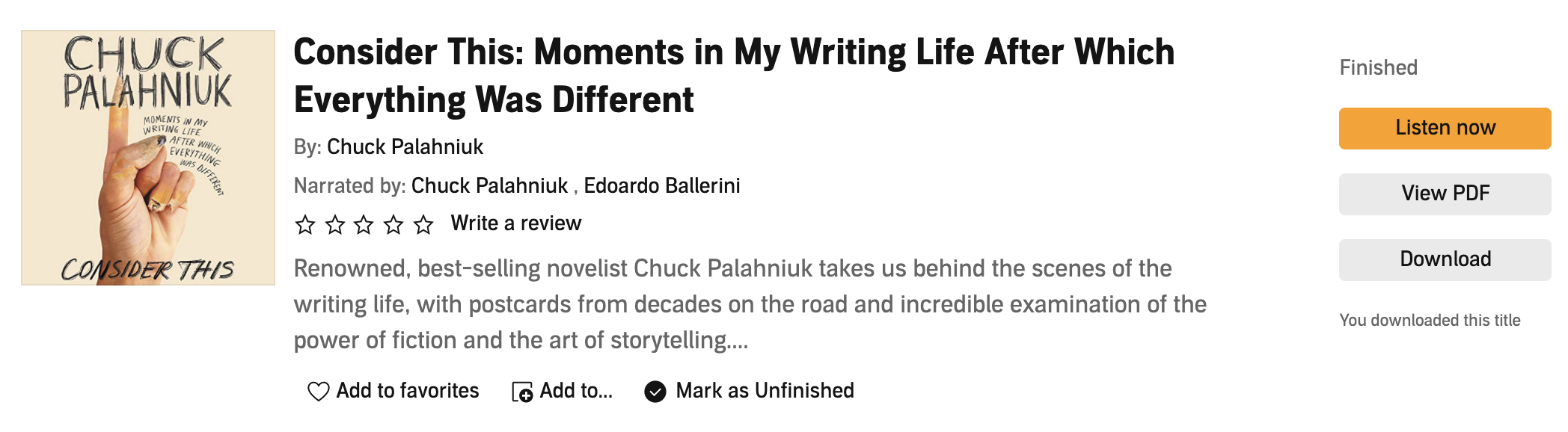
Consider This by Chuck Palahniuk: Narrated by Edoardo Ballerini

Readers familiar with–and fond of–Chuck Palahniuk’s distinctive style of storytelling are sure to find Consider This: Moments In My Writing Life After Which Everything Was Different to be no less compelling. This collection of insights and anecdotes was certainly no less captivating for me than Stranger Than Fiction or any of his other non-fiction material I’ve devoured over the years.
I’ve read several different books dedicated to the craft of writing and best practices to employ, some better than others. This book stands apart as being truly the most interesting. Shared as if we’re hypothetical participants in a kitchen table writer’s workshop hosted by Palahniuk, the reader/listener doesn’t feel any impulse to interrupt or make it a two-way conversation–though it strangely feels like a conversation at times.
Approaching the craft from a journalistic perspective rather than a creative writing perspective makes for a different set of rules and guidelines than many of these books provide while cementing some of the rules that are true, regardless of background.
Even if one doesn’t want to apply the rules and practices recommended by Palahniuk, they make for interesting experiments and elements to try out, allowing the writer to spread their wings in a different sort of environment.
The narration provided by Edoardo Ballerini was fantastic, and the bit from Palahniuk himself was a nice touch as well.
I can’t recommend this enough for anyone who wants to write, regardless of genre or industry.
Similarly, I have to recommend this to readers who want to experience a glimpse behind the scenes of one of the more peculiar and fascinating writers of my lifetime. His tales of book signings and road trips alone make this worth listening to or reading, even if you never have any impulse to put pen to paper or fingertips to keys.

The Dragon Reborn by Robert Jordan: Narrated by Kate Reading & Michael Kramer

The Dragon Reborn, I recalled quite correctly, was one of my favorite installments in what I’d previously read of The Wheel of Time series by Robert Jordan.
This is the book in which we receive a much clearer glimpse of the effect Rand al’Thor has on the world and people around him, largely through the events witnessed by his friends rather than from Rand’s perspective. It was a daring move, shifting the focus of the third novel in a series away from the protagonist, allowing the bulk of the tale to be told from the perspectives of Perrin, Mat, and Egwene. Though Perrin is the only one who knowingly pursues Rand, Mat, Egwene, and the others are drawn by the gravity of Rand pulling at the weave.
What we do witness of Rand’s journey to Tear–where he intends to prove himself and to embrace the prophecy that marks him as the Dragon Reborn–causes some small amount of concern that he is indeed going mad. While little attention is paid to the day-to-day travels as Rand journeys to take hold of his destiny, we are far from kept in the dark as to what he’s been doing as he manages to remain ahead of the pursuit from Perrin, Moiraine, Loial, and Lan.
As we bounce from one location to another, we are provided with a much greater perspective of what is happening throughout the world. We discover that the Forsaken have escaped from their imprisonment and taken up positions of power throughout the world. We learn that the corruption of the Black Ajah has grown within the Aes Sedai in Tar Valon. We learn of darkhounds and the soulless. We also discover that the Aiel have left the wastes and ventured secretly into the world that fears them, in search of the answer to a prophecy of their own.
The Dragon Reborn is a spectacular book, the best of the original trilogy, for sure. It is filled with intrigue, action, and suspense that marked Robert Jordan as a great storyteller.
The narration of this book is no less spot-on than the previous two installments of the series.

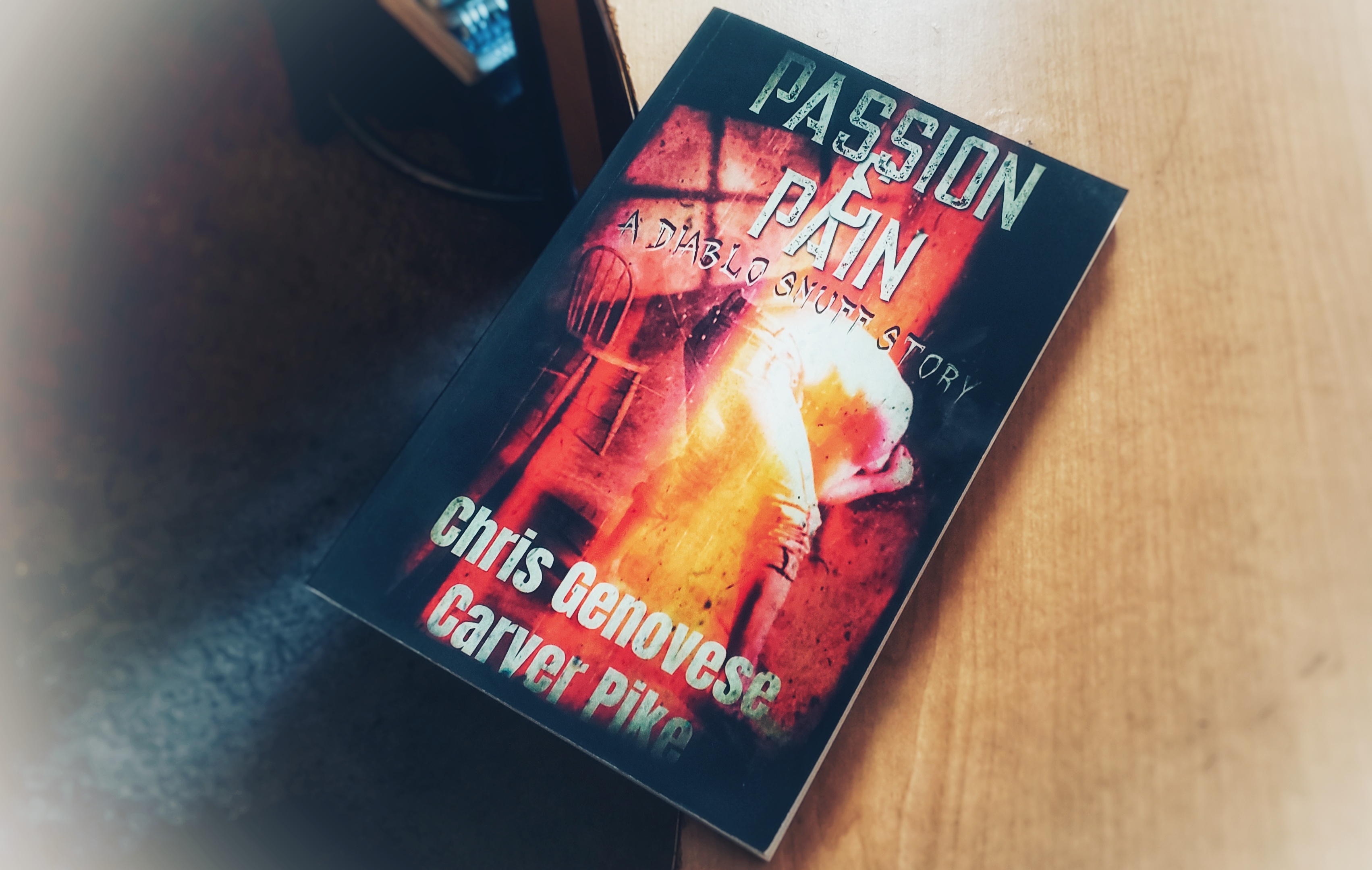
Passion & Pain by Chris Genovese & Carver Pike

This book, a collection of two connected stories, makes for a fascinating literary experiment.
I should first get it out of the way that Chris Genovese and Carver Pike are pen names for the same fantastic author, though I am vastly more familiar with his work as Carver Pike–being a fan of horror and not so much a fan of smutty, erotic, romance tales. The man behind those noms de plume is a terrific and skilled storyteller, so it’s no surprise that he’d be just as capable regardless of the umbrella beneath which he happens to be writing.
The Strings On Me by Chris Genovese introduces us to the character of Nick “Lucky” Luciano, a frat boy and a womanizer with a heart of gold. He’s not such a womanizer, all things considered…but it’s sort of the role he plays in his life within the fraternity.
A chance encounter brings Natalia to his attention and he is instantly captivated by this beautiful, mysterious, foreign woman. Unfortunately, she doesn’t seem quite so enamored of him, but Lucky isn’t one to give up too easily.
At the end of this first erotic romance tale, things seem to be going well.
Cutting His Strings is where Carver Pike takes up the baton and races the story of Lucky and Natalia through the finish line…and boy does he bring it to a finish.
The romance takes on a darker quality as the story continues, with the erotica still heavily present. Natalia’s attitude and behavior seem to change like a switch has been flipped and Lucky is left dazed and dizzied by the seemingly unprovoked transformation.
We discover that Natalia is roommates with an ex-girlfriend of Lucky’s and that the impetus to end that previous relationship was entirely brought about by Natalia’s secret machinations. She’d been no stranger to Lucky when they met, and he barely had a chance to avoid becoming her prey.
More importantly, we discover that Natalia is involved with the sinister secret society, Diablo Snuff. You’ll be familiar with Diablo Snuff if you’ve read my previous review of A Foreign Evil, or if you’ve read the other three Carver Pike books that connect with the Diablo Snuff series. Once Lucky is snared by Diablo Snuff, the odds don’t look great for him.
Will he be lucky enough that his ex-girlfriend will be able to put the puzzle pieces together in time to save him? Does she still love him enough to invest that sort of attention and concern toward the peculiar nature of his relationship with her roommate?
You’ll have to read the book to find out for yourself.

If you enjoyed the Japanese horror flick, Audition, you’re likely to enjoy this book.

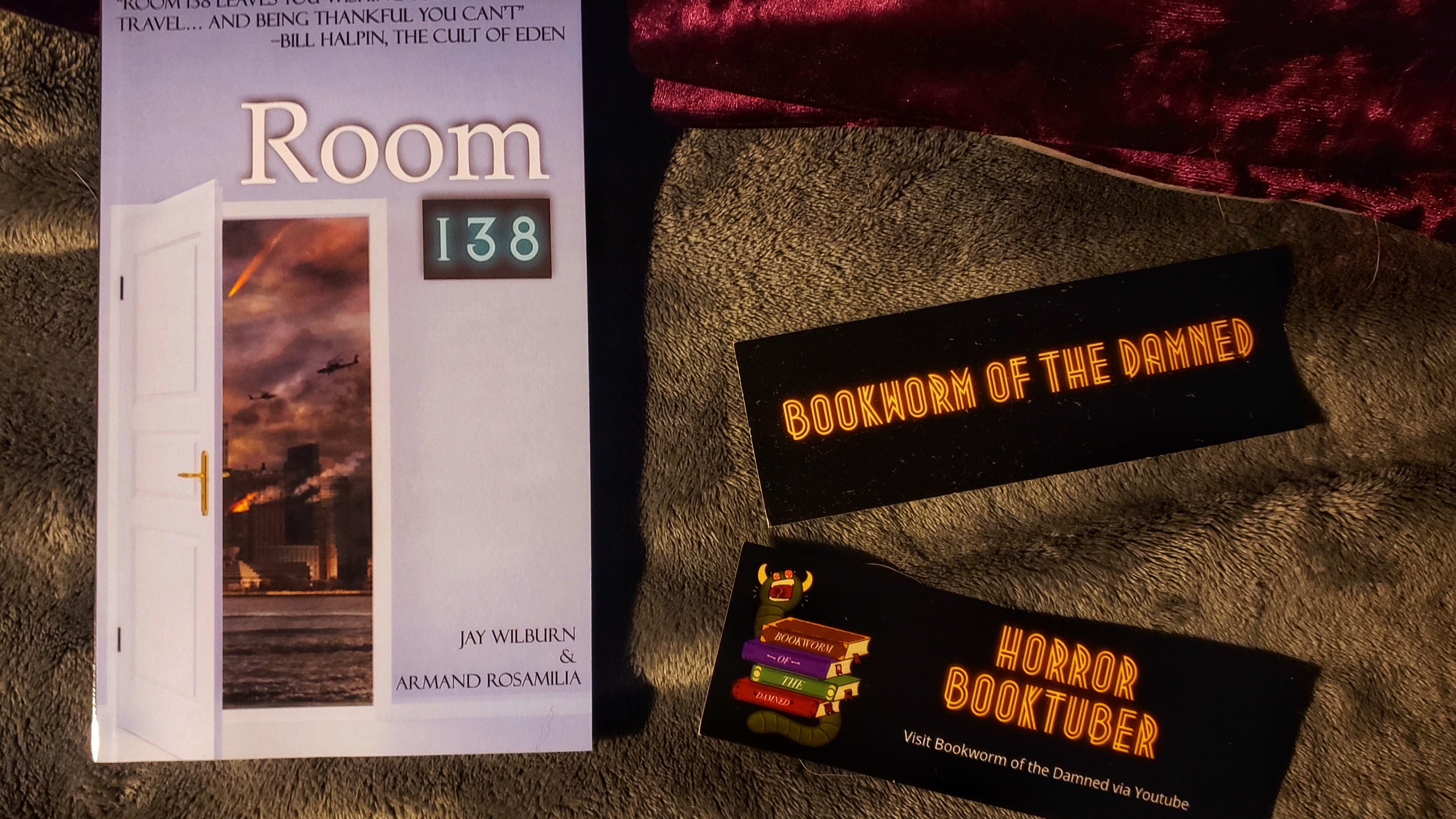
Room 138 by Jay Wilburn & Armand Rosamilia

Wilburn and Rosamilia together weave a disorienting tale. The individual narrative threads that make up Room 138 are as difficult to follow and keep straight for the reader as they are for our confused, terrified, and often paranoid protagonist, Hank Smith.
It’s hard to blame Hank for feeling paranoid, though. Waking up in a recently vacated hotel/motel room in a new year and a new city from where you’d gone to sleep would do that to a person. Just trying to imagine that life, where the month and date on the calendar keeps marching forward, while the year dances around to a tune you can’t quite hear…it’s enough to give someone a headache. With no recollection of who he really is, no concept of how long he’s been doing this same thing, and without the foggiest notion of why he’s even doing it…Hank keeps searching for abstract clues that he hopes will lead him to the next Room 138 and some illumination for the regions of his memory that remain in shadows.
If that sounds confusing to you, you’re in precisely the right state of mind to begin reading Room 138.
It’s a book that is equal parts a thriller, a science fiction fantasy, and a feverish, internalized mystery…but it’s so much more than those individual components.
It’s probably a good time to climb aboard and allow Mr. Train to guide you down the rails at breakneck speeds until the view beyond the window becomes nothing more than a peculiar blur of familiar objects twisted into alien shapes. Maybe you’ll be the next in line to join Hank and Savannah on their mission to save the world, one day at a time.

Dark Places by Gillian Flynn: Narrated by Rebecca Lowman, Cassandra Campbell, Mark Deakins, & Robertson Dean

Dark Places indeed.
This book takes the reader/listener to some truly dark places.
A Kansas family was slaughtered in the middle of a cold January night in 1985. The only survivor was the youngest daughter, Libby Day.
The oldest child, Ben, is the easy suspect for everyone. He’s a troubled teenage boy with a darkness inside of him that easily feeds into the Satanic Panic running rampant in those days. But was he guilty? Was Ben just as innocent of these horrific crimes as he was of the sexual assault accusations being leveled against him by numerous grade school girls?
We join Libby as an adult, running out of money from the donations sent her way as a sympathetic child survivor of the Day family massacre. No longer the sympathetic, victimized young girl, Libby lives in squalor and never quite figured out how to properly take care of herself. This desperate situation is what leads her to The Kill Club, a group of true crime fanatics who imagine themselves to be investigators.
Ripping off painful bandages and digging into a past she only barely recalls, Libby begins to question her courtroom testimony from all those years before. Some mysteries are better left in the shadows, though. Proving Ben’s innocence might lead to nothing more than further death and horror.
Gillian Flynn has a knack for developing interesting characters without making them feel particularly sympathetic. The characters populating Dark Places are no less captivating than others she’s developed, in large part because of precisely how flawed and sometimes awful they happen to be. Despite those flaws and the fact that it’s hard to care about the characters, you can’t help but find yourself invested in what’s happening.
The narrations performed by Rebecca Lowman, Cassandra Campbell, Mark Deakins, and Robertson Dean are fantastic. We experience different characters, at different times, with distinctly different voices…and it’s a nice touch.

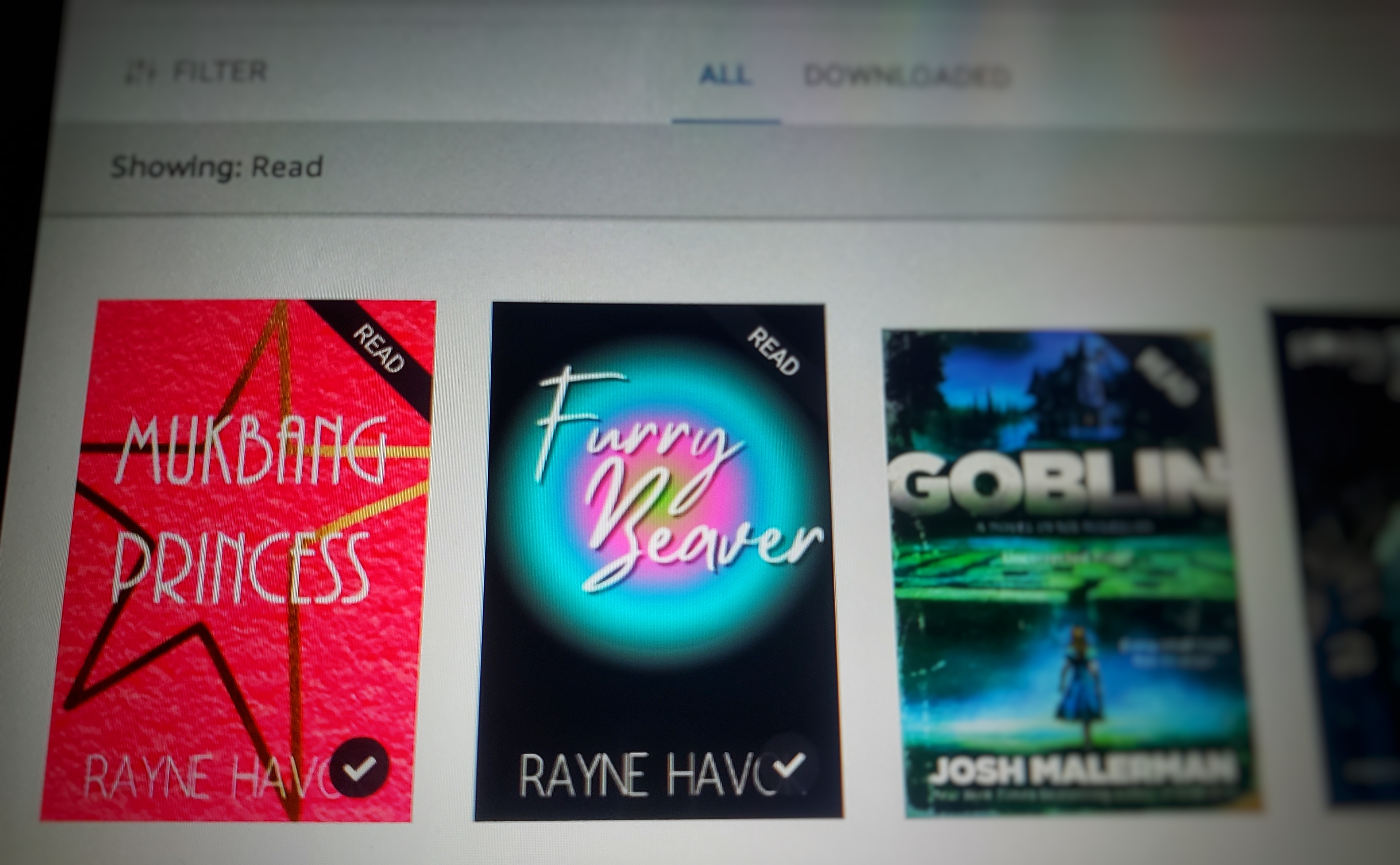
Mukbang Princess & Furry Beaver by Rayne Havok

I typically dedicate a single blog post to a single story, but most of those stories are novella-length or longer…with the occasional novelette slipping through. These two stories from Rayne Havok are definitely in the short story range. It seemed appropriate, under the circumstances, to review them both in one post.


I’ll start with Mukbang Princess:
This is a story about two teenage girls looking for a quick way to make money online. Neither of the characters is innocent or chaste, but neither of them is particularly looking forward to making their money from amateur pornography.
The world of mukbang initially has a sort of strange appeal, if only they can find the right thing to eat. Stumbling across what might be their ultimate meal ticket ultimately crosses the line for both of them, and the thought of working a regular job suddenly doesn’t seem so awful.
This story is hilarious.
It’s essentially what would result from certain conversations with friends, getting darker and more perverse…but coherently written out and captured. There’s as much perverse humor to the tale as there is sheer, awful grotesquerie…and it’s amazing.


Furry Beaver is up next:
This one is just filled to the brim with furry sex and slaughter.
I doubt most people attend a furry house party with any concern for their own safety…in this case, that is a fatal mistake.
Once the party gets going, there’s hardly a line of this story not dedicated to graphic sexual encounters and equally graphic violence. Havok wastes no time diving into the sweaty, fetid, sexually charged bloodbath…and she doesn’t come back up for air until it’s all over. Much like the titular beaver, whisking the blood from oily fur like it was water.

I recommend checking them both out at your earliest convenience. Links to the stories on http://www.godless.com are below.

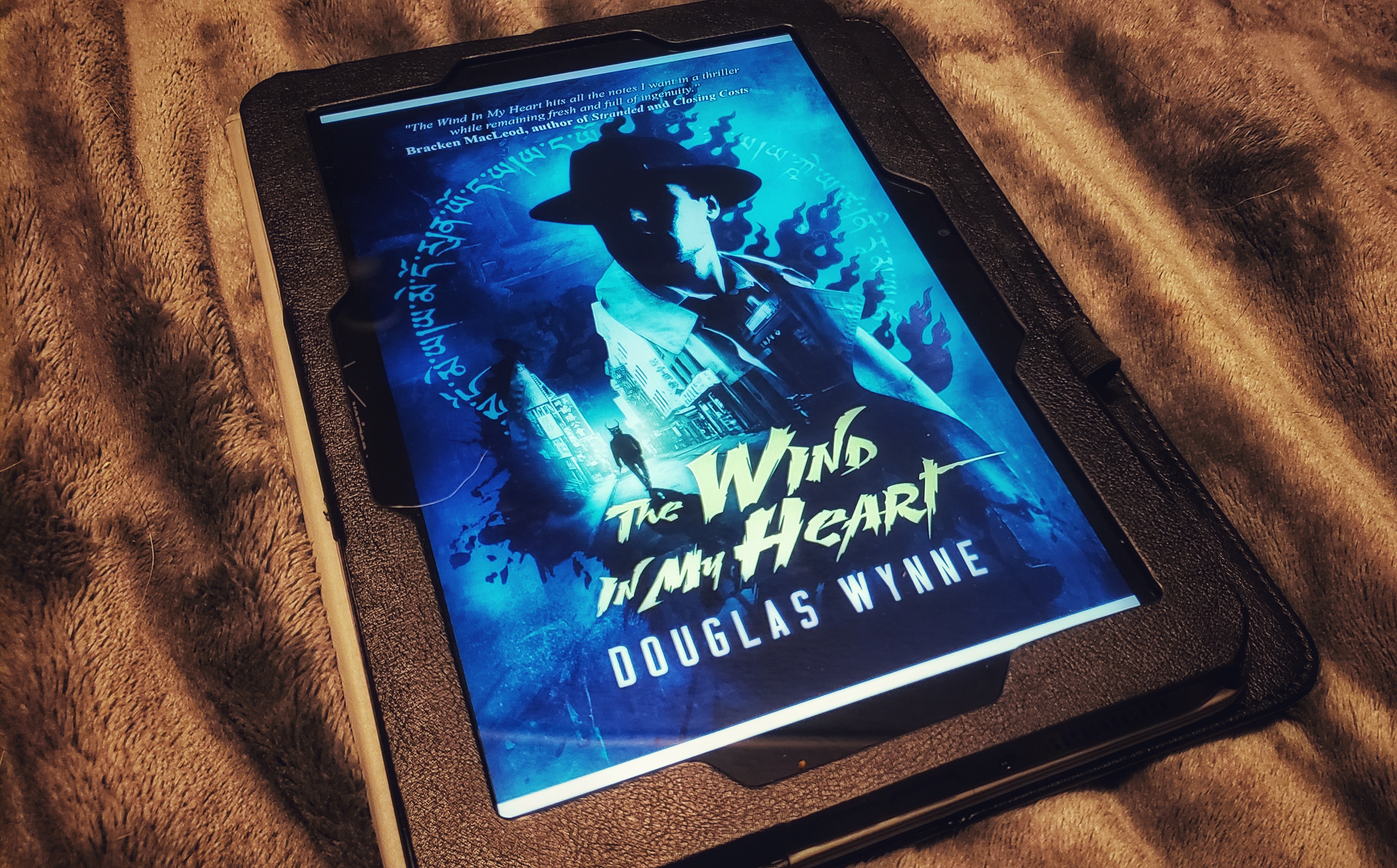
The Wind In My Heart by Douglas Wynne

Douglas Wynne knows how to craft a captivating tale. The Wind In My Heart–while taking place in the 1990s–hearkens back to the hard-boiled detective stories of authors like Dashiell Hammett and Raymond Chandler. For being a couple of generations removed from the anti-hero protagonists of those books, Miles Landry wouldn’t be out of place at all. Of course, it helps the aesthetic that this takes place in New York’s Chinatown.
Blending this combination of an old school detective noir with Eastern philosophy–in the Tibetan crisis-conscious New York of the early 1990s–creates an enchanting sort of mandala in literary form. Threads of the story circle back around, creating new patterns and surprising twists as the narrative takes shape and arrives at a final form…before being swept away like sand as you reach the conclusion and set the book aside.
Hired by the monks of a Buddhist community center to investigate what they believe to be a supernaturally perpetrated series of murders, Landry must traverse a dangerous gauntlet between Chinese gangs, the police, and a possible supernatural threat that stands to tear his world apart.
Unlike altogether too many books, there was an unexpected twist to this story…but not one that felt flimsy or poorly crafted. Nothing about Wynne’s book was poorly crafted.

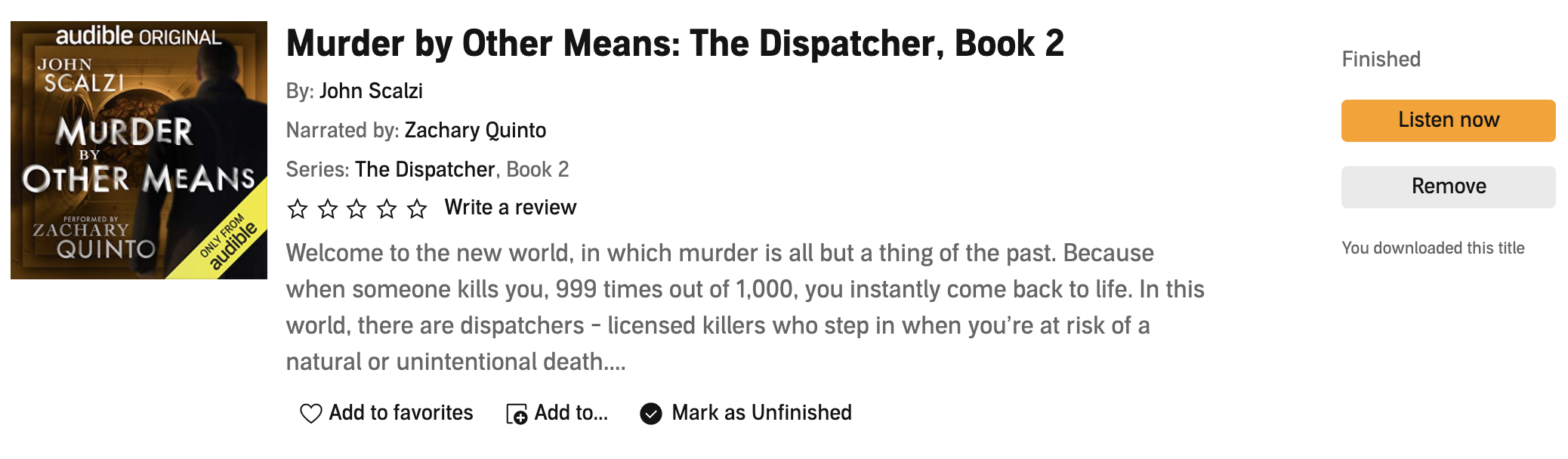
Murder By Other Means by John Scalzi: Narrated by Zachary Quinto

Few authors could successfully pack as much intrigue, mystery, and suspense into a novella as John Scalzi. Murder By Other Means is a prime example of Scalzi at his fast-paced best. At the heart of this story is a question, “How do you successfully assassinate people when 99.99% of murder victims reappear–unharmed–in their homes, only moments later?”
We return to the world of Tony Valdez, the titular Dispatcher of the previous story in this sequence, not too long after we left him at the end of The Dispatcher. Legitimate work has dried up for him and the city of Chicago is on an austerity budget that prohibits him from finding many side gigs on the up-and-up. This is where we meet up with him again, as he enters a law firm for a less than legal utilization of his skills.
From there it’s a dizzying spiral of international corporate intrigue, organized crime, suicide, and survival…with a healthy dose of police procedural and noir-ish detective story providing the framework. This is a better story than The Dispatcher, which was a pretty high bar to clear.
Zachary Quinto again provides narration for the story, and there’s probably no need for me to point out that he’s beyond excellent in all respects. I can’t imagine Tony with a different voice.

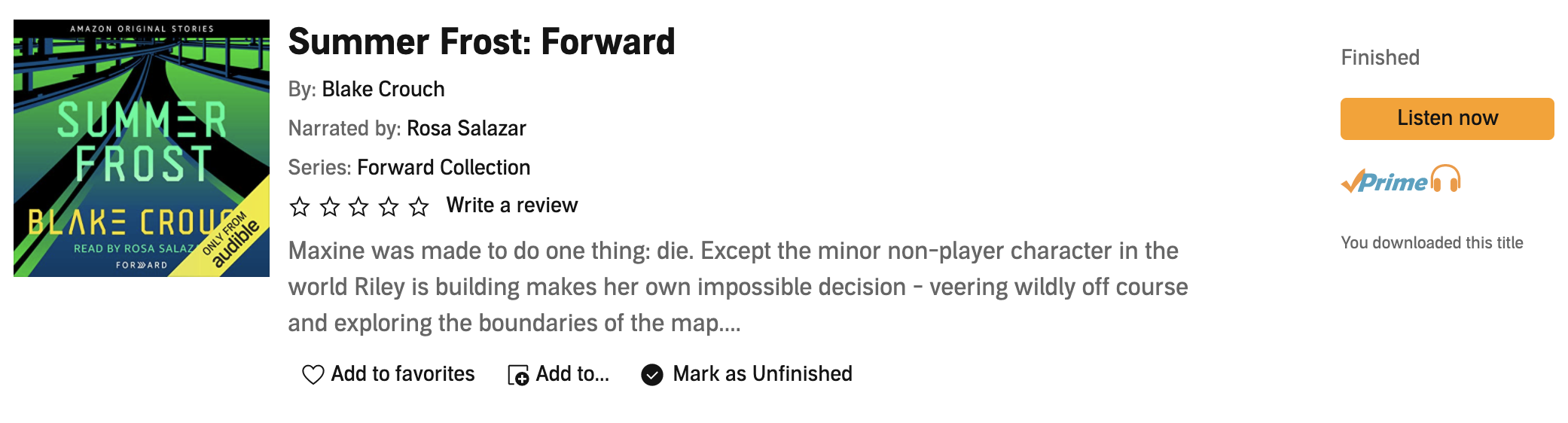
Summer Frost by Blake Crouch: Narrated by Rosa Salazar

Summer Frost is not treading entirely new ground, building up to a predictable outcome as it does…but it’s not the novelty of the tale that makes it worthy, it’s the quality of the storyteller. Blake Crouch is quite the storyteller.
Riley makes for a captivating protagonist as she works to assist the world’s first truly emergent intelligence reach and further maximize its potential. It’s appropriate, in a sense, that the AI’s name is Max (short for Maxine, the NPC within a VR game, the AI unexpectedly grew from).
It’s a sad tale of being too close to a problem to see that there’s a problem at all. In this case, the problem is that Riley has projected altogether too many human characteristics onto something that is far beyond human. Blinded by an affection that falls somewhere into a nebulous space of mother and child…or lover and object of obsession. We are helpless to do anything, hoping that we’re wrong, as the story races to the inevitable conclusion…but knowing, deep inside that there’s no other conclusion available.
The narration from Rosa Salazar is as spectacular as most of the narration has been for the installments of the Forward Collection. She lulls us into a sense of near-complacency that allows us to feel almost as taken off-guard as Riley ultimately is.

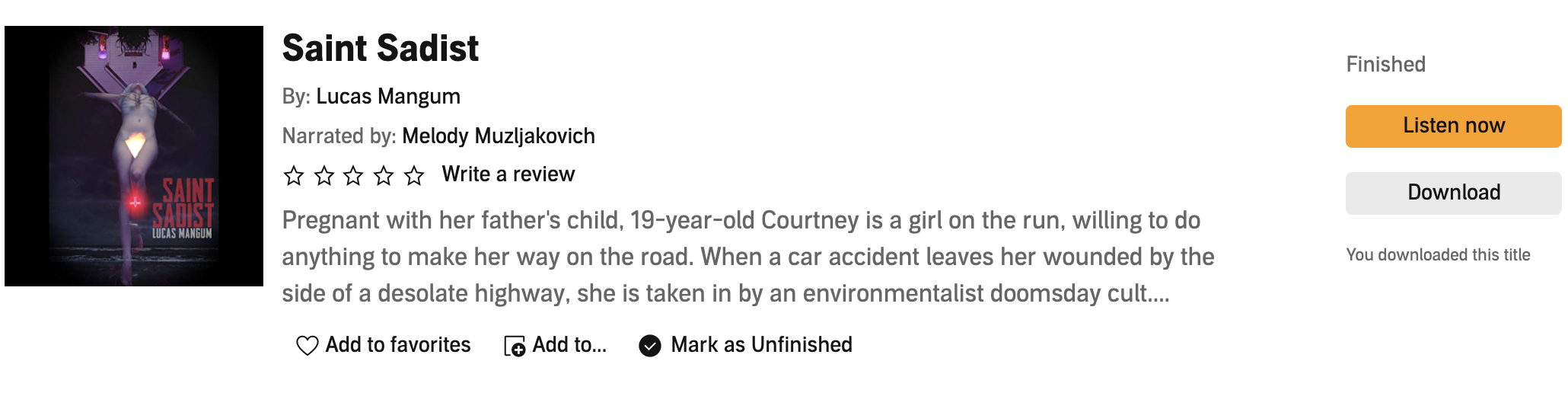
Saint Sadist by Lucas Mangum: Narrated by Melody Muzljakovich

Filth and purity.
These words will mean something to you as you follow along with Courtney’s awful narrative. They’re appropriate words to have in mind as you read Mangum’s Saint Sadist. In a strange sense, there’s an overarching theme of filth and purity, the duality of those two things, and the way they reflect one another throughout the whole story.
Courtney’s father was a violent and abusive man, until she discovered she could use her burgeoning sexuality as a shield to protect herself from those bouts of cruelty and violence. Becoming a victim of a wholly different sort of abuse, teenage Courtney believes she’s taken control of the situation, both protecting herself and preying upon her father’s weakness.
Then she gets pregnant.
Reading this, you might think this is the end…but it’s only the beginning.
Courtney escapes from her home, hoping to provide a better life for her incestuous offspring by living the life of a harlot.
Few authors would look at what they’d created thus far and decide they haven’t gone far enough. Lucas Mangum is one of those few.
The story grows increasingly vile and violent. The voice in Courtney’s head and the visions she experiences force us to wonder how much is real and how much is the result of severe psychological damage and depravity visited upon a young girl.
This is an unpleasant, raw, and disgusting masterpiece.
Melody Muzljakovich breathes life into both Courtney’s Texas drawl and the hissing whispers and chanting of her inner voice with equal skill. Other characters are similarly well-narrated.