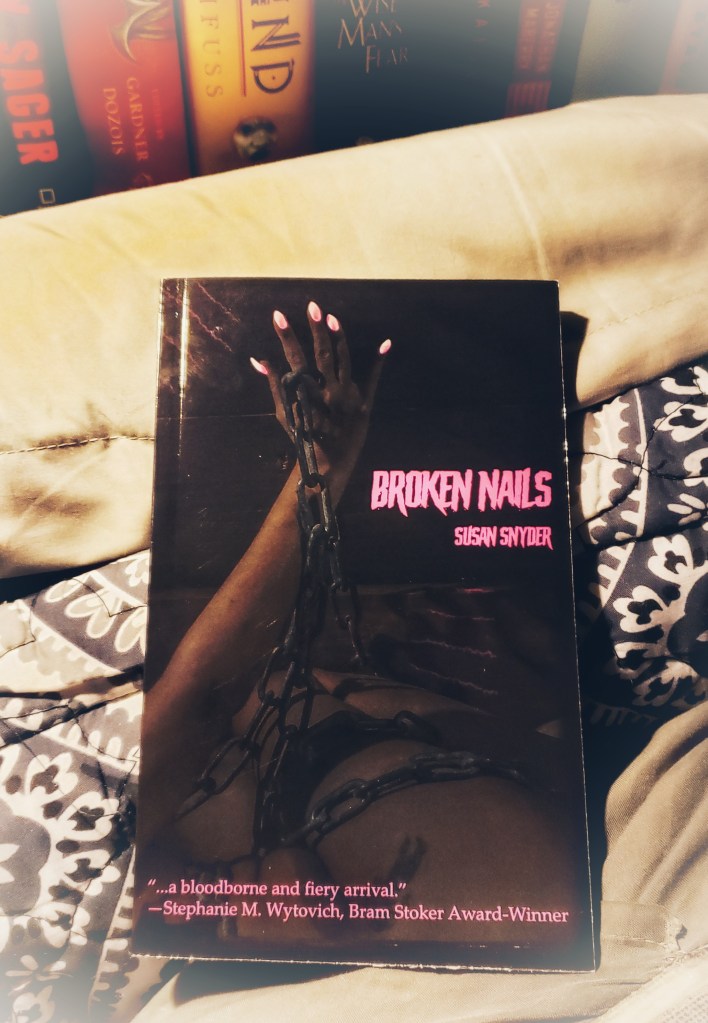
The first thing I will say about Susan Snyder’s Broken Nails is that it is far too short. You’re reading–and often re-reading–the poems, getting drawn into the almost nightmarish world she’s assembling with her words…and then it’s the end. It’s over. You’re not ready for it to be over just yet. As painful and raw as the experience was, you sort of want to continue exploring Susan’s interior. She’s ripped herself open for you and left herself exposed, but then it stops. This poetry collection is separated into three sections, each with a certain overarching theme. The second section, Reflection, was my personal favorite. It was also the most horrific in a number of ways. It’s sincerely a little bit painful as you allow the poet to paint you a portrait of a life that’s included no small amount of suffering. This is not poetry for those who are looking for flowery nonsense. This is poetry that examines topics like murder, sexual assault, suicide, and Satanism…and if you’re interested in that, dive right in.
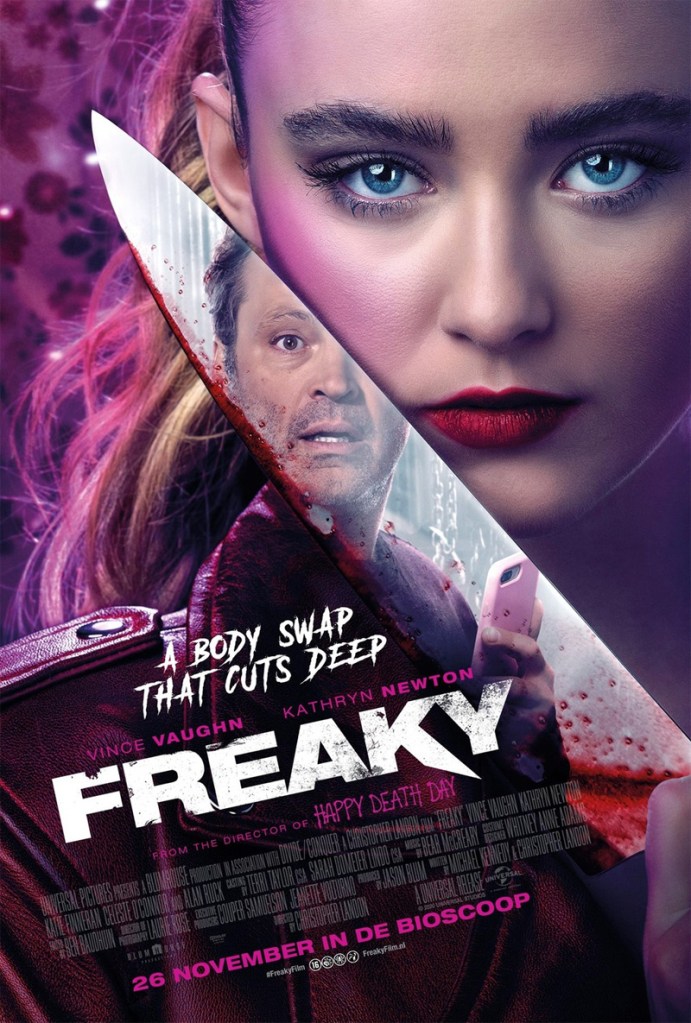
Freaky succeeds in being the perfect response to the Wheel of Fortune before-and-after puzzle, “Freaky Friday the 13th.” My personal favorite before-and-after remains my brother’s “Zyklon Bea Arthur,” but that would make for a far less interesting movie when you think about it. That’s neither here nor there. If you enjoyed Happy Death Day, The Hunt, and other Blumhouse productions with a horror/comedy bent…there’s nothing disappointing about this one. A mousy, grieving high-school girl swaps bodies with a notorious local serial killer after he fails to kill her with an ancient sacrificial dagger. I mean, what could be wrong about that? In a strange sense, it’s a coming-of-age tale about mourning and family…only with self-aware stereotypes and meta commentary on the usual slasher tropes. There are some interesting and gruesome kills throughout the movie, beginning with a play on my favorite kill from a slasher movie prior to this one, which was the wine bottle scene from Sorority Row (the 2009 remake of 1982’s House On Sorority Row). Vince Vaugh was spectacular as both the killer and as the high-school girl trapped in an adult man’s body. Seriously, it’s the best performance I’ve seen from him. Kathryn Newton was pretty impressive as well, transitioning from being a virtually invisible teenage girl to being a bloodthirsty murderer in a young woman’s body. As much as I enjoyed this one, I will say that it doesn’t tread any new ground and there’s nothing particularly surprising about it (beyond the quality of the performances and the graphic nature of some of the kills). It’s a fun movie for the sake of being a fun movie.
Veronica Roth’s Ark, her contribution to the Forward collection, is perhaps the most emotive and well-developed character study of the things I’ve read from her. I enjoyed the Divergent series as an adult, enough so that I was disappointed the movies never completed the story even as the movie adaptations managed to disappoint in the liberties taken with the narrative. In only a small handful of pages (under two hours of audiobook), Roth succeeded in capturing a particularly satisfying, somber snapshot of the world weeks away from an unavoidable apocalypse.
As an asteroid approaches the planet, sure to make it uninhabitable for humanity, we join Samantha and a small group of orphan scientists in Svalbard, Norway where they are cataloging and collecting biological samples of as much plant life as can be salvaged. A similar project is simultaneously taking place in Australia, focused on animal life. These small pockets of humanity are all that remain on an evacuated Earth. The rest of the human population had already left aboard generation ships, while those dedicated to the flora and fauna catalog risk everything by remaining until only a matter of a few weeks until impact. As the time approaches to say goodbye, we manage to feel some small amount of the desolation and loss through the quality of Roth’s storytelling.
Evan Rachel Wood’s narration is spectacular. Her voice easily capturing the interwoven tone of sadness and hope of this short tale. I’d honestly love to hear her narrating more audiobooks. She’s got a terrific range and capacity to bring characters to life.
Mercedes Lackey’s Hunter is the beginning of a trilogy that starts off feeling like it’s got a fair amount in common with a some of the more popular post-apocalyptic YA series; books written by Marie Lu, James Dashner, Suzanne Collins, Veronica Roth, and others. Though this novel does slip away from that feeling of being geared toward a young adult audience as it progresses, that feeling never quite dissipates altogether.
Lackey does manage to set herself apart from those other authors by deviating from the trend of dystopian science fiction and instead embedding within her post-apocalyptic America a dark fantasy environment that fans of her other books will recognize as being where she truly excels. My first experiences with Mercedes Lackey were thrilling, slow burn, dark fantasy standalone novels and series. She truly plays to her strengths with this first installment of the Hunter trilogy, and it pushes her into a whole different ballpark from those contemporary post-apocalyptic authors I’d mentioned previously.
We follow Joyeaux Charmand as she leaves the comfort and relative peace of her mountain enclave where she has trained to be a hunter, an individual capable of magic and the ability to summon “hounds” from another realm in order to combat a veritable plethora of monsters and creatures collectively referred to as “Othersiders” throughout the story. Borrowing from folklore from any and all cultures around the world, Lackey populates this version of America with creatures that may be familiar to some and unfamiliar to others (depending on your own cultural heritage or exposure to others). Joyeaux (Joy) is called to Apex, a massive, protected city on the East Coast where anyone with the skills to be a hunter are supposed to be sent for the purpose of training and employment by what is a strange military government.
It was after Joy arrived in Apex that I began to see strong correlations with The Hunger Games books, in that these hunters are treated as celebrities and forced to perform for cameras that are constantly monitoring them. That’s where the similarities disappear.
There is action, ample supernatural and fantasy elements, some horror, a bit of romance, a decent bit of intrigue and political thriller mixed into the narrative, and a great deal of character development. As an introduction to a trilogy, Lackey spends a great deal of time on the world-building, and she does an excellent job.
As I had picked this up as an audiobook, I feel it is worth noting that the narration captures Joy’s simpler perspective and relative (though not overwhelming) naiveté to a degree I found impressive. The voices are largely distinct and easily discernible as separate characters.
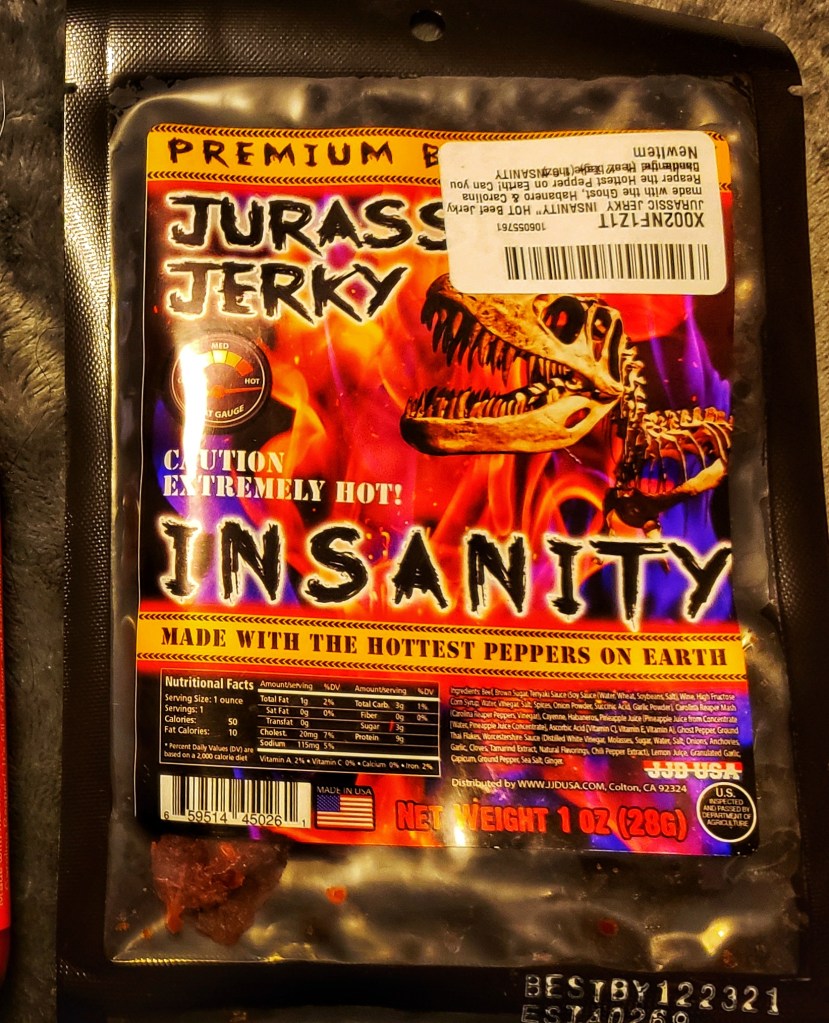
It is with a heavy heart that I tell you my Jurassic Jerky is no more. It was a delicious Valentine’s Day present while it lasted…and it lasted longer than I’d have expected, what with how positively delicious it was. The primary reason it lasted a couple of days is that it is not only delicious…but also ungodly hot, with a heat that sticks with you, burning the inside of your mouth for easily ten to fifteen minutes after you’ve finished what you were eating. That makes sense when you read that this particular jerky is seasoned with ghost pepper, habanero, and Carolina reaper. That last bit is exacerbated by the fact that, like all jerky, it tends to get stuck between your teeth. This provides a sort of timed-release quality. The bag pictured on the company website definitely indicates a greater quantity of jerky inside the packaging (there were two moderately large strips in my pouch)…but it is tasty enough that I would consider buying more for myself. I also want to try some of the other flavors.
With the title being what it is, I should have expected more of a focus on the investigations that led to the ultimate arrest and conviction of Richard Ramirez. They say it right there in the title, “The Hunt for a Serial Killer.” It was still disappointing to see what the documentary turned out to be.
Ramirez is one of the more fascinating characters from the annals of American serial killers, so it stood to reason they might have spent a bit more time focusing on who Ramirez was and what he did. Instead, I ended up sitting through three hours of police hero worship. Strangely, I would have preferred if it had been three hours of that bizarre hero worship that some people devote to serial killers…it would have been far more interesting, at the very least…also a touch more disturbing.
Some elements of the investigation were interesting enough, but certainly not sufficiently captivating to keep me from wanting to stop wasting my time at various points. The crime scene photos were largely things I’d been familiar with from various books and other documentaries over the years, as were many of the first-hand accounts from surviving victims and those who were close to the victims who were not so lucky. There wasn’t much by way of new material being covered with respect to Ramirez himself or the things he did.
There was one point in this circle jerk of police aggrandizement when a detective admits to punching a known acquaintance of Ramirez in the face, being mocked for the weakness of the blow, and when the officer threatens to punch the individual again he cowers and gives up what he knows. I don’t believe that account from the officer. I suspect what really happened is far more sinister and far less in accordance with proper behavior of police officers. My assumption is that the detective withdrew his sidearm and threatened to shoot Ramirez’s acquaintance after learning that he–as Robert De Niro in Raging Bull might have put it–throws a punch like he takes it up the ass and that his machismo and badge simply weren’t enough to get his way. That is, of course, just my impression of the segment in question. I could be wrong, but the story told by the detective simply wasn’t internally consistent and didn’t ring true at all.
The one thing I can say about Night Stalker: The Hunt for a Serial Killer is that it does reaffirm my contempt for Dianne Feinstein. How she handled things as Mayor of San Francisco was short-sighted and counterproductive. Her actions may have directly led to Ramirez avoiding capture long enough to ruin more lives. How she continued being voted for after that boggles my mind.
I can’t say that I’d ever be able to recommend this documentary to anyone. It’s tedious, sometimes mind-numbingly boring, and nowhere near as shocking or graphic as I was led to believe. It’s heavy handed in its overwhelmingly favorable depiction of law enforcement and largely neglects to tread any new ground.
I’m copying over some reviews of titles I’d written up in 2018 and earlier, just in case these titles are new for other people.
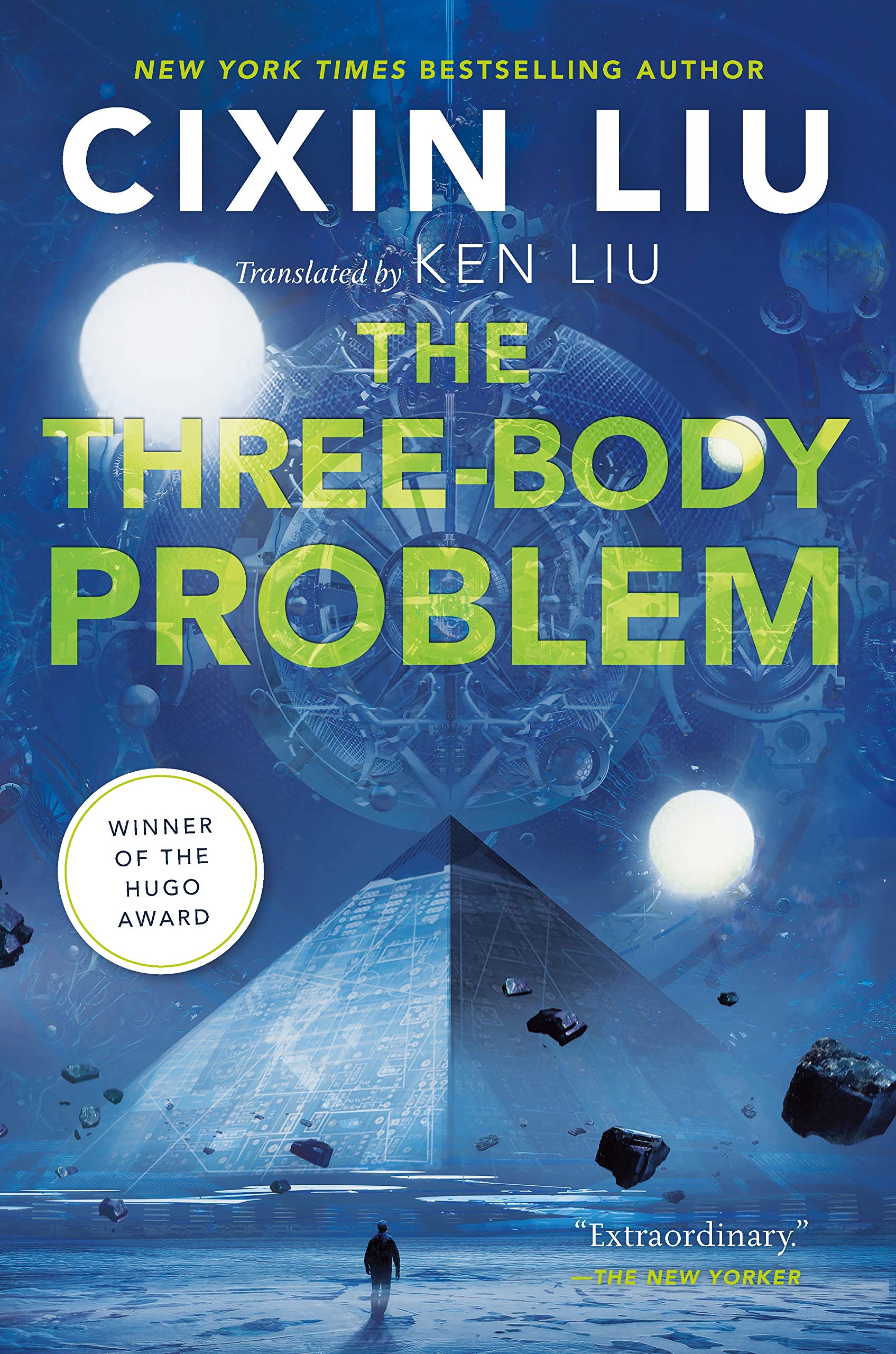
Liu Cixin is an author I wish I could be more familiar with. The Three-Body Problem was a positively stunning piece of hard science fiction with a profound hint of the fantastic still built on extrapolation. I don’t know what is lost in the translation from Chinese into English, but I find it difficult to believe that it could have been more well-written if it had been written originally in English. I suspect that this is equal parts the quality of the original material and the caliber of the translator. From what I have read it appears that the second volume in the trilogy has a different translator while the final volume is translated by the same man who expertly converted The Three-Body Problem into English. Sadly, though the second volume is available now, I have to wait until later this year before the third book is released in English. This novel begins during the nightmare of The Cultural Revolution spearheaded by Chairman Mao and a good deal of the narrative focuses on the anti-intellectual and anti-progress philosophy that was imposed upon the whole culture during that time period beginning in the 1960s and continuing for a couple of decades after that. It is interesting, to say the least, to have a perspective on that period provided by someone who grew up through it as the author had. From there it grows into a frankly captivating and disturbing first contact narrative that unfolds in a rather unexpected way. I can’t say much without giving altogether too much away, but I can’t recommend this book enough for anyone who enjoys science fiction or simply enjoys science and wants a fictional template through which certain concepts can be expressed and better visualized. I look forward to the second novel and wish that I could look forward to reading the third book much sooner than it is going to be available to those of us who can’t read a Chinese dialect.
I’m copying over some reviews of titles I’d written up in 2018 and earlier, just in case these titles are new for other people.
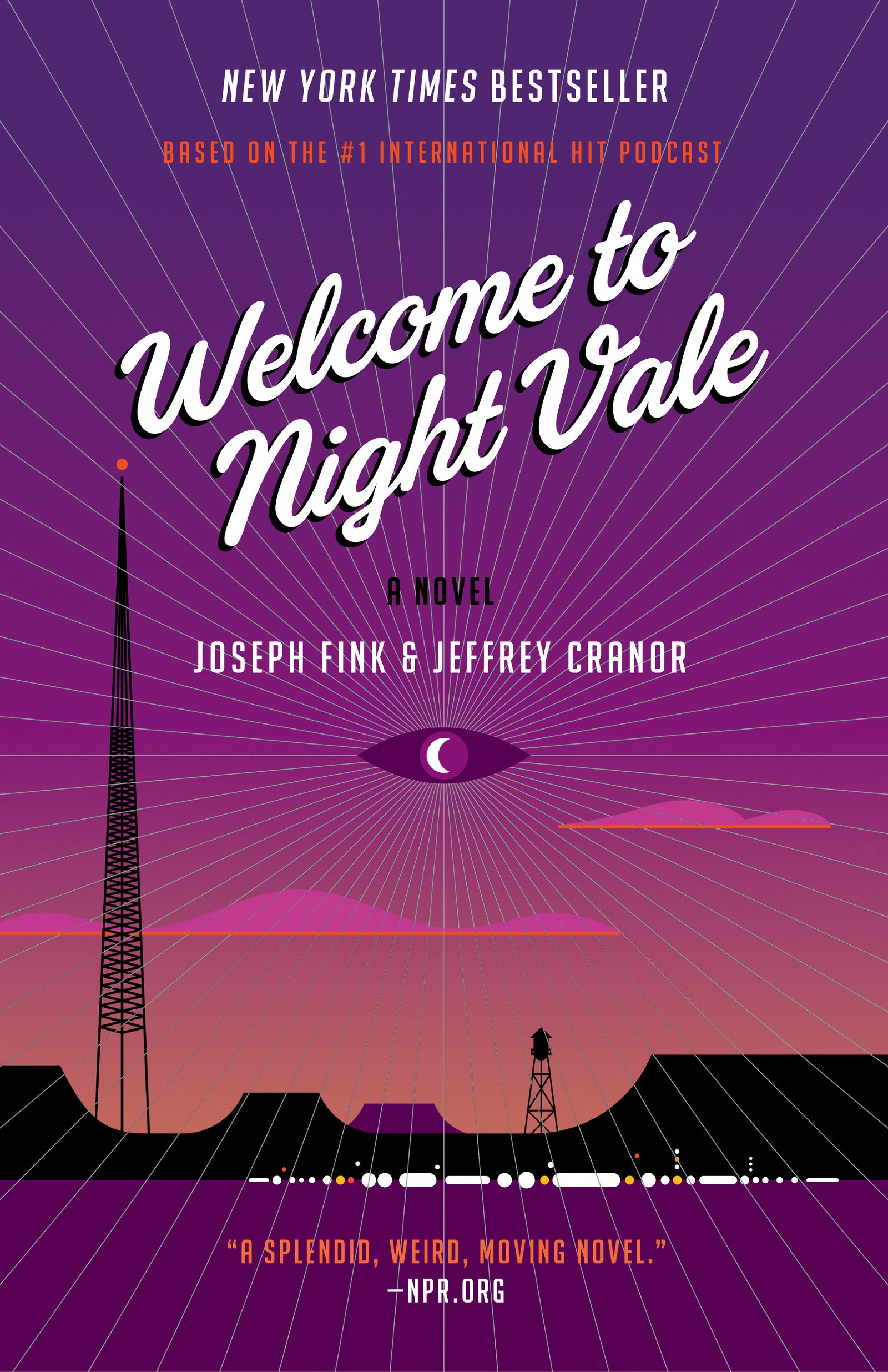
Welcome To Night Vale by Joseph Fink and Jeffrey Cranor is definitely an interesting read, especially if your tastes lean toward the absurd and surreal. It ranks up there with Douglas Adams (think Dirk Gently rather than Hitchhiker’s Guide) and David Wong, but with a bit less cohesion and rationality behind the narrative and the setting. That sounds like a bad thing, but it really isn’t…it’s refreshing to read something so ridiculous that still manages to be captivating and entertaining, because that is something a great many authors just can’t pull off. Throughout this novel, none of the absurdity and randomness ends up feeling like it’s there just to be there or simply to categorize the story as being bizarre or strange. Somehow the authors manage to make it all feel like it furthers the plot, and there is one of those…a plot. Reading this book makes me want to listen to more of the podcast that started it all, maybe from the beginning through the present (which would likely take up more time than I really want to invest). It’s a statement about the quality of the book that I would actually want to spend more time visiting the fictional, semi-lucid nightmare town that is Night Vale and hopefully they will opt to write another novel or two so that I don’t have to immerse myself in the podcast. As long as I don’t have to visit the library to read them, I’ll be ok.
I’m copying over some reviews of titles I’d written up in 2018 and earlier, just in case these titles are new for other people.
Peter Clines wrote a masterpiece with 14. The comparisons to LOST are absolutely spot-on, in that the novel successfully contains a great deal of the same surrealism, mystery, and even a few of the themes from the first couple seasons of that television show and places them inside an old LA apartment building instead of on an unnamed island. Combine that element of LOST-like intrigue and mystery with some House of Leaves and toss in a healthy dose of H.P. Lovecraft and you’ll start to approach the setting for 14. You hear people describe movies and television shows by stating that this or that (in reference to a location or vessel) is actually a character in its own right, and this book successfully makes the apartment building a pivotal character without imbuing it with thought or anything silly like that…and then Clines stuffs the building full of interesting human characters who display an almost contrived level of diversity without ever coming across as contrived. References to LOST and Fringe in the dialogue make it clear that the characters realize just how unusual their situation is, and that self-awareness makes them more compelling as far as I’m concerned. The whole story is fascinating, in large part because of how relatable the characters are, most of them at least. The only downside I can think of is that I predicted the ending less than halfway into the story, but maybe that just means I was approaching the book from a similar perspective to the author. This book undoubtedly falls into the top 5 stand-alone novels I’ve read in as many years. It might even still make my top 10 if I include novels that are part of a series.
I’m copying over some reviews of titles I’d written up in 2018 and earlier, just in case these titles are new for other people.
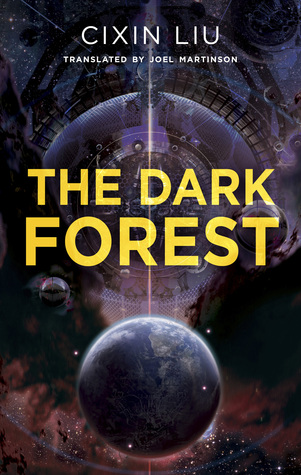
Liu Cixin crafted a thoroughly fantastic and stunning follow-up to The Three-Body Problem with The Dark Forest. The tension from the final chapters of the first novel carried over well into the sequel. The Dark Forest excels in portraying a worldwide reaction to the certain knowledge that an advanced alien species had successfully cut us off from advanced scientific inquiry (by making it impossible for us to study anything at the quantum level) in order to keep us weak in preparation for the massive fleet that they had sent our way to take over our planet and escape the inevitable destruction of their own. Just like the first novel, the development of fully realized characters is superb, and the exploration of our evolving and devolving society during the couple of centuries after doomsday begins looming on the horizon is spectacular. The most striking element of The Dark Forest is in the application of the title itself as an ominous response to the Fermi Paradox. The concept that we aren’t seeing evidence of alien civilizations because they are applying game theory to any other potential life in the universe is an interesting one. To announce one’s existence to anyone else in the dark forest of our universe presents the very real risk that anyone receiving the announcement might be aggressive or induce aggressive response from one who isn’t simply because they might assume that you might be. It’s a sincerely horrifying prospect that there could be numerous civilizations out there who are just acting prudently in not broadcasting their presence and that there are other civilizations who might validate that concern by being a threat to any other life they might encounter. It’s really fascinating to think of it that way. I certainly didn’t think of that when I was writing my paper on the Fermi Paradox when I was in college, and I wish I had. The only problem I can think of with this book is that there seems to be a minor shift in tone and style from the first novel, but that could easily be due to there being a different translator involved with this volume. It’ll be interesting to read the third book to see if that’s the case, since it is translated by the same man as the first one. I honestly don’t know where the third book might take me, because this one seemed to be such a perfect place to end the story…but I can hardly wait until the English translation is released later this year.

 Domus Necrophagous