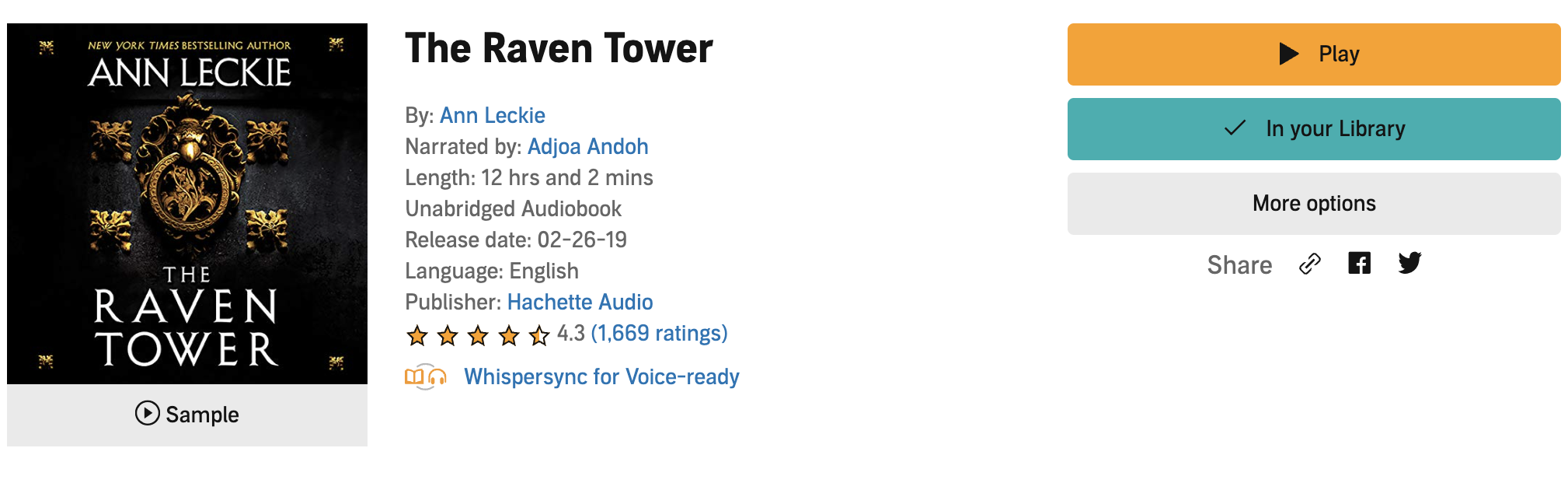
As much a collection of world-building elements as a story, The Raven Tower contains the same depth of political intrigue, examination of social structures, and mythological explorations one should expect if they’ve read other books from Ann Leckie. Much of the narrative is taken up by historical musings and the interactions of various gods, in particular The Strength and Patience of the Hill and The Myriad, two ancient gods who watched as humanity evolved and developed cultures and language.
Relayed to us by that ancient god, The Strength and Patience of the Hill, The Raven Tower is the story of Eolo, a soldier and the aide to Mawat, the next in line to serve as Lease to the Raven, God of Vastai.
Upon being called back home from the conflict at the border, Mawat discovers that his father, the previous Lease, has disappeared when he should have sacrificed himself upon the death of the most recent incarnation of the Raven. In his father’s place, Mawat’s uncle is sitting on the bench belonging to the Lease, proclaiming himself as such, in defiance of both custom and Mawat’s wishes. While Mawat mourns the father he believes to be dead and seethes with anger at his uncle’s presumptuousness and betrayal, Eolo sets out to solve the mystery of how any of this could have transpired. The truth, when revealed, might be too costly for those involved and far too dangerous for the kingdom of Iraden.
As interesting as the story of court intrigue, murder, and betrayal happens to be, I found myself wanting to hear more about the gods, their machinations, and the history of this world the deeper I delved into the story. Leckie has a knack for creating worlds that beg for the reader’s attention, drawing us in and making us crave more. The Ancillary books had a trilogy that allowed for greater satisfaction of this need, and I’m hoping that this won’t be the last time we visit the world she’s created with The Raven Tower.
The casual acceptance of Eolo as a trans-masculine character was a nice touch, without ever seeming shoehorned in or forced. This should come as no surprise to anyone who read the Imperial Radch trilogy, in which it was obvious that Leckie has a knack for exploring non-binary identities and cultures with the same deft hand that Ursula K. Le Guin brought to The Left Hand of Darkness. There are sure to be readers who dismiss this book because of that. But those are the same people who proclaim that they don’t want politics in their fantasy or science fiction, so it’s a simple thing to dismiss their opinions as uninformed, historically ignorant, and irrelevant.
Adjoa Andoh’s narration captures a wide breadth of characters and accents with seeming ease, though there were times when certain accents initially seemed a bit silly or cartoonish at first. As the audiobook continues, those accents seem less pronounced as the listener adjusts to hearing them and becomes acclimated to the environment cultivated within the narration. I certainly prefer this over the alternative, where every character sounds approximately the same, and there’s no variation where cultural differences should exist.
 Domus Necrophagous