Recursion by Blake Crouch, Narrated by Jon Lindstrom & Abby Craden

Blake Crouch guides us through a narrative full of twists and turns, switchbacks, and–well, obviously–recursions, as he tackles the well-trod ground of time travel, bringing a fresh new spin to the topic. False Memory Syndrome is becoming a plague, as people find themselves suddenly–and seemingly at random–overwhelmed by new memories of a life that wasn’t the one they’d been leading up until that moment. These memories are as vibrant and real as the ones they’d had access to only seconds earlier, and the confusion and contradiction are enough to drive people mad.

One detective’s obsession with the often disastrous impact of these false memories and the unknown vector by which the mental illness is transmitted leads him to an inevitable meeting with a research scientist focused on salvaging memories for those suffering from dementia, as she hopes to ease the horror of that debilitating condition. Unfortunately, a wealthy and powerful benefactor with seemingly unlimited capacity to predict market trends and so much more has his own goals for the technology, and he’s seemingly two steps ahead of both of them.

Crouch takes us from the seemingly innocent and altruistic beginning to the cataclysmic end, as the truth–and reality itself–becomes a tangled mess of interwoven timelines. At once thrilling and depressing in the way it captures the worst of human nature, this is a must-read.

The narration provided by Jon Lindstrom and Abby Craden is fantastic, and they thoroughly capture the characters and bring the listener into the story.

Infinite: Ghostland Trilogy Book 3 by Duncan Ralston, Narrated by Joe Hempel

Duncan Ralston brings his Ghostland trilogy to a superbly fitting conclusion with Infinite. He takes us back and forth in time, as the mystery surrounding Rex Garrote’s plan is revealed, and the truth is more horrifying than anything Ben Laramie and his friends could have imagined. The stakes are higher, and the enemies are far more numerous than solely Garrote and the forces he’s aligned beside him, but Ben is not one to give up. As Ralston races us toward a final confrontation that threatens existence, we’re forced to wonder how Ben and his allies fight an enemy who seems to know what’s coming, and who seemingly orchestrated every step they’ve taken to reach this point?

It was a treat, getting this deeper glimpse into Garrote’s life and personal history, the relationship between Garrote and Hedgewood, and the previously unexpected nature of Garrote House. Similarly, getting a deeper investment in Ben and Lilian’s families was an excellent experience, as the horrors of the Dark Rift loom ahead of our heroes.

As with the previous two installments of the Ghostland trilogy, the cast of characters is fantastic and each one is well-drawn and believable in their motivations and attitudes. The action is fast-paced and exciting, even as Ralston succeeds in giving us numerous breathers as he unveils the history that set the stage for the events we’re bearing witness to.

Joe Hempel’s narration is–as always–spectacular. There seem to be few narrators as prolific or in such high demand, and for good reason.

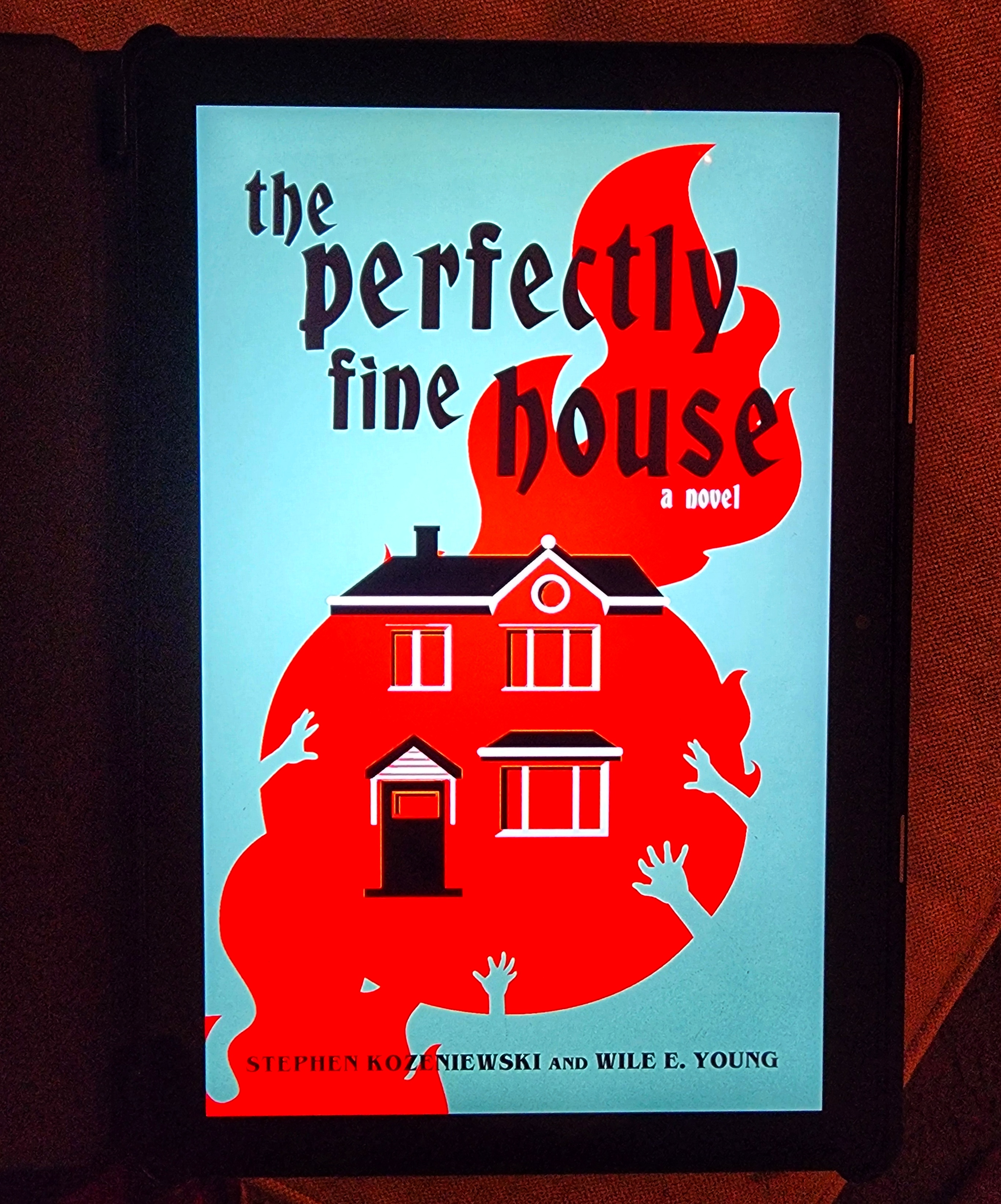
The Perfectly Fine House by Stephen Kozeniewski & Wile E. Young

Imagine living in a world where the dead remain side-by-side with the living–whether it’s animals or people, the dead remain tethered to the world and free to interact with it. This is the only world you’ve ever known–the way it’s always been. Imagine you find a house without any spectral presence–a place ghosts fear to tread–where any ghost unfortunate enough to cross a certain boundary is snuffed out. Would that place be as terrifying to you as a “haunted” location is to those of us in the more familiar world?

That is where this story begins, the discovery of a place that is not only devoid of spiritual entities but fatally harmful to them. Where it ends is far worse.

Kozeniewski and Young created a fantastic vision of a world in which things are quite different from our own, a society that is familiar enough to feel real yet so wildly different as to provide the reader with a sense of adventurous thrill as they learn how things work when the dead don’t leave us. We’re provided adequate time to explore this world before we’re forced to fear that it’s all going away, as whatever unknown force transformed the un-haunted house into a place of certain death for spirits begins to spread.

It’s a story of family, unanticipated romance, and the five stages of grief played out on a global scale…as humanity is forced to learn–for the first time–how to mourn the loss of those they loved in life. It’s a story of the sudden fear of mortality striking home everywhere, all at once…with devastating consequences. It’s all of those things, and so much more. There’s humor, there’s heart, and there is ample horror too.

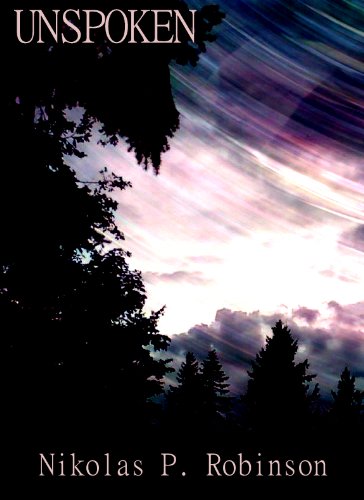
Unspoken

Unspoken was the first novel I released, back in late 2011, though it was not the first I’d written. There was some small amount of experimentation taking place in the writing of this story, focusing on a protagonist that wasn’t particularly likable or relatable to most people…but hoping to elicit some sympathy for him by the time we reach our conclusion. In that, I do believe I succeeded.

Unspoken is a short, but well-paced and compelling exploration of the themes of unrequited love and the insanity that accompanies it in the midst of a world sliding into madness. A story of love, regret, and the end of the world expressed with a poetic voice and postmodern sensibilities; it could be described as being a combination between George A. Romero’s The Crazies and an amalgam of The Notebook and Love In the Time of Cholera.

The story follows Nathan, recently employed as an overnight orderly in a state mental hospital. He has found himself lucky enough to develop a friendship with Leyna, another of the overnight staff, but that friendship quickly becomes something far more intense for Nathan, a fact he chooses to keep to himself.

Suffering through the turmoil of his unspoken desire for Leyna and inured to the environment of a mental hospital and the madness that has afflicted him in his personal life, Nathan neglects to notice the signs that become more and more prevalent in the world around him, signs indicating that something terrible is taking place. As the world descends into madness, Nathan and Leyna remain at the institution, hoping that isolation might protect them from the world collapsing around them, but in the end there may be no escaping some tragedies.

Horror author David Moody described Unspoken as, “…a brave and thought-provoking piece of work filled with palpable emotions and plausible situations.”

Unspoken by Nikolas P. Robinson

Between Two Fires by Christopher Buehlman, Narrated by Steve West

Christopher Buehlman’s Between Two Fires transports readers to the region now known as France during the peak of the Black Death. The world was ending. Sickness had emptied whole villages, leaving nothing behind but decaying remnants and ghosts that haunted the vacant homes. The survivors, few and far between, were living through horrors no one had ever seen. Amid this nightmare of disease and human predation, a war unlike any witnessed on Earth was taking place. This tableau of terror, both human and spiritual, is the world Buehlman brings to life.
When Thomas, a crude and disgraced knight, takes it upon himself to shelter and protect a young girl–who knows things she should not know and sees things others cannot see–he knows he’s set himself on a path that might end in tragedy. But nothing can prepare him for the madness and cruelty awaiting them on their journey to Avignon.
The boundaries of reality are repeatedly blurred throughout the narrative, forcing the reader to question–as Thomas does–whether he’s awake or dreaming. The dead haunt the living, tormenting them with cruel assertions and distorted recollections of the past. Ghosts appear and disappear, leaving us to wonder which of these apparitions are truly beyond the veil, and which are drawn from the memories of Thomas and the weary priest who joins him on his quest.
Will the trio arrive where they intend, or will the gates of Hell await them instead. Is there a difference?
Steve West narrated this audiobook almost perfectly. The delivery of dialogue and narrative components were both handled with great attention to detail. The narration was almost as gripping as the story itself.

The Silence by Tim Lebbon, Narrated by Marisa Calin and Ralph Lister

A couple of years before the release of A Quiet Place, Tim Lebbon gifted the horror community with his novel, The Silence. Exploration of a previously isolated cave ecosystem in Eastern Europe culminates in the emergence of a predatory species that spreads across the continent like a plague. Blind from evolving in a lightless environment, the creatures–dubbed vesps–attack anything that produces sound. In a noisy world dotted with population centers, humanity doesn’t have long to prepare for the nightmare speeding across the skies.
The focus on Ally, a teenager who has been deaf since an accident that took the lives of her paternal grandparents in early childhood, is a nice touch. Lebbon tackles the challenges associated with hearing loss with excellent detail, providing both Ally and her family with backgrounds and relationships that feel more than two-dimensional. Even with their well-established history of communicating in silence, their struggles as the family attempts to reach a secluded–and hopefully safe–location in the Northern UK are dramatic commentaries on how difficult silence is for human beings.
Lebbon spins a tense and harrowing tale that explores the highs and lows of human nature and our capacity to adapt to conditions beyond our control. The only problem I have with The Silence is that it ends, and there doesn’t appear to be a sequel forthcoming. Be sure not to gasp as you’re reading this one. Whatever you do, remain silent.
I was satisfied with the narration provided by Marisa Calin and Ralph Lister, though I felt like Marisa’s performance stood out as being a bit more authentic across the board, while Ralph’s narration was most exceptional with the dialogue from Hugh but lacking where the female characters were concerned. Overall, it was still a top-tier audiobook narration.

Ghost Summer: Stories by Tananarive Due, Narrated by Tananarive Due, Robin Miles, and Janina Edwards

The fifteen stories collected in Ghost Summer are some of the most engaging short stories I’ve had the pleasure of reading. That pleasure was in no small part because these stories often provide a vastly different perspective from much of the horror and speculative fiction on the market, informed by the author’s experiences as a black woman, both socially conscious and attuned to history. It’s a perspective and worldview that readers should actively seek out because Tananarive Due successfully displays both the ways we are all the same and the stark differences that haunt many people to this day.
There’s nothing not to love in this collection, but it’s the Gracetown stories kicking everything off that stuck with me the most. This strange, haunted place in northern Florida arrests the reader just as it seems to capture residents and visitors, sometimes in horrifying ways. Gracetown is a place of transformation and possession. It’s a town where the ghosts of a torturous, hateful past reveal uncomfortable truths.
Due provides us with glimpses of the past, of places where myth and legend overlap with the real world, where cultures collide with sometimes beautiful but often horrific results. We experience sadness and loss, sickness, and terror as the author paints all-too-real portraits of people, from those struggling to escape their circumstances to those hoping to find the peaceful embrace of death.
It isn’t all about the past or present, as she also takes us to the end of the world, displaying a keen understanding of human nature that proved almost prescient when compared to the pandemic conditions that ushered us into the current decade.
Narration provided by Tananarive Due herself, as well as Robin Miles and Janina Edwards makes for a different experience from story to story, each individual breathing life into the narratives in slightly different ways, but never in an unsatisfactory manner.

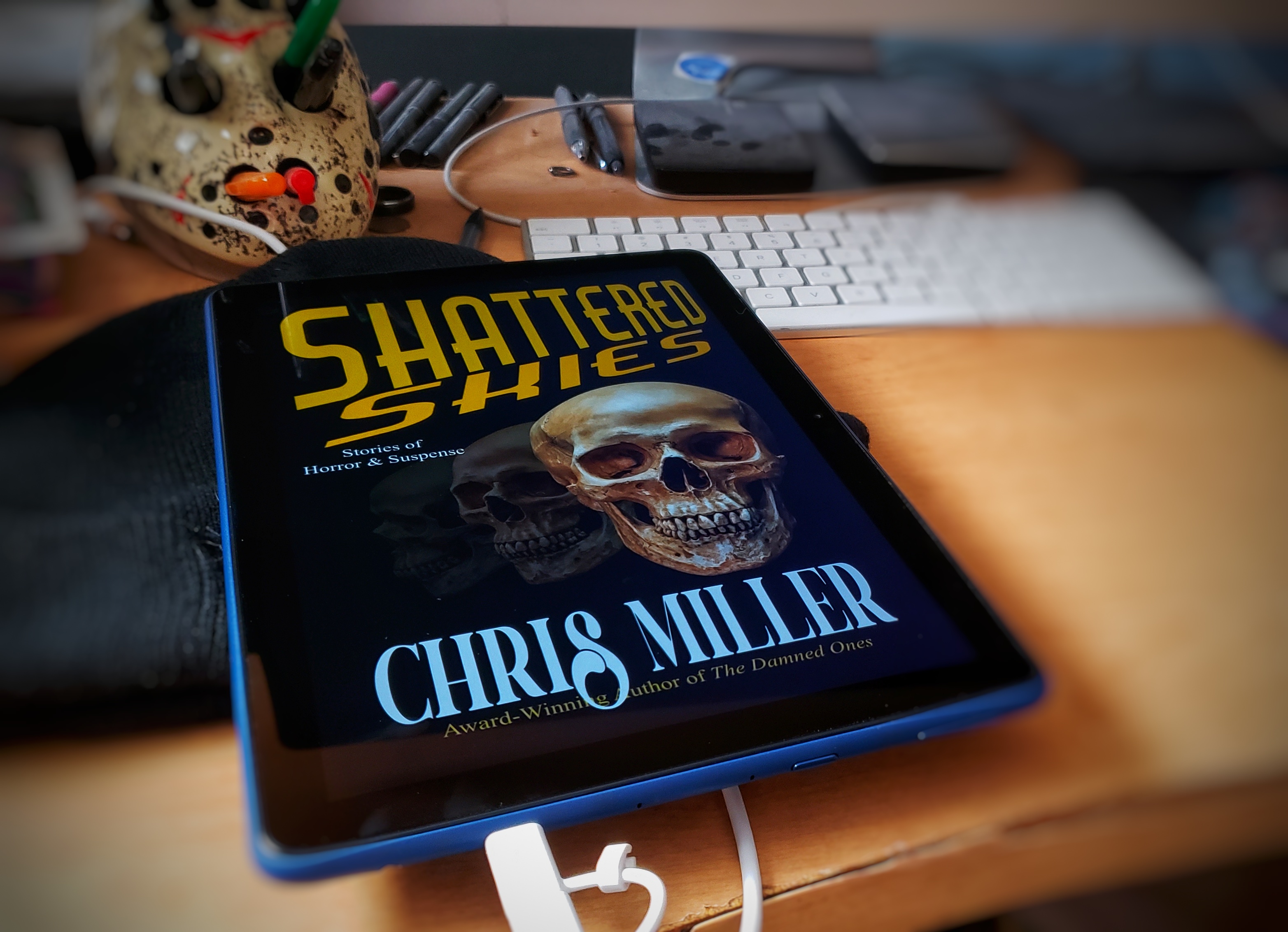
Shattered Skies by Chris Miller

The Foreword provided by Patrick C. Harrison III accurately captures the most impactful component of Chris Miller’s stories collected in Shattered Skies, suspense. There is an underlying sense of suspense to these tales, sometimes bordering on dread and other times sweeping the reader away with excitement, but ever-present just the same. Combining that anticipation and tension with masterful storytelling, Miller has assembled an amazing cross-section of what he’s capable of as a writer.
Instead of delving into each of the stories, as I often do, I’m choosing to focus on the handful that left the most lasting impression on me. This is not to say that anything is lacking in the others, just that I’m going to be spoiling things in small ways, and I’d prefer to avoid doing so with everything in this collection.
Kicking everything off with 10-35 At First United Bank, Miller thrusts readers into an all-too-plausible sort of horror as an elderly bank security guard finds himself caught up in circumstances he can’t control as he desperately tries to save the lives of those he loves. The bank heist trope receives a refreshingly sincere treatment that’s sure to be heartbreaking for readers.
Behind Blue Eyes was a story I’d already thoroughly enjoyed when I read And Hell Followed, an anthology of the end times. Miller’s portrait of a world going progressively more mad with each pressure wave of the horns blasting to signify the end is something that propels us toward a conclusion that feels simultaneously unfair and fitting. This one is a story of guilt and remorse over the way little things can have a profound and lasting impact on our lives, amplified in the recollection.
An attempt to relax with a house full of family transforms into a confrontation with a looming and mysterious terror enveloping the protagonist’s world in Horror On Lonesome Lane. Discovering what awaits on the other side has rarely seemed this awful and sinister.
Road Kill Gods provides us with a glimpse into what might be required of us to hold nature at bay as we carelessly and callously slaughter our way through our lives. Unwilling to accept the price to be paid, will our protagonist release a wave of horror upon the whole world?
As a child, there was no one in my family with whom I spent more of my time than my grandfather. In my case, it was my maternal grandfather rather than my paternal, but that doesn’t change the way Miller devastated me when I was reading Farewell. I was lucky enough to be in my 20s before my maternal grandfather passed away, and I can only imagine how much worse it would’ve been if he’d gone when I was much younger. Farewell is a touching and heartbreaking story, but it’s also a story of how tragedy can sometimes bring families closer and establish new roles for us as we seek to fill the void left in someone’s absence.
A Magnificent View brings us back to the same event from Behind Blue Eyes, or a similar enough event that we can assume they might be the same. Forced to witness the world collapsing into chaos from miles above the surface, a lone astronaut measures his life by oxygen percentage, knowing that he might still be the last survivor of the human race when all is said and done.
Wrapping up this collection with the M. Ennenbach co-authored Neon Sky was an excellent choice. We experience another story that, at its core, is about family and the risks we’ll take to save them. We’re gifted with another tale of a heist gone wrong, this one in a near-future cyberpunk dystopia. Fast-paced and endlessly exciting, Neon Sky is a fascinating juxtaposition from the somber tone of 10-35 At First United Bank. Miller and Ennenbach deliver a thrill ride populated by police drones, horrifying machines that keep the city functioning, an army of mafia killers, hackers, and confusing firearms.

Shattered Skies is a finalist on the ballot for the 2022 Splatterpunk Awards to take place at KillerCon Austin in August of 2022.

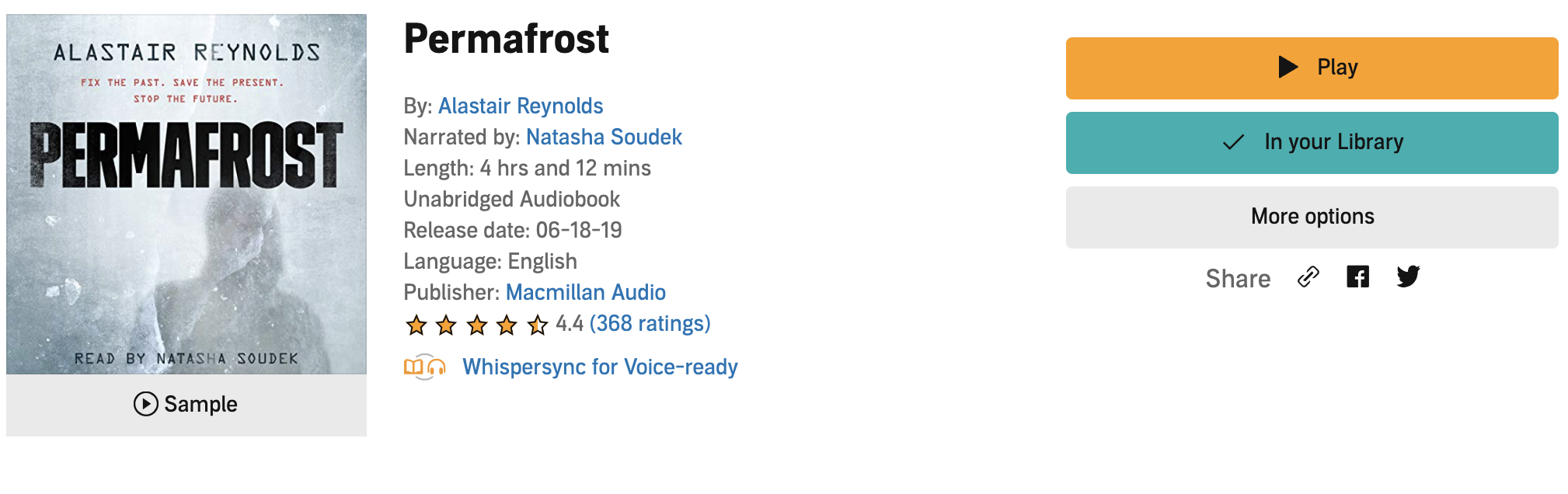
Permafrost by Alastair Reynolds, Narrated by Natasha Soudek

Most of my exposure to Alastair Reynolds has been in the form of grand, far-future space operas. Reynolds’s work appeals to me, in large part, because it’s typically heavy on the darker aspects of human nature–as well as the incomprehensible or frequently sinister nature of other intelligences humanity encounters amongst the stars. Of course, there’s also the necessary focus on the uncaring and hazardous nature of the universe itself.
While Permafrost takes place on Earth, in our not-too-distant future, it’s imbued with that theme of humanity struggling against forces of a universe that is indifferent to our survival. Only a couple of decades from where we find ourselves today, an unexpected global catastrophe begins. As insect, plant, and other animal life dies off, we find the remaining human population facing imminent starvation and dwindling numbers. The only solution is to find a way to make small changes in the past that will allow the humans of 2080 to implement their only chance of saving the human life that remains.
Unfortunately, we can’t send anything like a human being into the past. However, scientists have discovered a way to tether two consciousnesses separated by half a century or more via a neural interface grown from nanoscale machines transported back in time. By sending pilots–individuals who will assume control of an unwilling and presumably unwitting subject–downstream and into these hosts, the Permafrost project hopes to salvage the only thing that can save the future.
The unlikely protagonist of Valentina was a surprising choice, an elderly woman and mathematician, the daughter of a mathematician who specialized in paradox and the potential for time travel. Chosen as the first pilot sent back, Valentina soon discovers unanticipated consequences of assuming control of a host. More than that, Valentina learns the chilling truth that there might be forces further upstream, unexpected foes who might not want them to succeed in their mission.
The final scene of this novella is positively heartbreaking but totally in line with the sort of ending one might expect from Reynolds.
Natasha Soudek’s narration is perfect for both Valentina and Tatiana, capturing the differences between the two characters with effective nuance. She successfully managed to tackle the other characters no less effectively.

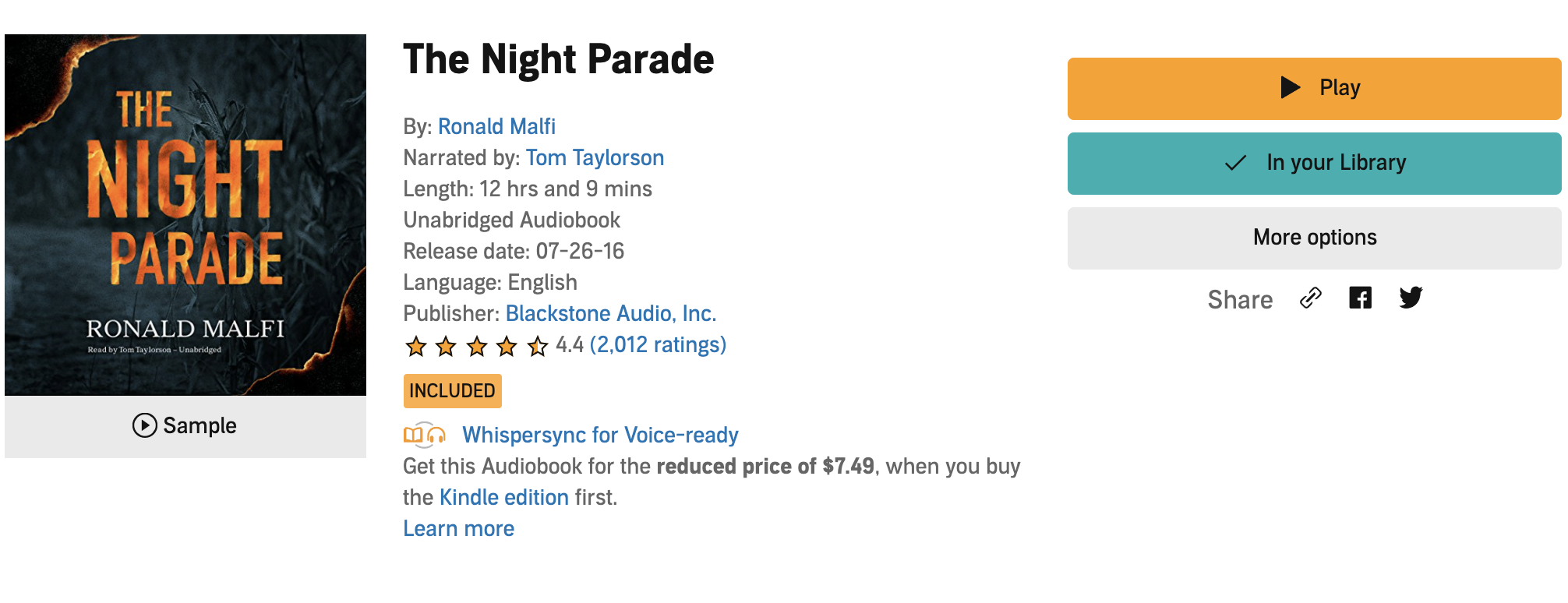
The Night Parade by Ronald Malfi, Narrated By Tom Taylorson

At its heart, The Night Parade is a story about a father’s love for his daughter and the risks a parent will take to keep their child safe from what they perceive as harmful. It’s also a story about mortality; it’s about coming to terms with it and recognizing that we won’t always be there for those we love. All of this heavy emotional content Malfi explores within the story is played out against the backdrop of a society in the process of collapsing, as madness consumes both those infected by “Wanderer’s Folly” and those forced to react to something so devastating.
Given no time to mourn the loss of his wife, David has no choice but to pack up their eight-year-old daughter, Ellie, and hopefully keep her away from the doctors and scientists he blames for his wife’s death. Immune to the disease ravaging the world, both Ellie and her mother were of great interest to the authorities who hoped to find a cure in their blood. But Ellie is special in a way her mother was not; she has a gift that might make her even more valuable to those who seek to exploit her.
Unfortunately, David is not immune. As he races across the steadily decaying husk of the United States in search of somewhere he can shelter Ellie, he’s also racing against time as his mental state declines. The reader’s forced to wonder how much of what he’s experiencing is real. How much is the result of hallucinatory nightmares that will ultimately consume what’s left of his mind?
The Night Parade is a horror story, but it’s also a tragically poignant tale. Malfi digs into the reader’s heart and begins systematically tearing away at it piece by piece as the narrative continues.
Tom Taylorson’s narration is largely excellent, though his performance of Ellie’s voice falls a bit flat. As a whole, where female voices are concerned, there’s a little left to be desired, but that’s a problem that plagues many male narrators. I certainly couldn’t have done any better.