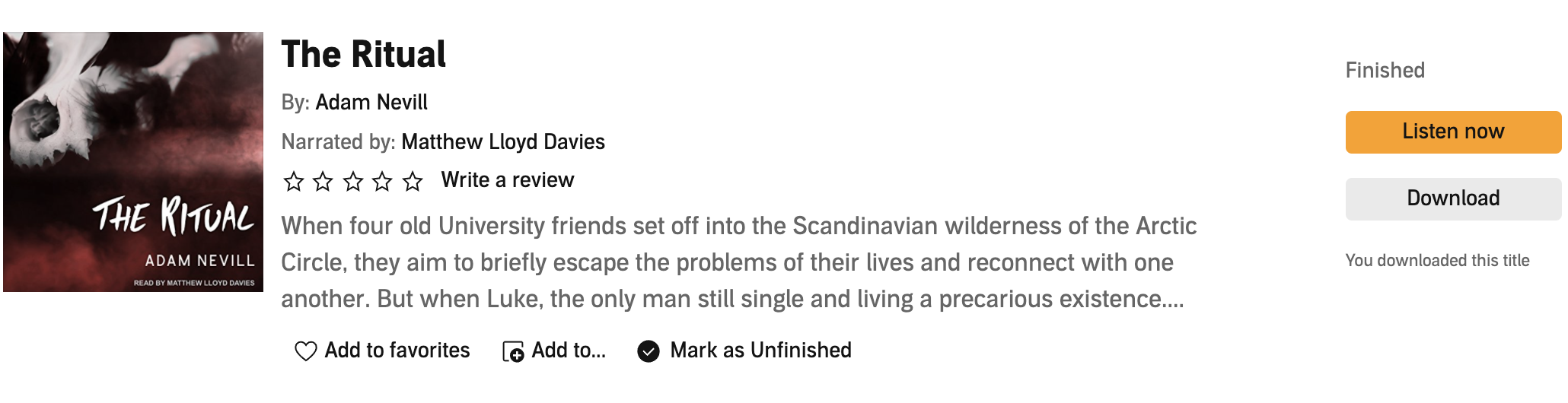
The Ritual by Adam Nevill, Narrated by Matthew Lloyd Davies

The Ritual is a fantastic journey into the realm of folk horror, a literary exploration into the sort of narrative that evokes themes familiar to fans of movies like The Wicker Man or Midsommar. As four friends hike into the autumn wilderness of Sweden, they discover that not all shortcuts are meant to be taken, that there are secrets and horrors in hidden places, and they find tensions that refuse to remain beneath the surface as stress and fear take a heavy toll on the men.
The gloomy, sinister forest is brought to stark, claustrophobia-inducing life as Adam Nevill draws us deeper into the trees and brush as the relentless rainfall paints everything gray and lifeless. The characters of Hutch, Dom, Phil, and Luke are similarly well-drawn and three-dimensional in their portrayal. This realism serves to make the narrative all the more captivating as we become invested in the drama playing out between the hikers and the overwhelming sense of unease as we experience the disquieting events through Luke’s perspective.
By the time the four men discover they’re not alone in the woods, it’s far too late to turn back, and the desperate push forward presents challenges that grow increasingly difficult.
Now, because I’ve seen the movie adaptation as well, I’m going to compare the two. This portion of my post will include spoilers, so anyone seeking to avoid spoilers of either book or film should stop here.
The movie would have benefitted a great deal from incorporating elements that were exclusive to the novel, such as the multi-generational graveyard and the ancient, decrepit church Luke discovered when he ventured off on his own. I loved that whole section of the story, and I think it added something to the atmosphere of the narrative moving forward. Similarly, the familiarity Hutch had with some of the architecture and runic writing was a nice touch that I felt could have made the movie better. I also preferred the absence of the cowardice subplot, wherein Luke did nothing and allowed a fifth friend to die. Unfortunately, with the absence of that subplot, we also lost the element of blurred reality that I enjoyed a great deal in the movie, wherein the god of the forest used illusions and hallucinations to manipulate the men.
The movie was superior once Luke made it to the village near the end. The addition of Dom being present and alive for a portion of that section of the story was a nice touch that I think made for a better overall story. Sure, we had the reconciliation between Luke and Dom in the novel as well, but it felt more appropriate at the point when the men were in captivity and facing the very real probability of death. Removing the irritating caricatures of Loki and Fenris was a great choice, as I almost stopped with the book when those characters insisted on remaining present for altogether too much of the narrative. The random insertion of the fictional, murderous nordic black metal band, Blood Frenzy, felt like a pointless way to share the author’s familiarity with contemporary bands within the genre. Additionally, the portrayal of the god/monster within the movie was spectacular and exceeded anything I imagined from the book.
Overall, I think I enjoyed the movie a bit more than the book, which is an uncommon thing…but it does happen.
The audiobook narration provided by Matthew Lloyd Davies was spectacular. He even managed to superbly capture the accents of the characters I’d have preferred to do without. The narration certainly served to add depth and texture to the narrative, something that leapt from the page, so to speak, bringing an extra quality to the words penned by Nevill.
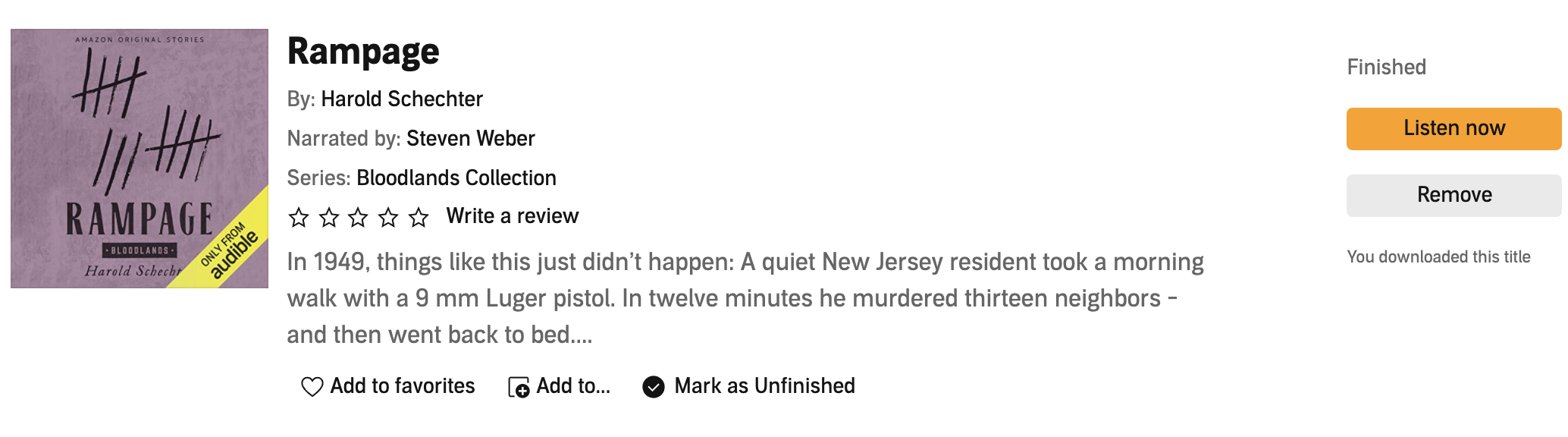
Rampage by Harold Schechter, Narrated by Steven Weber

Rampage is the story of Howard Unruh, a man who, in 1949, would murder thirteen of his neighbors (and people passing through his neighborhood) before returning to his apartment and returning to bed because he’d run out of ammunition. As the killer himself indicated during an interview, he’d have killed a thousand if he’d had sufficient ammunition.
Repressed homosexuality, experiences during the conflict of WWII, and assorted petty grievances against his neighbors simmered for years until finally exploding in a cold, meticulous series of killings that would thoroughly destroy the relative peace of Camden, NJ.
Considered the face of modern mass murder, Unruh had no apparent interest in committing suicide at the end of his bloody rampage, nor any plan to be killed by the police. He simply wanted to kill the people he perceived as being aligned against him or of having committed one slight or another, and once Unruh started, he didn’t seem interested in stopping until he had no choice but to do so.
The descriptions of the murderer’s flat affect and calm demeanor both during the rampage and during the subsequent questioning, while a bullet remained lodged in his thigh, were unnerving in a way I can’t quite put into words.
Steven Weber’s narration was as high quality as it has been for the rest of the Bloodlands stories, and I would love to hear him narrating further true crime audiobooks and even documentaries.

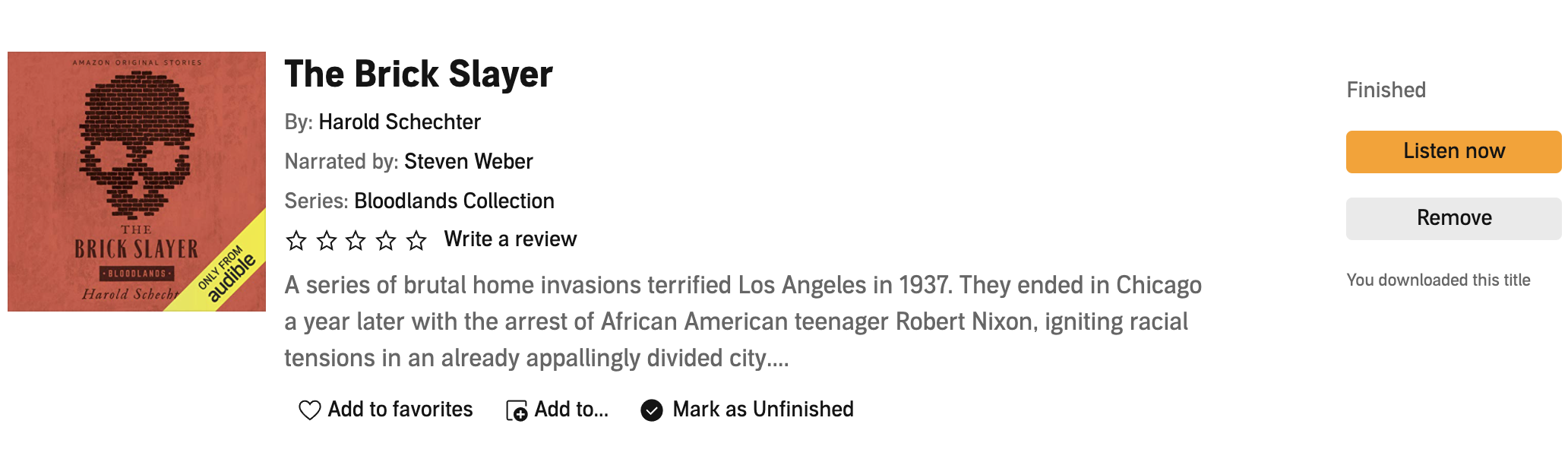
The Brick Slayer by Harold Schechter, Narrated by Steven Weber

The Brick Slayer provides us with an in-depth study of a series of home invasions and killings that transpired in Los Angeles and Chicago in the late 1930s. The title comes from the killer, Robert Nixon, using bricks to incapacitate the victims.
As interesting as the crime details might be, the vastly more interesting component of this particular narrative is the focus on the trial and the socioeconomic elements that contributed to the conditions of Robert Nixon’s life. It’s fascinating to think that Richard Wright’s Native Son was largely inspired by the circumstances surrounding Robert Nixon’s admittedly reprehensible acts and the reaction of those in law enforcement and the media to such horrific crimes committed by a young African American man. The barely suppressed racism of 1930s America seemed to be on full display throughout the investigation and subsequent trial, but it’s the more subtle and insidious racism of American culture that may very well have set Nixon down the path he ultimately found himself traveling.
Schechter’s insightful case studies are always profoundly interesting, but this one perhaps more so than many others, simply because of the tangential aspects of the society and culture at large during the years when these things took place.
Steven Weber’s narration is superb and well-suited to the Style of Schechter’s writing.

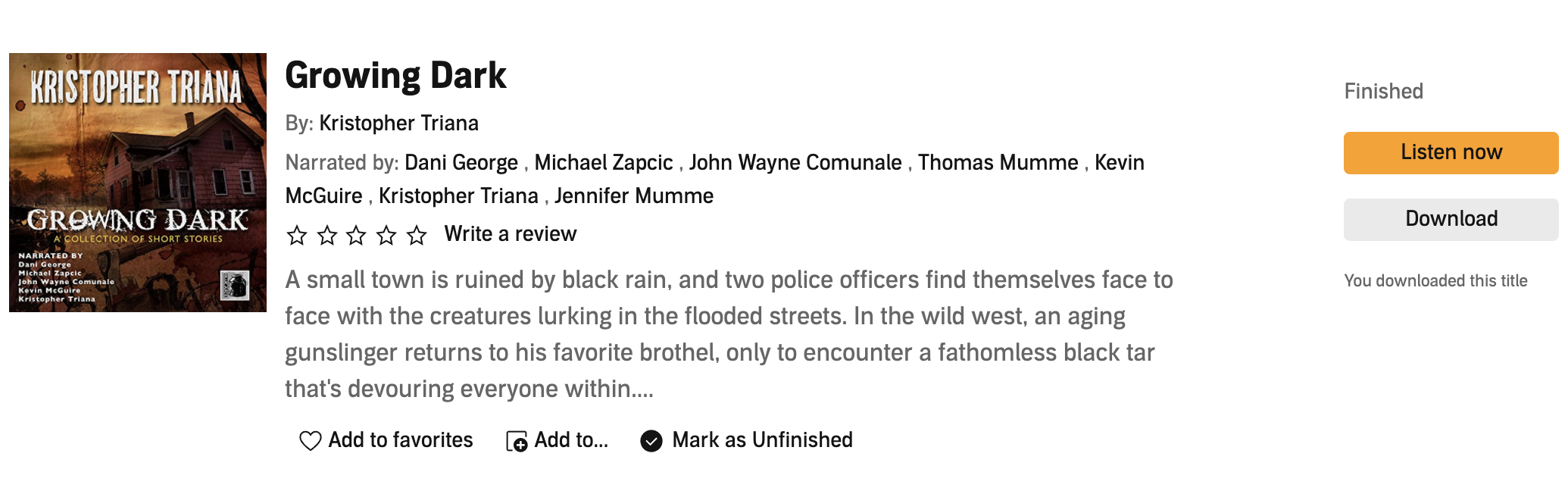
Growing Dark by Kristopher Triana, Narrated by Kristopher Triana, Dani George, John Wayne Comunale, Michael Zapcic, Kevin McGuire, Thomas Mumme, and Jennifer Mumme

Growing Dark truly showcases the eclectic range Triana is capable of in a way a reader would otherwise only discover if they took the time to read half a dozen books. Running the gamut from intense cosmic horror to something that could be considered kid-friendly, there’s no doubt any lover of dark fiction will find something to love in this short collection.
From the Storms, A Daughter kicks everything off, sharing the story of a town that’s been going through hard times, and they’re only getting harder as the region gets flooded. First responders in boats are struggling to locate stragglers to take them to safety, but what they find instead is evidence that there’s more to fear than the water.
Eaters is a post-apocalyptic excursion into the remnants of the old world, as a small party of hunters is clearing the area of zombies. As with most tales like that, things don’t go smoothly. Triana manages to bring some originality to the topic, and an ending that readers/listeners are unlikely to see coming.
Growing Dark is a coming-of-age tale gone wrong, as a farm boy surrounded by sickness and decay desperately wants to prove to his father that he can be a man. Sometimes being a man involves making some hard choices, and sometimes they’ll be bad choices as well.
Reunion is an insightful story of childhood regrets and how the mistakes we make can haunt us well into adulthood, altering the courses we travel and where we ultimately end up.
Before the Boogeymen Come was the most surprising inclusion in this collection. Triana entertains readers as he breathes life into the monsters who plague the imaginations of young children before media and experience provide new monsters to replace the old.
The Bone Orchard is a heartbreaking western tale that could be read, depending on the reader’s perspective, as being either pro-life or pro-choice in its message. An old shootist returns to an old haunt and old love, only to discover there’s a sinister secret behind keeping the brothel running smoothly.
Soon There’ll Be Leaves is a character study framed by multiple horrors, the most potent of which being reflection on a life not well-lived and the looming loss of family. Returning to a place he’d sooner never see again, our protagonist is approached by an old flame who proves the adage that one can never go home again, as an attempted affair takes an unforeseen twist.
Video Express is a nostalgic exploration of the video rental stores of our youth and condemnation of how we quickly turned our back on the family-run establishments in favor of places where we could easily snag the newest titles.
Giving from the Bottom is another character study, this time focused on the horrors of everyday life and the gradual erosion of both one’s ability to care and one’s will to live when nothing seems to turn out as expected.
The collection ends with the strangely epic Legends, a vision of an afterlife that is not at all what one might expect. In Triana’s captivating narrative, we discover that the dead–if they’re famous or infamous enough–become eidolons of a sort. Charles Bronson and Lee Marvin come together as paragons of what generations of moviegoers and fans imagined them to be, and as such, they are bestowed with purpose and power to protect the world from infernal entities who may have similarly familiar faces. For me, Legends was the best of the whole collection, providing a glimpse into a world I could see the author fleshing out into a much longer piece.
The narrations provided by Dani George, John Wayne Comunale, and Kristopher Triana himself were the best of the bunch. Triana especially did an excellent job of providing his characters with distinctive voices, and in the case of Before the Boogeymen Come a level of caricature that was enjoyable. The additional narrators, Michael Zapcic, Thomas Mumme, Jennifer Mumme, and Kevin McGuire were satisfying as well, just not as memorable as those provided by the three previously mentioned.

My Best Friend’s Exorcism by Grady Hendrix

My Best Friend’s Exorcism is a nostalgia-packed excursion into the life of adolescent girls in the 1980s. We meet Abby and Gretchen when the girls are in fourth grade, as Abby attempts to celebrate her birthday party at a roller-skating rink. Alone with her family, Abby fears no one will show up, but the strange new girl from school appears. What begins as an awful experience for the birthday girl develops into the best friendship either of them could hope for.
We’re provided with snapshots of the friendship between these two girls throughout the narrative, the bulk of the story devoted to character development.
The meat of the story picks up when the girls are in their Sophomore year of high school at the prestigious Albemarle private school. They’re near the top of the class, and they have bright futures ahead of them. That’s when everything changes. Abby finds herself helpless as she watches Gretchen changing into someone she no longer recognizes, and everything becomes a dizzying nightmare of lies and manipulation that she struggles to navigate while learning that there’s more going on than she can easily comprehend.
As a story about friendship and coming-of-age, it’s pretty fantastic, really delving into what it means to be best friends from childhood. As a horror or thriller story, it falls well short of the mark. I have the same issue with this Hendrix novel as I had with The Final Girl Support Group, in that the story grows tedious before it truly begins to get to the point where anything is happening that propels the narrative forward. Much like that novel, when this story starts getting good, it gets great, but it takes an awfully long time getting there. There are points when it appears to be picking up speed, only to revert to a meandering, detail-filled exploration of Abby’s day-to-day life, and it was challenging to make it through those intervals.
The narration provided by Emily Woo Zeller brings this story of youth and friendship to life in a way that it desperately required. Her performance of the various girls, notably Abby and Gretchen, was terrific. The voice provided for Christian (The Exorcist) was amusing and captured the absurd, muscle-bound character in such a way as to make him almost feel real. The audiobook edition of this novel made an otherwise unsatisfactory experience a much better one, and that is due entirely to the quality of the narration provided.

Billy Silver by Daniel J. Volpe, Narrated by John Wayne Comunale

Billy and Jeannie are definitely not Jack and Diane. They’re not the sort of couple Mellencamp would immortalize in song. It’s more likely they’d be immortalized by a band like Cannibal Corpse, preferably before the departure of Chris Barnes.
Billy Silver is a junkie and an alcoholic, a guitarist and singer, and an all-around degenerate. Despite all of his flaws, and there are many, he’s also captivating and occasionally funny. Within the first few pages, you’ll come to loathe him. That sensation never quite disappears, even as you begin to feel a small amount of sympathy for him along the way.
With his life falling apart even worse than it already had, Billy finds his way into a tattoo parlor where the mysterious Talia pays him to obtain a new piece of ink under the pretense of needing practice before the shop officially opens. It doesn’t take long before Billy’s self-destructive nature takes on an altogether more horrific and direct manifestation.
Daniel Volpe captures Billy and the other characters who populate his dingy, filth-riddled corner of existence with such detail that you can almost smell the halitosis and urine as the story carries you along.
Volpe brings the streets and back alleys of the city to life in crushing, grimy detail that is further enhanced by the narration provided by John Wayne Comunale. These two men together provide us with something as splendid as it is awful. I’m glad I’ve snagged more audiobooks narrated by Comunale because he is not only an excellent writer but a truly amazing narrator.

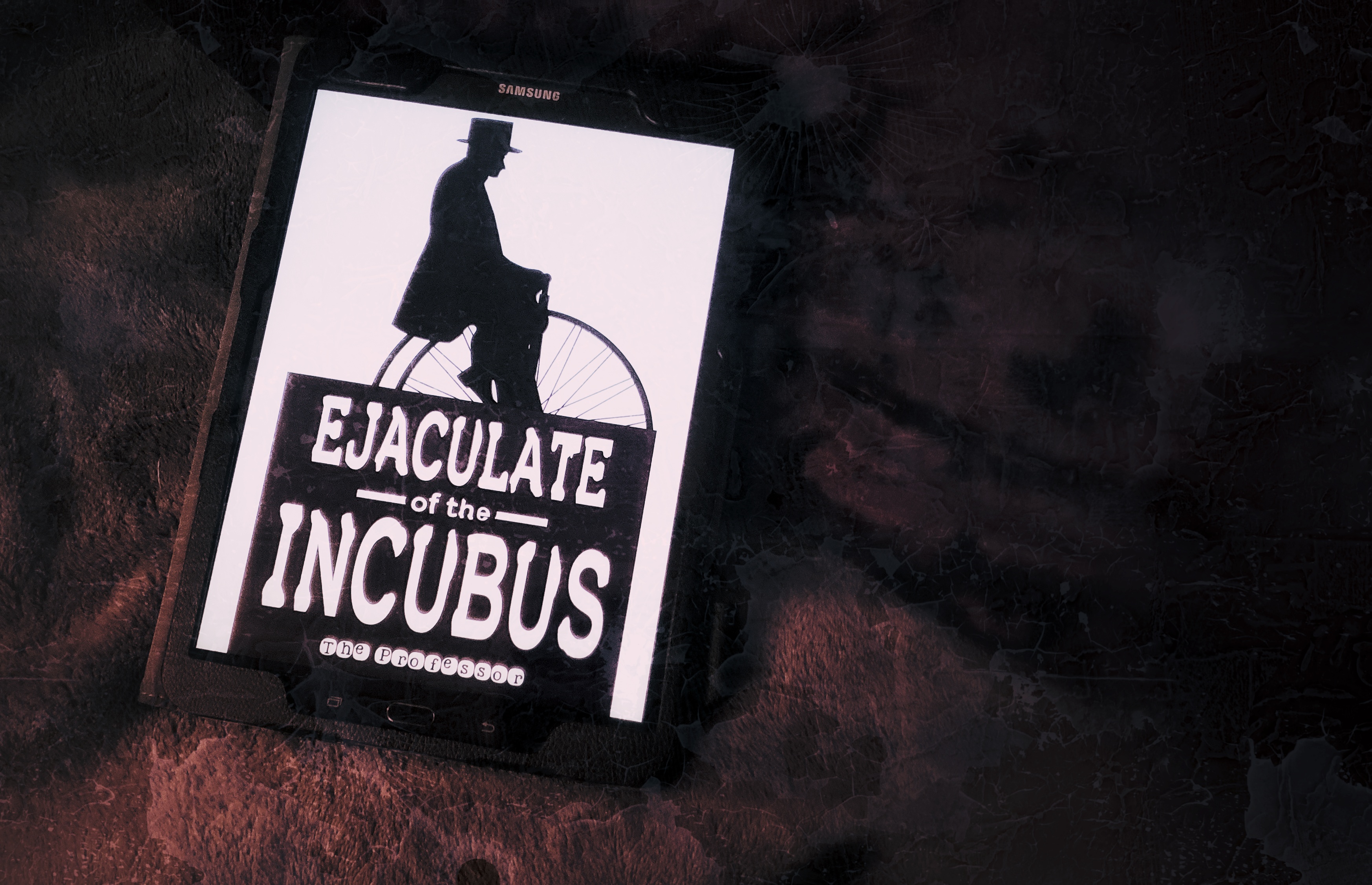
Ejaculate Of the Incubus by The Professor

Oh dear me, Professor, dear me.
I began Ejaculate of the Incubus with high expectations brought on by the, quite frankly, stellar performance during KillerCon 2021 of a separate, though no less graphic and revolting tale. As you can probably ascertain, I was most assuredly not disappointed.
This lovely tale starts as an unnamed narrator meets with an old friend, Professor Roberts, for tea. Anticipating some minor transformation resulting from Roberts returning from his recent honeymoon, our narrator is taken aback by a far more startling and peculiar metamorphosis having taken place. A prim and proper, detached and naive gentleman no more, Roberts displays a wild-eyed intensity and disheveled condition as he begins to recount recent events.
It was the honeymoon between Roberts and his bride, Lily, at an old monastery on the Sussex coast, that led them to discover a peculiar metallic object buried in the sand. Returning to their lodging, they caught a glimpse of a strangely proportioned man emerging from the surf, and they hurried to the security of human habitation. Upon inspection of their discovered object, Roberts discerned graphic depictions etched onto the surface that shocked his puritanical sensibilities.
This is where the story truly blossoms into something altogether peculiar, blending eroticism and revulsion into a dizzying melange of fluids both human and infernal.
The author, publishing under the nom de plume of The Professor, provides us with a deliciously vile story that lends sophisticated use of language and eloquence to acts of sexual depravity one typically finds when perusing the Urban Dictionary or Reddit forums. To say that I was impressed would be an understatement. I knew to expect something magnificent from this author, and I was still blown away.
The audio narration of the same work, provided by the author, is a fantastic experience that adds a different nuance and enjoyment to the experience. I’ll be eagerly awaiting any new material from The Professor.

This title is available as part of the 31 Days of Godless event at http://www.godless.com for October of 2021. You can obtain this for yourself by going to the website or downloading the app for your mobile device. The link is below:

Aliens: Infiltrator by Weston Ochse, Narrated by Bronson Pinchot

I don’t know when–or even if–I’ll have a chance to play Aliens: Fireteam, but listening to the audiobook for Weston Ochse’s Aliens: Infiltrator certainly sets the stage for a fascinating and original action/horror gaming experience. If I never get around to playing the game, it won’t be for lack of interest, and it certainly won’t be due to this book disappointing me.
The protagonist, Dr. Hoenikker, serves as a cipher of sorts, the lens through which we experience the introduction to the Weyland-Yutani scientific facility. While there’s ample character development across the board, Hoenikker being the newest member of the scientific team provides us with a great opportunity to experience everything through a fresh set of eyes. With his military experience, Ochse does a fantastic job bringing the supporting cast of characters to life, particularly the former Colonial Marines on staff at Pala Station.
With Murphy’s Law in full effect, Dr. Hoenikker joins the crew of Pala Station just as an infiltrator begins a campaign of corporate espionage. As with the real world, this relatively small trouble of spying and theft escalates in a cascade effect that explodes into an utter nightmare by the conclusion. Laboratory experiments go horribly wrong, communication breaks down, and everything falls apart.
Experimenting with what we’ve come to think of as the black goo from the Alien prequel films from Ridley Scott, we encounter some interesting and dangerous creatures produced from the local fauna, potentially more deadly than the Xenomorphs we’ve all come to know and love. This being an Alien novel, of course, there are Xenomorphs in the mix, and we get further exposure to how the black goo can modify the outcome of the genesis taking place.
Bronson Pinchot’s narration is sufficiently skilled that the characters almost always sound distinctly separate and discernable as individual actors in the narrative playing out. I especially enjoyed the performance for Rawlings, who I couldn’t help but picture as an African American Matthew McConaughey. The only instances where Pinchot’s narration failed was concerning female characters, but I’ve heard worse over time.

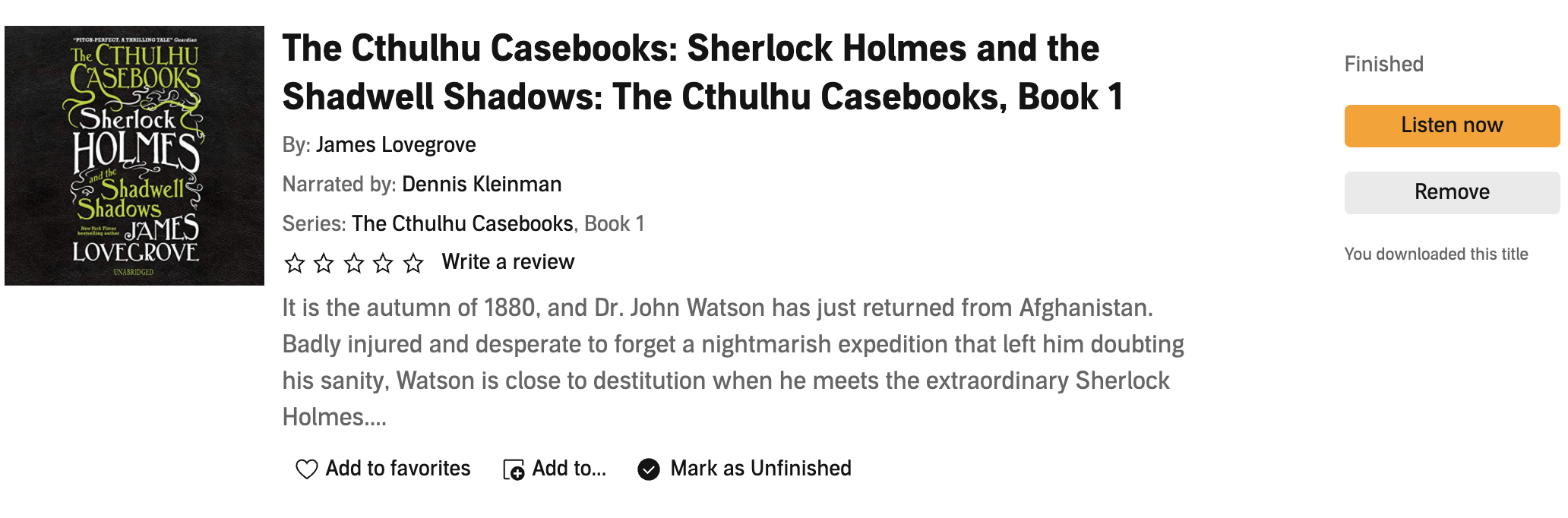
Sherlock Holmes and the Shadwell Shadows by James Lovegrove, Narrated by Dennis Kleinman

James Lovegrove writes himself into the narrative with The Cthulhu Casebooks, in a fictionalized account of his own life in the preface to this tale. As a distant relation to the former H.P. Lovecraft, a parcel finds its way to him upon the passing of another member of the Lovecraft family.
Contained within is a trilogy of manuscripts penned by Dr. John Watson, confidant and partner of Sherlock Holmes. In the tale that unfolds, we learn that the meeting of Watson and Holmes did not transpire as we’ve come to believe. Additionally, further elements of Watson’s previously available documentation of the cases he and Holmes investigated have been fictionalized to protect the world from forbidden knowledge of things best left unknown.
From the deserts and mountains of Afghanistan to long-forgotten catacombs beneath London, a global tale of unspeakable horror emerges. Upon meeting one another, Holmes and Watson find themselves in pursuit of answers to a rash of ritualistic deaths occurring during the new moon. What they discover will leave the pair, as well as other familiar characters from the Holmes’ archives, changed in ways never hinted at within the released accounts from Watson.
All-in-all, this was a worthwhile mixture of the Lovecraftian mythos and the characters developed by Sir Arthur Conan Doyle. The writing style emulates Doyle’s prose surprisingly well, and the insertion of creatures like Nyarlathotep and Cthulhu into the narrative was performed seamlessly. The story itself didn’t impress me quite as much as I’d hoped, but it was decent enough to nudge me toward checking out the additional two volumes in this series.
Dennis Kleinman’s narration of Watson was quite fantastic, as was his performance of Holmes’ dialogue. Sadly, the other characters felt perhaps a bit less set apart from the background. This is not to say that they weren’t distinct enough to tell them apart, because he managed that quite well, just that they weren’t brought to life in quite the same way the two protagonists were.

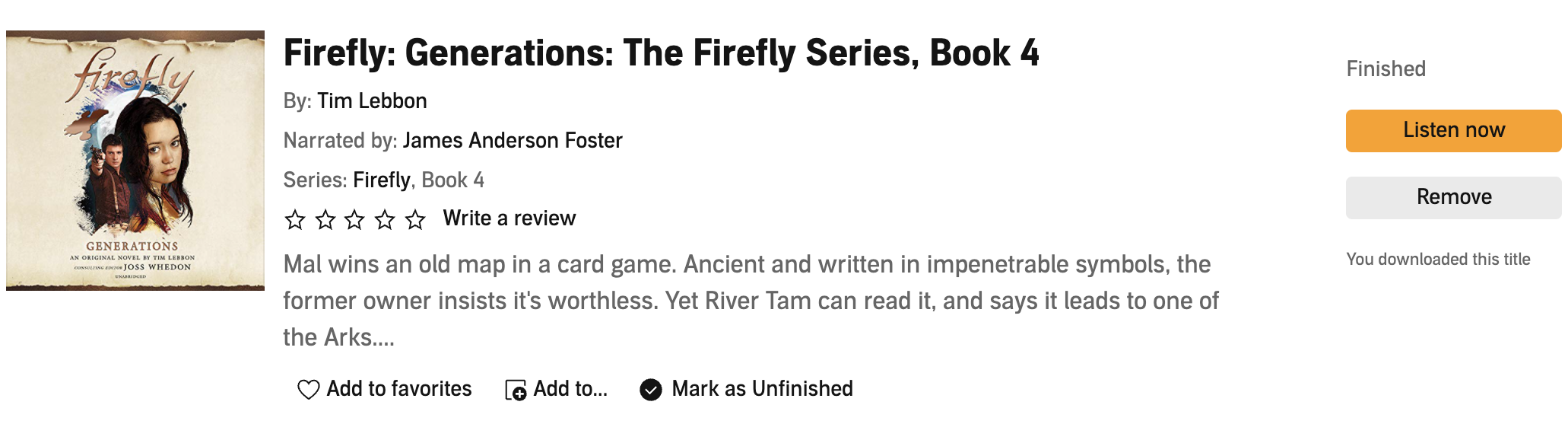
Firefly: Generations by Tim Lebbon, Narrated by James Anderson Foster

Firefly: Generations begins with the story of a map. This star map changes hands many times, through treachery or happenstance, but this is no mere map, and those who take it into their possession seem to somehow recognize that fact without being fully conscious of it.
The truth of the map only reveals itself when it finds its way into the hands of River Tam, where hidden machinery embedded in the material activates. From there, we find ourselves following most of Serenity’s crew into the outer reaches of the verse, where deadly secrets await them amidst an awe-inspiring relic of the history before mankind reached their new homes on the planets and moons the Firefly crew is familiar with.
This novel falls somewhere after the prematurely canceled television series, though before Inara and Book had permanently left the crew and retired to the locations where we meet them again in the movie Serenity.
Tim Lebbon takes the helm in this fourth Firefly novel, telling us a story that fills in gaps in the mystery that is the life of River Tam, the secret experiments conducted by Alliance scientists, and the centuries-past journey from Earth that was. Generations is a far different tale than those contained in the three previous Firefly novels, focusing on the more science fiction elements of the property rather than on the land-based adventures of the crew. It’s a nice transition, receiving this glimpse into the less western-themed exploits of Serenity and the family that calls her home.
Foster’s narration seems only to be improving with each subsequent audiobook release. As he more firmly captures the nuances and patterns of speech for the individual characters, one could almost close their eyes and envision the cast playing their parts.