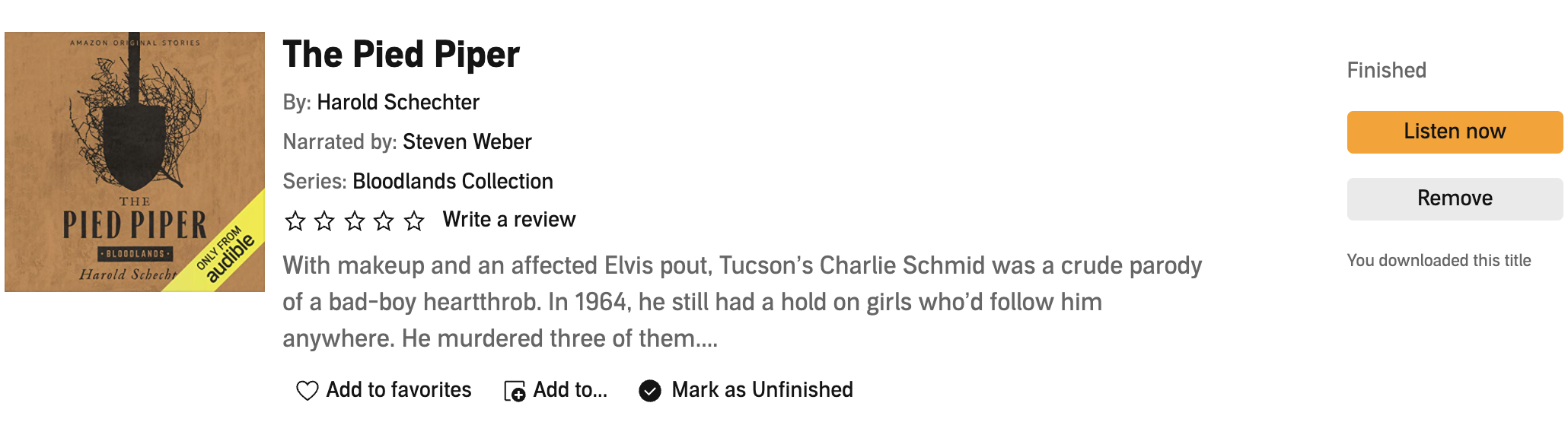
Harold Schechter’s The Pied Piper tells the sordid tale of Charles ‘Smitty’ Schmid, Jr., The Pied Piper of Tuscon. A strange, diminutive man, Schmid developed a carefully crafted bad boy image and a demeanor reminiscent of Elvis Presley that aided him in drawing attention and devotion from other loners and outcasts. With the assistance of two of these friends circling in his orbit, Schmid committed his first murder in 1964. He didn’t stop there, murdering two sisters only a little over a year later. Bragging about these killings whenever the occasion arose, he displayed neither shame nor remorse over what he’d done. Schechter’s portrayal of Schmid and his friends is less than flattering, though much of what he shares seems to be descriptions of these people from either Schmid himself or others in his circle or involved with the case. It’s interesting to see so much detail packed into such a short narrative, and it was fascinating to learn more about one of the lesser-known serial killers from the annals of American criminal history. Steven Weber provides terrific narration, proving again to be articulate and eloquent in his delivery of the story.
Harold Schechter’s Panic showcases an early American example of moral panic, mass hysteria, and pattern recognition gone horribly awry. This well-researched narrative begins with details of a tragic event, the result of the sort of irrational, hysterical panic arising in the 1930s surrounding the fear of child rapists and murderers surging across the American landscape. One father’s need to protect his daughters from a danger he perceived as being right around the corner erupts in a disastrous and heartbreaking conclusion. From that awful event, Schechter traces backward to the small number of isolated incidents that had been blown up and made to seem like part of a growing trend. Each of these individual cases was certainly terrible, but they were hardly part of a nationwide surge in that sort of criminal activity. Looking at the world we live in today, one can see that we haven’t grown beyond this sort of outrage-driven crusade where we perceive the boogeyman du jour in every shadow. Steven Weber’s narration is perfectly suited to this gripping non-fiction essay. I’m pleased to see that he continues to narrate other short samples of Schechter’s larger body of work contained in Bloodlands.
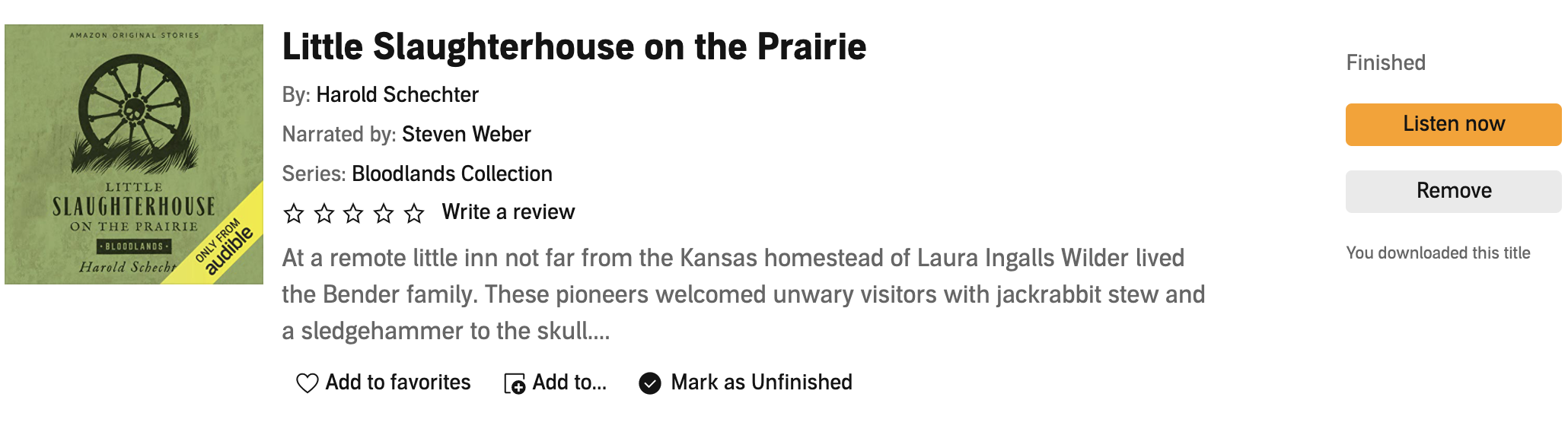
Little Slaughterhouse On the Prairie shares the story of the Bender family, contemporaries of Laura Ingalls Wilder’s family in Kansas during the late 1800s. A family of serial killers operating an inn in the remote, seemingly endless fields and plains of Kansas, the Benders were responsible for an unknown number of missing persons. Like something out of the fictional Splatter Western tales published by Death’s Head Press, the Benders were a monstrous family. Inviting guests into their inn for dinner and sleeping accommodations, those guests would frequently be greeted with a sledgehammer to the head before being further mutilated, robbed, and disposed of on their sprawling homestead. Men, women, and children alike fell victim to the predations of the Bender clan. The mystery of where the Benders disappeared, and what might have happened to them as they evaded justice was the primary focus of this narrative. Unfortunately, Schechter doesn’t seem to have any answers, even after all of his research. Ultimately, we’re left with more questions as multiple theories are proposed, some more appealing than others. Steven Weber’s narration is, again, fantastic. His delivery of these gruesome, historical details is satisfying and articulate.
It’s been a long time since I first read The Woods Are Dark. I was a teenager at the time. This version of the story is vastly different from the one I remember, but that’s probably because this is a different version of the narrative from the version I’d been exposed to back then. Forty years after it was published, it doesn’t hold up as well as some of Laymon’s other material, but it was still fun to listen to the audiobook edition and reacquaint myself with the story. Two groups of people stumble across the hideous secrets hidden away in the forests near the seemingly quaint town of Barlow, and their lives will never be the same again if they manage to escape. Neala and Sherri stop at the diner after a harrowing experience on the road, only to find the patrons are planning to serve up something off the menu. Lander, Ruth, their daughter, Cordelia, and her boyfriend, Ben, stop for the night at what they anticipate will be a peaceful set of cabins, but they soon discover they’ll never have a peaceful night of sleep again. Facing off against the murderous, inbred, cannibal Krulls, the two groups of victims and an unlikely ally find themselves in a life or death struggle in the woods. But the Krulls aren’t the only things lurking in the darkness, as there’s something even the monsters fear out there. None of this is pleasant or fun. This is not that kind of story, and Laymon was not that kind of author. This short tale contains graphic depictions of violence of all kinds, cannibalism, dismemberment, murder, rape, and pretty much every awful thing a reader might expect to find. Lander’s story is particularly awful and disturbing, showcasing an educated, well-read man descending into madness and depravity in no time at all. The trauma of the experience, the loss of loved ones, and the constant state of terror hardly seem sufficient to explain how one transforms from man to beast in such record time. This descent isn’t something unfamiliar to those who’ve read more of the author’s material. Laymon–as in much of his work–wanted to hint, not too subtly, that our pretense of civilization is more tenuous than we often fool ourselves into believing it to be. So, while it may be unrealistic and a bit absurd, it’s important to note that this is fiction, and Lander’s transformation is meant to be an extreme example, a caricature in a sense, of how primitive and bestial we are just beneath the surface. There’s a brief, passing reference in the narrative to Conrad’s Heart of Darkness (the basis for Apocalypse Now), and there are some intentional similarities to be found in The Woods Are Dark. Laymon knew exactly what he was doing when he crafted this story. The narration of the audiobook, performed by Bob Dunsworth, was not the best I’ve heard. Dunsworth has the voice of a radio DJ, with clear, articulate, annunciation, but there’s little more that I can say about him. He managed to make the characters distinct enough that nothing got confused or jumbled along the way, but his delivery was lacking in several ways.
The Final Girl Support Group is Grady Hendrix’s addition to the meta-slasher subgenre of literature. In some ways, this book succeeds in breaking new ground and adding a unique voice and commentary, though I couldn’t help but find the overall story disappointing. While I found the writing/narrative style of The Last Final Girl jarring and occasionally disruptive to my enjoyment, I would recommend either that or My Heart Is a Chainsaw, both by Stephen Graham Jones, over The Final Girl Support Group. If you’ve already read and enjoyed those two books, there’s no harm in checking this one out. The best element of this novel is the commentary on slasher fiction provided by the author. Hendrix infuses the narrative with critiques on the latent misogyny involved in slasher films, the unhealthy obsession with serial killers, violence in society, and the psychological effects of trauma. Shared via the unreliable narration of Lynette Tarkington, the survivor of the Silent Night Slayings (think Silent Night, Deadly Night), the narrative leads us along in a stuttering, stumbling adventure. We experience a world where alternate versions of the slasher flicks that defined–and redefined–the genre were based on real people and events. The survivors of these massacres make up the titular Final Girl Support Group; Adrienne (Friday the 13th), Marilyn (Texas Chainsaw Massacre), Dani (Halloween), Heather (A Nightmare On Elm Street), and Julia (Scream). After Adrienne’s murder and an attempt on Julia and Lynette’s life, Lynette finds herself unable to remain in the false safety and security of her life of isolation, obsession, and paranoia. She was never as safe as she believed herself to be, and she’s convinced that her sister final girls are in danger as well. But will anyone listen to her? Is there a conspiracy to slaughter all of the final girls, or is Lynette jumping at shadows that exist only in her traumatized mind? Will the truth be revealed before it’s too late? The twists are nothing readers won’t see coming, whether by design or not. Readers will find themselves wanting to shout at the pages–or along with the audiobook–the same way viewers shout at the screen, screaming for Lynette to put the pieces together correctly as we helplessly watch her fumble and chase red herrings. The audiobook was narrated by Adrienne King, the final girl from Sean Cunningham’s Friday the 13th. There perhaps couldn’t have been a better choice of narrator, as one of the first final girls of film history and someone who experienced real-life horror in response to that role. King brings Lynette to life in a way no other narrator probably could as well as successfully tackling the voices of the supporting characters.
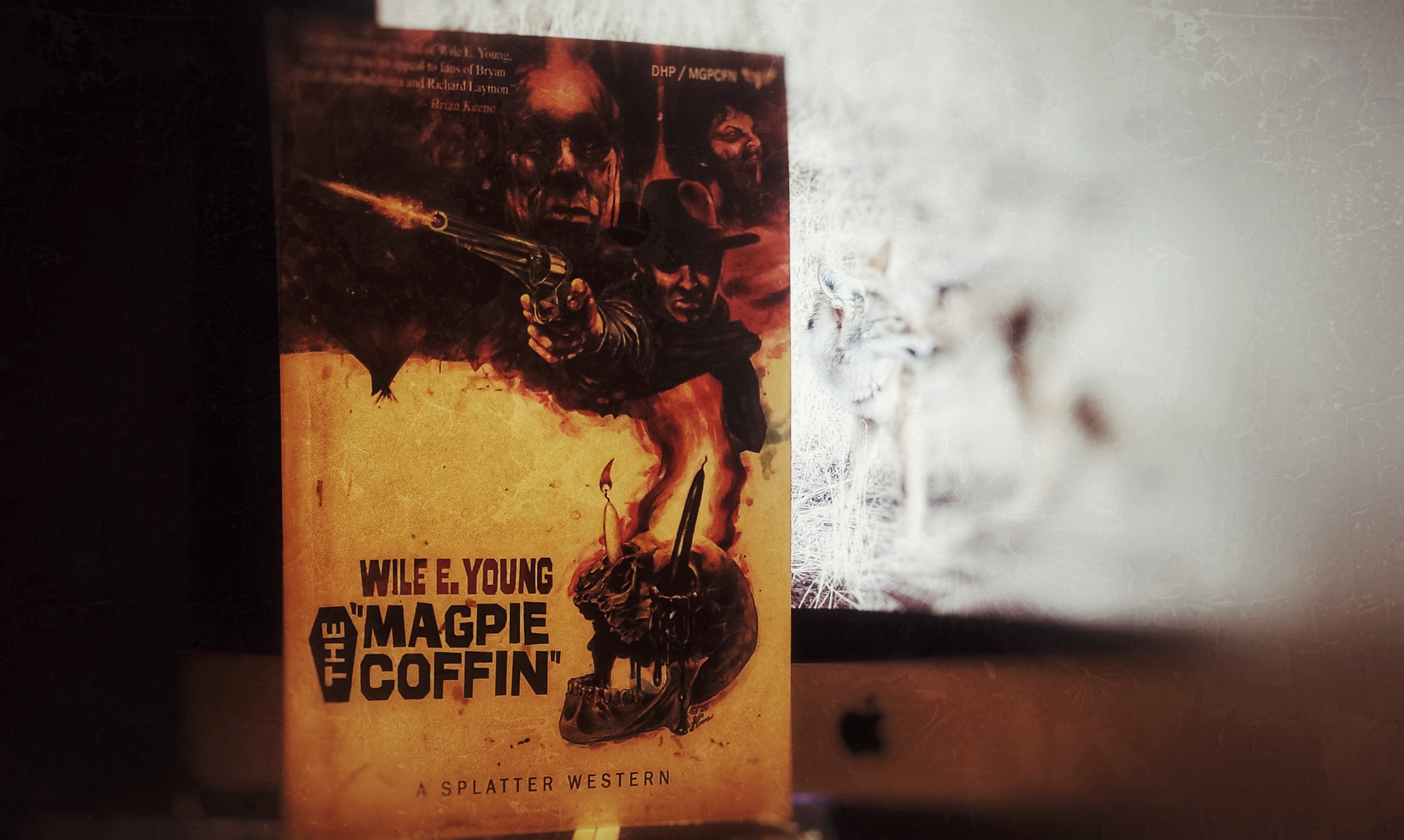
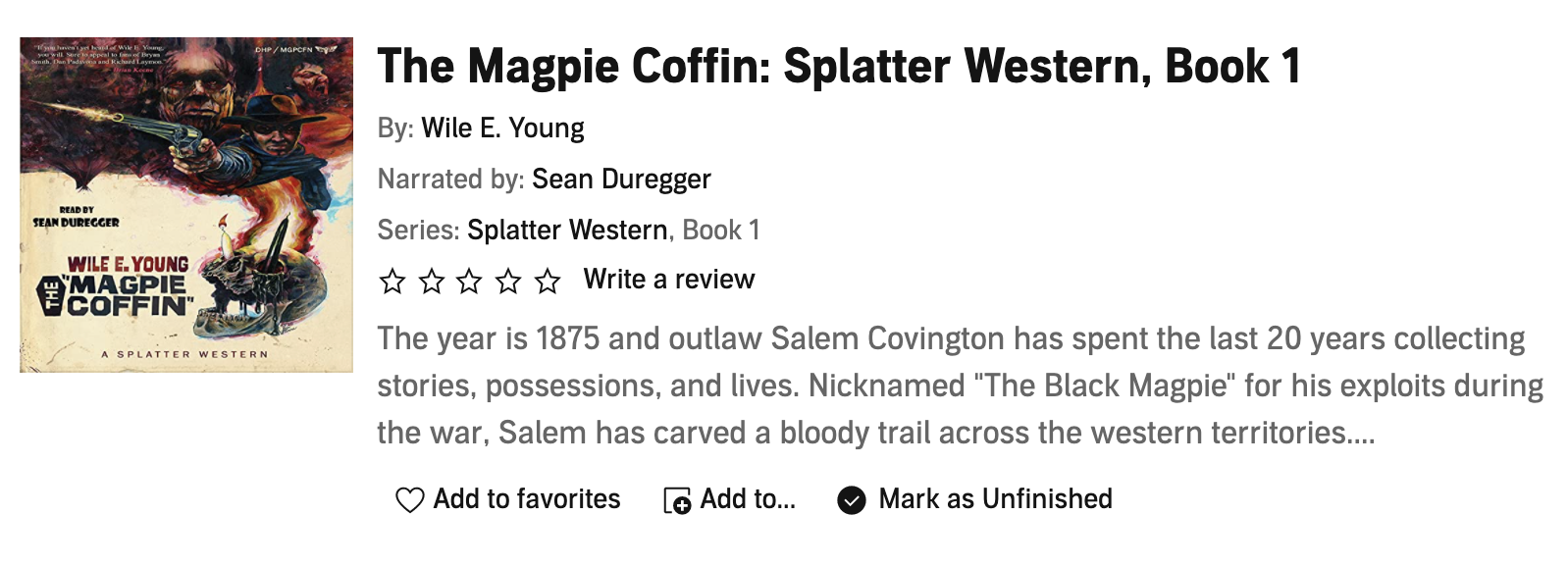
Wile E. Young paints a grim portrait of the postbellum American west, replete with magic and mystery. In this shadow permeated version of the wild west, the author spins a tale that fuses horror and fantasy with otherwise familiar tropes and western motifs. It would be impossible to talk about The Magpie Coffin without first spending some time introducing the protagonist of this amazing Splatter Western. Salem Covington is a riveting character. One can think of him, in the simplest terms, as being equal parts Jonah Hex, a wild west incarnation of Dexter Morgan, and a little bit Elric of Melnibone–substituting a pistol for the sword, Stormbringer. A student of dark magic from various sources and cursed with the need to kill for the sake of his own damned soul, Mr. Covington is far from a heroic figure. There is a strained and rigid nobility to him, though. As with most antihero characters, he has a code of sorts that guides his actions. Upon discovering that his old Comanche teacher, Dead Bear, has been murdered and that a white buffalo has been slaughtered by the same band of killers, Covington sets out on a quest to bring down everyone involved. Enlisting the assistance of one of the men associated with the killing, his pursuit of vengeance carries the reader through the Dakota Territory and into the Rocky Mountains of what would soon become Colorado. Leaving a trail of bodies and tortured souls in his wake, Salem Covington chases quarry who might just be too dangerous for even The Black Magpie to overcome. My only complaints with this book are present because I happen to be a South Dakota resident. North and South Dakota didn’t become states until 1889, and Deadwood is nowhere near North Dakota, sitting approximately 130 miles South of the North Dakota border. But, considering how few people seem to recognize that North and South Dakota exist at all, it’s not exactly a deal-breaker. The narration by Sean Duregger for the audiobook is fantastic, capturing the grit and cruel nature of Salem Covington with a degree of authenticity that felt right. The narrative, being shared by Covington in first-person, making it simple to distinguish the voices of secondary characters without any trouble.
The Ghoul Archipelago takes us on quite the adventure. On the high seas, to the islands of Southeast Asia, we experience a region of the world unfamiliar to many of us. Kozeniewski populates his near-future vision of the exotic environment with smugglers, pirates, island tribes, missionary religious fanatics, a smug computer programmer and inventor, and, of course, zombies. We’ve witnessed zombies all over American and Europe, the cities of Asia, and the islands of the Caribbean. Stephen Kozeniewski takes us to a novel location where we can witness the collapse of civilization and the rise of the undead, somewhere it’s less apparent that the rest of the world is gone. At the core of this story, we see the same sad commentary on human nature fans of the subgenre should be familiar with. No matter where we are in the world, it would appear that we’re always too preoccupied with petty squabbles and power plays to focus on the survival that should be the unifying goal under such dire circumstances. As depressing as it might be, the author probably isn’t far off from the truth of it all. Skirting through a gauntlet of pirates on the payroll of a billionaire still fixated on profit, adherents of a Christian death cult, and a megalomaniacal naval commander are Henk Martigan and his crew of smugglers. Will anyone make it through Kozeniewski’s tale alive, or will monsters, both living and undead, grind all of the survivors into a meaty pulp of blood and viscera until only maggots thrive? It’s not easy to create an original story of the zombie apocalypse, but The Ghoul Archipelago is precisely that. Reliant on three-dimensional, believable, and even sympathetic characters, Kozeniewski propels the reader through scattered viewpoints as the adventure becomes far more than just a zombie story. Jennifer Fournier’s audiobook narration is excellent, especially when capturing shifts in cadence and accent from one character to another.
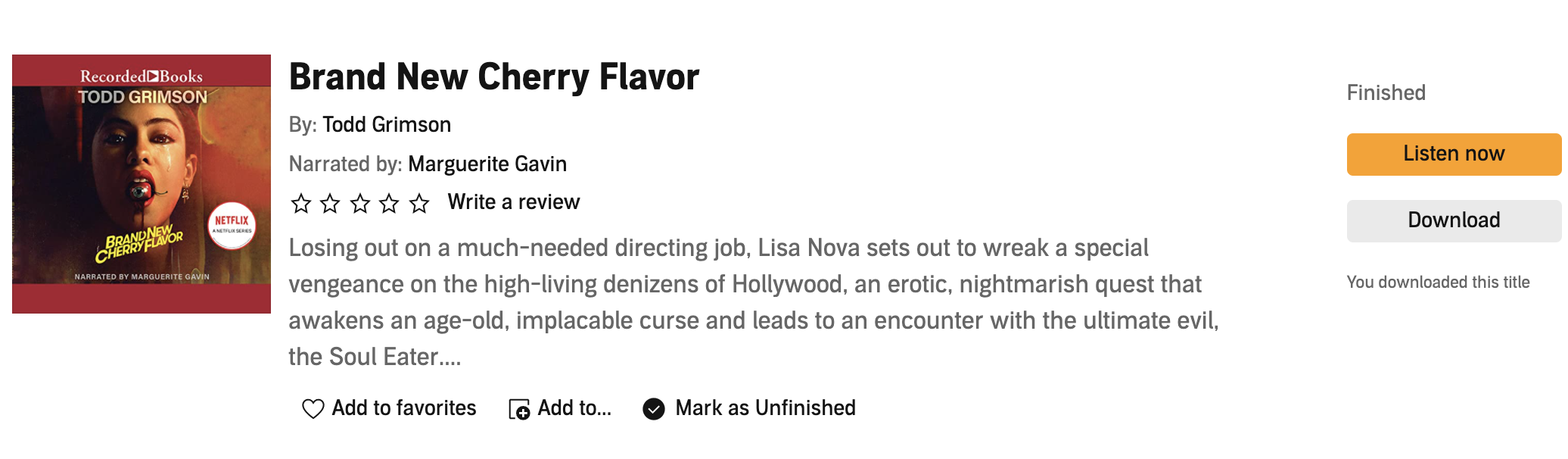
Brand New Cherry Flavor is a book packed with originality and uniqueness. There’s a potential within this story, a barely suppressed tension and horror seething just below the surface, that sadly never quite reaches fruition. My comment on wasted potential is not to suggest I didn’t enjoy the story because it was surprisingly enjoyable. I feel almost as though the lack of gratification or fulfillment was an intentional stroke by the author. Consider it a page from the Bret Easton Ellis playbook, metafictional and intentionally subverting the expectation of the readers. Lisa Nova is, for the most part, not a likable character. Throughout the narrative, she fluctuates between appearing vapid and slyly witty while perpetually coming across as shallow. Being unlikeable does not, however, make her unsympathetic. Witnessing as her life spins out of control with an increasing cost in collateral damage, it would be challenging to dismiss her plight. We join the tale just as Lisa’s passed over for a promised role as the Assistant Director on a major film project. This position had been promised to her by Lou Burke, the man she’d been having an affair with up until that point. As a concession, her now-former lover sends her to meet with people who will capitalize on her looks by paying her to star in a pornography adjacent film. Lou Burke, or as Lisa repeatedly refers to him, “Lou Greenwood, Lou Adolph, Lou Burke,” is a class act. He deserves to have a fork stabbed into his leg. Incensed, and seeking revenge, Lisa goes to her ex-boyfriend, Code, to inquire about a hitman she’d heard about through him. This leads her to Boro, and the rest of the story evolves in its phantasmagoric way from that interaction. Traveling from Hollywood to Brazil, from Brazil to New York, and from New York back to Hollywood, Lisa discovers that Boro has not only taken the job of destroying Lou Burke–and his family–but is also providing Lisa with the power to shape the world around her in ways many people could only dream of. Psychic tattoos, a mythological white jaguar, zombies (of the voodoo variety), drugs of all flavors and varieties, magical filmmaking, mirrors that show the past, and a garden of human limbs are only some of the more bizarre elements of this story. Though I enjoyed this book a good deal less than I would have liked, I can certainly understand the appeal it has for other readers/listeners. The audiobook narration supplied by Marguerite Gavin made the story more enjoyable than it might have been without such a competent narrator. She certainly managed to fully convey the character of Lisa Nova better than I think many narrators could.
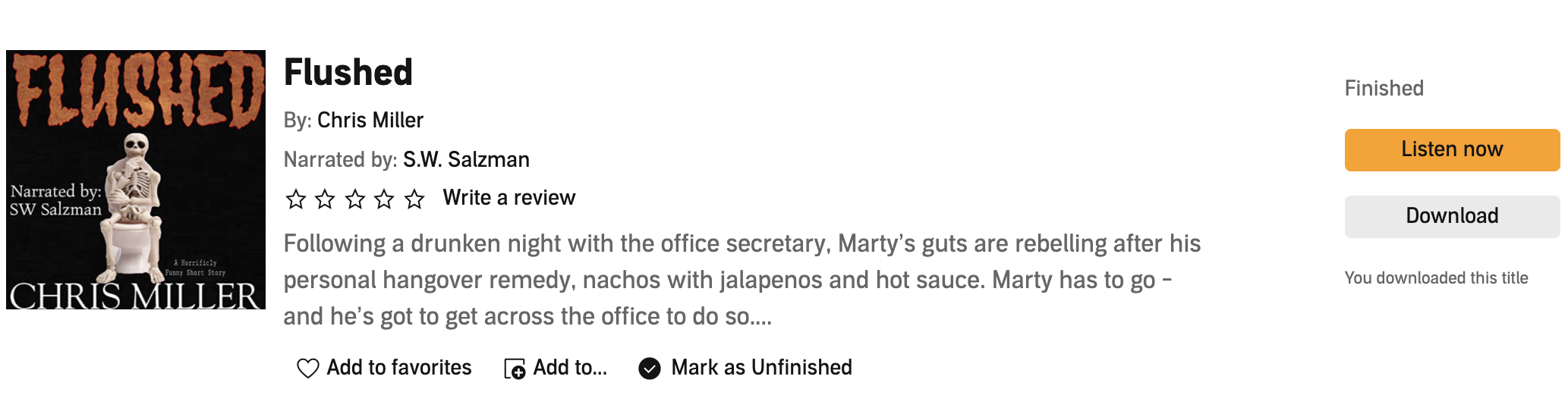
Chris Miller’s Flushed is short. I’d go so far as to suggest the value of giving this story a listen is inversely proportional to the size of the tale. What we have here is an uncomfortably–horrifyingly–relatable story of one of those times when we absolutely know our bowels are going to fail us in the worst possible way, at the most calamitous conceivable location, when the timing couldn’t be worse. While we all may not be able to relate to a drunken workplace hook-up with someone we’d sooner have avoided, I think we can all imagine how such a thing might happen. Miller tells an entertaining tale, increasingly implausible as Murphy’s Law takes a cruel toll on Marty. The narration provided by S. W. Salzman brings the extreme discomfort and humiliation to life.
The Bleed: Rupture is the beginning of something great, for sure. If the combined efforts of Mark Tufo, Chris Philbrook, and the always fantastic David Moody maintain this same sort of quality moving forward, this series will be spectacular. The three authors involved in this project successfully combine body horror, fantasy, and science fiction into something greater than the sum of the individual components. The individual stories meld together, creating a sweeping, epic tale of a multiverse in jeopardy as a race of gods and their halfbreed offspring fight a battle of attrition on one world after another against an unstoppable, all-consuming enemy, The Bleed. We get to experience the disastrous consequences of two gods with conflicting goals in modern-day London as Jenny struggles to come to terms with her heritage. We join the members of a lunar colony as their settlement faces catastrophic collapse. The small handful of survivors learn that there are secrets on the moon no one could have expected. And finally, we follow Arridon and Thistle, two half-gods, as their world approaches a horrifying end at the hands of a monstrous force that seeks to devour everything living and dead in absolute domination. As the stories tie together at the end in the most unexpected ways, I couldn’t help but want to move immediately on to the second volume in the series. The narration provided by Scott Aiello for the audiobook edition is fantastic. He tackles the cast of characters and their various accents better than many audiobook narrators I’ve heard.





 Domus Necrophagous