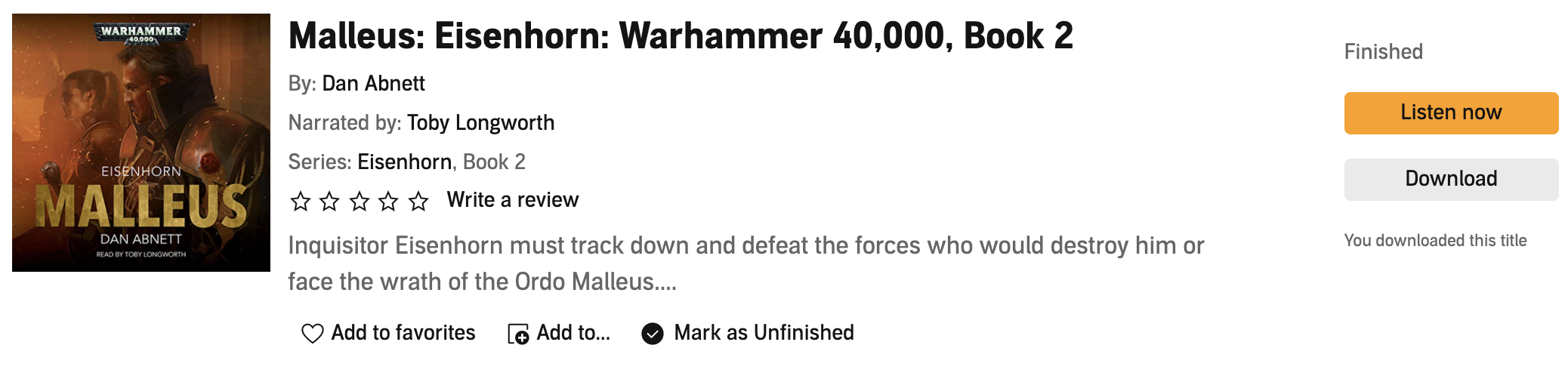
Eisenhorn Book Two: Malleus by Dan Abnett, Narrated by Toby Longworth

Gregor Eisenhorn, surrounded by a cast of characters both old and new, finds himself at the center of a vast conspiracy orchestrated, seemingly, by Cherubael.
Following a devastating attack on Thracian Primaris, events are set in motion leading Inquisitor Eisenhorn to one of two fates. Either Eisenhorn is escorted to the prisons of the Inquisition, where he’ll be branded a heretic and executed, or he locates the puppetmaster pulling the strings of far more sinister and powerful forces than any he’s ever faced, where the future of the Empire will be decided.
Dan Abnett seems to have skimmed over large sections of the narrative in this account of Eisenhorn’s legacy, sometimes going so far as to reference these other puzzle pieces without filling them in for us. Of course, upon reaching the climax of this tale, it makes perfect sense that a lot of those details are left out. There is, after all, a universe-spanning mystery to unravel, and providing the reader/listener with some of those other elements would give far too much away. It’s a shame, though, because it makes for a book that feels less evenly paced and complete than the previous installment of the series.
Though the events of Malleus certainly seem to be far more epic in scope than those of Xenos, something about the way they’re documented in this book makes them feel more condensed. This isn’t a flaw, but it was a peculiar thing I happened to notice.
The narration provided by Toby Longworth, as before, perfectly captures the grim, wry-humored tone of Gregor Eisenhorn in such a way that I can’t imagine him sounding otherwise. The voices provided for the additional characters are distinct enough–in most cases–to make the narrative flow smoothly.
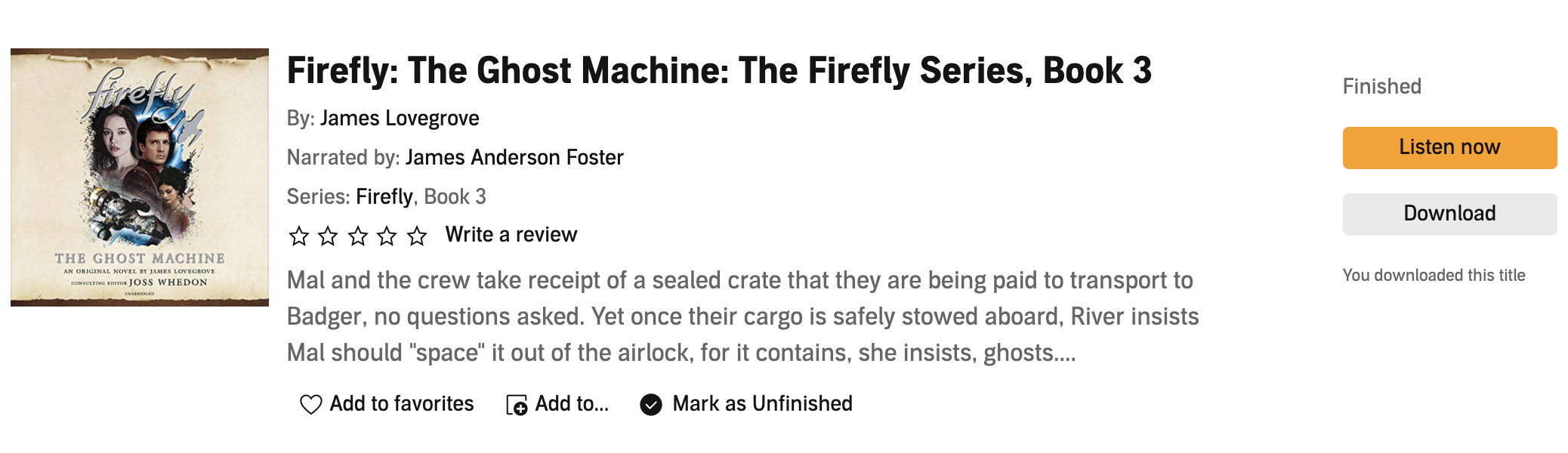

Firefly: The Ghost Machine by James Lovegrove, Narrated by James Anderson Foster

It was bound to happen, but I sort of hoped I would be wrong. Firefly: The Ghost Machine wasn’t the best of the tie-in novels following up the abruptly terminated Firefly series. I’m not suggesting it’s not a good story or that it’s something I’d recommend skipping over, but it wasn’t as good as the previous two books from James Lovegrove.
This third installment of the series of books filling in the gap between the Firefly finale and the continuation provided by Serenity falls into the interval after both Inara and Shepherd Book have left Serenity. The loss, relatively recent, leaves a discernable and tender hole in the lives of the remaining crew. Lovegrove’s writing succeeds in capturing that despondency without being heavy-handed about it.
At the request of Badger, the crew of Serenity heads to a distant location for recovery of a case containing an unknown device to deliver it to Badger for a client. Unhappy and unsettled by the lack of information provided–as well as Alliance patrols in that region of space–Mal determines he doesn’t like the deal and opts to pass on the money. The supplier doesn’t take kindly to Mal’s repudiation, and bullets fly.
Unbeknownst to Mal and the rest of the crew, Jayne sneaks the parcel onto Serenity, and everything goes sideways. The device was designed as a form of mind control and crowd suppression, triggering those in proximity to lapse into hypnogogic states. As the crew of Serenity finds themselves trapped in dreams they can’t rouse themselves from, River is the only one aware of the problem and hopes she’s capable of breaking her family aboard the firefly from their respective trances before it all ends in tragedy.
Naturally, we know they come through the other side since Serenity takes place…but we do catch glimpses into the dreams and nightmares of the remaining crew members along the way. Unfortunately, there’s not much more to the story than that.
As with the previous books, the narration from James Anderson Foster is spot-on. Aside from a full cast reading of the scripts, I don’t think they could have found a better narrator for these books.

Midnight Horror Show by Ben Lathrop: Narrated by Tee Quillin

A little backstory might be in order for this review.
This story is built around the old Screen Gems release of Universal horror pictures in syndication to television stations in the late 1950s. With the encouragement that the stations bring in a host to introduce the “Shock” and later “Son of Shock” pictures, Screen Gems helped to platform an industry, first popularized by Vampira, the original horror host on television. There have been many others along the way, including notable icons such as Vincent Price, Joe Bob Briggs, and Elvira. Midnight Horror Show captures a nostalgic snapshot of a time that’s lost in memory, turning it into something truly sinister, and telling a fantastic tale along the way.
With a series of unusual killings in the sleepy Iowa town of Dubois in 1985, Detective David Carlson finds himself thrust into the midst of an all-too-real horror show. Investigating the seemingly unrelated crimes, he encounters James West, a strange young man with a fixation on horror and heavy metal, soon to host his own horror show at a local drive-in with a dark history.
James’s obsession with a former television and drive-in host, Boris Orlof, brings Detective Carlson face-to-face with secrets and terrifying truths previously buried in the past. Confronting his own forgotten memories, a file of missing person cases from twenty years before, and the very real possibility that there’s more than simple movie magic taking place behind the scenes, Detective West finds himself fighting a ticking clock to solve the unbelievable mystery and save the young man he’s grudgingly befriended before Halloween night.
Midnight Horror Show is a captivating story that leaves you guessing what’s going to happen right up until the end. When you think you have a handle on what’s next, Lathrop manages to dodge your assumptions and veer off in a different direction.
The narration provided by Tee Quillin is fantastic and believable as he voices the assorted characters populating the tale with seeming ease.

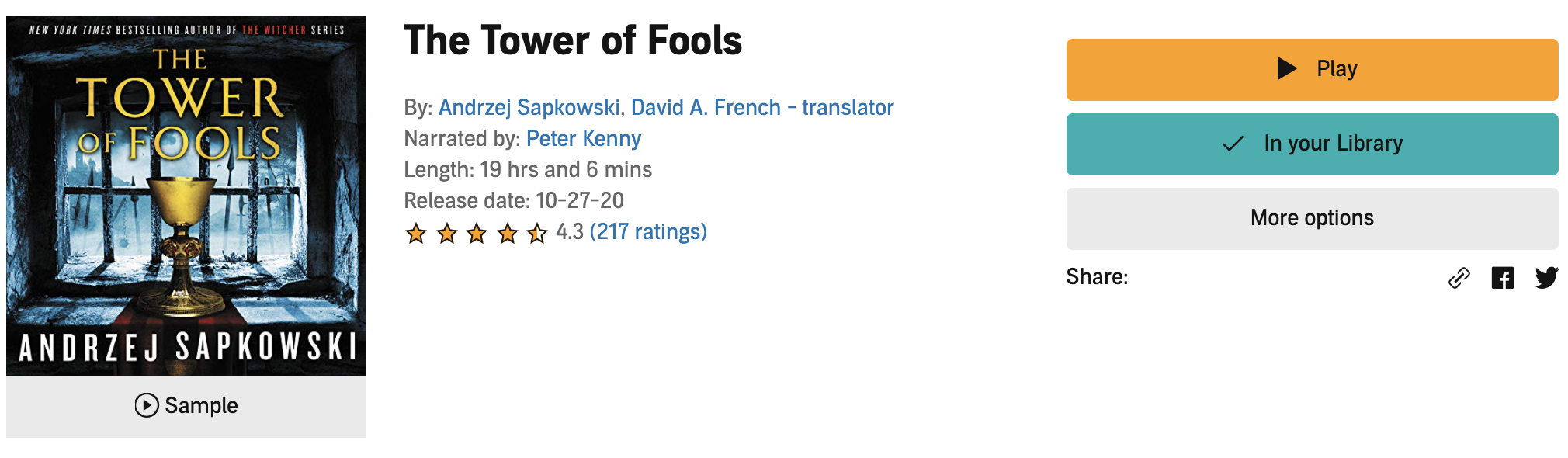
The Tower of Fools by Andrzej Sapkowski: Narrated by Peter Kenny

Andrzej Sapkowski’s The Tower of Fools won’t necessarily appeal to fans of his far more popular The Witcher series. While elements of his distinctive writing style carry over to this first book of the Hussite Trilogy, the story itself is a major departure from what readers might expect.
The Tower of Fools is more akin to Neal Stephenson’s Quicksilver (the first book of The Baroque Cycle) or Susanna Clarke’s Jonathan Strange & Mr. Norrell, in that it’s a dense fantasy tale firmly embedded within true European historical context. Whereas The Baroque Cycle transpired in a fictionalized version of the late 1600s to early 1700s, and Clarke’s novel took place in the 1800s, Sapkowski’s trilogy inserts itself into Eastern Europe of the 1400s.
We are introduced to Reinmar of Bielawa, an unlikely and peculiar hero, as unwanted adventure is thrust upon him by virtue of Reinmar caught in the process of a different sort of thrusting–with the wife of a member of a wealthy and powerful family. On the run from vengeful aristocrats (and those working on their behalf), the inquisition (for being a magician and heretic), and sinister forces with unknown motives, Reinmar finds himself on a meandering scramble across the Eastern Europe of the late Middle Ages.
Populated by an almost intimidating cast of additional characters, while not as bad as Pynchon’s Gravity’s Rainbow–a book I’ve never been able to finish–it becomes challenging at times to keep track of precisely who is who. Strange acquaintances along the way become friends, friends become enemies, and enemies become victims of the peculiar sort of charmed life Reinmar seems to live. With the familiar wit and subtle comedic writing Sapkowski brings to the narrative, we witness an extreme example of fortune favoring the fool. As Reinmar stumbles from one bit of trouble to another, dragging unfortunate allies with him as he careens from frying pan to fire and back again.
Densely packed with historical events and figures of the Hussite Revolutionary period, The Tower of Fools is as much a history lesson as a tale of fantasy. Though Sapkowski’s novel incorporates elements of magic, witches/sorcerers, and supernatural beings aplenty, the narrative is so deeply fixed in a foundation of historical veracity that it all feels more textured and real than it might otherwise. Of course, those familiar with The Witcher are well aware that the author is capable of fleshing out a fictional world without the benefit of drawing the fine details from real-world history. It’s a nice touch, though, being able to explore a historical period many of us aren’t familiar with.
The titular Tower of Fools–though referenced at numerous points throughout the story–makes an appearance in Chapter 26, at almost the end of the book. It could be argued that the wider world we witness in the book is the real Narrenturm, and the whole of Eastern Europe and the Holy Roman Empire makes up the real Tower of Fools.
Though the story is not one that I can praise in more than peculiarly specific ways, the narration provided by Petter Kenny is spectacular. This narrator is impressive, to put it mildly. He successfully tackles various accents, dozens of characters, as well as songs and chants performed in Latin and other languages, all with a clarity and quality that almost astounded me.

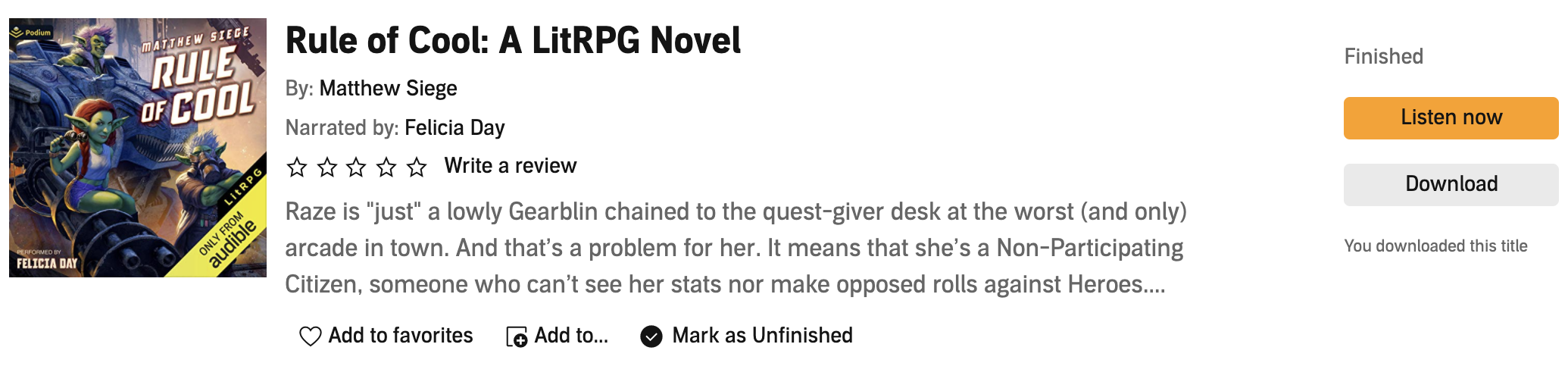
Rule of Cool by Matthew Siege: Narrated by Felicia Day

From a literary standpoint, Rule of Cool is certainly not the best example of the LitRPG genre…but it is far from the worst. I don’t expect epic fantasy literary prowess from LitRPG novels–because I’m not a complete idiot–but there are plenty of books within the genre that successfully combine skilled storytelling, captivating characters, and ample humor. This one had a fair bit of humor, some slightly worthwhile characters, and a story that could have been assembled from a story-in-a-box plot development application.
Personally, I prefer the stories where there’s some explanation–even a flimsy one–as to why we (and the characters) are exposed to stats, rolls, and other such RPG-oriented elements. Otherwise, it seems like a poor attempt to simply pad and shoehorn a story–decent or not–into a niche genre hoping to ride the coattails of those who came before. Combine all of that with a healthy dose of the fan service and the almost desperate geek appeal of Ready Player One, and you’ll have a good feel for Rule of Cool.
A story focused on life within an RPG world from the perspective of a bitter, moody NPC has a lot of potential. Sadly, Matthew Siege couldn’t bring that potential to life the way the concept deserved. The world itself is nonsensical. Rule of Cool is centered on a starter town, Hallow, where prospective heroes begin their journey to obtain levels and make names for themselves. For some inexplicable reason, Hallow is filled with detritus from the real world for no apparent reason, except that it somehow slipped from our world into this fantasy realm through a rift that is never adequately explained nor explored. It struck me as a poorly conceived ploy to justify random pop culture references littering the narrative, much the same way that damaged electronics and toys from our world litter the realm where Hallow’s located.
It’s not all bad. Don’t get me wrong.
This is a fun, albeit generic zero-to-hero tale centered around a trio of gearblins (a hybrid of goblin and gremlin) struggling to take their home back from the heroes who have been grinding them into the muck for generations. There’s social commentary embedded in the plot that–while unsubtle–appeals to me in a Marxist workers’ revolt sense.
The best aspect of Rule of Cool was that I listened to the audiobook edition. Felicia Day’s narration is fantastic, sufficiently so that it drags the story–kicking and screaming the whole way–to a higher level of quality than it would have had if I’d simply been reading the book.
I can’t recommend reading this book, but I would recommend the audiobook because the superb narration makes other aspects of the story far more tolerable than they probably deserve to be.

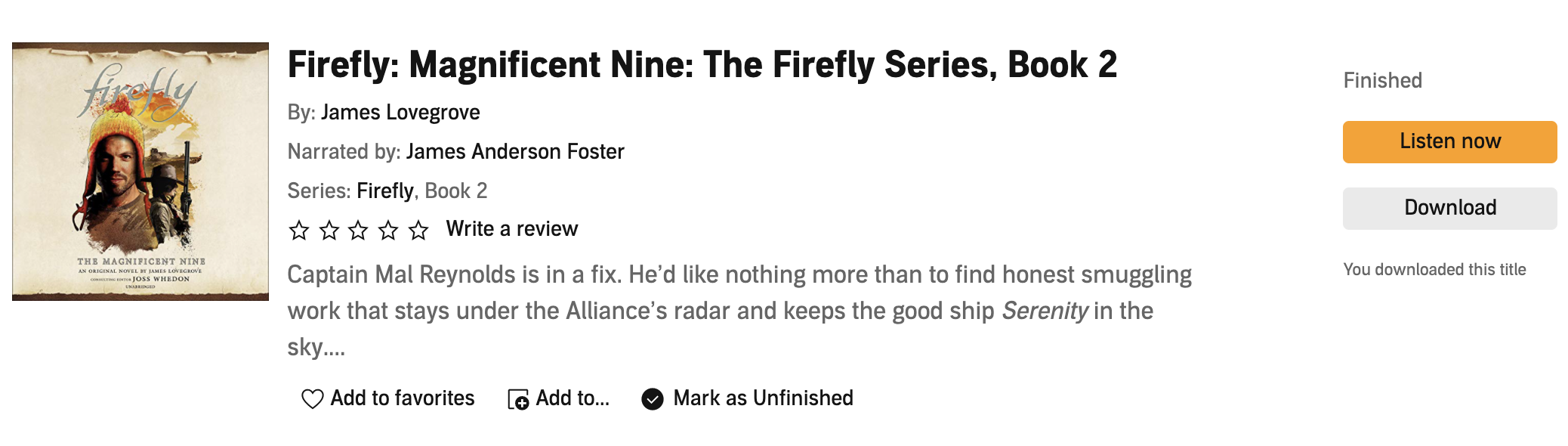
Firefly: The Magnificent Nine by James Lovegrove: Narrated by James Anderson Foster

The Magnificent Nine confirms the placement of these Firefly novels–or at least this particular installment–as falling between Objects In Space and the Serenity motion picture. The previous book hadn’t made any specific mention of the events in that episode and thus could have fallen before or after that final episode of the tragically short-lived series.
The crew of Serenity is floating adrift, between jobs and looking for work to keep themselves afloat when a message arrives from an old friend of Jayne’s. There’s trouble on the distant, dry–almost desert–world of Thetis. Jayne’s former lover, Temperance, is desperate to find help for her small village. A cruel, savage bandit going by the name of Elias Vandal threatens the survival of all residents of Thetis who won’t bow to his reign or join his cultish band of raiders and criminals.
Though there’s no money in the job, it’s the right thing to do, and the crew of Serenity naturally makes their way to Thetis. This group of nine mismatched compatriots is hardly the collection of soldiers or heroes Temperance was expecting, but they might be precisely the heroes the planet needs.
While the previous installment, Big Damn Heroes, provided us with a fair bit of additional backstory for Captain Malcolm Reynolds, this book supplements what we know of Jayne Cobb before his time with the crew of Serenity.
It’s a satisfying story that could have made for a pretty fantastic episode or two of the series.
The narration from James Anderson Foster is just as good as it was for the previous book–and hopefully will be for the remaining handful of Firefly supplemental novels.

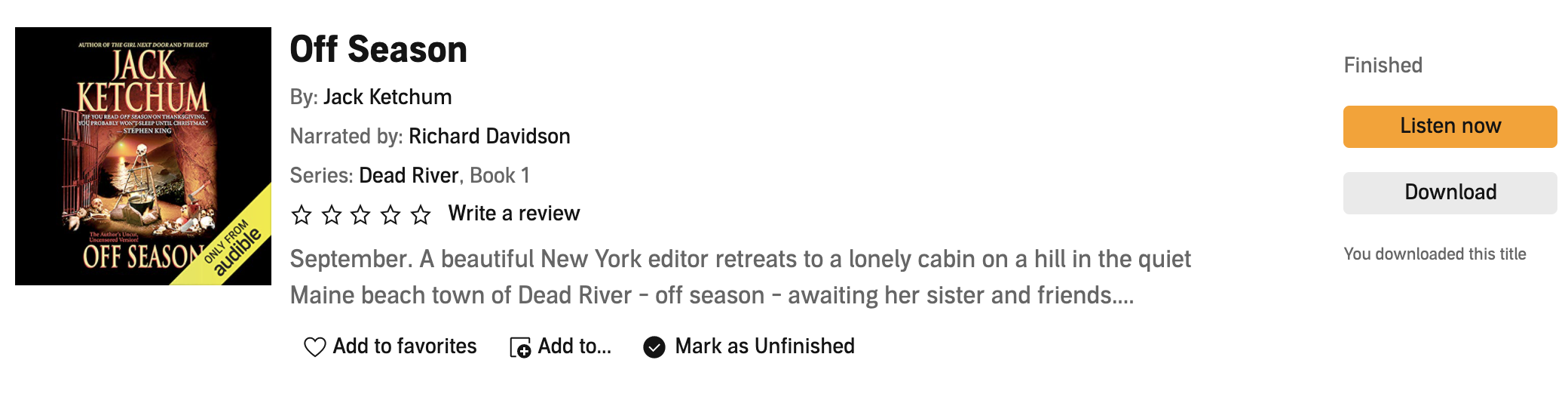
Off Season by Jack Ketchum: Narrated by Richard Davidson

I was a teenager when I first read Jack Ketchum’s Off Season in an already used paperback edition I’d found in a second-hand store or at a flea market. At the time, the book seemed truly graphic and bleak in a way most horror novels didn’t approach. Of course, most of my reading up to that point had been Stephen King, Peter Straub, Robert R. McCammon, Dean Koontz, Clive Barker, Anne Rice, and other more commercially accessible authors. Of those authors, Barker and McCammon were the two who most closely approached what I was reading from Ketchum.
If I enjoyed the bleak and hopeless tone of that edition of the book, I was sure to be in for a treat with the less censored edition released this century.
A good deal of the change to this story only arises in the final stretch of the story, but those relatively minor changes in terms of text produce massive changes in the outcome of the narrative. Listening to this audiobook edition of the novel, I understand why Ketchum was dissatisfied with the edits his publisher demanded. This was a story that pulled no punches and held nothing back, laying bare the callous inhumanity of the world we live in and the indifference of the universe itself.
A tragic hero becomes altogether more tragic in this edition of Off Season, and the story benefits from that transformation.
Those who read the original edition of this book may have wondered just how much worse a vacation to Northern Maine could have gone in the fall of 1981. Ketchum answers that question in this restored iteration of the tale. As the vacationers in the cabin are beset by the wild, raving tribe of barely human cannibals, you might notice some scenes that carry a bit more potency and illustrative violence…but the core of the story remains the same until you reach the end.
Richard Davidson’s narration is great, though there are times when it seems as if the Maine accents are a bit more of a caricature. It makes for an enjoyable listen just the same.

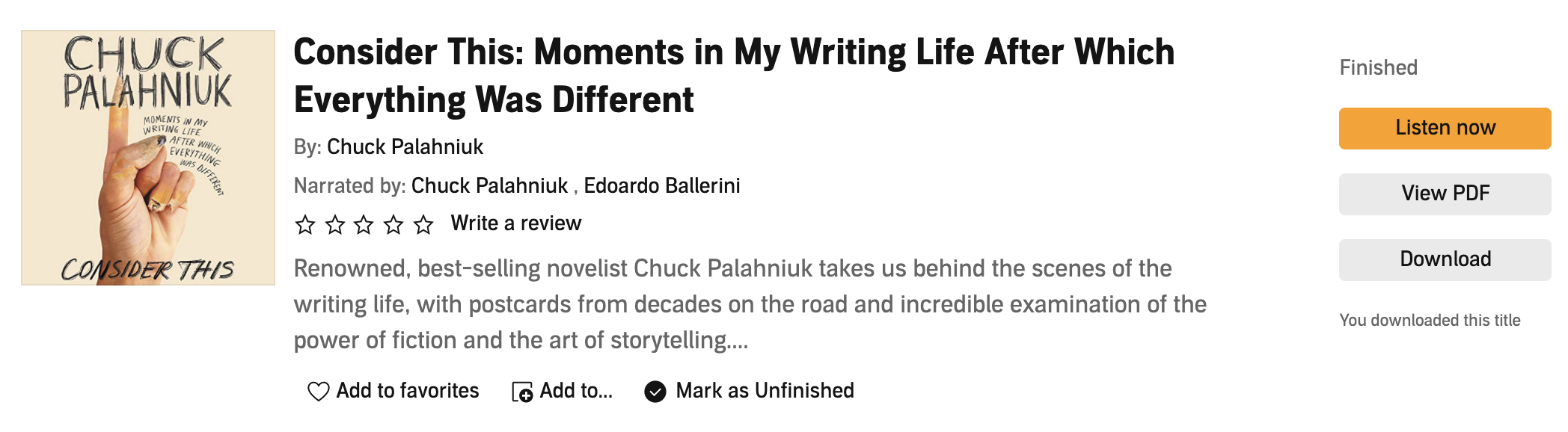
Consider This by Chuck Palahniuk: Narrated by Edoardo Ballerini

Readers familiar with–and fond of–Chuck Palahniuk’s distinctive style of storytelling are sure to find Consider This: Moments In My Writing Life After Which Everything Was Different to be no less compelling. This collection of insights and anecdotes was certainly no less captivating for me than Stranger Than Fiction or any of his other non-fiction material I’ve devoured over the years.
I’ve read several different books dedicated to the craft of writing and best practices to employ, some better than others. This book stands apart as being truly the most interesting. Shared as if we’re hypothetical participants in a kitchen table writer’s workshop hosted by Palahniuk, the reader/listener doesn’t feel any impulse to interrupt or make it a two-way conversation–though it strangely feels like a conversation at times.
Approaching the craft from a journalistic perspective rather than a creative writing perspective makes for a different set of rules and guidelines than many of these books provide while cementing some of the rules that are true, regardless of background.
Even if one doesn’t want to apply the rules and practices recommended by Palahniuk, they make for interesting experiments and elements to try out, allowing the writer to spread their wings in a different sort of environment.
The narration provided by Edoardo Ballerini was fantastic, and the bit from Palahniuk himself was a nice touch as well.
I can’t recommend this enough for anyone who wants to write, regardless of genre or industry.
Similarly, I have to recommend this to readers who want to experience a glimpse behind the scenes of one of the more peculiar and fascinating writers of my lifetime. His tales of book signings and road trips alone make this worth listening to or reading, even if you never have any impulse to put pen to paper or fingertips to keys.

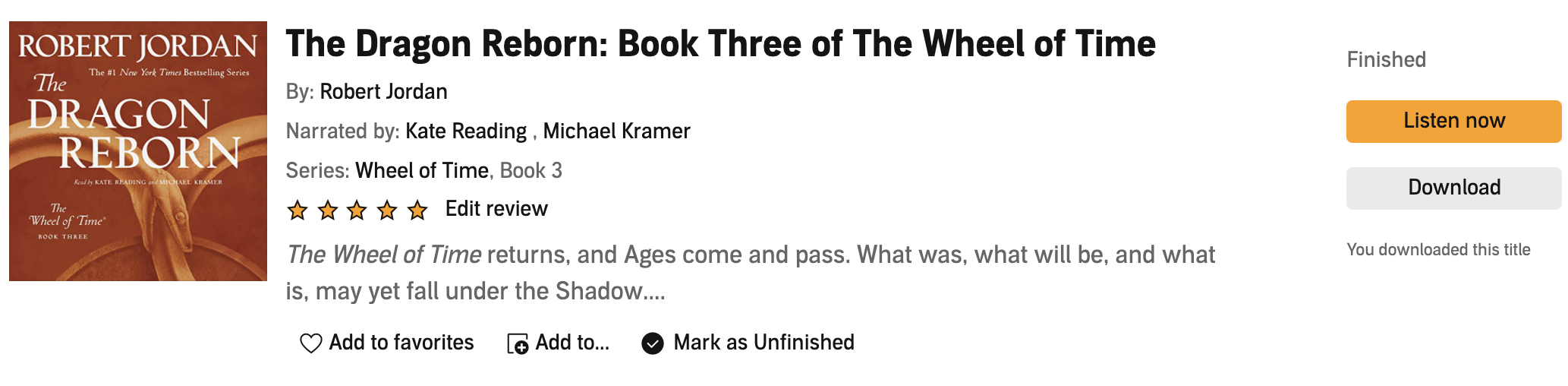
The Dragon Reborn by Robert Jordan: Narrated by Kate Reading & Michael Kramer

The Dragon Reborn, I recalled quite correctly, was one of my favorite installments in what I’d previously read of The Wheel of Time series by Robert Jordan.
This is the book in which we receive a much clearer glimpse of the effect Rand al’Thor has on the world and people around him, largely through the events witnessed by his friends rather than from Rand’s perspective. It was a daring move, shifting the focus of the third novel in a series away from the protagonist, allowing the bulk of the tale to be told from the perspectives of Perrin, Mat, and Egwene. Though Perrin is the only one who knowingly pursues Rand, Mat, Egwene, and the others are drawn by the gravity of Rand pulling at the weave.
What we do witness of Rand’s journey to Tear–where he intends to prove himself and to embrace the prophecy that marks him as the Dragon Reborn–causes some small amount of concern that he is indeed going mad. While little attention is paid to the day-to-day travels as Rand journeys to take hold of his destiny, we are far from kept in the dark as to what he’s been doing as he manages to remain ahead of the pursuit from Perrin, Moiraine, Loial, and Lan.
As we bounce from one location to another, we are provided with a much greater perspective of what is happening throughout the world. We discover that the Forsaken have escaped from their imprisonment and taken up positions of power throughout the world. We learn that the corruption of the Black Ajah has grown within the Aes Sedai in Tar Valon. We learn of darkhounds and the soulless. We also discover that the Aiel have left the wastes and ventured secretly into the world that fears them, in search of the answer to a prophecy of their own.
The Dragon Reborn is a spectacular book, the best of the original trilogy, for sure. It is filled with intrigue, action, and suspense that marked Robert Jordan as a great storyteller.
The narration of this book is no less spot-on than the previous two installments of the series.

Dark Places by Gillian Flynn: Narrated by Rebecca Lowman, Cassandra Campbell, Mark Deakins, & Robertson Dean

Dark Places indeed.
This book takes the reader/listener to some truly dark places.
A Kansas family was slaughtered in the middle of a cold January night in 1985. The only survivor was the youngest daughter, Libby Day.
The oldest child, Ben, is the easy suspect for everyone. He’s a troubled teenage boy with a darkness inside of him that easily feeds into the Satanic Panic running rampant in those days. But was he guilty? Was Ben just as innocent of these horrific crimes as he was of the sexual assault accusations being leveled against him by numerous grade school girls?
We join Libby as an adult, running out of money from the donations sent her way as a sympathetic child survivor of the Day family massacre. No longer the sympathetic, victimized young girl, Libby lives in squalor and never quite figured out how to properly take care of herself. This desperate situation is what leads her to The Kill Club, a group of true crime fanatics who imagine themselves to be investigators.
Ripping off painful bandages and digging into a past she only barely recalls, Libby begins to question her courtroom testimony from all those years before. Some mysteries are better left in the shadows, though. Proving Ben’s innocence might lead to nothing more than further death and horror.
Gillian Flynn has a knack for developing interesting characters without making them feel particularly sympathetic. The characters populating Dark Places are no less captivating than others she’s developed, in large part because of precisely how flawed and sometimes awful they happen to be. Despite those flaws and the fact that it’s hard to care about the characters, you can’t help but find yourself invested in what’s happening.
The narrations performed by Rebecca Lowman, Cassandra Campbell, Mark Deakins, and Robertson Dean are fantastic. We experience different characters, at different times, with distinctly different voices…and it’s a nice touch.