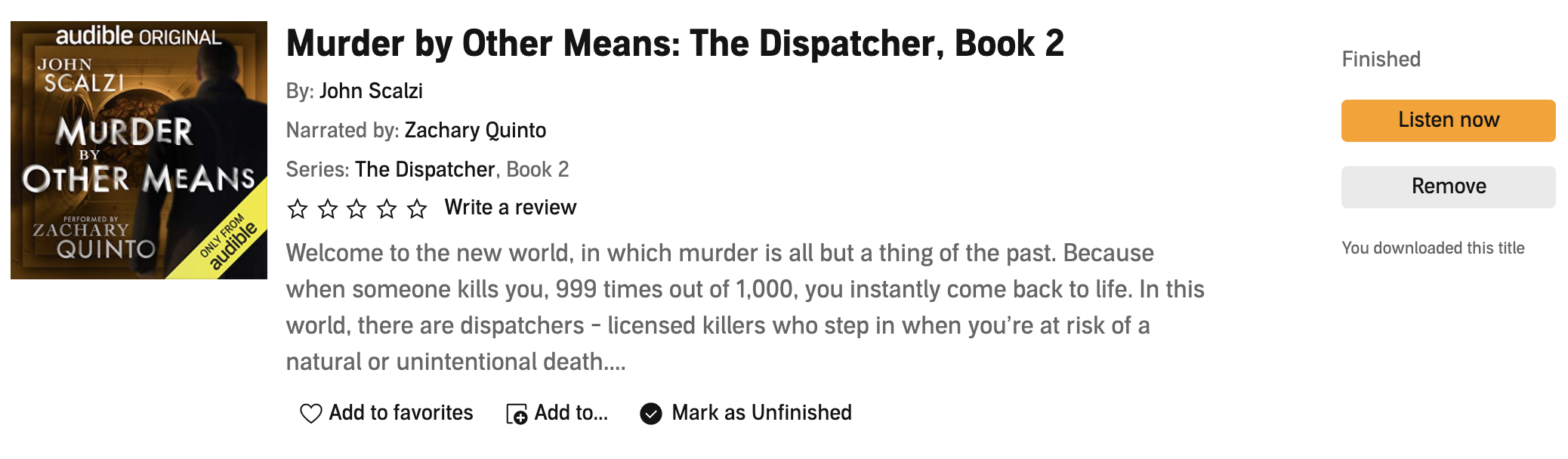
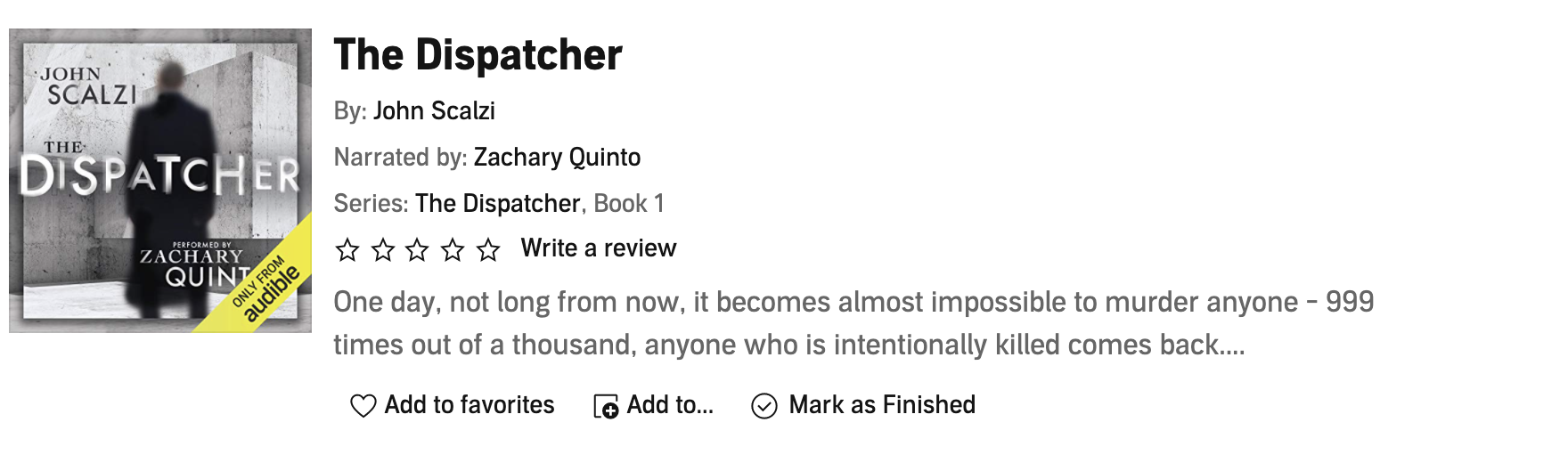
Few authors could successfully pack as much intrigue, mystery, and suspense into a novella as John Scalzi. Murder By Other Means is a prime example of Scalzi at his fast-paced best. At the heart of this story is a question, “How do you successfully assassinate people when 99.99% of murder victims reappear–unharmed–in their homes, only moments later?” We return to the world of Tony Valdez, the titular Dispatcher of the previous story in this sequence, not too long after we left him at the end of The Dispatcher. Legitimate work has dried up for him and the city of Chicago is on an austerity budget that prohibits him from finding many side gigs on the up-and-up. This is where we meet up with him again, as he enters a law firm for a less than legal utilization of his skills. From there it’s a dizzying spiral of international corporate intrigue, organized crime, suicide, and survival…with a healthy dose of police procedural and noir-ish detective story providing the framework. This is a better story than The Dispatcher, which was a pretty high bar to clear. Zachary Quinto again provides narration for the story, and there’s probably no need for me to point out that he’s beyond excellent in all respects. I can’t imagine Tony with a different voice.
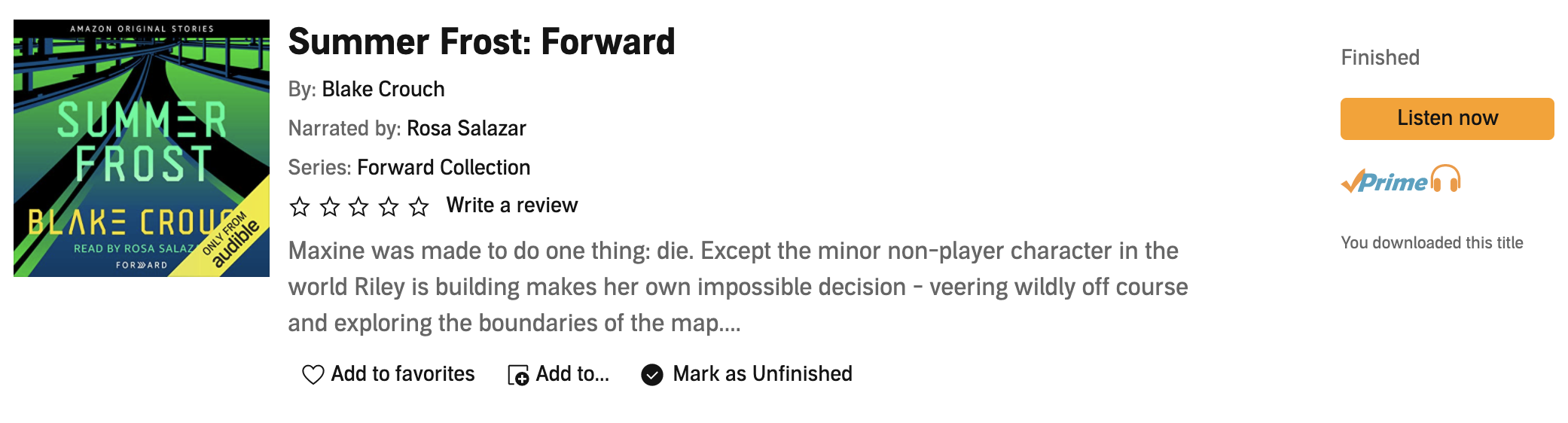
Summer Frost is not treading entirely new ground, building up to a predictable outcome as it does…but it’s not the novelty of the tale that makes it worthy, it’s the quality of the storyteller. Blake Crouch is quite the storyteller. Riley makes for a captivating protagonist as she works to assist the world’s first truly emergent intelligence reach and further maximize its potential. It’s appropriate, in a sense, that the AI’s name is Max (short for Maxine, the NPC within a VR game, the AI unexpectedly grew from). It’s a sad tale of being too close to a problem to see that there’s a problem at all. In this case, the problem is that Riley has projected altogether too many human characteristics onto something that is far beyond human. Blinded by an affection that falls somewhere into a nebulous space of mother and child…or lover and object of obsession. We are helpless to do anything, hoping that we’re wrong, as the story races to the inevitable conclusion…but knowing, deep inside that there’s no other conclusion available. The narration from Rosa Salazar is as spectacular as most of the narration has been for the installments of the Forward Collection. She lulls us into a sense of near-complacency that allows us to feel almost as taken off-guard as Riley ultimately is.
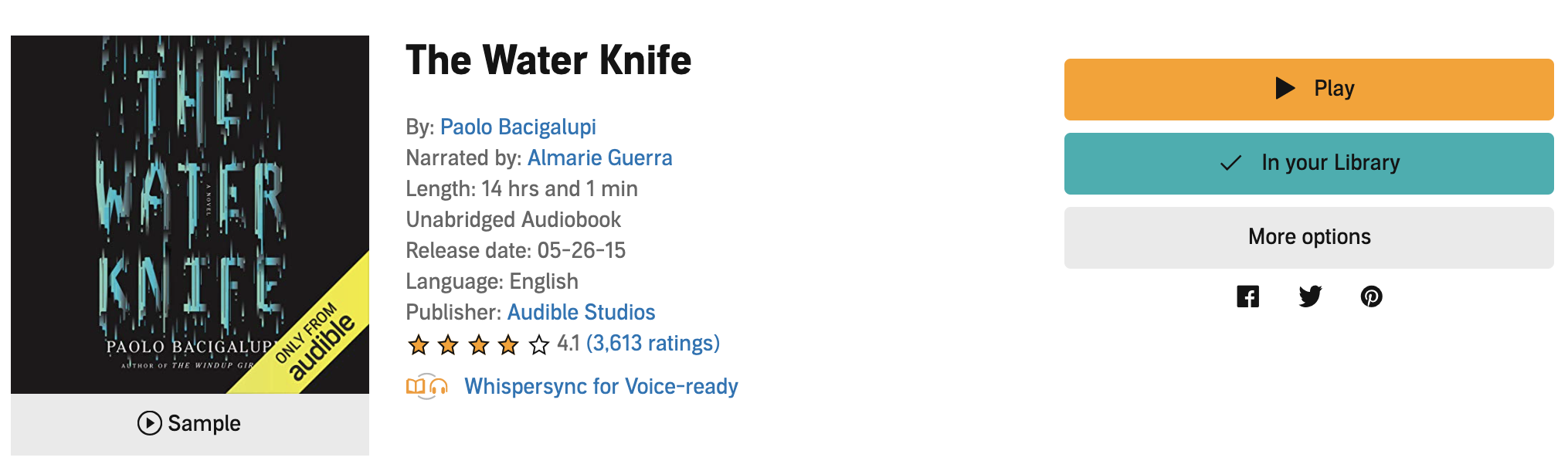
Paolo Bacigalupi paints a grim portrait of America’s future in The Water Knife. It feels substantially grimmer when one considers just how plausible it might be. We’re introduced to a global warming prediction come and gone, where the fertile regions for farming and ranching have shifted hundreds of miles to the North of where they are today, as the desert inexorably reclaims the land we’d believed we tamed. Water has become the most valued resource we have and is finally treated as being as precious and necessary as it has always been. Southern states have sealed their borders against one another and the National Guard of those respective states have become the private military forces enforcing those border separations and the water rights of the territories they patrol. Perhaps more horrifying than the abject human misery and exploitation we find within this narrative, there’s a bleak dystopia that’s taken hold. The separation between corporate interests and the interests of the state has become more blurred than they are in the world we see around us today. The characters we meet and follow through this twisted tale of espionage, cruelty, and power struggles are well-developed and fully three-dimensional in a way that breathes a searing, dust-filled life into the story. As the Nevada water knife, the journalist, and the Texas refugee follow their separate threads throughout the story, those threads become a tangled web of intrigue, betrayal, and murder. Bacigalupi displays a keen understanding of people, human nature, and the drastic toll we’ve taken on the world around us to an extent that is both depressing and almost awe-inspiring. It’s virtually impossible not to love this book even as the story itself leaves the reader/listener feeling hollowed out and helpless. Unlike so many dystopian glimpses of our future, this one lacks some magic solution to resolve the underlying failures of the society involved. The mystery is solved for the readers, but we’re left with no sense of satisfaction that resolution is just around the corner, and that makes this book more honest than many. The narration of the audiobook is expertly performed by Almarie Guerra, tackling the characters well enough that they all feel as if they’re distinctly separate voices within the audio edition of this novel.
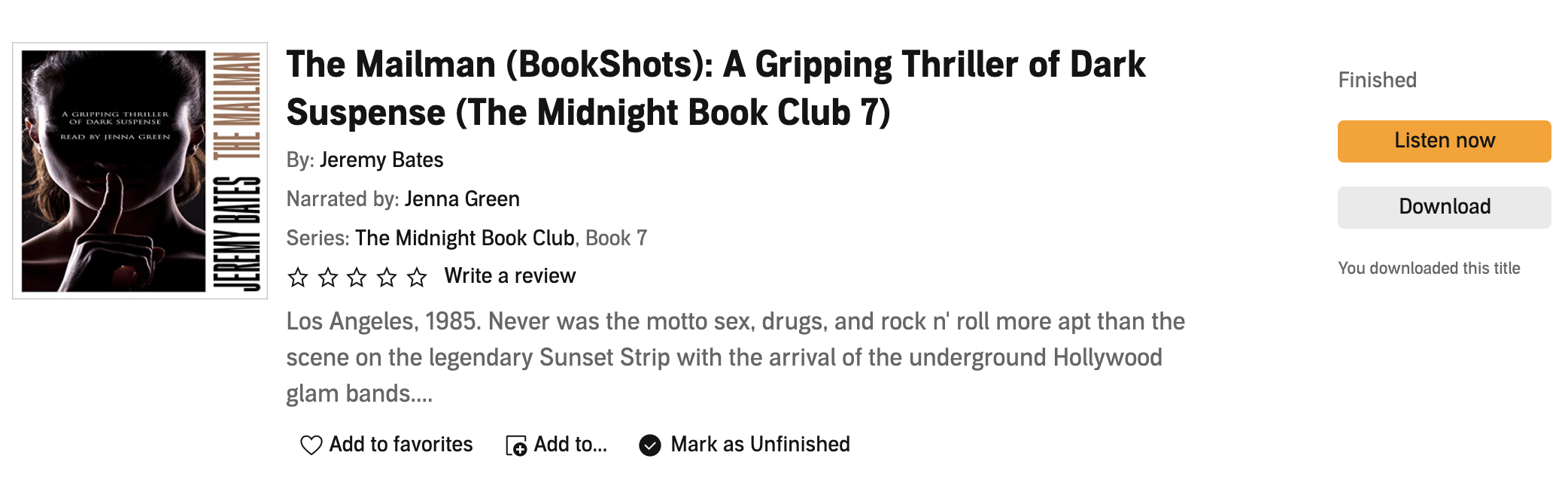
Jeremy Bates spins a particularly unsettling tale with The Mailman, introducing us to a mid-1980s Los Angeles and focusing tightly on the listless, unsatisfying life of a record executive’s housewife. On the surface, Mick and Jade Freeman appear to have it all, including a particularly bright future ahead of them as Mick is on the verge of signing a heavy metal band that’s being billed as the next Mötley Crüe…if he can only keep them from imploding before they record their debut album. Everything is not as perfect as it seems. Jade isn’t sure whether she even loves Mick anymore and she’s haunted by her infertility and the memory of the one child they’d had and given up for adoption decades earlier. Like a cliché, this is when the stunningly handsome mailman appears at Jade’s door…and again at her table while she’s having lunch by herself in a busy restaurant. Unlike the cliché, things get truly dark and disturbing from there. This story is a fine example to display why one should not cheat on their significant other…albeit a pretty extreme example. With a twist straight out of Oldboy, whether we’re talking about the manga or either of the movie adaptations, it’s hard to walk away from this story feeling clean. Jenna Green’s narration is excellent, capturing the UK accent of the frontman, and bringing the characters to life in the audiobook edition of this novella.
The Dispatcher introduces us to John Scalzi’s exploration into a future where the dead don’t always stay dead…as long as the deceased happens to be murdered. If someone dies by accident or by their own hand, well, for whatever reason, they stay dead. If someone murders you, there’s only a chance of 1 in 1,000 that you’ll remain dead. Those other 999 times, you’ll wake up naked in your bed, uninjured, and with full recall of the event that led to your demise. What might you do if you found yourself living in this future of inexplicable miracles? Would you participate in vicious, violent bloodsports? Would you challenge those who anger you to duels? Would you perhaps accept a job as a Dispatcher, one who performs the killing for those who are soon to die in hospitals when surgical procedures go wrong? That’s precisely the choice our protagonist made, to become a Dispatcher. Tony Valdez has a certain psychological makeup that allows him to perform the duties associated with his role without guilt or self-recrimination–without any real self-examination of any kind. When one of his colleagues disappears, an intrepid detective thinks there’s something sinister going on, directly related to his occupation, and Tony finds himself caught up in a mystery that leads him into the expanding gray area surrounding underworld activities where a Dispatcher’s skills are required. Zachary Quinto’s narration of this novella is spectacular. His voice is so distinct and perfectly suited for the cool detachment of Tony’s character. I’m pleased to see that he also narrates the sequel novella that came out last year.
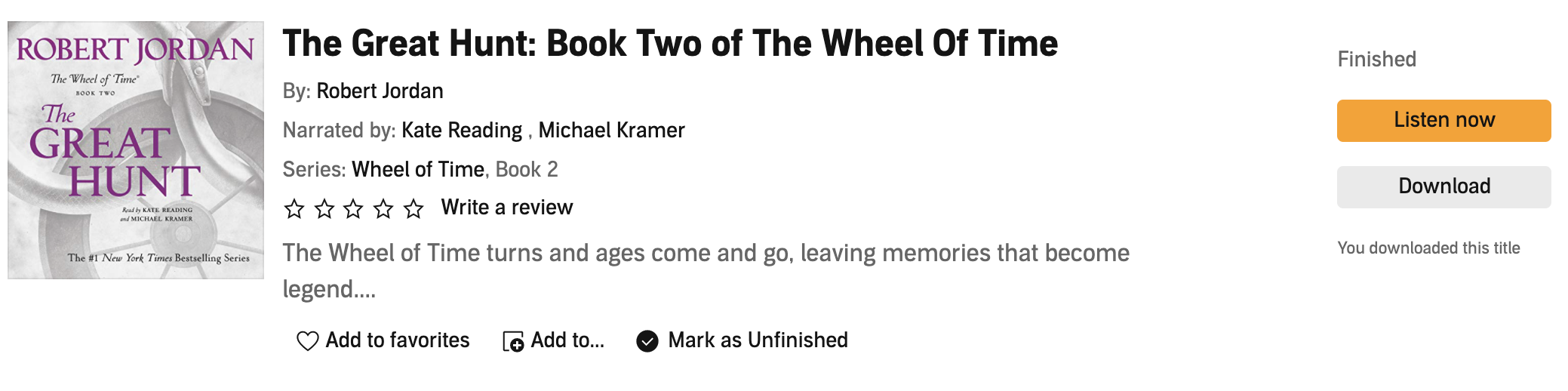
Robert Jordan’s The Great Hunt has always been one of the greatest follow-up novels to a series introduction. It could be argued that it’s the best installment of The Wheel of Time. As I indicated in my review of the audiobook for The Eye of the World, I haven’t read the whole series, so I can’t say for sure that this remains true throughout, but of what I’ve read, it is the best of the bunch. At its core, The Great Hunt is a story of acceptance amidst transformation…recognition of the changes taking place and the role one must play in this changing world. We see Perrin finally coming to terms with what he is, embracing his status as a wolf brother when it becomes the only way to continue the search for the Horn of Valere. While in Tar Valon and after, we watch Nynaeve learning to embrace her role as Aes Sedai as well as her burgeoning feelings for Lan. Even Rand begins to accept who and what he is, though in action and deed more than in word. Though he spends the bulk of the novel insisting he is nothing more than a shepherd, he slips into the guise of a leader and a lord with increasingly greater ease. I think that’s the aspect of this story that makes it my favorite of the portions I’ve read. There’s a vitality and realness just beneath the surface of the fantasy tale being woven, focusing on the nature of identity, diving into the differences between the versions of ourselves we know–or believe we know–and those others around us see and acknowledge. Of course, there’s also a great deal of action and adventure to this story, and that certainly helps to make it one of the best fantasy tales I’ve ever had the pleasure of reading–or, in this case, listening to. We get to explore the potential of divergent realities, where events play out with lesser or greater similarities to the way we know they’re playing out. We have the introduction of the Seanchan and the horrific creatures they use as beasts of burden and war, along with their hideous practices of forcing dedication from people they encounter and enslaving women with the capacity to channel the One Power. We have the rising of legendary heroes from the mists of time as the horn is sounded. Of course, we also have that fantastic duel between Rand and Ba’alzamon that changes everything going forward, forcing him into an unhappy acknowledgment of his place as Dragon Reborn. For books as old as these, and as popular, I don’t feel quite the aversion to providing spoilers, but I’ll try to keep it at what I’ve already given away. As one could expect, knowing how this story plays out, Kate Reading has more of a part to play in the narration than she did in the previous volume. I’m pleased to see that she and Michael Kramer appear to have narrated every volume of the series. I had known they narrated the first five books since I already had them purchased…but I looked ahead at the remaining Wheel of Time audiobooks and felt a bit of relief at seeing those names again and again throughout.
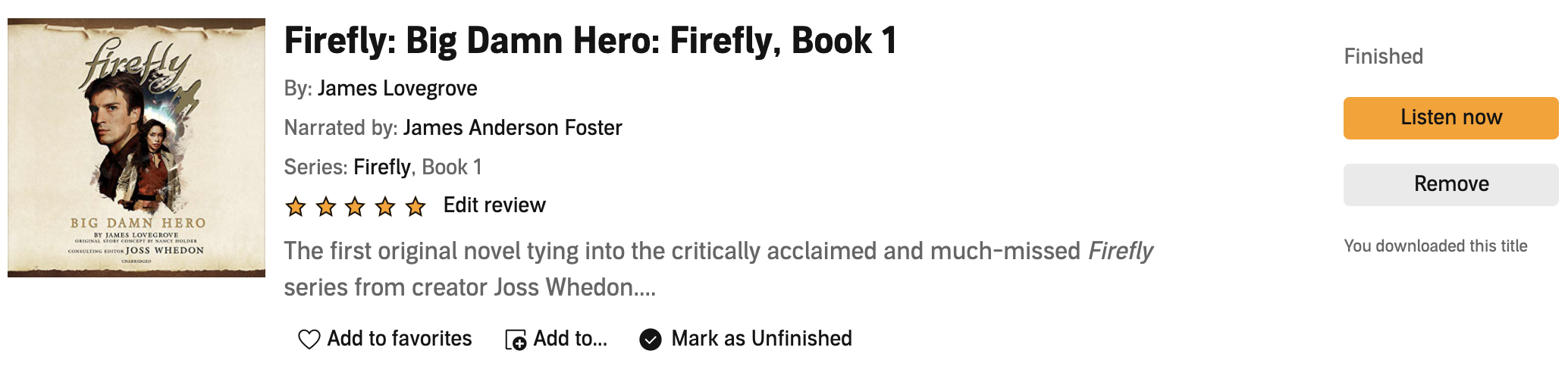
I wasn’t sure what to expect when I decided to pick up James Lovegrove’s Firefly: Big Damn Hero as an audiobook. That uncertainty and fear of disappointment directly led to the title sitting in my Audible library for an extended period before I chose to give it a listen. The graphic novel mini-series hadn’t been a disappointment, but Joss Whedon was credited with at least co-author status on those titles, with other writers from the television series being his compatriots. In the case of this novel, Lovegrove was not affiliated with the television series, nor was Nancy Holder, the individual who developed the concept behind Big Damn Hero…though Holder had written media tie-in novels associated with other Whedon properties such as Buffy and Angel. So, naturally, I was a little bit iffy about diving into this title…concerned that it might be a letdown. From the beginning of James Anderson Foster’s narration, I knew I’d made a mistake by letting the title sit for so long. This man thoroughly captures the tone and cadence of the characters in such a way that it’s obvious he’s watched Firefly and Serenity more than a time or two…or at least he comes across that way. Mal and Jayne are particularly well-narrated, with Badger, Wash, and Book coming in just a little bit behind those two. His narration of female characters leaves a bit to be desired, but that’s not at all uncommon, so I’m not going to worry altogether too much about it. The story of Big Damn Hero falls somewhere in the timeline after Episode 12 of the Firefly series, The Message, wherein Mal and Zoe put to rest a former comrade-in-arms from the war. There are references to the absurd knit hat Jayne received from his mother, the experience with Tracey (the comrade-in-arms I’d previously mentioned), as well as other threads of the story from earlier in the series. I suspect this story falls not long after The Message and a little while before Heart of Gold, the 13th episode of the show. It definitely takes place before Objects In Space, the final episode. Big Damn Hero centers around Mal and his life before and during the war. As such, it provides a good bit of backstory and character history we’d never encountered during the television show or subsequent movie. The crew arrives on Persephone to take on a hazardous job from Badger, while Mal has arranged a secondary job contact to supplement their cash flow. Pursuit of this second job leads Mal, Zoe, and Jayne to a bar on Alliance Day. If you’ve watched the show, you know what sort of things happen when Mal finds himself in an Alliance-friendly bar on that day of celebration…and that he somehow always seems to find himself in that situation. When Mal disappears, it initially looks like he’s been captured by Alliance loyalists seeking to root out any traitorous Browncoats foolish enough to be out and about on Alliance Day, but the truth is far more painful. As the rest of the crew attempts to solve the mystery and locate their Captain, Mal finds himself confronted by ghosts of his past and the memories, both good and bad, associated with those not-so-friendly faces. It could be that I’m biased by my love of all things Firefly, but this was an excellent way to spend close to ten hours. I recommend this for any fan of the show.
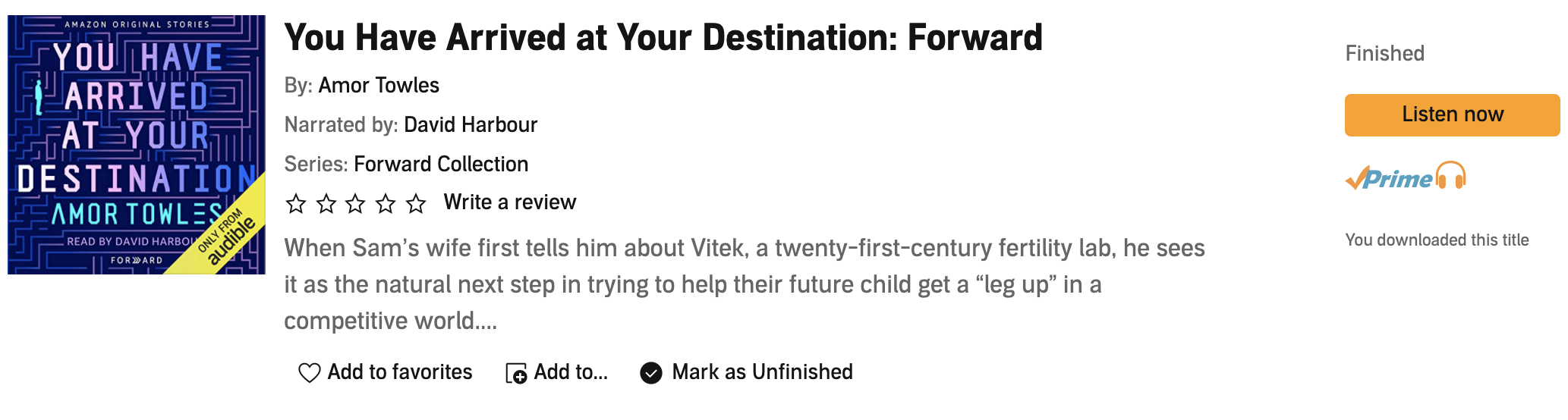
You Have Arrived At Your Destination by Amor Towles is, in my opinion, the weakest of the installments in the Forward collection assembled by Blake Crouch. The story proposes an interesting premise regarding eugenics, the effects of combined nature and nurture on our offspring, evaluation of one’s life in retrospect, self-determination, and relationship dynamics. Sadly, that premise full of promise seems to peter out and go not too far at all. It could be the author’s intention to have tossed several potential red herrings into the narrative for the purpose of making the reader/listener assume they know where it might be going from this point or that, but ultimately it led to a fairly disappointing overall experience. I’m not otherwise familiar with the author, beyond having heard that they’re quite well-respected for other material they’ve written…so I might have a greater appreciation for what they were attempting if I had a better handle on the author’s style as a whole. We join our protagonist at a pivotal moment in his life, as he’s faced with one of the most important decisions of his life. He and his wife are considering an enhanced version of family planning, but it all appears to be too much for him. That’s it. That’s how one could sum up the story, and that’s precisely what I’m going to do. The narration of the audiobook by David Harbour is great. His voice works particularly well for the middle-aged protagonist and the slick, salesman pitching the offerings from his company. That narration alone is the thing that makes the audiobook worthwhile…but that’s about all it had going for it.
The Last Conversation is the third of the six short stories in the Forward Collection assembled by Blake Crouch I’ve listened to. It is also the first time I’ve experienced Paul Tremblay as a science fiction author, and the experience was an interesting one. I’m sure he’s written other stories or books that have crossed into the science fiction territory, or at least I’d be surprised if he hasn’t, but I’ve only been familiar with him as a horror author and occasionally as a dark fantasy author. This brief tale showcases his talent for wearing a variety of hats with efficacy. It’s a solid second-person narrative detailing the awakening of the protagonist in isolation to protect him from a global pandemic, while the only other person–seemingly still alive–coaxes them through restoring memories and physical capabilities. The story was ultimately predictable, but no less satisfying for the very predictability of it. It wasn’t about telling us a new tale so much as providing a platform for the discussion of morality, humanity, the devastating combination of solitude and grief, and the ethics involved in cloning. In that sense, Tremblay packs a big punch into a small number of words. He utilizes and capitalizes on the elements of science fiction that have always been used by authors, the capacity to frame thought experiments in a fictional narrative that makes the philosophical subject matter more palatable and digestible for the readers (and sometimes the author). The narration, performed by Steven Strait, is superb. Strait captures the stubborn resistance of the protagonist to being held captive–even if it is for his own good–as well as the sadness and pity that mingles with that oppositional nature as the truth of everything is revealed in the end.
If you’ve ever asked yourself what American Psycho’s Patrick Bateman would be like if he were a teenage girl living in the current age as opposed to Wall Street of the 1980s, Full Brutal by Kristopher Triana is the book for you. I’m only joking a little bit with that introduction because–much like Ellis’s most popular character–Kim is pretty, popular, and superficially passing as being not only normal but successful and even a role model of sorts. This is, of course, a facade. As the story unfolds, Kim goes from being a calculating, manipulative sociopath dwelling on suicide–as much out of boredom and a desire to shock/stun the people who believe they’re close to her as very real depression over the fact that nothing brings her any sort of pleasure in life–to a cold-blooded monster. The turning point seems to be that pivotal decision in many teenager’s lives, whether they should have sex and with whom. Developing a fixation on serial killers as well as torture-porn movies (and actual pornography featuring torture) and finding a spark of pleasure in these things, it’s no real surprise that everything goes dark and brutal from there. She determines her first time should be with someone she has to break down and degrade to get there, and she sets her sights on her sex-ed teacher. When sex itself turns out to be less than the life-changing experience she was hoping for, instead of letting it depress her further, she finds entirely new ways to get herself off. Destroying lives, creating turmoil that spreads everywhere around her, and always seeking an even greater thrill, Kim finally discovers that catharsis she was desperately searching for. As she decides to go “full brutal” everything continues getting worse for those surrounding her. Dani George provides fantastic narration that captures the coldness and cruelty of Kim as well as breathing life into the vapid superficiality of her peers and friends–if one could consider these people to be either of those things. I’m torn, because I appreciate the way this book turns the psychopathic killer trope on its head in a sense, transitioning the usual victim of these sorts of stories into the perpetrator. The skillful storytelling is the same as I’ve come to expect from Triana, along with the depravity and attention to gritty, unsettling details. Those things are fantastic elements. On the other hand, I feel like Kim is sort of an exaggerated, almost sexist caricature of the sort of girls all rape-culture assholes like to pretend are all over the place. You surely know what I mean if you’ve bothered to torture yourself by reading incel screeds and the like. To a certain sort of guy, the world is populated by girls/women who will manipulate, dominate, and take what they want at any cost. For that sort of person, all girls are a stone’s throw from threatening to cry rape if they aren’t getting everything they want, or just because it’s funny to ruin someone’s life. To guys like that, most (if not all) girls are secretly very much like Kim…excepting the murderous streak. In that sense, I find the character and the story to be a bit problematic in the same way I would if the protagonist were a caricature of the mythical “welfare queen” from the Reagan era…as it sort of breathes life into an ignominious stereotype that should be allowed to die the off-screen death it deserves. Taking the good with the bad, I still can’t help but recommend this book to anyone who enjoys extreme horror. The best sort of horror is the kind that makes you uncomfortable and forces you to examine things you’d rather ignore, and that’s precisely what you get with Full Brutal.

 Domus Necrophagous