Slashtag by Jon Cohn, Narrated by Lauren Ezzo

Jon Cohn invites us to Slashtag, a multiplatform reality program that promises to take horror to new, previously undreamt heights. The Propitius Hotel, once the home of America’s most notorious and prolific serial killer, Arthur Wilson, is the setting for this nightmare-inducing challenge that pits seven celebrities (or what passes for celebrities) against the clock as well as the malevolent entities that wander the haunted hotel.

The characters are all believable and distinct from one another, especially as their carefully crafted facades begin to crumble under the strain of life-or-death stakes, and the people beneath are gradually revealed. Cohn handles that character development/dismantling with masterful skill. As self-awareness kicks in and self-preservation becomes essential, we witness these people transforming before our eyes, even as they struggle to maintain the personae they know their fans are logging in to see.

Tawny and April are amazing characters, fascinating and fleshed-out, and the rest of the cast Cohn introduces us to is no less vibrant and interesting in their own ways, even if their personality is bland (yes, I’m talking about Britt). In some instances, the clear analogs to real-life people are a lot of fun, especially as we meet the wealthy board members of Krentler Media.

The uncertainty of whether what’s happening is real or contrived is deftly handled, as characters react in vastly different ways, depending on where they fall along that spectrum of belief…until they’re all in the loop, and fully cognizant of the danger they’re in.

The premise behind the reality program itself, the purpose behind the torture and slaughter, and the mythology that’s brought to bear are enjoyable and metered out with just the right pacing.

Lauren Ezzo’s narration is spectacular, providing each character with their own delivery and cadence. Her narration made the book all the more enjoyable.

Recursion by Blake Crouch, Narrated by Jon Lindstrom & Abby Craden

Blake Crouch guides us through a narrative full of twists and turns, switchbacks, and–well, obviously–recursions, as he tackles the well-trod ground of time travel, bringing a fresh new spin to the topic. False Memory Syndrome is becoming a plague, as people find themselves suddenly–and seemingly at random–overwhelmed by new memories of a life that wasn’t the one they’d been leading up until that moment. These memories are as vibrant and real as the ones they’d had access to only seconds earlier, and the confusion and contradiction are enough to drive people mad.

One detective’s obsession with the often disastrous impact of these false memories and the unknown vector by which the mental illness is transmitted leads him to an inevitable meeting with a research scientist focused on salvaging memories for those suffering from dementia, as she hopes to ease the horror of that debilitating condition. Unfortunately, a wealthy and powerful benefactor with seemingly unlimited capacity to predict market trends and so much more has his own goals for the technology, and he’s seemingly two steps ahead of both of them.

Crouch takes us from the seemingly innocent and altruistic beginning to the cataclysmic end, as the truth–and reality itself–becomes a tangled mess of interwoven timelines. At once thrilling and depressing in the way it captures the worst of human nature, this is a must-read.

The narration provided by Jon Lindstrom and Abby Craden is fantastic, and they thoroughly capture the characters and bring the listener into the story.

Death Pacts and Left-Hand Paths by John Wayne Comunale, Narrated by John Wayne Comunale

John Wayne Comunale brings his usual irreverent humor and blasphemy to this tale of a working stiff who–like many of us–wishes he could find a shortcut to the life he would rather be living. Sometimes, that might be as easy as pushing someone in front of a bus, which–as it turns out–might be more challenging than you suspect. In this case, the desired shortcut comes in the form of a “Satanic” ritual.

A promotion at work, a life of ease, and the girl of your dreams, what would you do to have those things? Would you summon a peculiar little blob of a demon that resembles a demon about as much as the real Hell resembles the one you’ve always imagined from a lifetime of mythology and Christian upbringing–which is to say, not at all? Well, that’s what our protagonist decides to do, and he soon learns that there’s more work involved in making these dreams come true than it would have required if he’d just put in the effort in the first place. Mistakes were made.

Sometimes the shortcut isn’t much of a shortcut at all, but it’s difficult to see that until you’re already on the path, and by then it might be too late. Hindsight is 20/20, they say.

Comunale spins a fun little tale of a life spiraling out of control, the price of hubris, the hollow pleasure derived from cheating your way to success, and how important it is to be careful what you wish for. Along the way, he builds a new mythology of the realm we think of as Hell, the beings we think of as demons, and the harsh challenges associated with bridging that infernal realm with our own.

The author narrates his audiobook edition of the book, and there’s never any disappointment to be found in Comunale’s delivery. He knows just the right amount of sarcasm to imbue the narrative with, and the voices he has in mind for his characters.

Night Shall Overtake by Michael R. Collins

Michael R. Collins takes us in a new direction with this tenth-anniversary edition of his indie horror novel, Night Shall Overtake. A shape-shifting P.I. navigates a dark and treacherous city populated by living shadows, demonic entities, and cosmic creatures that drive men mad with only a glance. The author’s skillful world-building combines with excellent storytelling that ensures we seamlessly fall into the world he’s crafted as if it’s the most natural thing in the world. Thankfully, however, this is not our world.

Hired by a mysterious client, Twila’s boss sends her out to locate a missing woman with ties to the horror-filled section of the city only monsters call home, a place populated by nightmares and creatures so inhuman as to be incomprehensible. What Twila discovers is a web of deceit and death spreading in all directions from whatever her missing woman seems to have touched. And though the subject of her search appears to be dead, there are terrifying forces at work that now have Twila and everyone she knows in their sights. Her investigation has drawn attention that no one anticipated–and no one ever wants.

As the mystery deepens and the the intrigue grows increasingly hazardous, our cast of characters soon discover that whatever they’ve stumbled into, it could have implications that threaten all life–not just their own. The question is, can Twila get to the bottom of it all before the tensions escalate into a turf war between forces that will destroy the world in the process?

This book is a fantastic dark urban fantasy weaving elements from all sorts of horror into a classic noir-ish detective story, complete with sexual tension, witty dialogue, and exciting mystery.

This title, along with others by Michael R. Collins, will also be available through http://www.godless.com at the link below:

Demon Theory by Stephen Graham Jones, Narrated by Richard Ferrone

Like much of what Jones has written, Demon Theory defies easy classification and mixes subgenres with fluidity and skill that borders on awe-inspiring. There’s a little bit of Watcher In the Woods, a touch of Jacob’s Ladder, a hint of Scream, and perhaps a taste of the first two Return of the Living Dead films serving as inspiration behind this book–that in turn serves as the novelization of three fictional films constituting the “Devil Inside” trilogy. Filled with pop culture references and nods to obscure horror flicks (for today’s audience), witty dialogue, meta-commentary, and as much dark humor as there is horror, this book is an excellent experience for fans of Stephen Graham Jones.

We begin on Halloween night as a group of medical students goes to Hale’s childhood home where his diabetic mother needs assistance. When they arrive, with Hale’s mother nowhere to be found, they soon discover they’re stuck in the secluded and rundown house as a snowstorm rages outside. As the story progresses, we discover the six med students aren’t alone, and it takes on a sort of slasher narrative as we learn more about Hale’s family, his childhood trauma, and the presumed identity of the killer. As the body count rises and the possible supernatural elements are introduced, we speed toward a conclusion that feels fitting, though slightly ambiguous.

The second installment of the trilogy begins with a familiar scenario that’s been touched on in the first, but things aren’t quite right. The deck has been shuffled and we’ve moved forward in time and simultaneously backward, it seems. Familiar faces appear but in different roles. The names may be the same, but the details are off…however, it isn’t long before we learn that recollection of the previous story’s events are clear to at least one of the returning characters–though Nona is treated as if these “false” memories are indicative of mental illness. It’s almost Christmas, and we ultimately find ourselves in a hospital where the staff prepares for a performance to entertain the patients. This installment skips the slasher element and dives right into the supernatural aspect we experienced in the earlier tale, amplifying the stakes and the danger. It’s no longer simply the cast of six facing the horrors that we witness arising in the hospital corridors–but how many people would believe that demonic entities are afoot before it’s too late?

The final piece of the trilogy comes as a direct sequel to the second installment, but following another time jump. We’re three years further along and many familiar faces have returned, this time taking the fight back to Hale’s childhood home, hoping to stop whatever nightmare they’ve been living in since they first stepped foot into that house. Nona has a plan, but can her judgment be trusted? Can anyone be trusted, as we delve deeper into the events that brought all of this about? Supernatural horror meets slasher meets brazen scientific experimentation as we learn the truth about Hale’s father, his sister, and the identities of the friends who accompanied Hale home in the first place. This one starts off with a splattery, violent bloodbath to up the ante as a group of punk criminals first arrive at the isolated house as a sort of initiation rite, setting the stage nicely for what awaits our returning cast of characters when they show up only a short while later.

Richard Ferrone’s narration is phenomenal, conveying a sort of homage to the voice of Ghostface from the Scream movies, which feels as perfect as could be with the self-awareness and referential nature of the characters contained within the narrative as well as the writing itself.

Infinite: Ghostland Trilogy Book 3 by Duncan Ralston, Narrated by Joe Hempel

Duncan Ralston brings his Ghostland trilogy to a superbly fitting conclusion with Infinite. He takes us back and forth in time, as the mystery surrounding Rex Garrote’s plan is revealed, and the truth is more horrifying than anything Ben Laramie and his friends could have imagined. The stakes are higher, and the enemies are far more numerous than solely Garrote and the forces he’s aligned beside him, but Ben is not one to give up. As Ralston races us toward a final confrontation that threatens existence, we’re forced to wonder how Ben and his allies fight an enemy who seems to know what’s coming, and who seemingly orchestrated every step they’ve taken to reach this point?

It was a treat, getting this deeper glimpse into Garrote’s life and personal history, the relationship between Garrote and Hedgewood, and the previously unexpected nature of Garrote House. Similarly, getting a deeper investment in Ben and Lilian’s families was an excellent experience, as the horrors of the Dark Rift loom ahead of our heroes.

As with the previous two installments of the Ghostland trilogy, the cast of characters is fantastic and each one is well-drawn and believable in their motivations and attitudes. The action is fast-paced and exciting, even as Ralston succeeds in giving us numerous breathers as he unveils the history that set the stage for the events we’re bearing witness to.

Joe Hempel’s narration is–as always–spectacular. There seem to be few narrators as prolific or in such high demand, and for good reason.

All Hallows by Christopher Golden, Narrated by Ron Butler & January LaVoy

Christopher Golden’s All Hallows transports us back to the simpler times of the mid-1980s, a time without cellphones and internet. I’m not a Luddite, by any stretch of the imagination, but something about the world back then triggers a healthy dose of nostalgia for me. It works especially well regarding horror because there’s no need to factor in the ever-connected nature of the modern world and its limitations on what makes sense. The bulk of Golden’s novel transpires on Halloween night, isolated to one suburban neighborhood. The setting definitely helps to make the story feel more intimate.

As the children of Coventry venture out to collect their toll of candy and treats, strange new children are making their way into the crowd, behaving strangely and unsettling some of the locals while going largely unnoticed by others. It’s not until they begin communicating with some of the neighborhood kids that we discover just how disturbing the situation is. Children and parents alike are forced to wonder what’s really going on in their otherwise tranquil neighborhood. Who are these peculiar kids? What do they want? And who is The Cunning Man?

All the while, family drama and infidelity threaten to upset the peace, creating distractions and turmoil that turn attention away from the genuine threat in their midst. Friendships are strained to their limits, families are falling apart, and a monstrous unearthly horror sweeps through the darkened streets and homes of unsuspecting victims.

Golden’s tale is a heartbreaking one. When all is said and done, no one will be the same, and the survivors might not be the lucky ones as they’re forced to face the dual traumas of loss and guilt no one is prepared for.

Narrations by Ron Butler and January LaVoy bring the story to life in a wholly authentic way that draws you into the tale as effectively as Golden’s masterful writing already would.

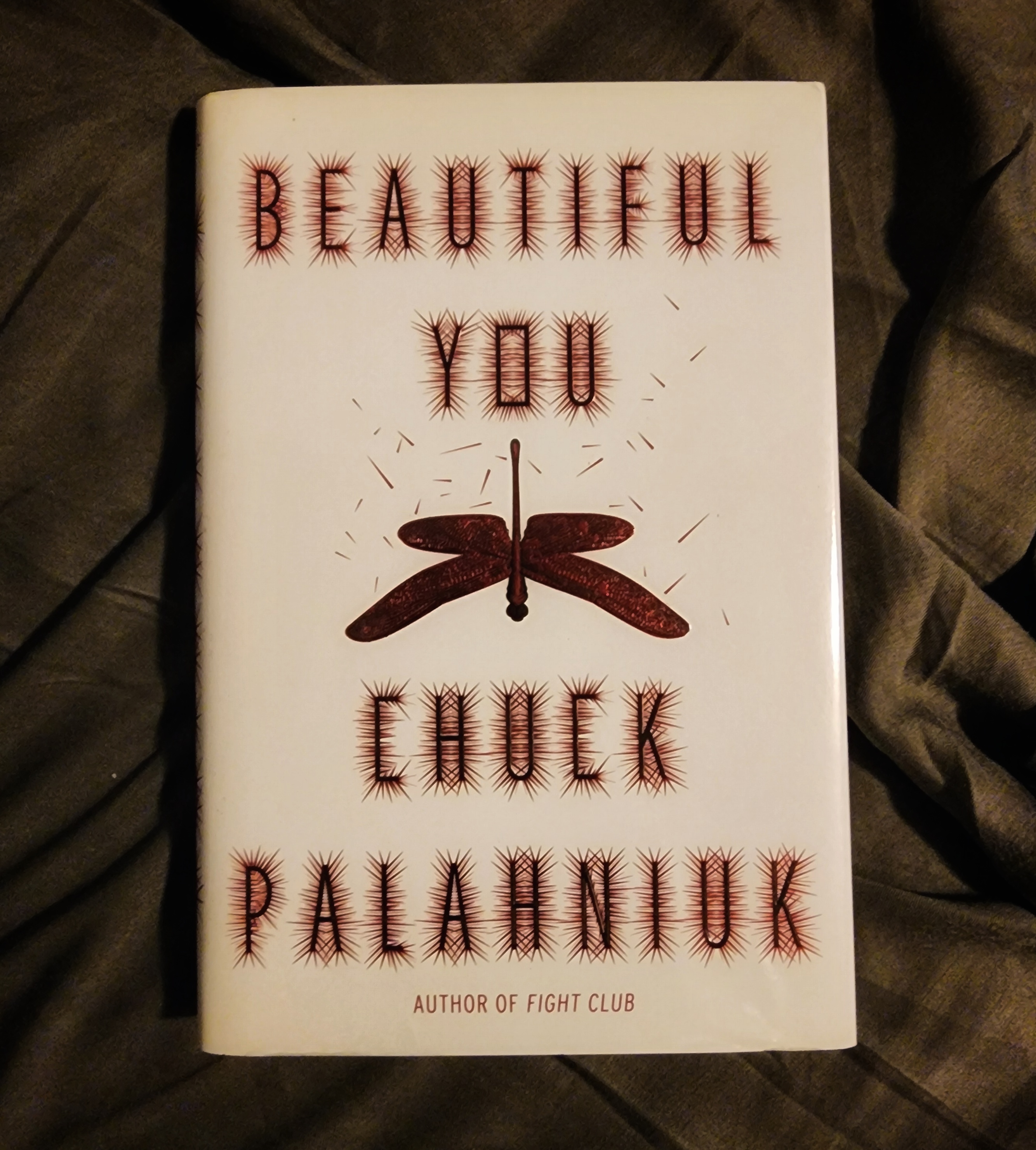
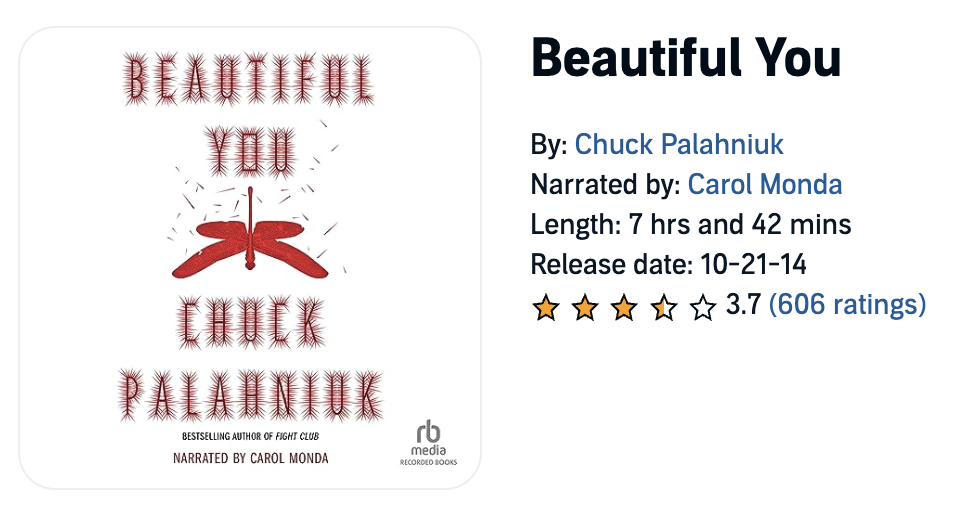
Beautiful You by Chuck Palahniuk

I’m a long-time reader of Palahniuk’s work, and I’ve rarely found anything disappointing in his writing. Beautiful You, I’m happy to say, was no exception. As always, his unique literary voice and cadence shine through, while still managing to avoid seeming repetitive or tired.

This novel introduces us to Penny Harrigan, a woman whose life seems to be an unending series of disappointments, whether it’s her career or her love life. All of that changes when tech billionaire C. Linus Maxwell takes an interest in her. She’s as surprised as everyone else, as she lives out a Cinderella fantasy that most girls would only dream of. Unfortunately, the dream is quickly revealed to be more of a nightmare, as she begins to feel less like a romantic partner and more like a guinea pig. Maxwell is not the man the tabloids make him out to be, perhaps because he secretly owns them.

As this intensely sexual tryst continues, Penny silently watches the clock ticking down to the inevitable conclusion that awaits all of Maxwell’s romantic partners. And when that end arrives, it’s as jarring and disorienting as the beginning was.

It’s soon revealed that Maxwell has his eyes set on an objective with global repercussions, and Penny has been ignorantly complicit in the horrors that await the women of the world. By the time she realizes what’s going on, is it too late to get anyone to hear her?

As she struggles to put a stop to the plan already in motion, she’s hammered with revelations that force her to question her life, her identity, and the extreme limits of human sexuality.

As sexually explicit as Beautiful You happens to be, there’s nothing remotely erotic about it. That’s the magic of Palahniuk’s writing. He was able to approach a topic so steeped in sexual content without making it feel smutty or even remotely sexy. He takes us right to the verge and then turns away…like literary edging. There’s a perversity in the clinical detachment of it all, and the sense of impending awfulness that the reader or listener is impossible to dismiss. In a sense, it makes us feel superior to the characters, because we see the trap that awaits and convince ourselves we could escape it. It forces you to wonder if we’d succumb to the same terrible outcome if this sequence of events played out in the real world.

The moral of the story, I suppose, is that men need to focus more on the pleasure their partners are experiencing…otherwise, the Beautiful You line of products might just take our place.

Carol Monda’s narration definitely captures the initially neurotic and out-of-her-depth qualities of Penny’s character as well as who she becomes as the events of the story transform her.

This Skin Was Once Mine and Other Disturbances by Eric LaRocca, Narrated by Andre Santana, Natalie Naudus, Michael Crouch, & Steven Crossley

It seems appropriate that the first title I’m reviewing in June of 2024 is a title by a recently prolific and extremely talented LGBTQ+ author. This Skin Was Once Mine: and Other Disturbances is a collection of four unconnected stories that nevertheless work well together because of the common themes of relationships, secrets, and revelations that emerge as the tales are told. The title, also the title of the first of the stories, is emblematic of Eric LaRocca’s work, substantially longer than one expects a title to be, but so thoroughly captivating that it’s impossible to ignore.

In the titular tale, we are introduced to Jillian Finch, who returns to her childhood home following her father’s death, only to discover that many of the things she thought she knew about her family and her former life are not quite how she recalls them. As hideous secrets are revealed to us, her traumatized psychology shifts her focus to things that are seemingly trivial by comparison. As she reflexively ignores the horrible things she endured and survived, we witness the residual effects of childhood trauma and the devastating ripples they have.

The next story in this collection, Seedling, also deals with grief and mourning, as a son returns home to an emotionally distant father when his mother passes away. He discovers the wounds we carry with us, passed down from generation to generation, as hurt is revisited. And even as he and his father come to understand one another better than they ever have, it seems that the seeds germinating early in life have grown into cancerous wounds that might be impossible to heal.

All the Parts of You That Won’t Easily Burn introduces Enoch Leadbetter as he attempts to find the perfect knife to satisfy his husband’s needs for an upcoming dinner party. Instead, he finds a secret and shameful obsession that consumes him, as he loses touch with who and what he was with startling consequences.

In the final story, Prickle, we meet two elderly gentlemen as they come together for the first time in a long while. Worried that time may be limited, they play a cruel, sadistic game they once enjoyed. But as the challenges grow increasingly perverse, we’re forced to witness a shocking loss of humanity and decency.

Each of these stories is spectacularly well-written and deeply immersive, which is truly the most insidious aspect of LaRocca’s storytelling. They remain with you long after you’ve stepped away, and you’re forced to move forward, knowing that there’s no sense in worrying about the innocence you lost along the way. Like the snake shedding its skin, there’s no reason to look back or to think, “This skin was once mine.”

The narrations provided by Natalie Naudus, Andre Santana Michael Crouch, and Steven Crossley were spot-on. The perfect narrator was selected for each story, in my opinion. They made the tales feel more authentic and poignant. I don’t know how long it took to choose who would narrate the individual stories, but if it was a drawn-out process, it was worth every second of deliberation.

https://www.audiobooks.com/audiobook/this-skin-was-once-mine-and-other-disturbances/755321

All I Want Is To Take Shrooms and Listen To the Color Of Nazi Screams by John Baltisberger

That title’s a mouthful, right? Well, I challenge you to come up with a more appropriate title for the book after you’ve had an opportunity to read it. This is going to be a challenge to review because it’s so many different things. There’s so much going on within these pages. At the core, it’s a collection of short fiction and poetry, much of which is focused on kaiju–I’ll return to that later. But this collection is unique in that it’s assembled in a framing story that tells us a colorfully embellished autobiography of Mr. Baltisberger himself.

Colorfully embellished is certainly one way to describe it. This is the autobiography of John Baltisberger if he took off the restraints that civilized society has shackled him with. There is violence galore–violence we certainly hope isn’t an accurate representation of John’s life. If it is, then we should probably keep our mouths shut and let him go about his business. Because his business is killing neo-Nazis, fratboy rapists, corrupt police, klansmen, and other people the world might be better off without…and ingesting copious amounts of hallucinogenic substances. Of course, as we learn later on, much of his attention has shifted to focus on his intensely sexual relationship with his loving wife and the fantastic daughter they’ve produced. But maybe there’s still room for killing bad guys. There’s always room for that, right?

So, regarding the kaiju-focused short fiction and poetry. A few years ago, Mr. Baltisberger offered to write personalized kaiju poems or stories taking place in locations of your choosing. I was one of the individuals who took advantage of that offer, and I was pleased to see that the brief tale was included in this collection. They’re a lot of fun, and it’s hard not to enjoy giant monsters going on monstrous rampages as such creatures are wont to do.

One feature that stood out for me was roughly two-thirds of the way into the book, where there’s a hugely epic poem that will surely satisfy fans of Baltisberger’s stand-alone poetry. It tells a tale of history and war, intrigue and mysticism. That alone is worth the price of admission. It is best thought of as admission because Baltisberger is going to take you on a dizzying, kaleidoscopic thrill ride that rivals anything you’ll find at Six Flags.

You can also find this title, along with many others by the same author as well as the publisher, Planet Bizarro Press, by going to http://www.godless.com or following the link below: