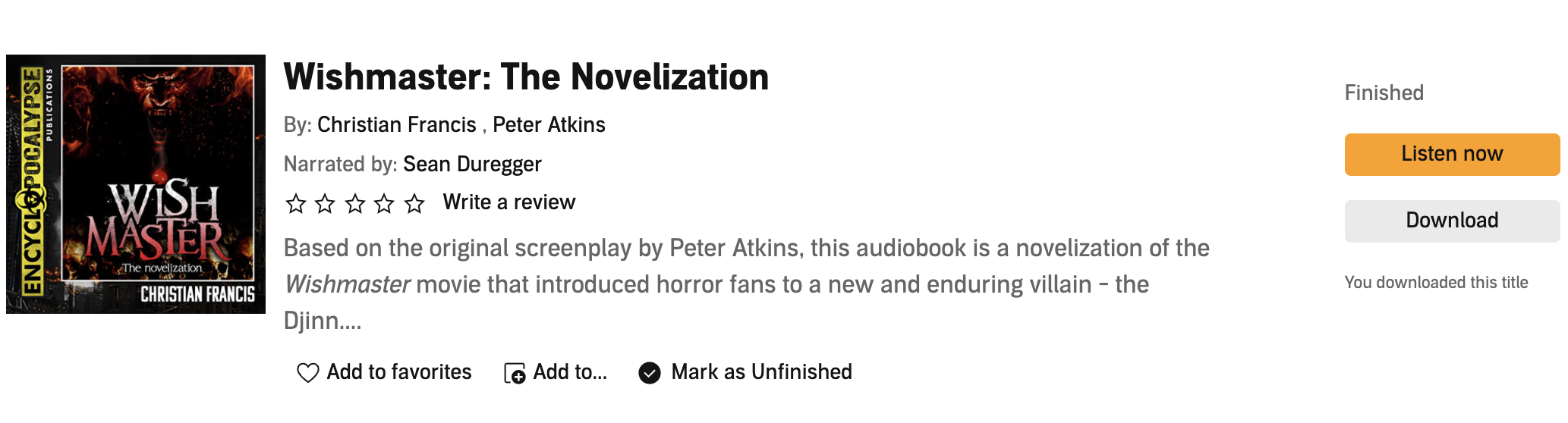
Wishmaster: The Novelization by Christian Francis, Narrated by Sean Duregger

The novelization of Wishmaster verifies something for me that I’ve long suspected to be true. While I own it, and I’m able to enjoy it for what it is, I never cared for the 1997 movie altogether too much. It just felt all too cheesy and poorly put together, like it was building on the worst aspects of the Nightmare On Elm Street series. It wasn’t the story that was the problem–I now know for sure–because I thoroughly enjoyed this novelization based on the screenplay.
From the tumultuous devastation in ancient Persia to the symmetrical horrors of the climax at Beaumont’s party, the descriptions from the narrative–and the visions elicited in my imagination–were far superior to what was executed on the screen under Robert Kurtzman’s direction. While the casting choices for the movie weren’t bad, Andrew Divoff being a particularly fantastic choice, most of the decisions seemed to be less focused on who would be right for the role and more aimed at drawing in a preexisting audience from other intellectual properties. The absence of performers who felt shoehorned into their roles also made for a better experience through the novelization.
It was enjoyable, following along as an ancient evil was set loose in a modern city, a city unprepared for a creature of magic and malevolence like the djinn.
Sean Duregger’s narration was excellent. He especially captured the demonic tone and texture of the djinn’s voice, both in its natural form and in the guise of Nathaniel Demerest. He had some pretty impressive shoes to fill, lending his voice work to a character originally played by Andrew Divoff, but he managed to pull it off successfully. Additionally, with a movie that had been narrated by Angus Scrimm (the Tall Man himself), Duregger was biting off a lot more than most would dare…but again, he did it, and he did it justice. There’s a reason he’s steadily become one of my favorite audiobook narrators.
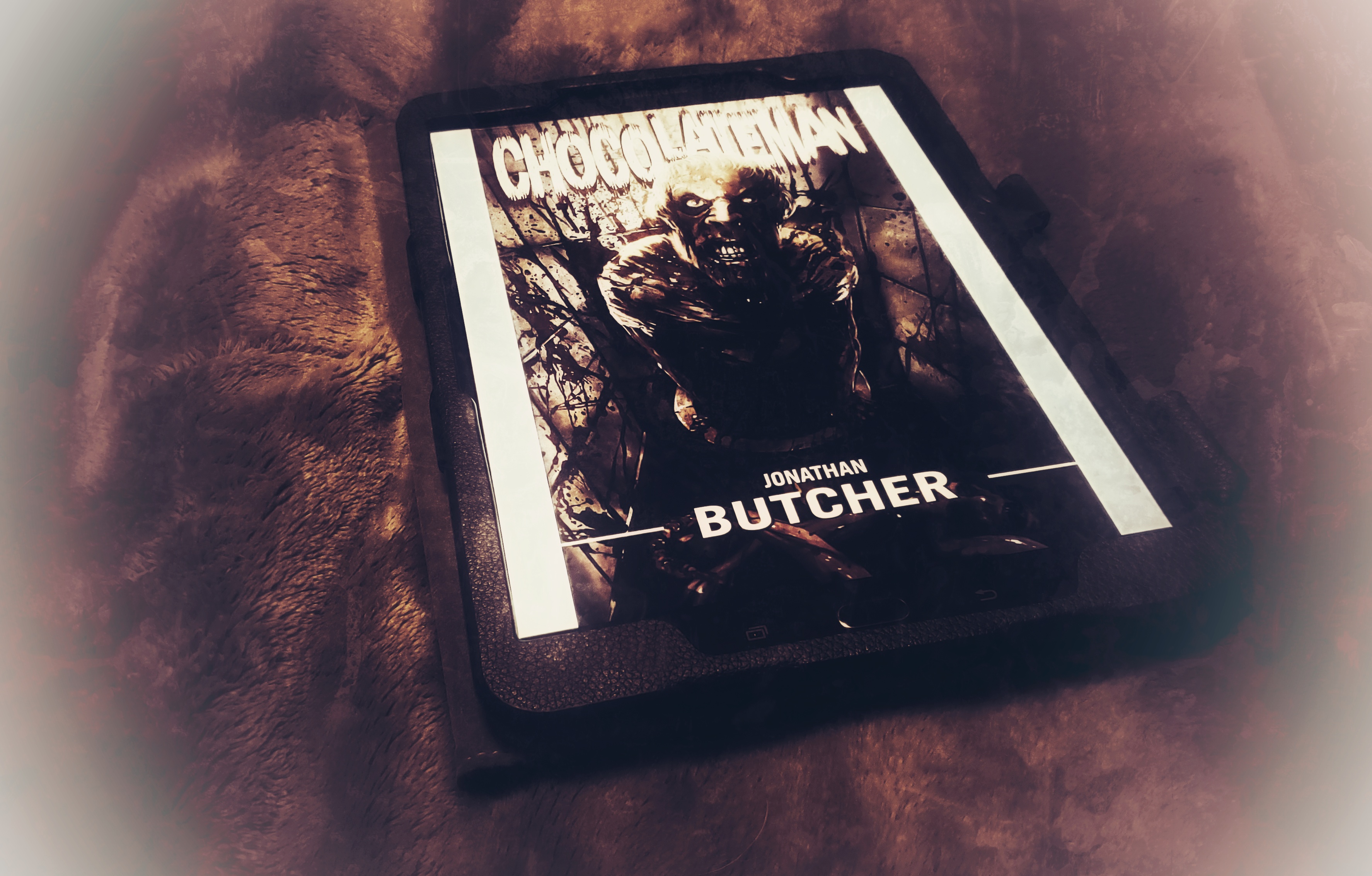

Chocolateman by Jonathan Butcher

If you’ve already subjected yourself to Butcher’s coprophilic masterpiece included in Scats, Splats, and Stupid Twats, you’re already familiar with Kreb, The Chocolateman. You can think of him as something akin to Candyman, a monstrous, supernatural being who comes when you make the mistake of uttering his name. Of course, instead of bees and honey, his aesthetic is purely fecal.
This larger volume can be considered the origin story for The Chocolateman. Butcher takes this opportunity to tell us how Kreb found his way into our world and our bathrooms in search of delicious choc-choc.
James Tooth appears to be a successful man with a loving family, but he is tormented by a horrible secret that troubles him more profoundly as the 22nd anniversary of his parents’ deaths approaches. James is terrified of poop and with good reason. Throughout the story, Butcher provides readers with glimpses of James’s childhood, the horrible events of 22-years before, when he was only ten years old. As the past catches up with him, taking a terrible toll on both himself and those around him, he has no choice but to face the nightmare that’s haunted him the previous two decades, his older brother, Kreb.
Mixed up in the whole mess, James’s drug dealer, Mucklow, and his bodybuilding lover, Isabella, find themselves in the wrong place at the wrong time over and over again, leading them on a collision course with the Tooth family and The Chocolateman himself.
Amazingly enough, considering how absurdly revolting the concept of Chocolateman is, Jonathan Butcher still populates this tale with well-developed and sympathetic characters. Grotesque, gory, and visceral as much of the narrative happens to be, it’s also fantastically well-written and articulated in such a way as to never seem quite as gratuitous as it’s clearly meant to be. Chocolateman isn’t simply a collection of repulsive gags and toilet humor. At its heart, it’s a story about family, fears, and the ways we cause harm when trying to do what we believe to be the right thing.

This title was released on http://www.godless.com as part of the 31 Days of Godless event for October of 2021. You can pick it up for yourself by going to the Godless website or by downloading the Godless app to your mobile device of choice. The links for purchase are available below:

Until the Sun by Chandler Morrison, Narrated by John Wayne Comunale

You’re a 15-year-old boy living with a foster family when you awaken to the sounds of shattering glass followed by what can only be violence. This isn’t the first time your short life has been punctuated with instances of horrific bloodshed, and if you choose to join the band of peculiar killers reveling in the chaos they’ve created in what is your third home in only a third as many years, this most certainly will not be the last. Don’t worry, this isn’t a choose-your-own-adventure story, and this pivotal decision is taken out of your hands and placed in the skilled, albeit sadistic custody of Chandler Morrison.
Entering the dizzying narrative of Until the Sun, you’ll be swept along currents of blood, strange drugs, and adolescent hormones until you find yourself standing dazed, in the sunlight of a new day, waiting for the ride to end. Morrison thoroughly captures that sense of being caught up in a life that feels entirely out of your control. This extends so far as to include the fact that, as a reader, you’ll see the final moments coming long before our protagonist does…and you’ll experience sensations that range from pity to heart-wrenching sympathy as you witness events unfolding.
We’re forced to wonder–if we’re being honest with ourselves–whether we’d be any more capable of wresting control from those who steer us along the destructive path ahead of us if we’d experienced the same tragic and disorienting life of young Casanova. I suspect we’ll never know, and we should be grateful for the fact that the dreadful sequence of events befalling that young man could only happen in fiction.
Morrison provides us with a vampire story that is both more and less than that. Until the Sun is a dark, twisted, and perverse coming-of-age tale that abruptly detours us through the worst possible paths to reach the conclusion. A conclusion, I might add, that is equal parts hilarious and cruel in both its predictability and subversion of what a reader might expect when first choosing the book.
John Wayne Comunale’s narration is effective in bringing to life the characters who often feel like caricatures of people we might have known in our own lives, or maybe people we’ve been at different points in our lives. There probably isn’t a narrator who would have been better suited for this drug-fueled, bloody, and irreverent combination of various horror subgenres.

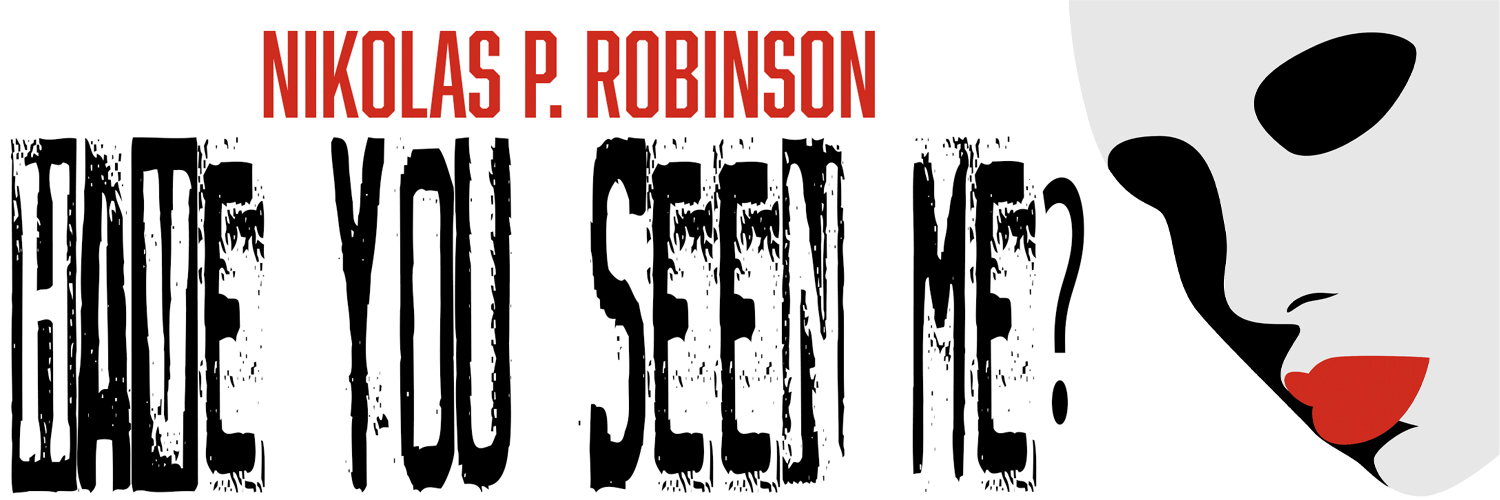
Have You Seen Me?

When his teenage daughter disappears, Offi–former Officer Standish learns he will do anything to find her. In his search he will plummet to lows he’d never dreamed possible, braving trials that test the limits of his imagination and his intestinal fortitude.
How far would you go to save the life of your only child?

Just in time for Thanksgiving, I’m bringing you a story that should make you hold your loved ones closer, treasuring family. I don’t want to spoil anything, because I delve into the backstory surrounding what motivated me to write this one in the Author’s Notes at the end of the story…but in the midst of this, you’ll encounter the snippet I’d set aside to share as part of the KillerCon 2021 virtual convention. Sadly, I opted not to dive right into the depravity and that decision did me no favors.

You can find this Godless exclusive short by going to http://www.godless.com or by downloading the Godless app to your mobile device of choice. The link is below:

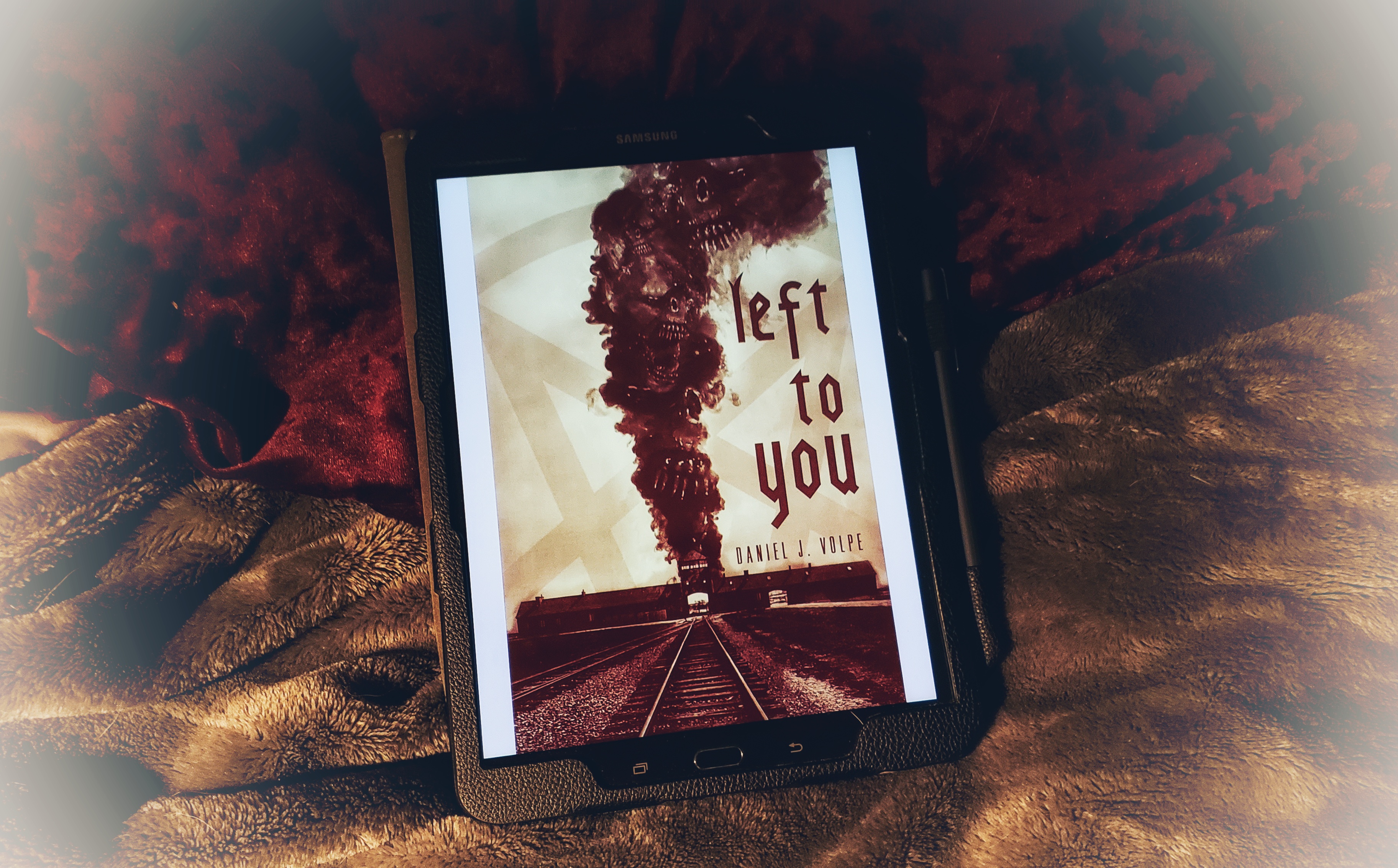
Left To You by Daniel Volpe

Robert Sinclair is a good kid who has a lot on his plate, but he pushes through it all and remains good-natured and hard-working. Working multiple jobs, struggling to remain afloat while caring for a mother suffering the end-stage of cancer, Robert doesn’t have much room in his life for anything else.
While working a dead-end job at L-Mart, Robert has developed a friendship with an elderly gentleman, Josef Lazerowitz. A former theology professor in Poland, Mr. Lazer is burdened by an unbelievable history, plagued with unspeakable secrets that will soon become Robert’s burden to bear.
Both of these men, Robert and Josef, are decent and sympathetic characters forced to experience their individual, horrific torments separated by more than half a century. In the end, what they’ll share is a terrible and shameful confidence that could destroy both of them and anything they hold dear.
Daniel Volpe constructs a captivating, mysterious tale that’s so thick with atmosphere and depth that the reader can hardly keep from being immersed in the experiences brought to life on the page. His detailed exploration of Josef’s life in 1940s Poland is gripping and profoundly vivid, almost painfully so. The author’s unique portrait of the supernatural world and how it interacts with our own was fascinating. As the story delves into those things only near the latter half of the book, it still doesn’t feel like the reader is short-changed or left wanting. I can’t recommend this book enough, especially to those who enjoy a bit of historical fiction with their horror.
I will suggest that one scene in this book troubled me, and it involves a bit of a spoiler, but I’ll do my best to dance around that by explaining a little bit about my own life, hopefully framing why I found it disturbing without telling you about the scene itself. I had a dog named Molly. She was a terrific, atypical chihuahua who was perpetually thrilled to meet new people. When she was seven years old, she was taken from me by cancer in her blood. That little girl died in my arms, in what I can only describe as a traumatic experience without going into detail. I now have a dog who is half golden retriever and half German shepherd and husky–funny enough, named Talia–who is two years old. She’s been with me since December of 2019. Fans of Volpe’s work might find that last bit to be a strangely serendipitous thing. Having a personal connection with both a golden retriever and a dog named Molly, there’s a particular scene that I found difficult.

I picked this title up as part of the 31 Days of Godless event at http://www.godless.com in October of 2021. You can obtain a copy for yourself by going to the website or downloading the app to your mobile device of choice. The link is below:

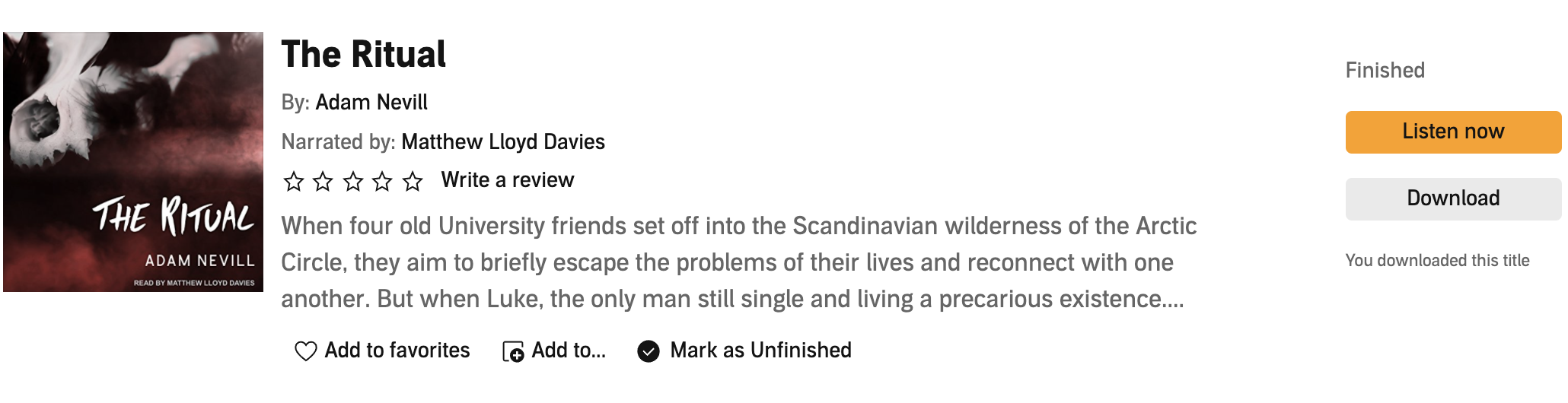
The Ritual by Adam Nevill, Narrated by Matthew Lloyd Davies

The Ritual is a fantastic journey into the realm of folk horror, a literary exploration into the sort of narrative that evokes themes familiar to fans of movies like The Wicker Man or Midsommar. As four friends hike into the autumn wilderness of Sweden, they discover that not all shortcuts are meant to be taken, that there are secrets and horrors in hidden places, and they find tensions that refuse to remain beneath the surface as stress and fear take a heavy toll on the men.
The gloomy, sinister forest is brought to stark, claustrophobia-inducing life as Adam Nevill draws us deeper into the trees and brush as the relentless rainfall paints everything gray and lifeless. The characters of Hutch, Dom, Phil, and Luke are similarly well-drawn and three-dimensional in their portrayal. This realism serves to make the narrative all the more captivating as we become invested in the drama playing out between the hikers and the overwhelming sense of unease as we experience the disquieting events through Luke’s perspective.
By the time the four men discover they’re not alone in the woods, it’s far too late to turn back, and the desperate push forward presents challenges that grow increasingly difficult.
Now, because I’ve seen the movie adaptation as well, I’m going to compare the two. This portion of my post will include spoilers, so anyone seeking to avoid spoilers of either book or film should stop here.
The movie would have benefitted a great deal from incorporating elements that were exclusive to the novel, such as the multi-generational graveyard and the ancient, decrepit church Luke discovered when he ventured off on his own. I loved that whole section of the story, and I think it added something to the atmosphere of the narrative moving forward. Similarly, the familiarity Hutch had with some of the architecture and runic writing was a nice touch that I felt could have made the movie better. I also preferred the absence of the cowardice subplot, wherein Luke did nothing and allowed a fifth friend to die. Unfortunately, with the absence of that subplot, we also lost the element of blurred reality that I enjoyed a great deal in the movie, wherein the god of the forest used illusions and hallucinations to manipulate the men.
The movie was superior once Luke made it to the village near the end. The addition of Dom being present and alive for a portion of that section of the story was a nice touch that I think made for a better overall story. Sure, we had the reconciliation between Luke and Dom in the novel as well, but it felt more appropriate at the point when the men were in captivity and facing the very real probability of death. Removing the irritating caricatures of Loki and Fenris was a great choice, as I almost stopped with the book when those characters insisted on remaining present for altogether too much of the narrative. The random insertion of the fictional, murderous nordic black metal band, Blood Frenzy, felt like a pointless way to share the author’s familiarity with contemporary bands within the genre. Additionally, the portrayal of the god/monster within the movie was spectacular and exceeded anything I imagined from the book.
Overall, I think I enjoyed the movie a bit more than the book, which is an uncommon thing…but it does happen.
The audiobook narration provided by Matthew Lloyd Davies was spectacular. He even managed to superbly capture the accents of the characters I’d have preferred to do without. The narration certainly served to add depth and texture to the narrative, something that leapt from the page, so to speak, bringing an extra quality to the words penned by Nevill.

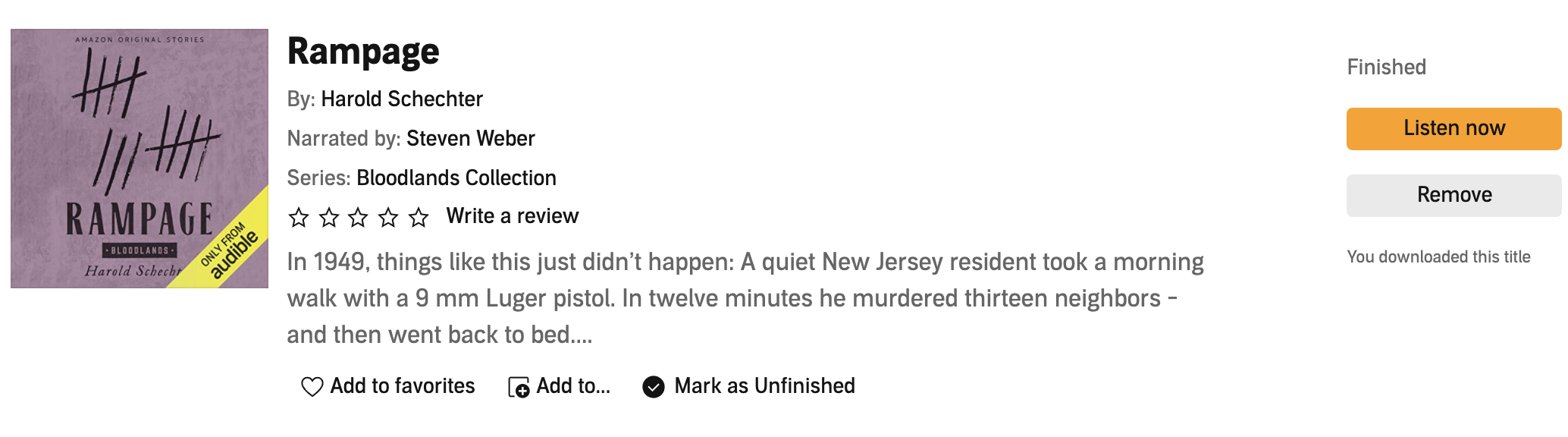
Rampage by Harold Schechter, Narrated by Steven Weber

Rampage is the story of Howard Unruh, a man who, in 1949, would murder thirteen of his neighbors (and people passing through his neighborhood) before returning to his apartment and returning to bed because he’d run out of ammunition. As the killer himself indicated during an interview, he’d have killed a thousand if he’d had sufficient ammunition.
Repressed homosexuality, experiences during the conflict of WWII, and assorted petty grievances against his neighbors simmered for years until finally exploding in a cold, meticulous series of killings that would thoroughly destroy the relative peace of Camden, NJ.
Considered the face of modern mass murder, Unruh had no apparent interest in committing suicide at the end of his bloody rampage, nor any plan to be killed by the police. He simply wanted to kill the people he perceived as being aligned against him or of having committed one slight or another, and once Unruh started, he didn’t seem interested in stopping until he had no choice but to do so.
The descriptions of the murderer’s flat affect and calm demeanor both during the rampage and during the subsequent questioning, while a bullet remained lodged in his thigh, were unnerving in a way I can’t quite put into words.
Steven Weber’s narration was as high quality as it has been for the rest of the Bloodlands stories, and I would love to hear him narrating further true crime audiobooks and even documentaries.

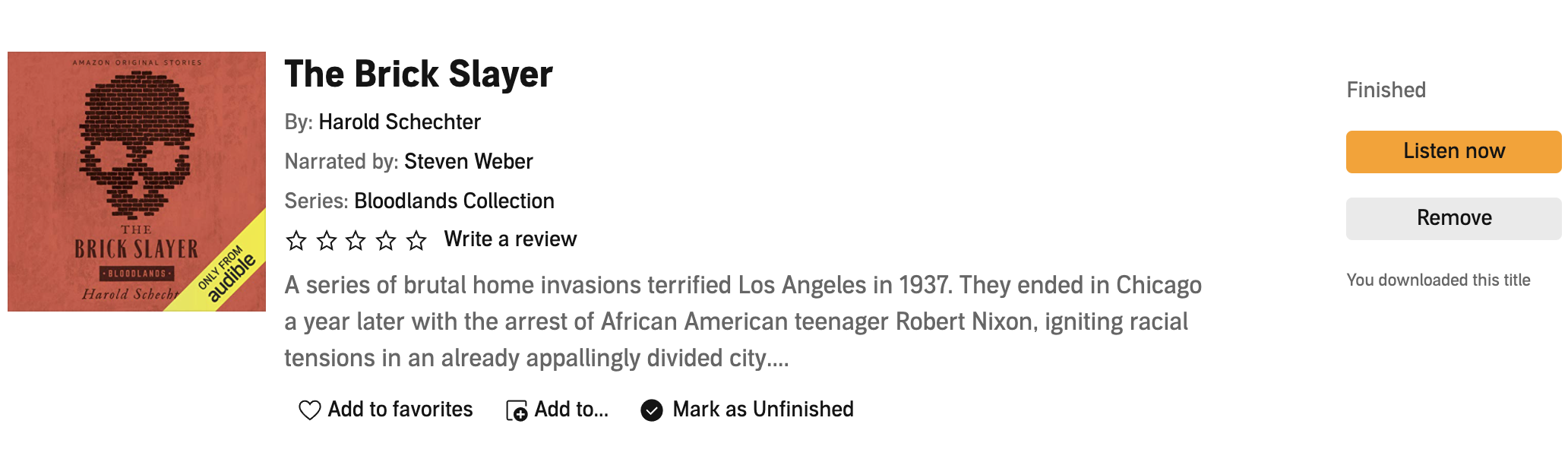
The Brick Slayer by Harold Schechter, Narrated by Steven Weber

The Brick Slayer provides us with an in-depth study of a series of home invasions and killings that transpired in Los Angeles and Chicago in the late 1930s. The title comes from the killer, Robert Nixon, using bricks to incapacitate the victims.
As interesting as the crime details might be, the vastly more interesting component of this particular narrative is the focus on the trial and the socioeconomic elements that contributed to the conditions of Robert Nixon’s life. It’s fascinating to think that Richard Wright’s Native Son was largely inspired by the circumstances surrounding Robert Nixon’s admittedly reprehensible acts and the reaction of those in law enforcement and the media to such horrific crimes committed by a young African American man. The barely suppressed racism of 1930s America seemed to be on full display throughout the investigation and subsequent trial, but it’s the more subtle and insidious racism of American culture that may very well have set Nixon down the path he ultimately found himself traveling.
Schechter’s insightful case studies are always profoundly interesting, but this one perhaps more so than many others, simply because of the tangential aspects of the society and culture at large during the years when these things took place.
Steven Weber’s narration is superb and well-suited to the Style of Schechter’s writing.

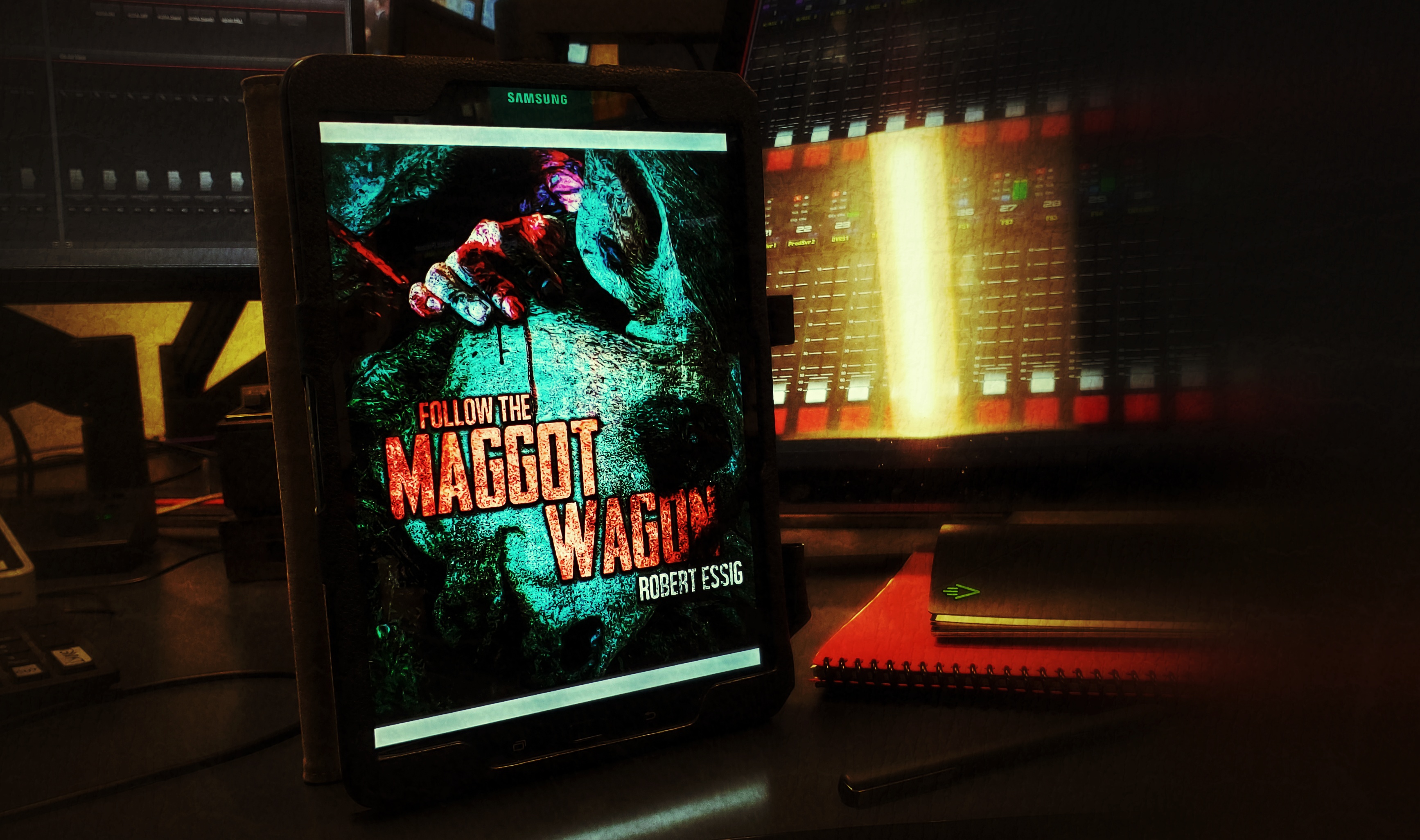
Follow the Maggot Wagon by Robert Essig

Follow the Maggot Wagon takes the road trip narrative in a deliciously awful direction. Jamie and Adam had been friends for most of their lives, but they’d gradually grown apart as Adam’s impulse control issues and drug use led him down paths Jamie wouldn’t follow. Though Adam’s poor impulse control might have helped to push the friends apart, it was also the thing that contributed to years of pranks, dares, and manipulation by Jamie and other friends. Old tensions arise as the two friends find themselves stuck behind the maggot wagon, a truck that smells like it’s hauling a full load of carrion beneath the tarp in the back, and Jamie takes this as an opportunity to push Adam into doing something risky and juvenile, pushing his buttons along the way.
The true surprise of Essig’s story isn’t what’s going to happen, as the reader begins to suspect where things are going long before we arrive at the farmhouse. The shock is the motivation behind it. Throughout the story, we catch glimpses of the eroding facade of civility between the two friends, as the interactions take on an increasingly cruel and bitter tone. We think we know why we’re speeding toward the inevitable outcome, only to find ourselves just as stunned as Jamie and Adam are when more secrets get revealed.
I suspect many of us have friendships like this, where old grudges and recrimination are difficult to forget and perhaps more challenging to forgive. Thankfully, most of us don’t decide to follow the maggot wagon as Jamie and Adam did.
This was an excellent character study, portraying both individuals with vivid and tragic dimensionality. Both Jamie and Adam are relatable, and that makes it all the more disturbing because one has to wonder how much or how little it might take to push us into either the driver’s or passenger’s seat.

This title was released as part of the 31 Days of Godless event at http://www.godless.com for October of 2021. You can obtain a copy for yourself by going to the website or downloading the app to your mobile device of choice. The link is below:

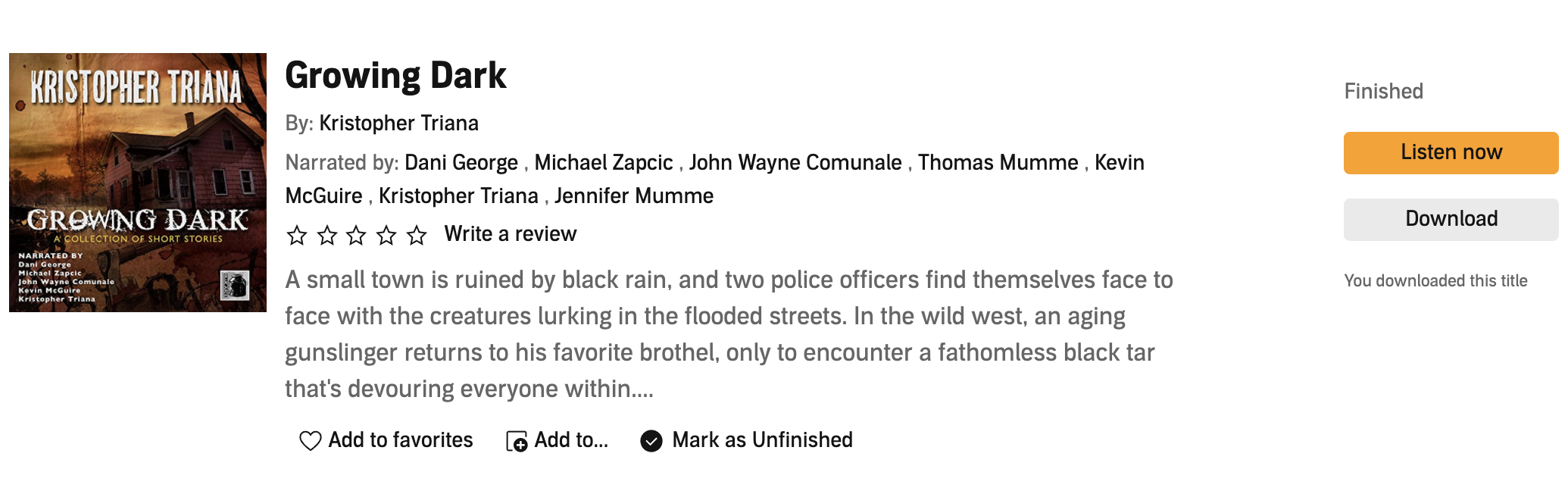
Growing Dark by Kristopher Triana, Narrated by Kristopher Triana, Dani George, John Wayne Comunale, Michael Zapcic, Kevin McGuire, Thomas Mumme, and Jennifer Mumme

Growing Dark truly showcases the eclectic range Triana is capable of in a way a reader would otherwise only discover if they took the time to read half a dozen books. Running the gamut from intense cosmic horror to something that could be considered kid-friendly, there’s no doubt any lover of dark fiction will find something to love in this short collection.
From the Storms, A Daughter kicks everything off, sharing the story of a town that’s been going through hard times, and they’re only getting harder as the region gets flooded. First responders in boats are struggling to locate stragglers to take them to safety, but what they find instead is evidence that there’s more to fear than the water.
Eaters is a post-apocalyptic excursion into the remnants of the old world, as a small party of hunters is clearing the area of zombies. As with most tales like that, things don’t go smoothly. Triana manages to bring some originality to the topic, and an ending that readers/listeners are unlikely to see coming.
Growing Dark is a coming-of-age tale gone wrong, as a farm boy surrounded by sickness and decay desperately wants to prove to his father that he can be a man. Sometimes being a man involves making some hard choices, and sometimes they’ll be bad choices as well.
Reunion is an insightful story of childhood regrets and how the mistakes we make can haunt us well into adulthood, altering the courses we travel and where we ultimately end up.
Before the Boogeymen Come was the most surprising inclusion in this collection. Triana entertains readers as he breathes life into the monsters who plague the imaginations of young children before media and experience provide new monsters to replace the old.
The Bone Orchard is a heartbreaking western tale that could be read, depending on the reader’s perspective, as being either pro-life or pro-choice in its message. An old shootist returns to an old haunt and old love, only to discover there’s a sinister secret behind keeping the brothel running smoothly.
Soon There’ll Be Leaves is a character study framed by multiple horrors, the most potent of which being reflection on a life not well-lived and the looming loss of family. Returning to a place he’d sooner never see again, our protagonist is approached by an old flame who proves the adage that one can never go home again, as an attempted affair takes an unforeseen twist.
Video Express is a nostalgic exploration of the video rental stores of our youth and condemnation of how we quickly turned our back on the family-run establishments in favor of places where we could easily snag the newest titles.
Giving from the Bottom is another character study, this time focused on the horrors of everyday life and the gradual erosion of both one’s ability to care and one’s will to live when nothing seems to turn out as expected.
The collection ends with the strangely epic Legends, a vision of an afterlife that is not at all what one might expect. In Triana’s captivating narrative, we discover that the dead–if they’re famous or infamous enough–become eidolons of a sort. Charles Bronson and Lee Marvin come together as paragons of what generations of moviegoers and fans imagined them to be, and as such, they are bestowed with purpose and power to protect the world from infernal entities who may have similarly familiar faces. For me, Legends was the best of the whole collection, providing a glimpse into a world I could see the author fleshing out into a much longer piece.
The narrations provided by Dani George, John Wayne Comunale, and Kristopher Triana himself were the best of the bunch. Triana especially did an excellent job of providing his characters with distinctive voices, and in the case of Before the Boogeymen Come a level of caricature that was enjoyable. The additional narrators, Michael Zapcic, Thomas Mumme, Jennifer Mumme, and Kevin McGuire were satisfying as well, just not as memorable as those provided by the three previously mentioned.