We Need To Talk About Portland…

We need to address some serious misconceptions and outright lies that are circulating regarding Portland, OR, and the allegedly embattled Department of Homeland Security. I’ve heard this city referred to as a “War Zone,” “Under siege from attack by ANTIFA, and other Domestic Terrorists.” President Trump claimed he was acting to “protect War Ravaged Portland” when he declared that he would be mobilizing the Oregon National Guard against the wishes of Governor Tina Kotek. Trump’s fictional narrative is so pervasive that right-wing propagandists and Trump supporters are uncritically repeating it left and right, even (and perhaps especially) when provided with evidence that he has no idea what he’s talking about.

If someone (myself included) from Portland shares photos and videos that counter this deluded perspective that the city is a “War Zone,” they’ll be condemned for “Cherry Picking,” and either not sharing evidence of the correct locations, or at the right times. They’ll come back with video clips from FOX News, OAN, Newsmax, or right-wing influencers that selectively focus on moments of conflict, ignoring the context. They also often overlook the fact that several of these videos are from the 2020 BLM protests or from three or four months ago, as is clear from the background, in which one can easily see that the windows of the Portland ICE Facility are not boarded up, as they have been since mid-June of 2025.

I can only assume this disingenuous, bad-faith distribution of selectively edited media is what the President was referencing when he discussed the fires and devastation supposedly in evidence throughout Portland (and especially in proximity to the Portland ICE Facility), because none of that is presently relevant.

Other people will respond by sharing photos and videos of homeless people, tents and litter on the street, graffiti, or people using drugs openly. This, of course, has nothing at all to do with the premise behind President Trump’s deployment of troops and the increase in Federal Law Enforcement in the city. The homeless population, tents on sidewalks, and drug users are not (in any sense) related to the supposed siege of the Portland ICE Facility. It’s the equivalent of an Ad Hominem attack or tossing a Red Herring into the discussion of the city. It’s irrelevant to the conversation at hand, and it ignores the fact that all American cities (including those much smaller than Portland) have homeless individuals and families, drug use, and graffiti.

No one with any intellectual honesty or integrity will deny that Portland has a problem with homelessness. I don’t think I’ve ever heard anyone suggesting otherwise. What they will say is that it’s not worse than other large American cities, which is accurate. As of January 2024, Portland didn’t even crack the Top Ten, and as of this year, Portland is the 28th most populous city in the United States. Denver has only 100,000 more people, but has twice as many homeless people, according to the same numbers from January 2024. Seattle has only about 150,000 more people, but had more than twice the homeless population of Portland last year.

But Portland, Denver, and Seattle combined barely reach half the homeless population of Los Angeles, which is roughly half again the homeless population of New York City.

Homelessness is a complicated issue. The contributing factors are manifold, and the solutions (while comparatively simple) aren’t things anyone in a position to do so wants to seriously address.

Are these National Guard troops and Federal Law Enforcement Officers coming to Portland to address issues like homelessness?

No, they are not.

Which means anyone trying to distract from the topic at hand by tossing that into the mix needs to shut the fuck up and let the adults talk. Bad faith bullshit is not welcome.

So, let’s talk about the alleged assault on ICE that Kristi Noem, Tom Homan, Donald Trump, and others want to claim is taking place.

Before we move on, I’d like to dedicate some time to Kristi Noem, though. I have a relatively unique perspective in that I lived in South Dakota while Kristi Noem served as Governor, and previously as a U.S. Representative, before I moved to the Portland Metro. She was much-maligned by even Conservatives I knew in South Dakota, as a corrupt and undemocratic force in State Government. Of course, that didn’t stop them from voting for her, because she happened to be a Republican.

Noem’s histrionic portrayal of the protests in Portland is not novel. She has a long history of opposing the First Amendment right to Speech and Assembly, stretching back to the protests against the Keystone Pipeline. She was also investigated for Corruption regarding the circumstances surrounding her daughter and the Real Estate Appraisal Licensing system in South Dakota.

Perhaps most egregious, when South Dakota voters passed a Ballot Measure to legalize Recreational Cannabis in 2020, she and two members of Law Enforcement filed a lawsuit to overturn the results of the election, which passed by a margin of 54 to 46%. It’s particularly amusing when you compare it to her Gubernatorial Victory in 2018, of only 51%. The courts sided with Noem and the two Law Enforcement officials, claiming the Ballot Measure violated a “single-subject” provision. Never mind that any Ballot Measures in South Dakota undergo a legal review by the Secretary of State to confirm that they conform to state statutes.

I don’t entirely blame Noem. South Dakota has a history of corruption and anti-democratic practices. It was only two years before she was elected Governor when voters approved an Anti-Corruption measure that would have led to an independent ethics commission, campaign finance reform, restrictions on gifts from lobbyists, and increased transparency regarding campaign contributions. The Governor at the time, Dennis Daugaard, and the State Legislature repealed the Initiated Measure only a few months later, with Daugaard suggesting that voters hadn’t really thought things through.

As you can see, Noem comes from an environment where corruption and undemocratic sentiment run rampant. It should have been a warning sign about the Trump Administration that she would be so readily welcomed into the fold. For some of us, it was. Of course, for many of us, there had already been several warnings.

Placing her in charge of Homeland Security has been an unmitigated disaster, as anyone could predict. But it’s not the disaster she might propose. Since Donald Trump returned to office in January, at least 15 people have died while in ICE Custody. This does not include the two detainees who were murdered by the shooter in Dallas last month. That number also doesn’t include individuals who died shortly (or immediately) after they were released from ICE Custody, nor does it include individuals who have died since being deported or falling victim to the Administration’s new take on Extraordinary Rendition.

But, guess what, a total of zero ICE agents have been killed in that same time frame. This, despite President Trump’s wild claim that people have died in Portland. Unless he’s speaking of unrelated deaths (or deaths from years ago), no one has died as a result of protests happening in Portland. The last death of anyone involved with the Department of Homeland Security (not an ICE agent) was a U.S. Customs and Border Protection agent who was shot on January 20th, during a traffic stop in Coventry, Vermont.

Most recently, the only injury of note was when an ICE officer was dragged by a car driven by an undocumented immigrant attempting to evade him. The immigrant in question was killed; the ICE officer was not.

Still, all the talk from the Administration has been focused on how ICE agents are under attack. But, it certainly sounds like it’s far less dangerous to work for ICE than it is to be taken into their custody.

Noem and Homan like to talk about large percentages when they discuss the increase in assaults on ICE agents. Of course, those numbers are readily subject to scrutiny, because that percentage reported by DHS has fluctuated dramatically, sometimes within hours: 500%, 700%, 1,000%. It’s almost as if they’re just tossing large numbers in front of a percentage sign to appeal to the average person’s inability to contextualize what a percentage increase actually means. A keen observer might notice they’re loading the statements to make people afraid.

Let’s break down how percentage increases work for those of you who need some assistance.

If there were hypothetically only one ICE agent assaulted between January and September of 2024, it would mean that five, seven, or ten had been attacked during the same time frame this year to reach those previously mentioned percentages of 500, 700, or 1,000%. But to say it was ten agents that had been assaulted over the course of an eight or nine-month interval doesn’t have the same dramatic flair to it. Most recently, they’re claiming it’s a more than 1,000% increase, but without providing any actual numbers to contextualize what that percentage means. The real numbers (according to all official records) were something to the effect of ten assaults in 2024 compared to 79 in 2025. This is also far less dramatic than using a percentage increase to trigger an emotional response. After all, we could refer to it as a 790% increase. Which number sounds scarier to you?

Mind you, only a small percentage of these assaults involved protesters, and an even smaller number had anything at all to do with Portland. These attacks are largely coming from people they are detaining.

And, of course, the numbers have spiked. ICE is more active and aggressive, and is utilizing tactics that are absolutely going to increase violent reactions. When masked men with no official insignia are grabbing people and hauling them into unmarked vehicles, it looks more like a kidnapping than anything official or legal. Never mind that there have been several documented incidents this year of people being assaulted, kidnapped, and raped by people pretending to be ICE agents. There’s even one reported killing by a fake ICE officer. Knowing all of this, would you simply accept that this is a legitimate, state-sanctioned detainment?

There’s also the deeply concerning fact that several of the things that constitute assault in the eyes of DHS have been categorically ludicrous in many instances. The official claim was that the New York City Comptroller, Brad Lander, had assaulted agents when he was detained at an Immigration Court proceeding in June, though the available video evidence shows no assault of any kind. Garbage dumped on an ICE agent’s lawn was also one example of “assault” on DHS, while another was a sign that included an individual ICE agent’s name and a great deal of profanity. There was even an incident here in Portland where an Indigenous woman was charged with Assault because an ICE officer claimed to get a headache because she was blowing a whistle on the sidewalk in front of the Portland ICE Facility. Even if those examples were the only questionable ones, they would present a huge issue when discussing relatively small numbers of incidents.

And, of course, it could be argued just as easily that assaults performed by DHS agents have increased by similarly huge percentages, but Noem and Homan are disregarding that. The very real likelihood, though, is that more people are being assaulted by ICE agents than are assaulting them.

Several of these assaults have been without cause or provocation, unless you claim standing in place, holding a sign with mean words on it, and yelling profanities at these masked men constitutes a clear threat. Based on how fragile and sensitive the Administration seems to want us to believe the people working for ICE happen to be, I guess those things might just be adding to the assault statistics.

Of course, all of this escalation on the part of the Administration is a painfully transparent attempt to trigger a response. The same thing was done in Los Angeles earlier this year. The same tactic was also on display during the BLM protests in 2020. President Trump, Kristi Noem, Tom Homan, and others are gambling on the likelihood that increased Federal Agents and the addition of Military Personnel will be sufficient to push the situation past a tipping point. At that point, they will have the flimsy justification required to impose greater Authoritarian control over Portland, Chicago, and wherever else they decide they want to add pressure.

It’s an absurd truth, and one that got Portland’s Mayor, Keith Wilson, laughed at and mocked, but the best thing protesters can do is to refuse to take the bait, to stay home, and to make the Administration look like the scaremongering force it absolutely is. Of course, that may not solve anything, since right-wing agitators have been masquerading as protesters and journalists already. It would hardly be a stretch to imagine them inciting violence just to ensure it adversely impacts their opponents. Some of them also have a documented history of instigating fights, both within the protest groups and as counter-protesters. They also have a history of fabricating violent altercations and even going so far as to start fights just to selectively capture the retaliation on camera for the purpose of furthering their propaganda objectives.

Either way, what we end up with is a situation wherein protesters are expected to behave in a way that is beyond reproach, or they’re condemned for inciting violence. That may sound painfully familiar to anyone who has dedicated time to studying the Civil Rights Movement. But the uniformed individuals who are supposedly trained to de-escalate situations are deploying pepper spray and gas canisters despite the law clearly stating the use of force must be reasonable, necessary, and proportionate. They’re intended to adhere to the same standards required for self-defense on the part of the average person.

In fact, on July 25th, Assistant Chief of Operations for Portland Police Bureau, Craig Dobson testified, “It makes it extremely difficult for us to deal with, as the folks that are on the other side of this fence have been, night after night, actually instigating and causing some of the ruckus that’s occurring down there…” and that DHS agents are not following best practices.

It’s also on record that ICE had been witnessed firing pepper balls on the crowd without any apparent warning or provocation on June 12th. Then, it was back on June 14th when protesters shattered the glass of the front door, subsequently leading to the boarding up of all windows. DHS officials panicked and used indiscriminate force against the protesters at that time. The one ICE agent who was hurt had abrasions and nothing worse. The same kind of disproportionate and indiscriminate attack by ICE agents was documented on June 23rd and 24th, when an ambulance had to be called because a protester was hit in the head with a gas canister. It can get dangerous out there, but the vast majority of the danger is directed at the people exercising their Constitutional Right to protest the actions of the Administration and the Department of Homeland Security.

If someone intends to protest, they need to understand their rights. But that’s not enough; they also need to know the limited power bestowed upon the people they are protesting against. It’s essential to recognize that Department of Homeland Security officers have significant limitations. No one within ICE has the authority to arrest, detain, or restrain any American Citizens. There are several examples of ICE agents violating this explicit limitation in their purview. There are exceptions regarding Citizens who assault an ICE agent or who actively interfere with ICE performing the duties that are within their scope. U.S. Customs and Border Protection officers have fewer restrictions. But a Citizen would have to commit a Federal Criminal Offense in the officer’s presence before they can restrain, arrest, or detain someone. Finally, Federal Protective Services has similar authority to Customs and Border Protection, but its scope is focused on Federal Facilities.

It’s imperative to recognize that, unless a protester is actively breaking the law in some way related to the “work” DHS performs, these officers are not permitted to so much as lay a hand on any Citizen. Assuming the protester has not trespassed onto the Federal Property, damaged the same, assaulted an officer, or obstructed them in their lawful duties, no one working for DHS has any authority to use physical force against the protester.

They can (and should) be sued each and every time they violate the limited authority they have. Further, though I want to be clear that I am not encouraging violence, if someone is attacked by an employee of DHS without provocation, they are well within their rights to defend themselves. Even though they may be wearing uniforms, their authority as Law Enforcement ends the moment they violate the restrictions associated with their role. If someone does fight back (and some would suggest they should), I will offer the same recommendation I’ve received from individuals who specialize in self-defense; if they’re threatened to the extent that they have to defend themselves, they need to make sure it’s safe for them to turn their back on the threat to walk away. The threat can no longer be a threat.

If you find yourself in a situation wherein you have to fight back (and I believe you should), that fight doesn’t end in the street. Keep fighting their attempts to prosecute you for assault as well, because if they’ve stepped outside of bounds, they’re just some asshole, not an actual cop. In Oregon, you’re legally entitled to use physical force if you believe it’s necessary to protect yourself, another person, or your property from Unlawful physical force. You are permitted to use whatever force is proportionate to the perceived threat. Just keep in mind that you cannot be the initial aggressor.

Not Only CAN We Pay for It, We SHOULD.

There’s always a lot of talk about how we can’t afford Single-Payer Healthcare here in America, and how much our taxes would increase if we were to implement a Universal Healthcare System. I got tired of listening to people who probably haven’t performed any mathematical operations more involved than basic addition or subtraction since they reached adulthood. I decided it was worthwhile to examine three countries that do provide for their citizens: Denmark, Canada, and the UK, to see how they compare to us here.

For the sake of simplicity, despite it making the whole process far more complicated for me, I’ve taken the liberty of converting all currencies to USD based on the conversion rates as they were today.

In Denmark, there is no Federal Tax on the first $8,080 an individual earns. From $8,080 to $94,224, there is a 12% Federal Tax rate. Anything above $94,224 is taxed at a rate of 15%.

If someone were to earn a hypothetical annual income of $150,000, they would face a total Federal Tax burden of $18,673.68, leaving them with $131,326.32 of their income.

There’s also a Municipal Tax rate that falls between 22 and 27% on all income. At the highest rate, it would decrease the remaining amount to $95.858.49. This means they pay a total of $54,141.51 in taxes on an annual income of $150,000. At the lower rate of 22%, it amounts to a grand total of $51,673.68 they’d pay.

In America, an individual is looking at a tax rate of 10% on the first $11,925. They pay 12% on everything earned between $11,925 and $48,475, 22% from that amount to $103,350, and 24% up to $197,300. So, the same person earning $150,000 in the United States would have a Federal Tax burden of $28,847, which is substantially higher than the federal taxes paid in Denmark.

To factor in municipal taxes, the closest comparison is to consider state income taxes, where applicable.

In the eight states where there is no State Income Tax, that $28,847 is all the individual pays, based on their annual wage. Most of us, of course, live in the 42 states where there’s an income tax levied on an individual’s wages.

Fourteen of those states have a single rate applied to all income, as opposed to a progressive system like we have at the federal level. Arizona is 2.5%, Colorado and Mississippi are 4.4%, Georgia is 5.39%, Idaho is 5.695%, Illinois is 4.95%, Indiana and Louisiana are 3%, Iowa is 3.8%, Kentucky is 4%, Michigan and North Carolina are 4.25%, and Pennsylvania is 3.07%.

In Arizona, the individual would pay an additional $3,750, and in Idaho, they would pay $8,542.50 in addition to the $28,847 they’re paying in Federal Income Tax. The larger amount is $38,389.50, so an individual living in Idaho would pay only $15,752.01 less in state and federal taxes than someone living in Denmark, on the same $150,000.

For states with progressive tax rates, you could be facing a maximum rate of 5% in Alabama and Massachusetts, 3.9% in Arkansas, 9.3% in California, 6% in Connecticut, 6.6% in Delaware, 7.9% in Hawaii, 5.58% in Kansas, 7.15% in Maine, 5.25% in Maryland, 7.85% in Minnesota, 4.7% in Missouri, 5.9% in Montana, 5.2% in Nebraska, 6.37% in New Jersey, 4.9% in New Mexico, 6% in New York, 1.95% in North Dakota, 3.5% in Ohio, 4.75% in Oklahoma and Rhode Island, 9.9% in Oregon, 6.2% in South Carolina, 7.6% in Vermont, 5.75% in Virginia, 4.82% in West Virginia, 5.3% in Wisconsin, and 8.5% in the District of Columbia.

For someone in North Dakota, that would translate into a total State Income Tax of $2,925, while in Oregon, it would come to $12,894.50 above the federal taxes collected, or a total tax burden of $41,741.50. This is only $12,400.01 below the maximum federal and municipal tax burden on the same income in Denmark.

We already know that taxes are higher in Denmark than in the U.S.. That comes as no surprise. But now we understand what the difference is, instead of imagining some abstract higher dollar value. So, let’s take a look at two other nations with universal healthcare.

Canadian federal taxes are 15% up to $41,883.75, 20.5% from there to $83,767.50, 26% up to $129,853.86 and 29% up to $184,992.22. The same $150,000 annual salary would lead to a total of $32,693.57 in federal taxes.

The individual provinces have their own tax rates, of course. The highest rate you’d experience at that salary would be in Nova Scotia, which is 21% on anything over $112,894.50. The lowest would be Nunavut, which has a rate of 11.5% on any income above $129,853.13. Looking at the highest rate, you’d be looking at an additional $24,829.79 beyond the $32,693.57 in federal tax, for a total of $57,523.36, which is moderately higher than the highest burden you’d encounter in Denmark.

In the UK, there is no tax burden up to the first $17,220.90. We’re looking at 20% from there until $68,869.90, and 40% up to $171,441.80. So for the same income of $150,000, you’d pay a total of $42,781.84 in federal taxes. You’d also be responsible for National Insurance Tax of 8% on earnings from $17,220.90 to $68,869.90, and 2% on earnings above that. Thus, you’d be paying an additional $5,754.52 on top of the $42,781.84, for a grand total of $48,536.36, which is lower than in both Canada and Denmark, but still slightly higher than the previous examples of Idaho or Oregon.

Of course, in Denmark, Canada, and the UK, you benefit from Single-Payer Healthcare along with those higher tax burdens; burdens that may not be quite as comparatively high as people in the U.S. often imagine them to be. Those increased taxes are largely offset by what we pay for our Insurance Premiums, even with employer-provided insurance.

The cost of individual Health Insurance Premiums in the U.S. can average anywhere from as little as $1,368 to as much as $8,951 per year, and family coverage is often dramatically higher. None of that even factors in the Out-Of-Pocket expenses for care and medication or multi-thousand-dollar deductibles we’re responsible for, before Health Insurance provides any assistance at all. For example, I have comparably fantastic Health Insurance through my employer. The Deductible for my Family Coverage is $3,300 annually, with an Out-Of-Pocket Maximum of $7,500. God forbid we have to find help Out-Of-Network, though, because the Deductible there is $10,000. Halfway through July, my Insurance Premium has cost me $1,491. It’s worth noting that this is entirely separate from Dental and Vision Insurance. To put all of that in perspective, that means that, in addition to the $1,491 I’ve paid just for the privilege of having Health Insurance, I also have to pay $3,300 Out-Of-Pocket before Insurance begins contributing to further Medical Care or Mental Health expenses. Until I’ve paid $7,500 Out-Of-Pocket, all my Health Insurance will contribute is a percentage toward those costs. I want to remind you that I have exceptionally affordable Health Insurance compared to many people I know.

All of this is brokered through Insurance Companies that receive massive Subsidies from the tax dollars we’re already paying. Companies that actually increase the cost of healthcare in the process. UnitedHealth Group, made famous by Luigi Mangioni, is a perfect example of this.

UnitedHealth Group raked in $372 Billion in 2023, $281 Billion of that revenue from the insurance division headed by Brian Thompson, the man killed on a New York City street by Mangioni. Only two years earlier, UnitedHealth’s insurance division obtained 72% of its revenue from Federal Subsidies, and it can only be assumed that the percentage increased by 2023. In 2024, the Federal Government spent between $1.7 and $1.9 Trillion on Healthcare Subsidies. All of this is money paid out to an industry of middlemen who have inserted themselves between people and their healthcare providers, while making massive profits in the process. In contrast, the UK spent approximately $353.5 Billion on healthcare in 2024. That is less than 19% of U.S. spending. Of course, the population of the UK is just shy of 70 Million, roughly 20% of the U.S. population of nearly 350 Million. What that means is that the Per Capita spending is virtually the same, though actually lower for the UK…but the majority of U.S. taxpayers see none of the benefits associated with that health spending. Looking at those numbers, it makes me wonder why there would even be a need to increase Income Tax rates if we weren’t propping up a parasitic and unnecessary industry in the process.

Or is it simply that the UK and other nations are better equipped to efficiently provide for their citizens than the U.S. happens to be? I’m willing to admit that we’re just not very good at doing things efficiently or effectively. I think there’s more than sufficient evidence to reinforce that perspective.

Beyond purely financial considerations, Single-Payer systems are far less likely to deny service, and when it does happen, it is typically an administrative error. Whereas, here in America, it’s a cost-saving measure on the part of the provider to maintain its profit margins.

And, the real kicker, if you don’t receive at least your premium costs in coverage from your insurer (and most people don’t), that money gets spread around to everyone else covered by the same insurance provider and to the people working there, leading to massive profits for the corporations in question and CEO salaries that can reach as high as $23 Million in total compensation. For example, even though I have reached my Deductible of $3,300 for the year, my Insurance Company is highly unlikely to pay out even the $1,491 I’ve paid so far in Premiums for their percentage of the payments before the new annual cycle begins.

Of course, none of this even takes into consideration the portion of my Premium that’s paid by my employer, which has reached almost $8,000 so far this year. So, even if my Insurance Company somehow ends up paying out $5,000 for their part of my Healthcare expenses, they’ve already got $4,419 lining their pockets without either me or my employer paying another dime toward the Premiums. I don’t get that money back. My employer certainly doesn’t receive the excess back at the end of the year either. Have you ever looked at your paychecks and calculated how much free money you and your employer are handing over to an Insurance Company that (as a policy) does whatever it can to avoid helping you? Now, take a moment to consider that all of the money coming in from people like you adds up to maybe a quarter of what the Insurance Company has for revenue.

But, of course, it’s “Socialism” if your Tax Dollars provide Single-Payer Health Coverage for every Citizen in the U.S.. But if your money is distributed between the thousands of people with the same insurer (while lining the pockets of the obscenely wealthy), then it’s an entirely different sort of thing. It’s “Socialism” even though it’s a Public Service provided by the Capitalist Governments of essentially every other Civilized Nation in the world, as well as several that we consider less than “First World” countries.

One additional benefit worth noting is that public universities cap most tuition at less than $13,000 per year in the UK. Canadians can expect an average annual tuition of under $4,800, and college tuition is not charged at all in Denmark. Whereas in the U.S., In-State tuition averages roughly $11,000 per year (ranging from less than $7k in Florida or Wyoming to more than $20k in Connecticut or Pennsylvania), and Out-Of-State tuition explodes to an average of around $30,000 (from less than $13k in South Dakota to more than $60k in Michigan).

Which is to say that you can be both healthier and better well-educated at substantially less cost in those nations, even when you factor in the increased tax burdens. Of course, as I pointed out already, there’s no reason to raise the taxes individuals pay in the U.S. if we were more efficiently utilizing the slightly higher amount the U.S. already pays Per Capita for Healthcare Subsidies than the government of the UK.

Don’t let idiots and fear-mongers influence you. None of the nations discussed are “Socialist” countries. They just take the role of government more seriously, providing for the public good.

It might also be worth noting that, in 2023, UnitedHealth Group donated $792,500 via PAC contributions to federal political campaigns. Roughly 54% of those PAC contributions went to Republican candidates and 45% went to Democrats.

It also spent an even more substantial amount of PAC funds on In-State campaigns all across the U.S.. This was divided up between individual candidates, party contributions, and ballot measures.

And, in 2024, UnitedHealth Group (according to its filing with the U.S. Senate) dedicated $6.85 Million toward lobbying efforts, above and beyond Millions in PAC spending. Think about that for just a moment. This Corporation receives most of its revenue from Federal Subsidies. And then it spends a small portion of that revenue to support the campaigns and political parties that ensure it keeps getting that money.

It’s easy to spend that kind of money when a company brings in a net income of $14.4 Billion (which was UnitedHealth’s lowest profit margin since 2019), a number heavily impacted by the Billions they spent recovering from a cyberattack on one of their claims processing subsidiaries. With everything adjusted accordingly, they proudly claimed a record high profit of $25.7 Billion for last year.

Spending $6.85 Million through lobbyists and millions more through PAC contributions isn’t a challenge when you have that kind of profit involved. The amount spent on corporate lobbying was, after all, only 0.048% of the net profit.

Of course, UnitedHealth Group has already dedicated $3.37 Million toward lobbying efforts so far in 2025, so they’re hardly skimping on graft despite it not being an election year.

While the industry rakes in massive profits, it’s happy to return the favor by lining the pockets of politicians and political parties across the political spectrum, all to ensure it has its interests taken care of.

If you can look at this and think it’s fine, while Single-Payer Healthcare would be too costly, you’re not only missing the point, but you’re being intellectually dishonest.

Skullcrack City by Jeremy Robert Johnson

S.P. Doyle is a banker, and he’s up to some shenanigans when we first meet him. That much should be expected of anyone disreputable enough to become a banker, especially an ex-junkie. An unexpected promotion provides Doyle with an opportunity to set off on a quixotic mission to do some good with his improved access, seeing himself as a hero who can take down the corrupt institution from the inside.
To accomplish his lofty goal, Doyle will need some chemical assistance. Meth, it’s said, is one hell of a drug, but Hex makes meth look positively prosaic by comparison. As Doyle’s consumption becomes increasingly massive, the threads of the conspiracy he believes he’s unraveling within the bank’s records grow more convoluted and seemingly absurd. With Deckard, his pet turtle, as the only voice of reason in Doyle’s life, nothing is stopping the erratic and manic banker from slipping off the rails.
Unfortunately for Doyle, the conspiracy he’s stumbled across is far more sinister and far-reaching than even his feverish, drug-addled imagination could conceive.
Before long, Doyle’s swept up in a dizzying world of occult forces, reality-bending drugs, insane body modifications, corporate assassins, near-immortal doctors performing unspeakable experiments, and giant gorilla-like monstrosities–referred to as Skullcrackers–who speak with the voices of the dead. What possible chance could Doyle and a small band of resistance fighters have when struggling against such insurmountable odds, at least without making sacrifices that test the limits of what it means to be human?
Jeremy Robert Johnson has created a lunatic narrative that defies genre, incorporating elements of horror, science fiction, bizarro, and crime fiction into a captivating melange that’s sure to make any reader feel like they might be on the same drugs as the unlikely hero. The most amazing accomplishment of Johnson’s Skullcrack City is that the diverse threads of this story remain straight and easy to follow, a testament to the author’s extreme skill and attention to detail.

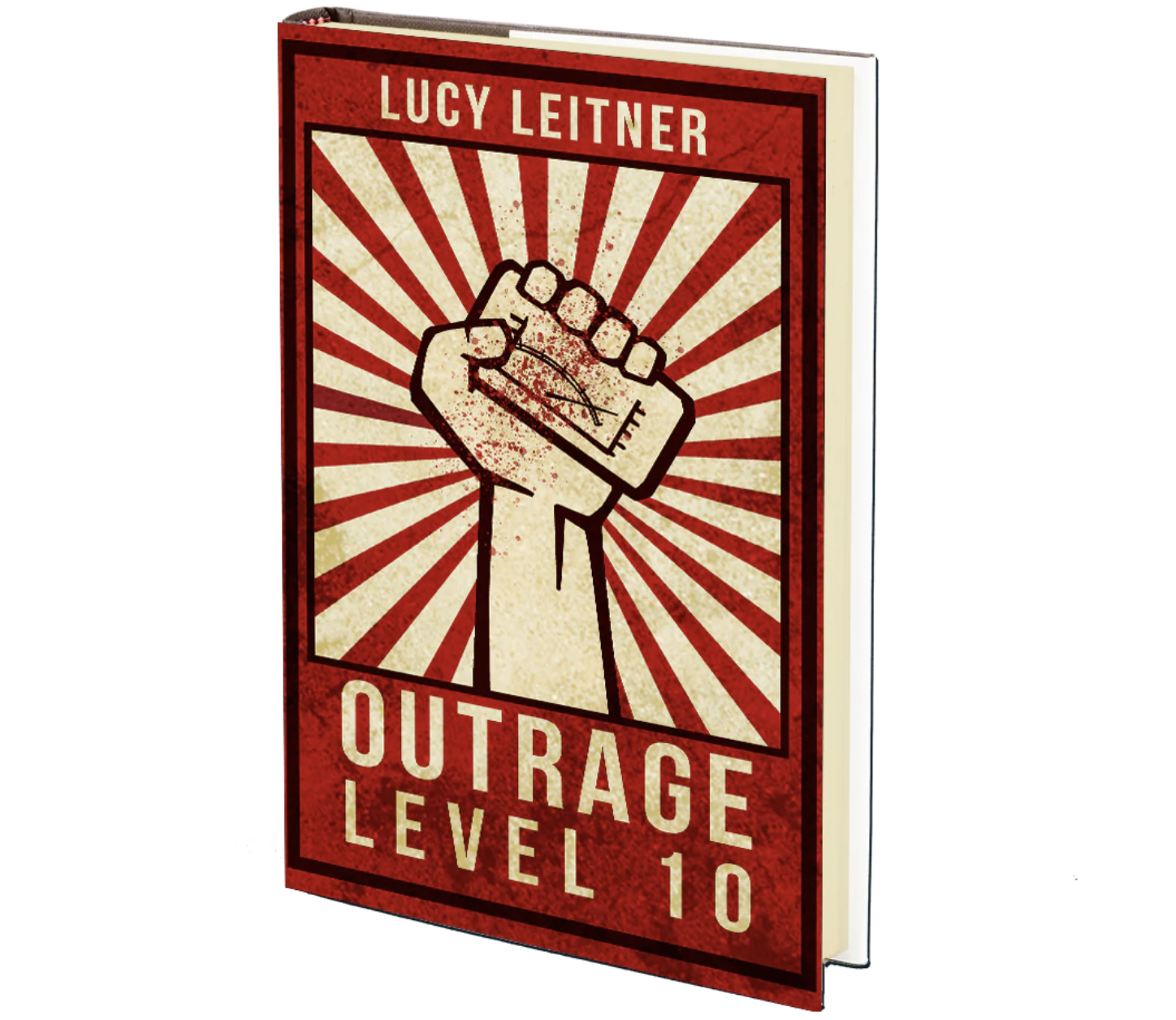
Outrage Level 10 by Lucy Leitner

It should have been a better world. Adam Levine was dead. The oligarchy and patriarchy of the old world order were dismantled by revolutionaries. Direct democracy had replaced the corrupt justice system, allowing all citizens to participate as members of the jury of peers. Unfortunately, the future envisioned in Lucy Leitner’s Outrage Level 10 is not the utopia the people believe it to be.
Alex Malone is a throwback, a former enforcer on the ice with a history of drug abuse and brain damage as mementos of the days when hockey was still a sport. As with all violent and destructive forms of competition, hockey is no more. Malone’s former career has become a ridiculed and maligned memory of the brutality and uncivilized nature of the world before the revolution. There aren’t many options available to someone with Malone’s history, so he becomes a cop, a member of another institution with a tainted history of violence and cruelty, extant in this future America as little more than glorified meter maids and health inspectors.
When Malone’s psychiatrist injects him with a potential cure for his brain damage, Alex initially seems happier, and his memories appear to be returning. But are they his memories?
What unfolds from there is a high-intensity mystery, as Alex and his unlikely partners in crime seek to unravel a sinister plot that strikes at the very heart of the nation and threatens to display the utopian society for the savage and superficial dystopia it is.
Leitner does an excellent job of sharing this cautionary tale of a revolution compromised by not only the flawed and dangerous men guiding it but also by a society engrossed in social media and an unwillingness to recognize the lack of justice associated with the court of public opinion as a substitute for legitimate courtrooms. Differences of opinion are escalated to the point of being perceived as assaults, and “cancel culture” truly becomes a thing as citizens sentence one another to death for crimes against their fragile sensibilities.
Reading Outrage Level 10 reminded me of the way Lenin–and later Stalin–essentially took the reigns of the revolution’s government apparatus and steered the force it gifted them toward their political opponents and enemies of the state who did nothing more than offer dissenting opinions. In all respects, it applies here in America just as effectively. There’s a worthwhile message to be found in these pages, that the revolution doesn’t end when the old structures are taken away. A constant state of vigilance is required to keep the new structures honest and focused on the goals of the revolutionaries.

You can obtain a copy of this book by going to http://www.godless.com or by downloading the Godless app to your mobile device of choice. The links are below: