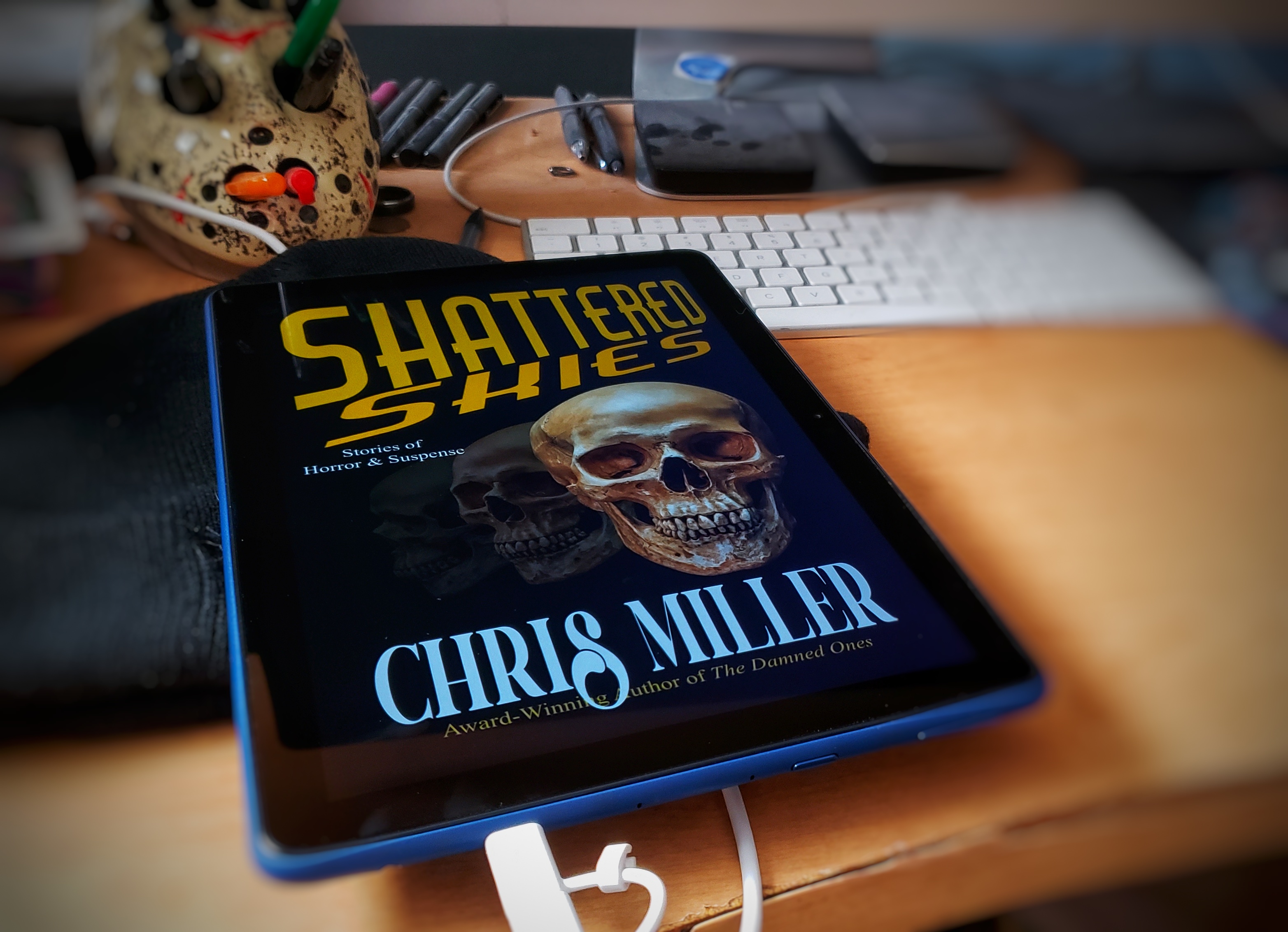
Shattered Skies by Chris Miller

The Foreword provided by Patrick C. Harrison III accurately captures the most impactful component of Chris Miller’s stories collected in Shattered Skies, suspense. There is an underlying sense of suspense to these tales, sometimes bordering on dread and other times sweeping the reader away with excitement, but ever-present just the same. Combining that anticipation and tension with masterful storytelling, Miller has assembled an amazing cross-section of what he’s capable of as a writer.
Instead of delving into each of the stories, as I often do, I’m choosing to focus on the handful that left the most lasting impression on me. This is not to say that anything is lacking in the others, just that I’m going to be spoiling things in small ways, and I’d prefer to avoid doing so with everything in this collection.
Kicking everything off with 10-35 At First United Bank, Miller thrusts readers into an all-too-plausible sort of horror as an elderly bank security guard finds himself caught up in circumstances he can’t control as he desperately tries to save the lives of those he loves. The bank heist trope receives a refreshingly sincere treatment that’s sure to be heartbreaking for readers.
Behind Blue Eyes was a story I’d already thoroughly enjoyed when I read And Hell Followed, an anthology of the end times. Miller’s portrait of a world going progressively more mad with each pressure wave of the horns blasting to signify the end is something that propels us toward a conclusion that feels simultaneously unfair and fitting. This one is a story of guilt and remorse over the way little things can have a profound and lasting impact on our lives, amplified in the recollection.
An attempt to relax with a house full of family transforms into a confrontation with a looming and mysterious terror enveloping the protagonist’s world in Horror On Lonesome Lane. Discovering what awaits on the other side has rarely seemed this awful and sinister.
Road Kill Gods provides us with a glimpse into what might be required of us to hold nature at bay as we carelessly and callously slaughter our way through our lives. Unwilling to accept the price to be paid, will our protagonist release a wave of horror upon the whole world?
As a child, there was no one in my family with whom I spent more of my time than my grandfather. In my case, it was my maternal grandfather rather than my paternal, but that doesn’t change the way Miller devastated me when I was reading Farewell. I was lucky enough to be in my 20s before my maternal grandfather passed away, and I can only imagine how much worse it would’ve been if he’d gone when I was much younger. Farewell is a touching and heartbreaking story, but it’s also a story of how tragedy can sometimes bring families closer and establish new roles for us as we seek to fill the void left in someone’s absence.
A Magnificent View brings us back to the same event from Behind Blue Eyes, or a similar enough event that we can assume they might be the same. Forced to witness the world collapsing into chaos from miles above the surface, a lone astronaut measures his life by oxygen percentage, knowing that he might still be the last survivor of the human race when all is said and done.
Wrapping up this collection with the M. Ennenbach co-authored Neon Sky was an excellent choice. We experience another story that, at its core, is about family and the risks we’ll take to save them. We’re gifted with another tale of a heist gone wrong, this one in a near-future cyberpunk dystopia. Fast-paced and endlessly exciting, Neon Sky is a fascinating juxtaposition from the somber tone of 10-35 At First United Bank. Miller and Ennenbach deliver a thrill ride populated by police drones, horrifying machines that keep the city functioning, an army of mafia killers, hackers, and confusing firearms.

Shattered Skies is a finalist on the ballot for the 2022 Splatterpunk Awards to take place at KillerCon Austin in August of 2022.
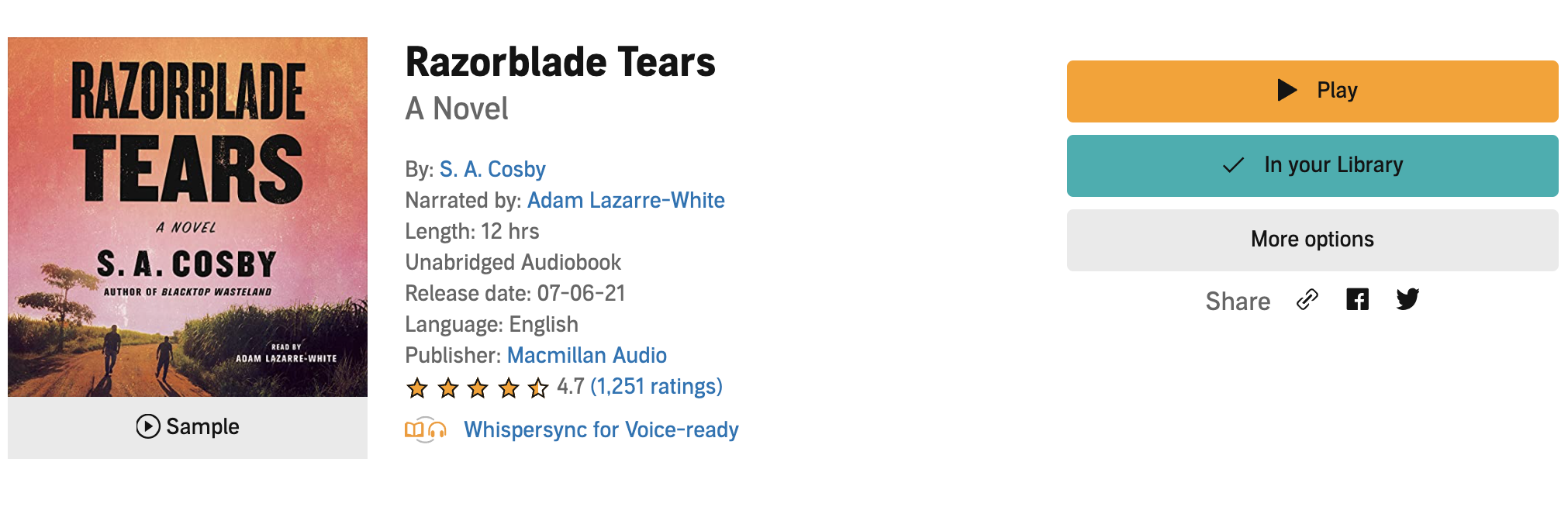
Razorblade Tears by S. A. Cosby, Narrated by Adam Lazarre-White

There is no question why S. A. Cosby’s Razorblade Tears made it to many national publications’ best of 2021 lists. This novel rests near the top of my list of best titles published in 2021 as well, especially when I focus on non-horror titles. 2021 was a good year for crime and suspense literature. Stephen King released Billy Summers, Kristopher Triana released And the Devil Cried, and S. A. Cosby released the absolute masterpiece Razorblade Tears.
Neither Ike nor Buddy Lee were great fathers when their sons were alive. Between recurring stints in prison and their prejudices about the fact that the boys were gay, in large part informed by antiquated perspectives on what it meant to be a man, the two men had driven substantial wedges between themselves and the sons they loved with reservations. It was only after the two young men were murdered that either father allowed themselves to embrace the sons they’d shown far too little affection when they were alive. Isiah and Derek, the interracial married sons, are like ghosts at the periphery of the tale Cosby weaves for us. They haunt the two men we come to admire, despite all of their faults, at the core of this novel.
Had Ike and Buddy Lee been able to overcome their ingrained bigotry while the boys had been alive, the two would have met years before the funeral, but that was not who the two men were. It turns out that the meeting of these two vastly different–yet strangely similar–men would be a fateful occasion that would lead to more bloodshed than either of the men could anticipate.
As the police investigation into Isiah and Derek’s deaths stalls out, Buddy Lee approaches Ike with a proposition that the two of them might have better luck taking matters into their own hands. Unraveling the mystery behind the brutal murder of the boys will force the two ex-cons to confront their pasts, their preconceived notions, and their concepts of love as the trail leads them through Hell and back before bringing them closer to home than they could’ve imagined.
The regret and retribution at the core of this book are at turns heartbreaking and viscerally satisfying. Most important, Cosby doesn’t shoehorn in any ersatz redemption for Ike and Buddy Lee because both men are so damaged and broken that redemption, in the sense that many writers would define it, simply wouldn’t make sense. That is not to say there’s no redemption here; there is redemption in these pages, but it’s the hollow sort that arises from the transformations coming far too late for it to make any difference.
Witty dialogue, well-crafted characters, and realistic portrayals of race relations, homophobia, and the difficulty associated with escaping a criminal past fill this novel with so much depth and honesty that it would be impossible to convey in a review. All I can say is that anyone delving into this book will come out the other end with an understanding that they didn’t have when going in.
Adam Lazarre-White’s narration for the audiobook is phenomenal. The additional character he brings to both Ike and Buddy Lee with his delivery of their dialogue is something that weighs heavily in favor of the audiobook edition of this novel because there’s such life and depth added to the characters with that extra texture.

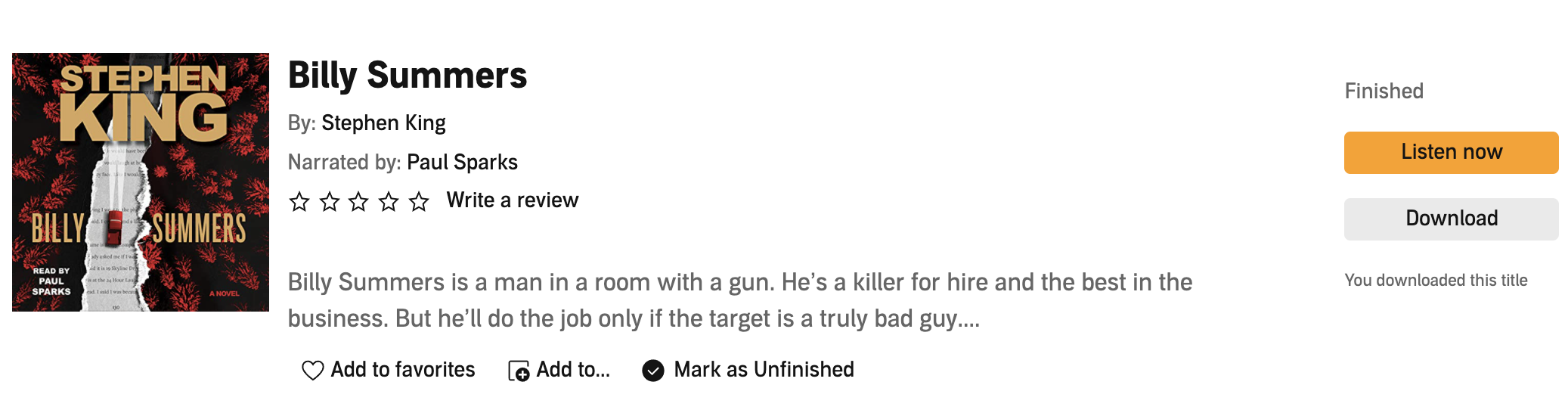
Billy Summers by Stephen King

Billy Summers is, in my opinion, the best book Stephen King’s written in a great many years. It also stands out as being one of the best non-horror books of 2021, probably of the past few years at the very least. I’m not one of those to denigrate King just because he’s King; there’s a reason he’s perhaps the best-selling horror author of all time. He knows what he’s doing, even if I sometimes question his ability to stick the landing concerning his endings. Botched endings aside, most of his oeuvre is pretty well stellar, and even the material that hasn’t aged well is still worth diving into.
With Billy Summers, while there are passing references to supernatural forces within the world (commentary on The Overlook Hotel), King has made what I consider to be his most pronounced deviation from the realm of horror and the supernatural. Beneath the surface, this novel has a lot to say about the subjective nature of morality, the fluidity of identity and self-identity, the importance of memory, and the relationships we develop in our lives. None of that overshadows the surface-level compelling narrative of Billy and Alice.
Billy is an almost unnaturally skilled killer. While he’s an expert with firearms, he’s written with such humanity and depth that he never crosses the line into being a caricature of the action heroes from film and television. Highly literate, prone to in-depth analysis of both himself and those around him, and always planning, Billy has nevertheless immersed himself within a character he refers to as his “dumb self” when interacting with the criminals for whom he acts as a shooter. Providing his employers with a false sense of confidence derived from apparent superiority has allowed Billy to avoid being perceived as a threat, and it’s potentially kept him alive through the years.
When Billy accepts what he imagines to be one last job, he’s provided with a long-term identity that brings to the surface a dream he’d never expected to pursue. As time passes and Billy immerses himself deeper within the fictional identity, he begins noticing some disturbing signs that everything might not be as smooth as expected when the time comes to complete the job. Thankfully for Billy, he’s much smarter and more capable than the people who hired him.
As Murphy’s Law takes over and anything that can go wrong does go wrong, Billy finds himself in a complex paternal relationship with a damaged young woman. As they help one another heal, Billy learns that he’s still got one last job to complete, and it’s far more dangerous than the one he’d signed up for.
The pacing is superb, and the balance of character study with narrative as we find ourselves led by King to the conclusion of the tale is about as perfect as one could hope to experience.
Paul Sparks expertly tackles the audiobook narration, thoroughly capturing the different sides of Billy as he slips from identity to identity throughout the story. He additionally captures the secondary characters well enough that there’s never any doubt who we’re hearing in the dialogue. Sparks exhibits fantastic cadence as he guides us along the path King has carved for us to follow.

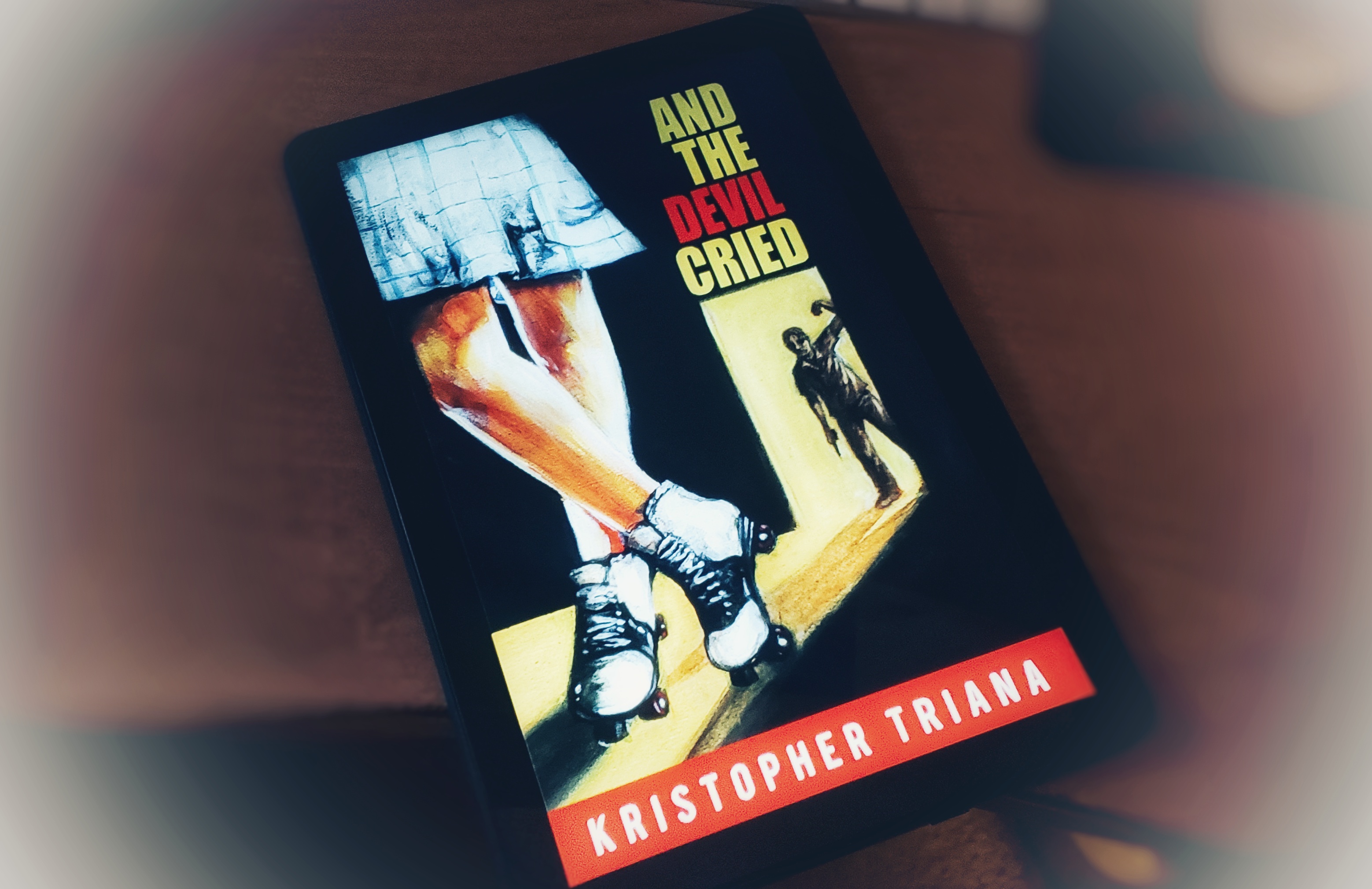
And the Devil Cried by Kristopher Triana

The release of Kristopher Triana’s And the Devil Cried is one of those examples of strangely serendipitous timing. It serves as an odd juxtaposition with Stephen King’s Billy Summers. Both stories are about men who became involved with organized crime after committing a murder during their youth and enlisting with the military. That is, of course, where the similarities end, as the characters themselves couldn’t be more different.
Triana excels in crafting unlikeable characters. His true skill is in developing these characters who manage to be entirely captivating precisely because of how unlikeable they are. Jackie is a prime example of that. Committing his first murder at the age of 17 for no better reason than greed and bitterness over the good fortune of the victim, Jackie never strives to be a better person.
After his time in the Army, Jackie never adjusts to civilian life, and he gets arrested for an attempted armed robbery. The story picks up as he’s being released and reacquainting himself with bad people he met while on the inside. As the story unfolds, you find yourself wishing he’d never been released, but there wouldn’t be much of a book if that were the case.
Misogynistic, abusive, sexist, violent, bigoted, and fundamentally heartless, there’s not much about Jackie that resembles a human being, and that’s what makes him an excellent protagonist for this particular story. While this isn’t one of Triana’s extreme horror or splatterpunk tales, he brings those sensibilities to the pulp crime genre with a character so devoid of decency that he’s almost a caricature of what one might expect a hardened criminal to be.
There are components of this story that are difficult to read. I’d suggest those are notably Jackie’s treatment of homosexuals in prison and his unabashed fixation on young girls, but it’s worth sticking it out to the end. Triana showcases a talent for writing hardboiled pulp crime that transcends the genre conventions. It’s a little bit Scarface, a little bit The Godfather, and all Triana.
While it’s not my favorite of his books, it’s well worth reading and it displays a side of Triana as an author that I’d never witnessed previously. It’s encouraging to see him stepping outside of his comfort zone and exploring new ground, and that makes me curious about what he’ll have in store for us next.

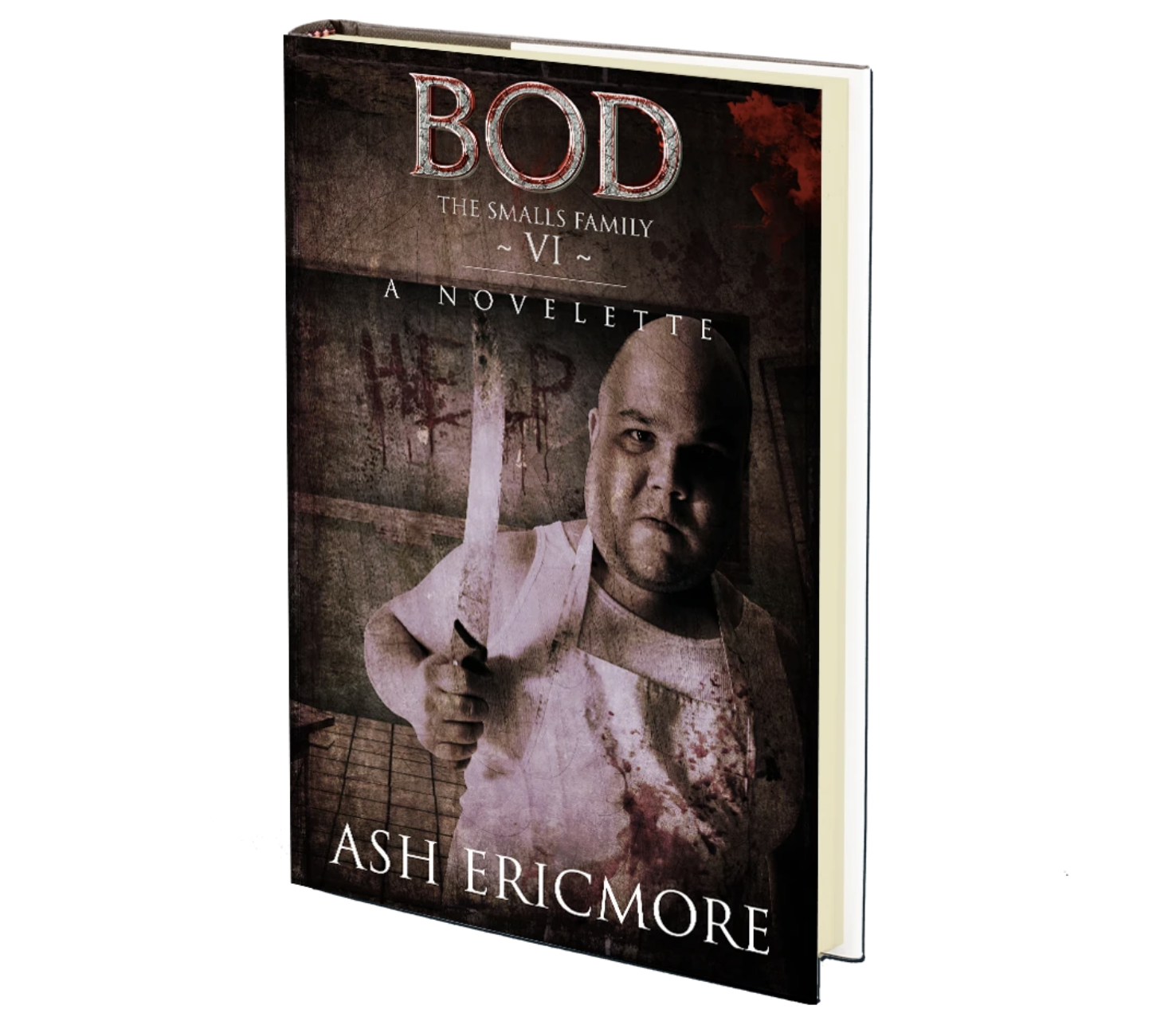
Bod by Ash Ericmore

Peter Smalls might just be the dumbest of the Smalls siblings; he’s certainly the least competent of the brothers we’ve met thus far. I’m not sure that makes him any less dangerous than the others. He might be more dangerous for being how he is.
We’re introduced to Peter just before Peter introduces Theo to his rodent buddy, Petey. Theo had somehow got on the wrong side of a member of the Smalls’ extended family, a cousin who goes by Valentine. Bod and his little buddy, Petey, are there to make things good. This is a win-win scenario for Petey because the little fella hasn’t eaten in a while.
Bod’s been hired by the Eastern Europeans to take care of some competition, but he’s going to be in for a couple of surprises when it comes time to take care of business. That is if he can think clearly enough to get to the correct address.
While Bod wasn’t quite as entertaining as Bliss and Cockwinder for me, it’s still a Smalls Family story, which makes it an absolute thrill ride of over-the-top violence and depravity. You can’t go wrong with any of these stories. Ash Ericmore continues to exhibit the same cinematic storytelling that made readers all over the world fall in love with this dysfunctional family, cementing himself as the literary amalgam of Guy Ritchie and Eli Roth, with just a touch of Tarantino for flavor.

Bod was Ash Ericmore’s release during the AntiChristmas event at http://www.godless.com for December of 2021. You can check it out for yourself by going to the website or by downloading the app to your mobile device of choice. The link is below:

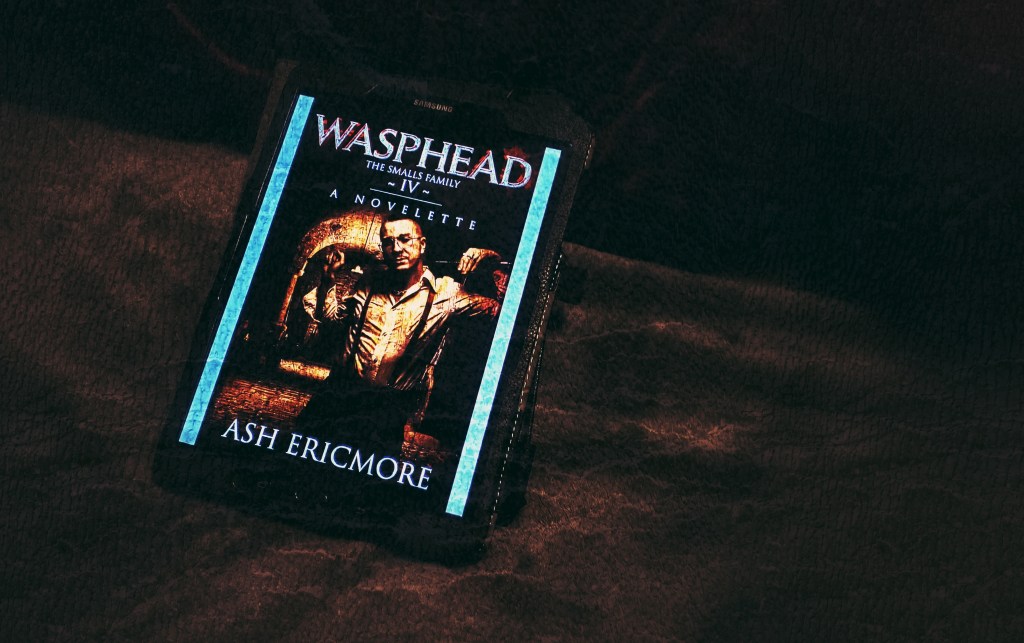
Wasphead by Ash Ericmore

Reed is the fourth of the Smalls brothers we’ve had the pleasure of meeting, and it could be argued that he might just be the most unstable and disorganized of the bunch.
In Wasphead, we discover a man who prides himself on a certain level of decorum and a pretense of organization and planning, but he is clearly quite lousy at formulating and executing a plan. With the help of his recently adopted associate, Reed Smalls takes on a risky, high profile job that stands to put him in direct conflict with a local crime boss. Thankfully, for us, nothing goes even remotely according to plan. As the story progresses to a messy, fluid-drenched, and dismembered conclusion, we can only hope to hold on for the ride.
Reed might be my least favorite of the Smalls brothers we’ve met so far, based on personality alone, but his misadventure is no less captivating than the previous three. The fact that this character is so starkly different from the others we’ve encountered is an excellent display of how thoroughly diverse in their disfunctionality the Smalls brothers are. I can’t even begin to imagine what’s coming next.

Wasphead is available as part of the 31 Days of Godless event at http://www.godless.com for October of 2021. You can pick it up for yourself by going to the website or by downloading the Godless app. The link is below:

Wasphead (The Smalls Family IV) by Ash Ericmore

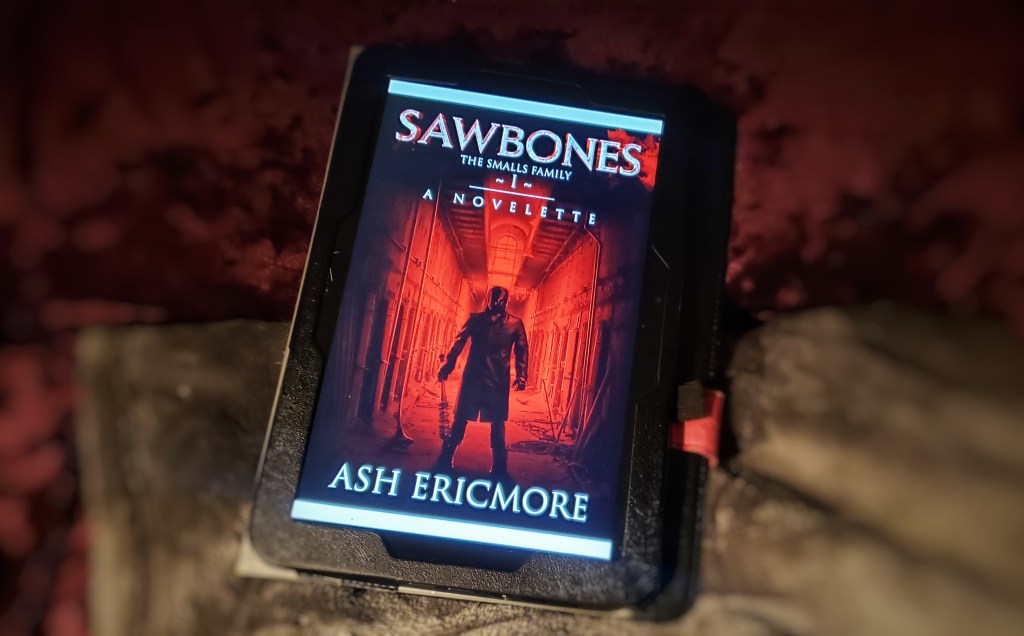
Sawbones by Ash Ericmore

Sawbones introduces the reader to Edward Smalls, one of seven siblings in the Smalls family, and it is one hell of an introduction.
A meeting with Alfred Leonard, a drug dealer and the criminal equivalent of middle-management, takes an unexpected turn as Edward is asked if he’d be willing to supply a snuff film for some new European business partners. No stranger to killing, Edward agrees to the strange proposition.. He already makes a living by supplying harvested organs on the black market, earning him the nickname Sawbones. How hard can it be to make a video incorporating sex and death?
Locating a suitable victim and getting her back to his dungeon workspace turns out to be the simple part. Everything else seems to be working against him, from the oppressive heat to unwanted visitors. Edward learns the hard way that film sets are a perpetual state of barely organized chaos, and that the people behind-the-scenes bankrolling the production often seem not to share the same creative vision as the director.
Edward Smalls is a strangely likeable character, considering how he earns his living. Ericmore successfully fleshes out a human monster who seems uncomfortably relatable and awkwardly amusing. It’ll be interesting to meet the other members of the Smalls family as the series continues. If this first installment is a solid basis of what to expect, there’s no way anyone could come out of this series feeling disappointed. The story reads like the novelization of a film written as a collaboration between Tarantino, Ritchie, and Roth.

You can obtain Sawbones, as well as the subsequent two volumes of the series right now, by going to http://www.godless.com or by downloading the Godless app. The link is below:

Sawbones (The Smalls Family I) by Ash Ericmore

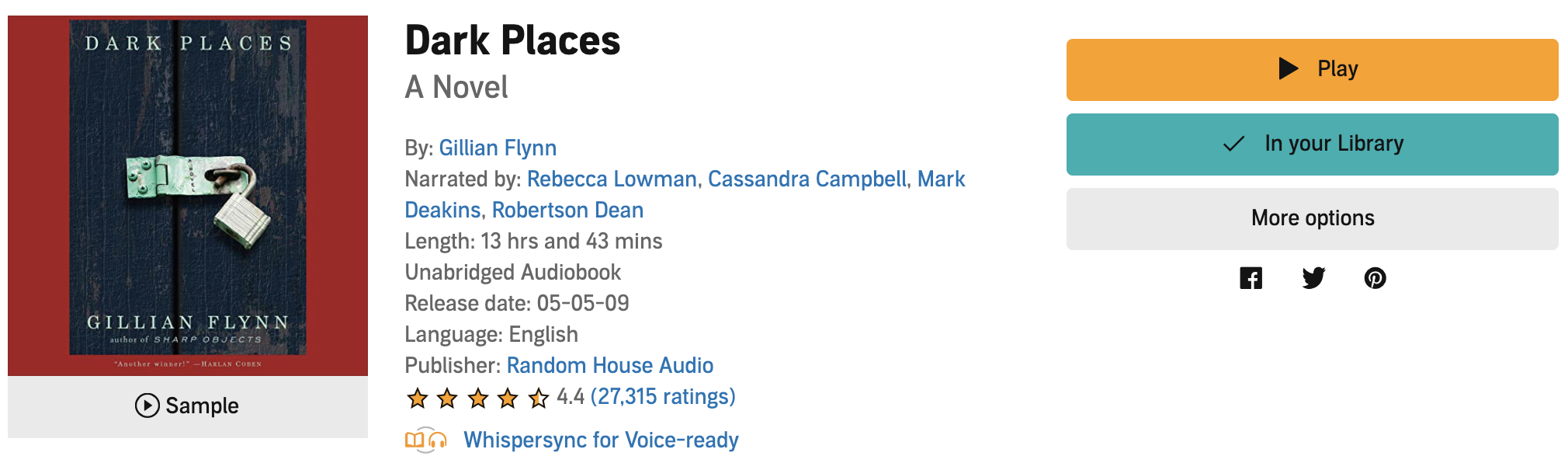
Dark Places by Gillian Flynn: Narrated by Rebecca Lowman, Cassandra Campbell, Mark Deakins, & Robertson Dean

Dark Places indeed.
This book takes the reader/listener to some truly dark places.
A Kansas family was slaughtered in the middle of a cold January night in 1985. The only survivor was the youngest daughter, Libby Day.
The oldest child, Ben, is the easy suspect for everyone. He’s a troubled teenage boy with a darkness inside of him that easily feeds into the Satanic Panic running rampant in those days. But was he guilty? Was Ben just as innocent of these horrific crimes as he was of the sexual assault accusations being leveled against him by numerous grade school girls?
We join Libby as an adult, running out of money from the donations sent her way as a sympathetic child survivor of the Day family massacre. No longer the sympathetic, victimized young girl, Libby lives in squalor and never quite figured out how to properly take care of herself. This desperate situation is what leads her to The Kill Club, a group of true crime fanatics who imagine themselves to be investigators.
Ripping off painful bandages and digging into a past she only barely recalls, Libby begins to question her courtroom testimony from all those years before. Some mysteries are better left in the shadows, though. Proving Ben’s innocence might lead to nothing more than further death and horror.
Gillian Flynn has a knack for developing interesting characters without making them feel particularly sympathetic. The characters populating Dark Places are no less captivating than others she’s developed, in large part because of precisely how flawed and sometimes awful they happen to be. Despite those flaws and the fact that it’s hard to care about the characters, you can’t help but find yourself invested in what’s happening.
The narrations performed by Rebecca Lowman, Cassandra Campbell, Mark Deakins, and Robertson Dean are fantastic. We experience different characters, at different times, with distinctly different voices…and it’s a nice touch.

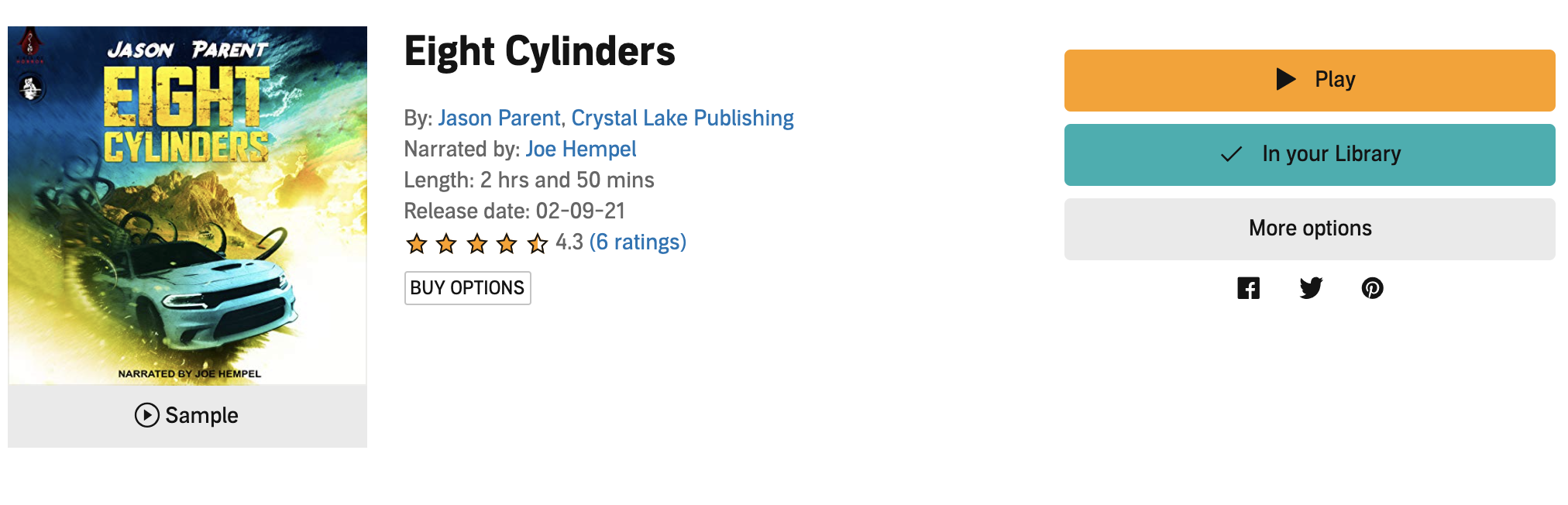
Eight Cylinders by Jason Parent, narrated by Joe Hempel

Jason Parent’s Eight Cylinders captures a sort of grindhouse action/horror vibe that I appreciated a great deal. We’ve got a story about crime, cars, creatures, confusion, and condemnation in the middle of the desert…and if that doesn’t appeal to you at least a little bit, there’s probably something wrong with you.
Comparing it to movies and other visual mediums, as I usually do, it’s a little bit Tremors, a touch of From Dusk Till Dawn, a good bit The Road Warrior, and a dash of the old show The Prisoner (or maybe, for those who never watched that one, Lost). If you were to toss all of that into a blender and add a splash of cosmic horror, you’d end up with something along the lines of Eight Cylinders.
This story had me invested as soon as Seb began using a novelty Magic Eight Ball glass eye to make his decisions for him as he sped away from Vegas after a deal gone exceedingly bad. Criminal and “bad guy” that he might be, Seb is particularly relatable as a protagonist, and you can’t help but cheer him on as he races through the desert multiple times throughout this short tale. The attention to detail concerning cars, trucks, and ATVs through the narrative gives one the impression that Parent is a bit of a gearhead at heart, or certainly one who spent some quality time researching this tale with gearheads…and that comes through clearly with Seb’s absolute love for his Dodge Charger and his appreciation of other vehicles in the narrative.
Joe Hempel’s narration is excellent, and I’ll surely be watching for other titles he’s provided his voice talents to.
My sole complaint about this story is that it felt a little rushed at times like we were racing from one point to another without getting enough time to really experience where we were.