
The Dragon’s Path by Daniel Abraham, Narrated by Pete Bradbury

It’s not uncommon to encounter political machinations and glimpses of the underlying bureaucratic structure of the world in fantasy novels. Along with the history of the realms and people in question, understanding something of the politics of those fictional worlds is an important element in making them feel like real places. Daniel Abraham has taken this world-building further than most authors by focusing a great deal of his storytelling attention on the facets of finance and trade within the world of The Dragon’s Path. What’s superbly surprising about Abraham’s novel is how interesting he manages to make the details of this commerce.
Of course, it isn’t all banking and trade relations. Abraham has packed this first novel of The Dagger and the Coin series with conflict (both small and large scale), gods and myth, political intrigue, and plenty of witty dialogue.
Cithrin is a half-breed orphan raised as a ward of the Medean banking house of Vanai, and she carefully studied under the tutelage of Magister Imaniel. As the armies of Antea approach the city walls, the only way to keep the resources of the bank safe from plunder is to send them away from the city. Cithrin is tasked with escorting the bank’s property to safety as part of a caravan headed by the tragic hero, Marcus Wester.
As it happens, Cithrin isn’t the only member of Wester’s party who isn’t who they seem. Marcus has replaced some of his complement with a troupe of actors led by Master Kit, the performers playing the role of soldiers and guards. But Master Kit is more than he seems as well. A past he’d thought he escaped will come back to haunt him again before the tale concludes.
In the middle of everything is Sir Geder Palliako, a bookish and weak man who finds himself tossed about by fate and the machinations of those above him in the royal court of Antea. Struggling against forces he only barely recognizes as nudging him along, Geder becomes the key to leading the world down a path from which there will be no turning back.
Abrahamson packs this novel with a diverse cast of characters, both sympathetic and flawed in equal measure, and he sends them on a series of adventures as captivating as they are well-thought-out. It would be virtually impossible to reach the end of The Dragon’s Path without wanting to see where this tale will take us.
Pete Bradbury’s narration spectacularly breathes life into the vast cast of characters populating this story, setting them apart from one another without any apparent difficulty. His voice propels the listener through the circuitous web of the narrative, leading us to the end far more quickly than we want to arrive.

The Raven Tower by Ann Leckie, Narrated by Adjoa Andoh

As much a collection of world-building elements as a story, The Raven Tower contains the same depth of political intrigue, examination of social structures, and mythological explorations one should expect if they’ve read other books from Ann Leckie. Much of the narrative is taken up by historical musings and the interactions of various gods, in particular The Strength and Patience of the Hill and The Myriad, two ancient gods who watched as humanity evolved and developed cultures and language.
Relayed to us by that ancient god, The Strength and Patience of the Hill, The Raven Tower is the story of Eolo, a soldier and the aide to Mawat, the next in line to serve as Lease to the Raven, God of Vastai.
Upon being called back home from the conflict at the border, Mawat discovers that his father, the previous Lease, has disappeared when he should have sacrificed himself upon the death of the most recent incarnation of the Raven. In his father’s place, Mawat’s uncle is sitting on the bench belonging to the Lease, proclaiming himself as such, in defiance of both custom and Mawat’s wishes. While Mawat mourns the father he believes to be dead and seethes with anger at his uncle’s presumptuousness and betrayal, Eolo sets out to solve the mystery of how any of this could have transpired. The truth, when revealed, might be too costly for those involved and far too dangerous for the kingdom of Iraden.
As interesting as the story of court intrigue, murder, and betrayal happens to be, I found myself wanting to hear more about the gods, their machinations, and the history of this world the deeper I delved into the story. Leckie has a knack for creating worlds that beg for the reader’s attention, drawing us in and making us crave more. The Ancillary books had a trilogy that allowed for greater satisfaction of this need, and I’m hoping that this won’t be the last time we visit the world she’s created with The Raven Tower.
The casual acceptance of Eolo as a trans-masculine character was a nice touch, without ever seeming shoehorned in or forced. This should come as no surprise to anyone who read the Imperial Radch trilogy, in which it was obvious that Leckie has a knack for exploring non-binary identities and cultures with the same deft hand that Ursula K. Le Guin brought to The Left Hand of Darkness. There are sure to be readers who dismiss this book because of that. But those are the same people who proclaim that they don’t want politics in their fantasy or science fiction, so it’s a simple thing to dismiss their opinions as uninformed, historically ignorant, and irrelevant.
Adjoa Andoh’s narration captures a wide breadth of characters and accents with seeming ease, though there were times when certain accents initially seemed a bit silly or cartoonish at first. As the audiobook continues, those accents seem less pronounced as the listener adjusts to hearing them and becomes acclimated to the environment cultivated within the narration. I certainly prefer this over the alternative, where every character sounds approximately the same, and there’s no variation where cultural differences should exist.

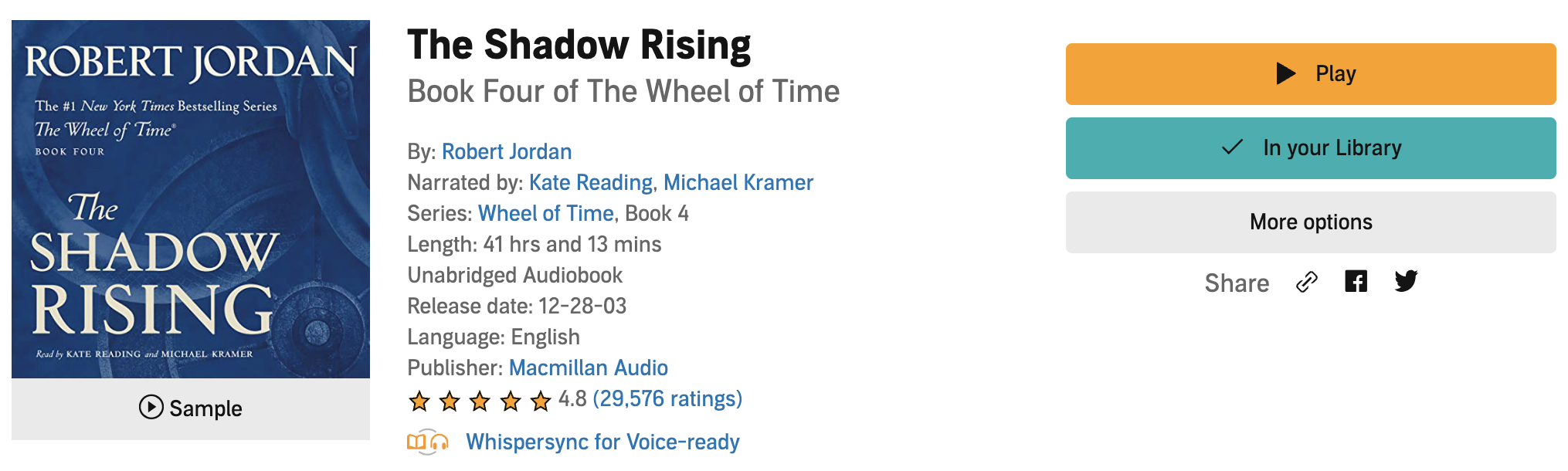
The Shadow Rising by Robert Jordan, Narrated by Kate Reading and Michael Kramer

The Shadow Rising picks up where The Dragon Reborn left off, with Rand al’Thor wielding his authority from the Stone of Tear after breaching the fortress with the assistance of a cadre of Aiel and taking Callandor in accordance with prophecy. For a brief interval, the companions who set out from the Two Rivers are together in one place again, before the machinations of the Forsaken and Rand’s reluctant determination to embrace his fate forces them to head in separate directions yet again.
Mat and Moiraine follow Rand deep into the Aiel Waste, set for the sacred city of Rhuidean where Rand means to fulfill the next prophecy on his path to become The Dragon Reborn.
Perrin, Faile, and Loial depart for the Two Rivers, where Perrin hopes to save his family and friends from the Children of the Light, only to discover that things are far worse than his nightmares prepared him to expect.
Nynaeve, Elayne, and Thom Merrilin follow the trail of the Black Ajah to Tanchico, desperate to discover the secret weapon the dark sisters are hoping to use against Rand.
All of this takes place while Min attempts to sus out the meaning of her prophetic visions at the White Tower, as tumult and upheaval loom on the near horizon.
The Shadow Rising was one of my favorite books in Robert Jordan’s Wheel of Time series when I originally began reading the series years ago. This was primarily because we begin to catch tantalizing glimpses of the world before the breaking as well as insights into the less previously well-explored cultures introduced in the first three books, in particular, the Aiel and Seanchan. Jordan also provided readers with a fascinating look at the dynamic between various Forsaken as well as the Dark Friends operating in the world, and how those various individuals and groups are frequently acting at odds with one another.
It isn’t all world-building in this book, though. There’s plenty of action and a whole lot of story along the way.
As with the previous three audiobooks, the narration provided by Kate Reading and Michael Kramer is spectacular, at no point taking the listener out of the experience or disrupting the flow of the narrative.