Andrew Najberg’s Gollitok brings to mind the work of Soviet and Russian post-apocalyptic authors like Dmitry Glukhovsky or Arkady and Boris Srugatsky. It’s refreshing to come across a title today with the same dystopian feel that one otherwise only sees in Cold War or post-Cold War literature. What begins as a bit of a mystery in which none of the characters trust–or can trust–one another while exploring and struggling to survive the isolation and potential contagion of the Gollitok prison colony quickly transforms into a masterpiece of body horror and the dangers associated with being on the wrong side of a fascist government.
As abbreviated as the story actually is, the characters are still well-drawn and the environment feels uncomfortably real. It’s hard to talk about the book without giving too much away. It’s clear that Najberg put a great deal of thought into both the environment and the social dynamics that underlie the narrative he’s crafted…but it’s something you’ll really have to experience for yourself. I suggest you do precisely that.
Joe Hempel’s narration is absolutely spot-on, capturing the nuances of characters, the various accents, and the tension the narrative builds within the reader/listener.
John Langan proves that he is a master storyteller with the collection of tales included in The Wide, Carnivorous Sky & Other Monstrous Geographies. It’s a diverse selection of tales, with some common threads of meta-commentary and a love of classic horror woven throughout many of them. This is an exceptional example of what’s meant by literary horror when the term gets bandied about. There’s a clear appreciation for the written word and it comes across as what feels like an almost meticulous process of selecting just the right words every step of the way.
We begin with a couple of stories that approach the zombie theme from vastly different directions, the second of which, “How the Day Runs Down,” was one of the most original and entertaining things I’ve had the pleasure of reading. While it isn’t–on the surface–overtly comedic, there’s something about a zombie plague as experienced by Thornton Wilder that manages to amuse the reader/listener to a great extent.
“Technicolor” showcases both Langan’s appreciation of the classics and his knack for metatextual analysis within the stories he tells, this time focused on Poe as he plays with the true story of the man’s life and then blurring the line between fiction and reality.
The titular story, “The Wide, Carnivorous Sky,” is a vampire tale unlike any other I’ve had the pleasure of reading…and that is a damn shame because I would love to read more stories like this one.
“City of the Dog” and “The Revel” tackle other supernatural creatures with the same deft hand Langan used when approaching zombies and vampires.
“The Shallows” presents a cosmic horror tale that’s as eerie and discomforting as anything written by Lovecraft, filled with tension and dread that are palpable to the reader.
“June, 1987. Hitchhiking. Mr. Norris.” is a bit more flippant than the other stories included, but when one discovers that it’s meant to be a sort of cruel and horrifically humorous tribute to the fantastic Laird Barron, that all starts to make sense.
“Mother of Stone” is the perfect tale to cap off the collection. It draws the reader in and fills them with a disquieting sense that the real world may not be quite what we believe it to be. This is one of those stories that makes you happy to know you’re reading fiction, though the investigation at the heart of the tale makes it feel all too real. It felt, much like “The Shallows,” like Langan was delving into the realm of cosmic horror, but in a far more practical and plausible fashion…which made the story delightful.
Eric Martin’s delivery as the narrator is superb, and fully captures the literary qualities of Langan’s work.
Ronald Malfi excels in telling tales that center around mistakes we make as children coming back to haunt us, whether it’s a manifestation of our own guilt, someone exacting their revenge, a supernatural force, or a combination of those things. One of the most thrilling aspects of Malfi’s storytelling is that we’re often left to wonder which scenario(s) we’ll encounter in the story we’re reading. Small Town Horror is just such a story.
When a successful attorney, Andrew Larimer, receives an unexpected phone call from a childhood friend and agrees to return to the hometown he left in the rearview 20 years earlier, it sets him down a path of deception, mystery, and horror. Reuniting with former friends he hasn’t seen in decades, Andrew quickly learns that he might have been better off staying home than involving himself in the nightmare unfolding in Kingsport. As the shadow of an unspeakable event from the shared past of these five friends looms over their lives, they will find themselves tested and pushed to their limits.
Though it takes a while to discover the dark secret they’ve carried with them all these years, it’s fairly easy to figure out the broad strokes as the story unfolds. And while the revelations may not be a shock or surprise, I don’t think that was the point. It was the journey there that Malfi seemed to be focused on, building the tension as we wondered what would come next and who would suffer. We’re forced to wonder what might have happened if they’d only made different choices. Would honesty and accountability have produced a different outcome? I can only imagine that would be the case. That is, after all, the overarching theme–the danger of deception, and especially self-deception.
Even knowing the likely outcome, the conclusion hits like a punch to the gut. That is, after all, another of Malfi’s skills.
Joe Hempel, as always, brings the story to life as only the hardest-working audiobook narrator in the world (I can only assume) can manage.
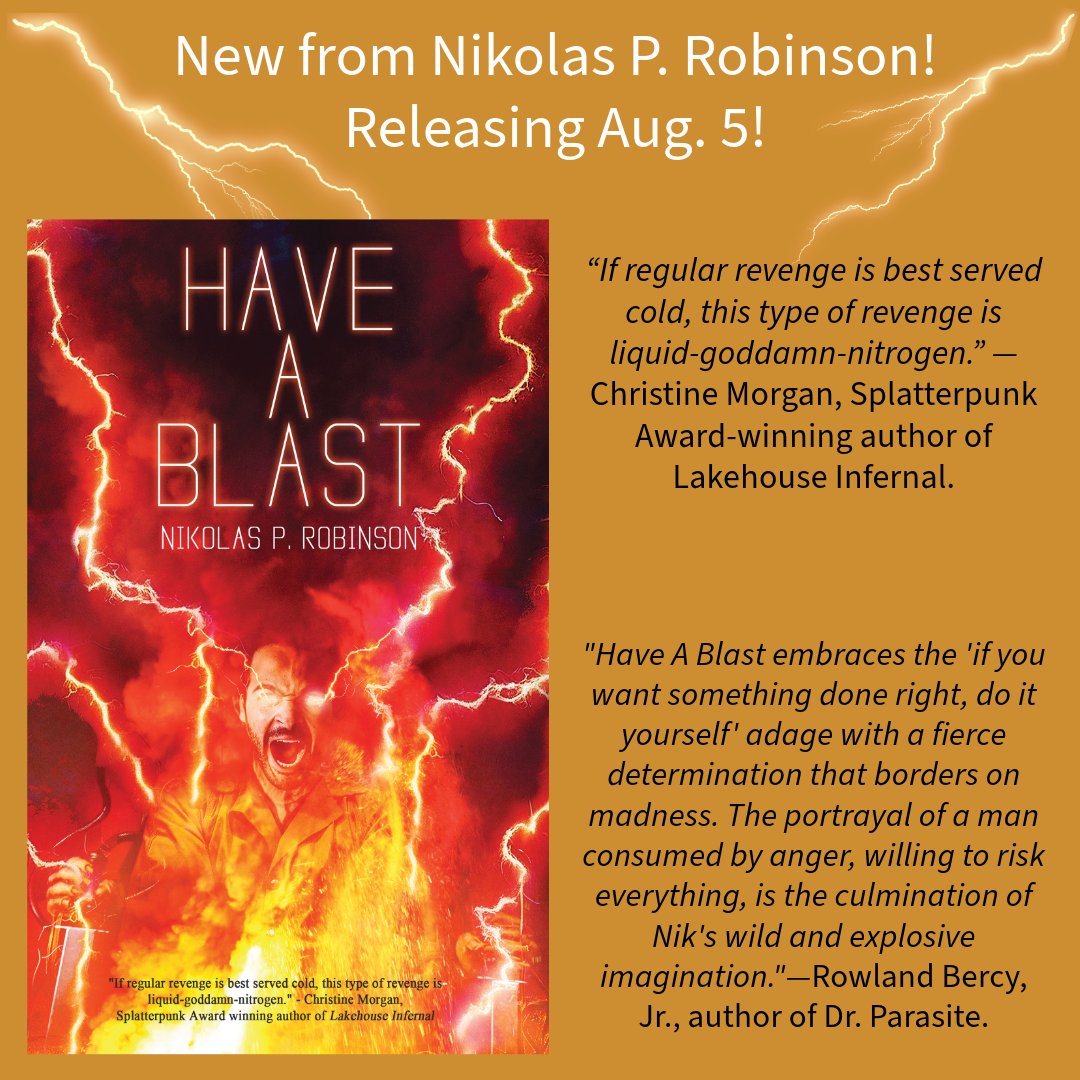
In 2022 I was invited to write a short story to be featured in an anthology focused on Wrath, as part of a series of anthologies centered around the Seven Deadly Sins. I was enthusiastically on board. Revenge and wrath are close to my heart, where fiction is concerned.
Unfortunately, I ran into a couple of issues that led to my inability to submit the story I’d been writing–not the least of which was that, upon rewriting the story, it exploded to almost double the word count expected by the publisher. I felt defeated and like I’d let the publisher in question down by not getting them the story I’d eagerly anticipated sending their way.
When Candace Nola started talking with me about rewriting/revising Innocence Ends, she asked if there was anything new I’d be interested in sending her way. I quickly wrapped up the loose threads I hadn’t tied off in the revenge story and sent it her way.
She wanted it! She had some requests and suggestions for areas she wanted me to expand on, and the story grew to just about the short end of what’s considered a novella.
And so, on August 5th of 2024, Have A Blast explodes onto the scene.
Molded by war and disfigured by a roadside bomb, Oliver Clark doesn’t hold out much hope for the future. Then he meets Jayne, and all of that changes. But when she’s taken from him, Oliver sets his sights on revenge.
No matter who it was, he’s determined that they’ll learn how far someone will go when they have nothing holding them back, and nothing left to lose.
Jae Mazer’s Salt Of My Blood is a tale of two vastly different characters, revealed through snapshot windows into their respective lives as we wait for what we’re sure will be a tumultuous meeting when the two come together. From childhood through the setbacks and disappointments of adult life, we witness the two characters grow and evolve along separate paths. Living in post-war Denmark, Lærke and Harald are deeply tied to the treacherous North Sea, but their relationships with the water are as distinctly different as their personalities.
Lærke’s lifelong love of the sea transforms into something far more peculiar–equally disturbing and beautiful in the way Mazer tackles a fascinating taboo–when she discovers her only true friend where the sand meets the sea. Harald’s love of the sea is deeply tethered to his cruel and predatory nature, and piracy becomes his sole passion. When their two worlds collide, it is truly captivating; a spectacle sure to feel like a reward to the reader.
Mazer addresses heavy topics in this modern-day fairy tale; sexual assault, mistreatment of women, the antiquated concept of the wife’s role within marriage, and the misogyny that underpins all of those things.
This story can be found on the Godless platform by clicking on the link below:
Take one part As Above, So Below, one part The Descent, and one part Jacob’s Ladder (with just a dash of House of Leaves) and you’ll end up with something that adequately sets the stage for Mike Salt’s Hollow, the fourth installment of his Linkville Horror series. There’s much more involved than those three components, but they capture the atmosphere Salt crafts with this claustrophobic tale of terror.
Beneath the sleepy, seductive, and sinister town of Linkville is a tunnel that runs through the whole of downtown. Despite attempts by the city to renovate it and transform it into a tourist attraction, it’s fallen into disrepair. When Tyler and Robin returned to their hometown of Linkville, to visit with their friend Bird, they had no reason to think they’d be venturing into that tunnel. But when Bird frantically leaves his brother’s house upon their arrival, intent on tracking down his family and their friends who have been missing for a few days, Tyler and Robin feel compelled to help their friend out.
But it doesn’t stop with the tunnel. A hole in the tunnel leads into what appears to be a cavern hidden beneath, and that’s where Bird is certain his brother and sister-in-law have disappeared. Cooler heads do not prevail, and the three friends venture into the depths of a place from which there seems to be no escape.
Hollow is filled with labyrinthine mysteries, nightmares that come to life, claustrophobic tension, and the uncertainty of being unable to trust one’s own reality. It’s a bleak and torturous tale of survival from which there might be no such thing as surviving. While it’s a fully encapsulated story, without any need to explore the other Linkville Horror books, I suspect that this experience is more than sufficient to draw readers/listeners back to Linkville, even if they never get to explore the seemingly endless evil that exists just beneath the surface…and that may be a blessing. If Salt ever does invite readers back to the tunnels, it might be best to decline that invitation, as it can only get worse from here. Tyler and Robin would most certainly agree.
The narration provided by Curtis Michael Holland takes a little getting used to, but once you’re comfortably settled in, it’s a fun ride. I will say that he sounds just a bit like H. Jon Benjamin, which isn’t a bad thing, it just brings to mind many of the animated characters he’s voiced over the years while you’re trying to focus on the story.
It’s not a popular opinion within the horror community, but I have not been a fan of Grady Hendrix. His writing is top-tier, and the concepts behind his work have always been compelling, but there’s something in the execution that’s never worked for me in the past. I’ve seen the rave reviews of books like My Best Friend’s Exorcism and The Final Girl Support Group, and I’ve gone into them hopeful…only to feel disappointed. I wanted to like them. Something about the characters and the pacing always left the stories lacking.
And then I took a chance on Horrorstor.
This was what I was hoping to find. The other Hendrix books didn’t do it for me, but this one contained the perfect blend of wry humor and sincere horror. The characters didn’t irritate me, the pacing felt simultaneously practiced and natural, and the story itself was fascinating.
If you’ve spent any time shopping at IKEA, you’re familiar with the planned layout that’s guaranteed to draw you deeper into the store before you ever have a chance to find an exit. The way out is through, but it’s a long way through. This is precisely the dynamic ORSK has implemented in its shameless attempt to copy the already established IKEA. And that makes it all the more difficult for employees to figure out how or why things are being damaged, defiled, and destroyed overnight. And, what’s worse, sales are down.
Could someone be breaking in? Or is this a case of someone phrogging in the establishment? That’s what the manager hopes to find out when he enlists two of his employees to spend the night there with him, as they prepare for a visit from corporate headquarters.
Unfortunately, the truth is far worse and infinitely more difficult to understand. Will any of the employees survive the night, or will they get lost in the labyrinth?
There’s a lot to unpack, from the scathing indictment of consumerism and the mindless drive to shop and spend that’s promoted and encouraged by the corporations hoping to pad the bottom line to the predatory conditions at-will employees are subject to, simply to keep the lights on. Hendrix imbues this story with plenty of social commentary.
The chapter breaks–with their increasingly sinister product descriptions–were one of the best things Hendrix could have added, making the whole experience that much more entertaining.
Tai Sammons’s narration of the main story was fantastic, and Bronson Pinchot’s delivery of the product advertisements separating the chapters was a masterful stroke of brilliance.
If you’re familiar with Bentley Little, you’re probably well aware that he’s an author who excels at tales of small towns with dark secrets, hidden mysteries, and sinister forces beneath the surface. He takes the mundane and everyday aspects of our lives and transforms them into something sublimely creepy with apparent ease. That is, in fact, the man’s bread and butter as far as I’m concerned, and few have come close to doing it half as well.
The Walking includes a fair bit of what you’d expect from Little but with a lot more history involved than is often found in his work. The tale unfolds during two different periods, as the revelations behind what’s happening are deeply tied to events of the distant past, where a town of witches was established in the Southwest. In this place, they could be safe from persecution and the religious intolerance of the rest of American civilization. That is until everything falls apart.
In the modern day, we discover a plague of peculiar variety, in that some recently deceased people are suddenly driven to walk, although they’re clearly quite dead. Family secrets are uncovered, the cruel fate of the once-prosperous town of witches is revealed, and the cast of characters we’ve been following are forced to meet face-to-face with the mysterious force that’s animating the dead and calling them home.
Fans of The Summoning are sure to enjoy the appearance of a certain opportunistic FBI agent.
This was slower than a lot of Little’s work, but it was not disappointing for that fact. It felt different from much of his other work, including the pacing and the wider scale of the overall narrative.
John Pirhalla’s narration was top-notch, leaving no complaints and nothing to be desired.
Jon Cohn invites us to Slashtag, a multiplatform reality program that promises to take horror to new, previously undreamt heights. The Propitius Hotel, once the home of America’s most notorious and prolific serial killer, Arthur Wilson, is the setting for this nightmare-inducing challenge that pits seven celebrities (or what passes for celebrities) against the clock as well as the malevolent entities that wander the haunted hotel.
The characters are all believable and distinct from one another, especially as their carefully crafted facades begin to crumble under the strain of life-or-death stakes, and the people beneath are gradually revealed. Cohn handles that character development/dismantling with masterful skill. As self-awareness kicks in and self-preservation becomes essential, we witness these people transforming before our eyes, even as they struggle to maintain the personae they know their fans are logging in to see.
Tawny and April are amazing characters, fascinating and fleshed-out, and the rest of the cast Cohn introduces us to is no less vibrant and interesting in their own ways, even if their personality is bland (yes, I’m talking about Britt). In some instances, the clear analogs to real-life people are a lot of fun, especially as we meet the wealthy board members of Krentler Media.
The uncertainty of whether what’s happening is real or contrived is deftly handled, as characters react in vastly different ways, depending on where they fall along that spectrum of belief…until they’re all in the loop, and fully cognizant of the danger they’re in.
The premise behind the reality program itself, the purpose behind the torture and slaughter, and the mythology that’s brought to bear are enjoyable and metered out with just the right pacing.
Lauren Ezzo’s narration is spectacular, providing each character with their own delivery and cadence. Her narration made the book all the more enjoyable.
John Wayne Comunale brings his usual irreverent humor and blasphemy to this tale of a working stiff who–like many of us–wishes he could find a shortcut to the life he would rather be living. Sometimes, that might be as easy as pushing someone in front of a bus, which–as it turns out–might be more challenging than you suspect. In this case, the desired shortcut comes in the form of a “Satanic” ritual.
A promotion at work, a life of ease, and the girl of your dreams, what would you do to have those things? Would you summon a peculiar little blob of a demon that resembles a demon about as much as the real Hell resembles the one you’ve always imagined from a lifetime of mythology and Christian upbringing–which is to say, not at all? Well, that’s what our protagonist decides to do, and he soon learns that there’s more work involved in making these dreams come true than it would have required if he’d just put in the effort in the first place. Mistakes were made.
Sometimes the shortcut isn’t much of a shortcut at all, but it’s difficult to see that until you’re already on the path, and by then it might be too late. Hindsight is 20/20, they say.
Comunale spins a fun little tale of a life spiraling out of control, the price of hubris, the hollow pleasure derived from cheating your way to success, and how important it is to be careful what you wish for. Along the way, he builds a new mythology of the realm we think of as Hell, the beings we think of as demons, and the harsh challenges associated with bridging that infernal realm with our own.
The author narrates his audiobook edition of the book, and there’s never any disappointment to be found in Comunale’s delivery. He knows just the right amount of sarcasm to imbue the narrative with, and the voices he has in mind for his characters.