Woom by Duncan Ralston

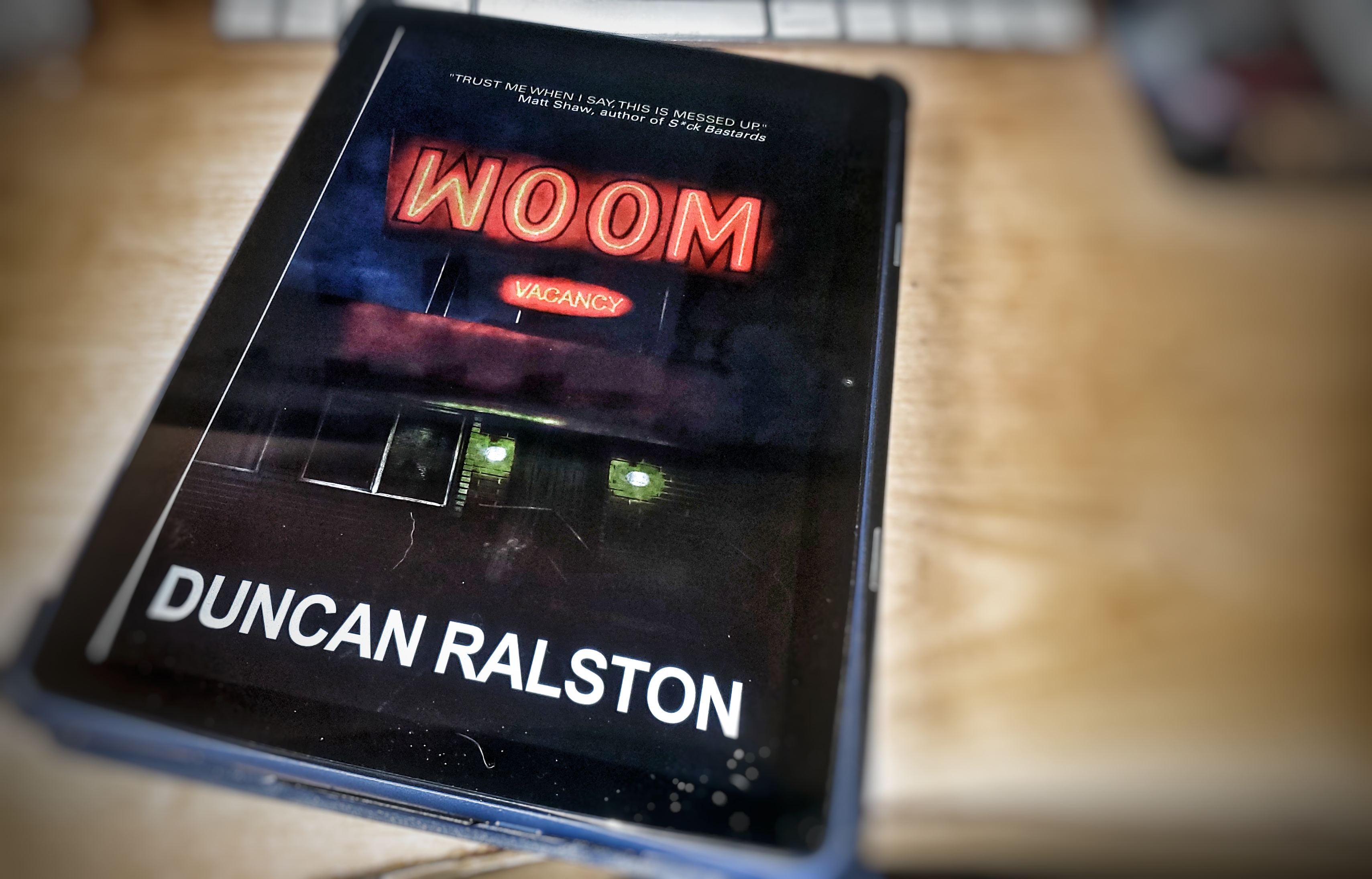
Duncan Ralston’s Woom is a masterpiece of an anthology tale with the most seamlessly incorporated framing story I’ve had the pleasure of reading. It’s like Campfire Tales if that movie had been X-rated and situated in a run-down, no-tell motel room. While Woom works as a single, longer-form piece of literature, it’s also a series of vignettes that flows together surprisingly well. As Angel and Shyla share their respective stories, the content becomes progressively more unsettling and vile. That shouldn’t bother you, though. It’s what you checked in for, after all.
When Angel checked in to Room 6 at The Lonely Motel and requested a big girl from the escort service, he expected disappointment. It’s what he’d experienced previously, both in life and in his previous attempts to find the right woman for the objective he has in mind. When Shyla arrives at the door, it seems like Angel might have found just the woman he’s been looking for. As the night progresses, and he opens up to her as she opens up for him, it becomes increasingly likely that Shyla will be uniquely suited to provide Angel with what he needs.
Mental illness, childhood and adult trauma, sexual fetishes, graphic violence, and a desperate need for redemption and rebirth swirl together into a perversely entertaining book. Woom is a story that dares the reader to continue reading, the whole time knowing that things are only going to get worse but that the way out is through.
What follows might be a spoiler, but I’m not sure I’d consider it one. While it’s obvious from the outset that Angel was telling stories from his own life, I don’t think that was meant to be a surprise to the reader, so I feel comfortable commenting on that without worrying that it’s too much of a spoiler. I suspect Shayla might have been the only person taken aback by that revelation. She wasn’t the brightest character, after all.


The Haunted by Bentley Little, Narrated by Dan Butler

Concerned that their neighborhood might be going downhill, Julian and Claire Perry decide to look at some available properties in their small town of Jardine, New Mexico. Drawn to a house in the historic district near downtown, they’ll soon discover that some neighborhoods are worse than others, and some homes can be worse than they’d ever imagined.
Bentley Little is a master of the haunted house story, somehow managing never to retread his other material, keeping the tales fresh and filled with new horrors each time. The Haunted is no exception.
The Haunted isn’t a story of gradually building unease and uncertainty, as we encounter from many tales of haunted houses. As with most hauntings, it begins with the children, but it isn’t long before everyone in the family recognizes the danger in their home on Rainey Street. It soon becomes clear that everyone in the neighborhood knows what the Perry family will discover. There is no subtlety to the monstrous presence lurking in the Perry family’s new home, and its reach is greater than any of them could have known.
As is often the case with Little’s writing, there’s a massive history he’s built up leading to the events of the novel itself, and he provides readers with tantalizing glimpses of the detailed past as the story approaches its climax. The presence in their home is no mere ghost, and the house is only the most recent structure built on that place.
Dan Butler’s narration is excellent, leaving nothing to be desired. The best narrators do one of two things, they either bring the story and its characters to life, or they manage to make the listener feel almost as though they’re reading the book themselves. Butler is of the latter variety, and one of the better narrators I’ve come across in that respect.

The Dark Country by Dennis Etchison, Narrated by Dennis Etchison, Stefan Rudnicki, and Gabrielle de Cuir

The Dark Country collects sixteen short stories from Dennis Etchison’s career, some particularly short, and all of them brimming with imagination. Unfortunately, many of the stories in this collection end without any conclusion, needlessly terminating in cliff-hangers that left me less than satisfied. The style of writing and the quality of the storytelling were both great. It was the lack of any real ending to many of the stories that limited my enjoyment at times.
In most cases, I take the time to provide some manner of synopsis for each story included in a collection like this, but I will instead focus on a few of the stories that stood out to me as being the best of those included. In all honesty, some of the more surreal and peculiar tales would be impossible to review without giving everything away.
It Only Comes Out At Night is an excellent way to kick off the collection, as we join a husband and wife on a road trip through the desert. A lonely rest area is transformed into a sinister and horrific place where unknown threats lurk and unwary travelers might never leave. Etchison captures the eeriness and isolation of late-night travel on empty stretches of highway, as well as the almost sinister ambiance of those out-of-the-way oases we find ourselves stopping at against our better judgment. Whether it’s because we’re exhausted, we require fuel, or we’re desperately in need of a restroom, long-distance travel has forced all of us to stop at one of those rest areas or convenience stores arising seemingly from nothing as they appear in the middle of nowhere. Unfortunately for the couple at the center of Etchison’s tale, this rest area might live up to those nightmare scenarios we imagine.
The cruel and monstrous twist awaiting readers at the end of The Pitch is both darkly comedic and altogether too plausible. A random gentleman offers to perform the sales pitch for a variety of kitchen gadgets in a shopping center, displaying the ease with which any slicing and dicing needs might be completed, with a special focus on the safety mechanisms. Buyer beware. Always check your purchases before use.
The Late Shift builds an atmosphere of mystery and confusion as two young men stop at an all-night convenience store where they swear they recognize the attendant behind the counter. Something isn’t right, and their attempts to uncover the truth might just provide an unsettling first-hand understanding of why overnight workers seem a little unusual.
Finally, the collection closes with The Dark Country, a story of a Mexican vacation and horrible mistakes made in response to a series of thefts. This final story showcases both the inherent bigotry of the Americans and the in-group vs. out-group thinking that emerges within the collected tourists as they begin perceiving the locals as predatory outsiders.
The various narrators brought different qualities to light within the stories they performed. It seems as if some thought went into the distribution of stories, to pair each tale with the voice best suited for the narrative in question.

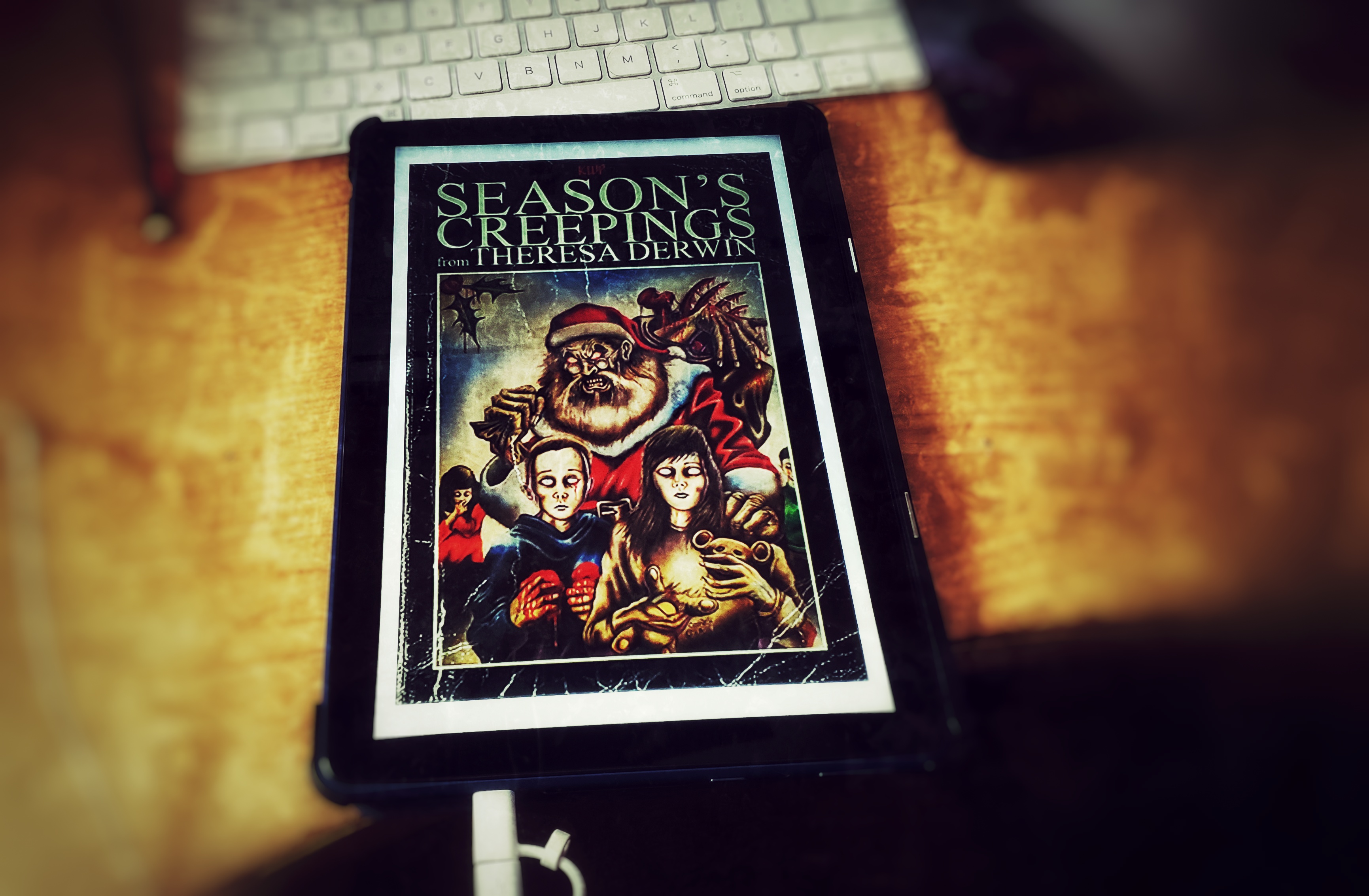
Season’s Creepings by Theresa Derwin

If you’re looking for some new Christmas stories to read aloud in front of the crackling fire while everyone sips at hot chocolate, these might not be the stories you’re looking for. Do people still do things like that with their families? I’m just going to assume that they do. Maybe I’m wrong. Maybe these are precisely the stories you want to read to children and extended family as everyone gathers for the holidays. I’m not one to judge those things.
Theresa Derwin has assembled a lovely collection of Christmas-themed horror with Seasons Creepings. Perhaps it is a bit unusual that I was reading this in February, but I didn’t judge you about sitting around a fire and reading these stories to your children, so I’d appreciate it if you extend me the same courtesy.
The collection begins with the amusing Fifty Hades of Grey. A group of middle-aged women gathers together to exchange Christmas gifts, but one of those presents isn’t quite the innocent gag gift that it seems. A lady doesn’t reach a certain age without knowing how to handle a surprise or two, though.
‘Twas the Night provides us with a new interpretation of the familiar poem, replete with scathing social commentary.
With The Red Queen, we’re introduced to a new acquaintance and admirer of Charles Dickens, as she nudges him along in the writing of A Christmas Carol. Some stories live on forever, and maybe it’s fitting that the authors do as well…assuming they keep writing.
Night of the Living Dead Turkey shares an epistolic account of the zombie apocalypse brought about by infected turkeys. Unfortunately, this zoonotic virus might be more dangerous than the standard avian flu.
For proof that revenge isn’t necessarily a dish best served cold, Last Christmas is a tale of infidelity, friendship, and the perfect holiday meal.
And finally, A Contemporary Christmas Carol provides us with a glimpse of Mr. Scrooge’s regrets as he witnesses his former life of wealth and comfort eroded thanks to the interference of ghosts and the writing of Dickens himself. Sometimes our characters aren’t quite as enthusiastic about what we put them through as we portray them as being, and this is a fine example of that.
Theresa Derwin has compiled a terrific little Christmas collection that’s sure to be perfect for the dysfunctional family gathering. I only wish I’d read this a couple of months ago instead of waiting until I’m either two months late or ten months early.

This title was released through http://www.godless.com as part of the AntiChristmas event for December of 2021. You can pick it up for yourself by going to the website or by downloading the Godless app to your mobile device. The link follows:

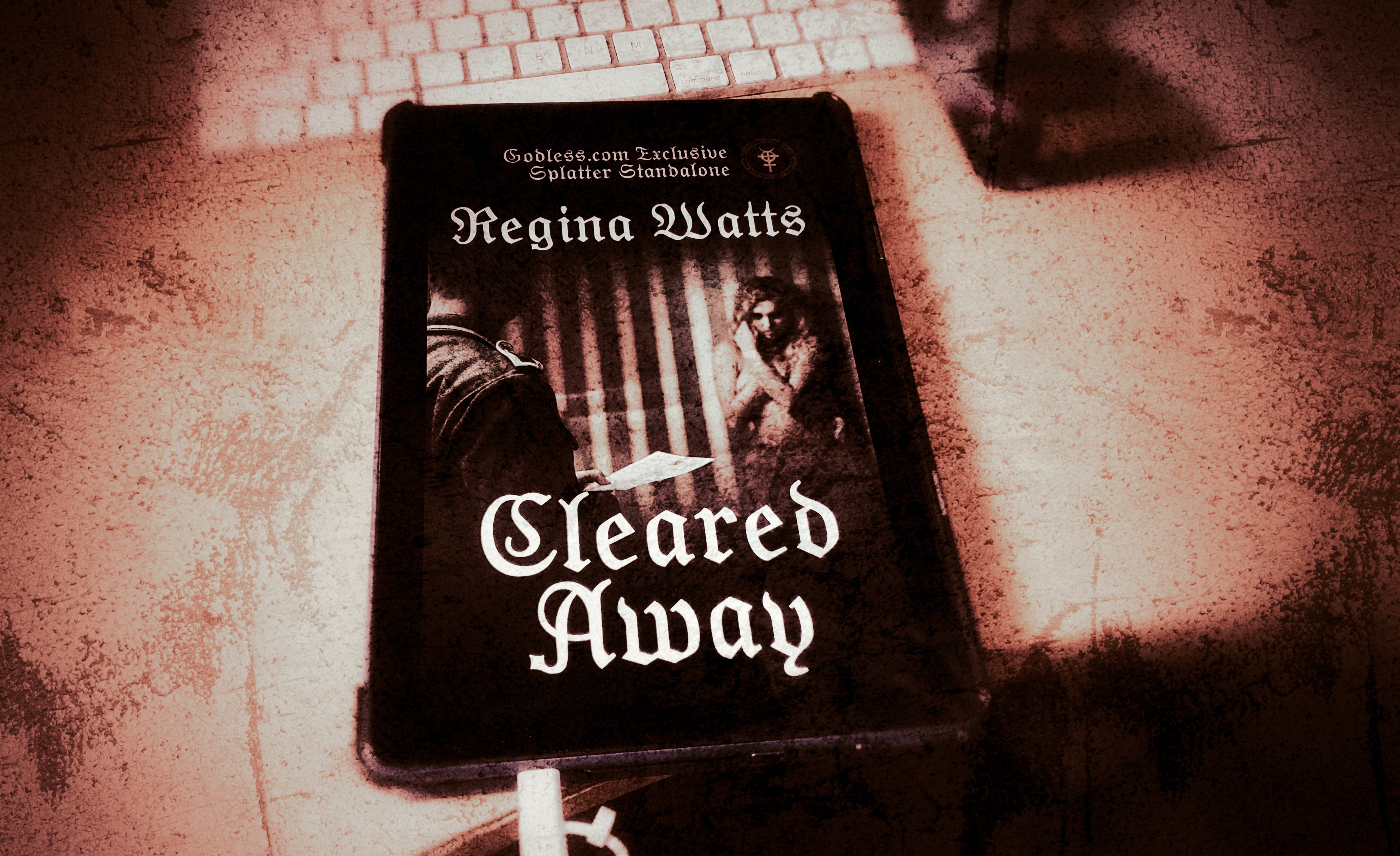
Cleared Away by Regina Watts

Cleared Away is a truly unpleasant story. Were it not for the quality of the writing, I’d suggest there wouldn’t be anything redeeming in these few pages. Unfortunately for all of us, this story was written by Regina Watts, which means there’s plenty of quality in the prose. It should come as little surprise that this story–taking place in Nazi Germany–contains elements of rape, extreme violence, and anti-semitism. The reader should be prepared.
We experience the predations of Major Basilius as he turns his attentions toward a young Jewish girl recently transported to the concentration camp. With Watts at the helm, one should know to expect that there is nothing but brutality and degradation to follow.
There is nothing erotic or arousing in this story. If you’re looking for something like that, you’re in the wrong place, and you’ve picked up the wrong story.
Avoid reading the following if you want to avoid spoilers:
Though we find ourselves continually hoping for something to happen, some vengeance to be enacted against Basilius, Watts tears that hope away with each passing sentence. While this may be less satisfying for the reader, it’s altogether too authentic as far as the outcome is concerned. For most women in the position our young victim finds herself in, there was no salvation to be found. This young woman could have been any of the hundreds–or perhaps thousands–of victims who found themselves raped, abused, and tortured by those in power at concentration camps throughout Europe. Cleared Away is heartbreaking in its brutality and unrelenting, unflinching depiction of the treatment of this poor girl. At the same time, it’s important to remember that this is nothing compared to what was done to so many people in real life.

You can check this out for yourself by going to http://www.godless.com or by downloading the Godless app to your mobile device of choice. The link is below:

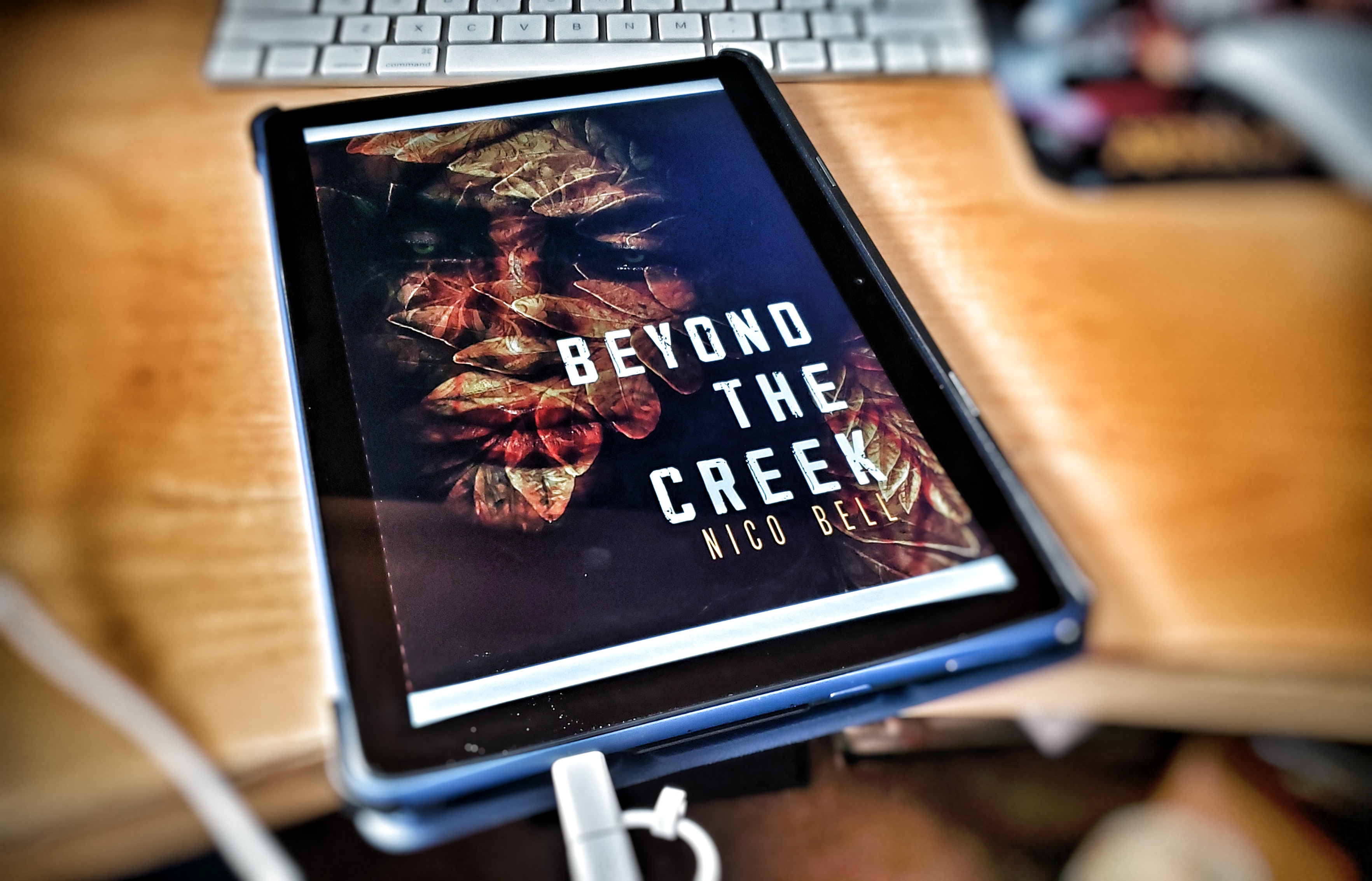
Beyond the Creek by Nico Bell

Beyond the Creek tells us the story of Alex Foster, a young woman who finally discovered the strength to escape from an abusive relationship when she learned she was pregnant. Starting over with nothing in a small forested town, Alex is desperate to provide a better life for her unborn child. She takes a job as a caregiver for Peter Nox, a recent stroke victim undergoing physical and speech therapy, and it seems like she might be on track to make a go of life away from her abusive ex.
Shrouded in mystery and the subject of rumors and superstitious whispers around town, the Nox family and their sprawling estate might be something more than Alex signed up for. Is it possible that she escaped from one monster in her life only to fall into the web of something far more terrifying? The answer to that question–and many others–may only be discovered beyond the creek on the property. Or are there answers to be found in the secret room beneath the Nox house?
Nico Bell spins a dizzying tale of survival, family, and motherhood that keeps the reader breathless as they follow Alex on her journey into the darkness. Drawing from Greek mythology, Bell provides us with something captivating and unpredictable as she guides us along with Alex to unravel the threads that threaten to bind her to a fate worse than anything we imagined as the story began.

You can purchase this for yourself by going to http://www.godless.com or by downloading the Godless app to your mobile device. The links are below:

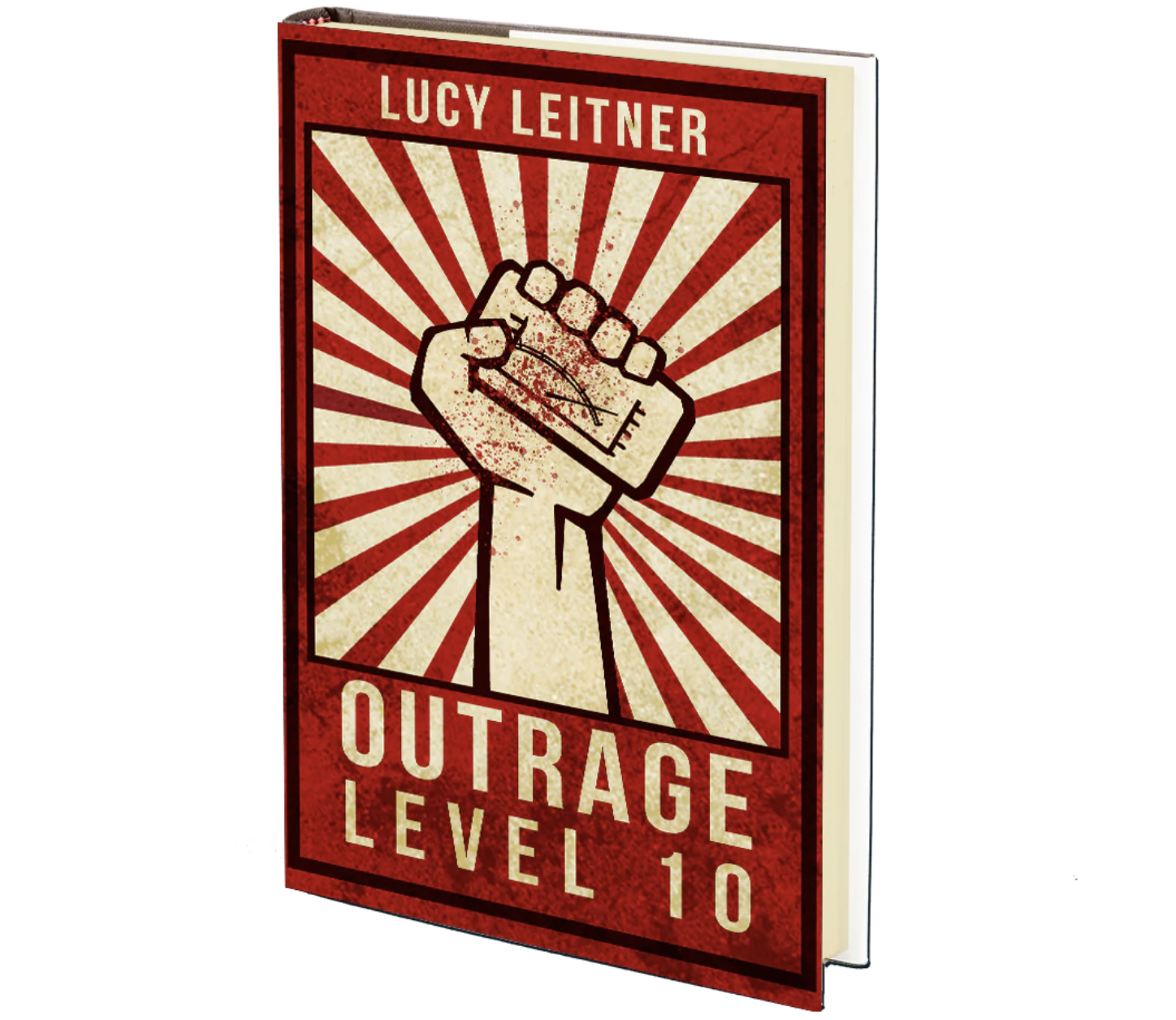
Outrage Level 10 by Lucy Leitner

It should have been a better world. Adam Levine was dead. The oligarchy and patriarchy of the old world order were dismantled by revolutionaries. Direct democracy had replaced the corrupt justice system, allowing all citizens to participate as members of the jury of peers. Unfortunately, the future envisioned in Lucy Leitner’s Outrage Level 10 is not the utopia the people believe it to be.
Alex Malone is a throwback, a former enforcer on the ice with a history of drug abuse and brain damage as mementos of the days when hockey was still a sport. As with all violent and destructive forms of competition, hockey is no more. Malone’s former career has become a ridiculed and maligned memory of the brutality and uncivilized nature of the world before the revolution. There aren’t many options available to someone with Malone’s history, so he becomes a cop, a member of another institution with a tainted history of violence and cruelty, extant in this future America as little more than glorified meter maids and health inspectors.
When Malone’s psychiatrist injects him with a potential cure for his brain damage, Alex initially seems happier, and his memories appear to be returning. But are they his memories?
What unfolds from there is a high-intensity mystery, as Alex and his unlikely partners in crime seek to unravel a sinister plot that strikes at the very heart of the nation and threatens to display the utopian society for the savage and superficial dystopia it is.
Leitner does an excellent job of sharing this cautionary tale of a revolution compromised by not only the flawed and dangerous men guiding it but also by a society engrossed in social media and an unwillingness to recognize the lack of justice associated with the court of public opinion as a substitute for legitimate courtrooms. Differences of opinion are escalated to the point of being perceived as assaults, and “cancel culture” truly becomes a thing as citizens sentence one another to death for crimes against their fragile sensibilities.
Reading Outrage Level 10 reminded me of the way Lenin–and later Stalin–essentially took the reigns of the revolution’s government apparatus and steered the force it gifted them toward their political opponents and enemies of the state who did nothing more than offer dissenting opinions. In all respects, it applies here in America just as effectively. There’s a worthwhile message to be found in these pages, that the revolution doesn’t end when the old structures are taken away. A constant state of vigilance is required to keep the new structures honest and focused on the goals of the revolutionaries.

You can obtain a copy of this book by going to http://www.godless.com or by downloading the Godless app to your mobile device of choice. The links are below:

The Lesser Dead by Christopher Buehlman, Narrated by Christopher Buehlman

While Christopher Buehlman doesn’t add anything new to the heavily-tread mythology of the vampire, what he does provide us with is a fresh and captivating story with characters that come to life–or undeath–and a gritty 1970s New York that feels tangible, even if we do spend a significant amount of our time in the sewers and subway tunnels beneath the city itself. The admittedly unreliable narration of the tale from Joseph H. Peacock is both entertaining and, at times, depressingly bleak.
A spoiled child from an affluent family in the early 20th century, Joey was accustomed to getting what he wanted, and when his mother insists that the cook who adores him has to go, Joey doesn’t take kindly to the replacement. A successfully implemented plan to remove the new cook from his household triggers the cascade of events that leads to Joey becoming a vampire at the young age of 14.
Forty years later, Joey lives beneath Manhattan with an eclectic assortment of other vampires when he first sees the children mesmerizing their victims on the subway. Concerned with the hazard these child vampires pose, Joey’s undead family begins the hunt for these strange and unexpected creatures. Monstrous, cruel, and driven by a sort of nightmarish glee, the children represent a greater threat than any of the other vampires imagined.
Buehlman weaves a fantastically disarming narrative filled with twists and turns that keep the reader reeling. Characters are developed only for the reader to discover that they have to dispel what they thought they knew. Minor details take on sinister connotations as new information gets revealed.
As a narrator for his book, Buehlman displays a keen talent for accents and speech patterns, thoroughly gifting his characters with distinct personalities that come through the tone and inflection of his voice. I’ve heard lower-quality narration from numerous “professional” narrators and voice actors in the past.

Darker Than You Think by Jack Williamson, Narrated by Jim Meskimen

Jack Williamson managed to craft a different sort of werewolf tale with Darker Than You Think, creating whole new mythology along the way and tethering it all with the cutting-edge science–and pseudoscience–available at the time the story was written. It’s a strange thing that more writers didn’t take his lead and incorporate elements of this mythology in novels written since the 1940s.
The narrative follows Will Barbee, a reporter with close ties to members of a concluded expedition into the Gobi desert. On scene when the leader of the expedition experiences a sudden, suspicious death just as he’s preparing to make a grave announcement regarding their discoveries, Barbee doggedly pursues the story he knows is there. What follows is a disorienting melange of waking life and dreams, the questionable nature of reality, and the blurred line where fact meets fiction.
At its core, Darker Than You Think is a tale of a millennia-long conflict between human beings and a close relative hiding in plain sight while preying on humanity. Centuries before, humankind had thought they won the war; but a rising tide of Homo lycanthropus has been utilizing advances in scientific understanding to build their numbers and grow in strength. Awaiting the emergence of the Child of Night who will lead them to a golden age for their kind, the lycanthropes have only one thing to fear, an ancient weapon humanity can use against them, recovered on the expedition to the deserts of Mongolia.
A race against time ensues as Will Barbee, led by the enchanting April Bell, struggles to discover the nature of this weapon and neutralize the threat it poses.
The pulpy writing style of the times is a refreshing transition from modern literature. Though the identity of the Child of Night was so predictable that any discerning reader will have it figured out shortly after the mystery is proposed, the story is still an enjoyable one. Will Barbee comes across as almost painfully stupid at times, and his denial of what he’s experienced is stretched far beyond what should be credible for even the most disoriented and frightened individual.
Jim Meskimen’s narration is perfectly suited for a book written in the 1940s, sounding almost like the narrator of the radio dramas popular at the time. He captures the feel of the times in a way a lot of narrators might struggle to embody.

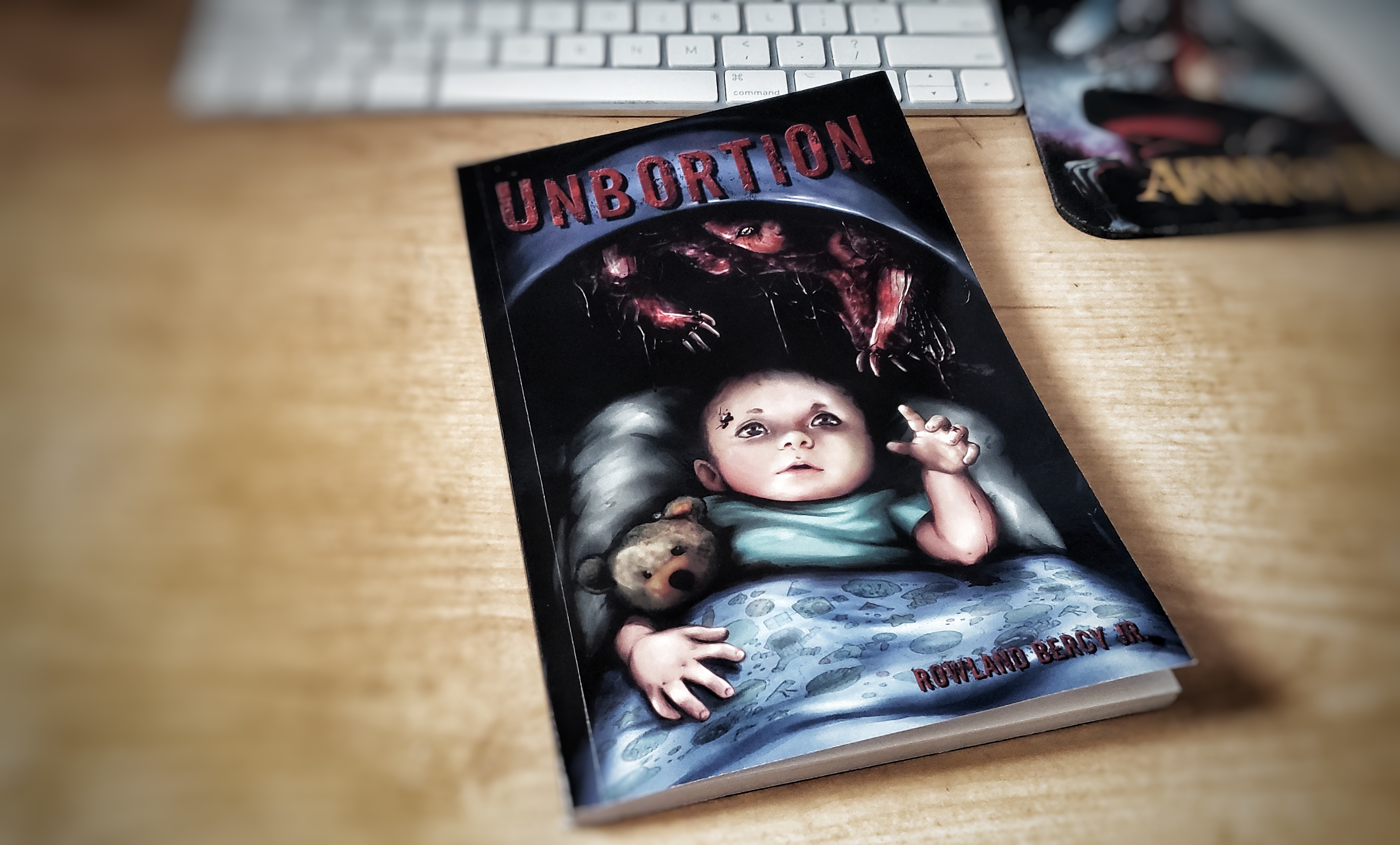
Unbortion by Rowland Bercy Jr.

Unbortion begins with a trigger warning sensitive readers will be remiss to ignore. What follows that warning is a description of a late second-trimester surgical abortion procedure, including vacuum aspiration. Skipping past that scene will not spare the reader much, but it will potentially relieve them from the depiction that might be a specific trigger.
From there, Rowland Bercy Jr. takes the reader on a most peculiar and revolting adventure as the discarded and dismantled fetus, tethered by loose nerve fibers, drags itself through the city in search of the host who rejected it. Initially mistaken for spaghetti by a homeless man digging through a dumpster, our vengeance-seeking fetus attempts to take up residence in the man’s abdominal cavity, only to discover it’s an inhospitable place before forcing its way through his rectum and continuing its journey. It gets weirder from there.
In the end–despite the revolting details and the absurdity of the concept–Unbortion is a tale of rash decisions made out of fear, the unbreakable bond between a mother and her child, and forgiveness.
The anti-abortion sentiments underpinning the narrative made me think that Rowland has missed an opportunity by not pushing this book on the most vocal and ardent members of the anti-abortion crowd. For all of its extreme horror elements, I can’t help but suspect that he could manage to find a ready and willing audience for this book in a subsection of that demographic. I could even imagine a world wherein some of those people would push to have copies of Unbortion sitting in the waiting rooms and lobbies of places where abortions are conducted, in an attempt to change the minds of those intending to undergo such procedures. I’m only half-joking about that because he could be sitting on a virtual gold mine there.
While I’m not in the anti-abortion camp myself, that doesn’t make this any less enjoyable or the underlying message any less poignant.