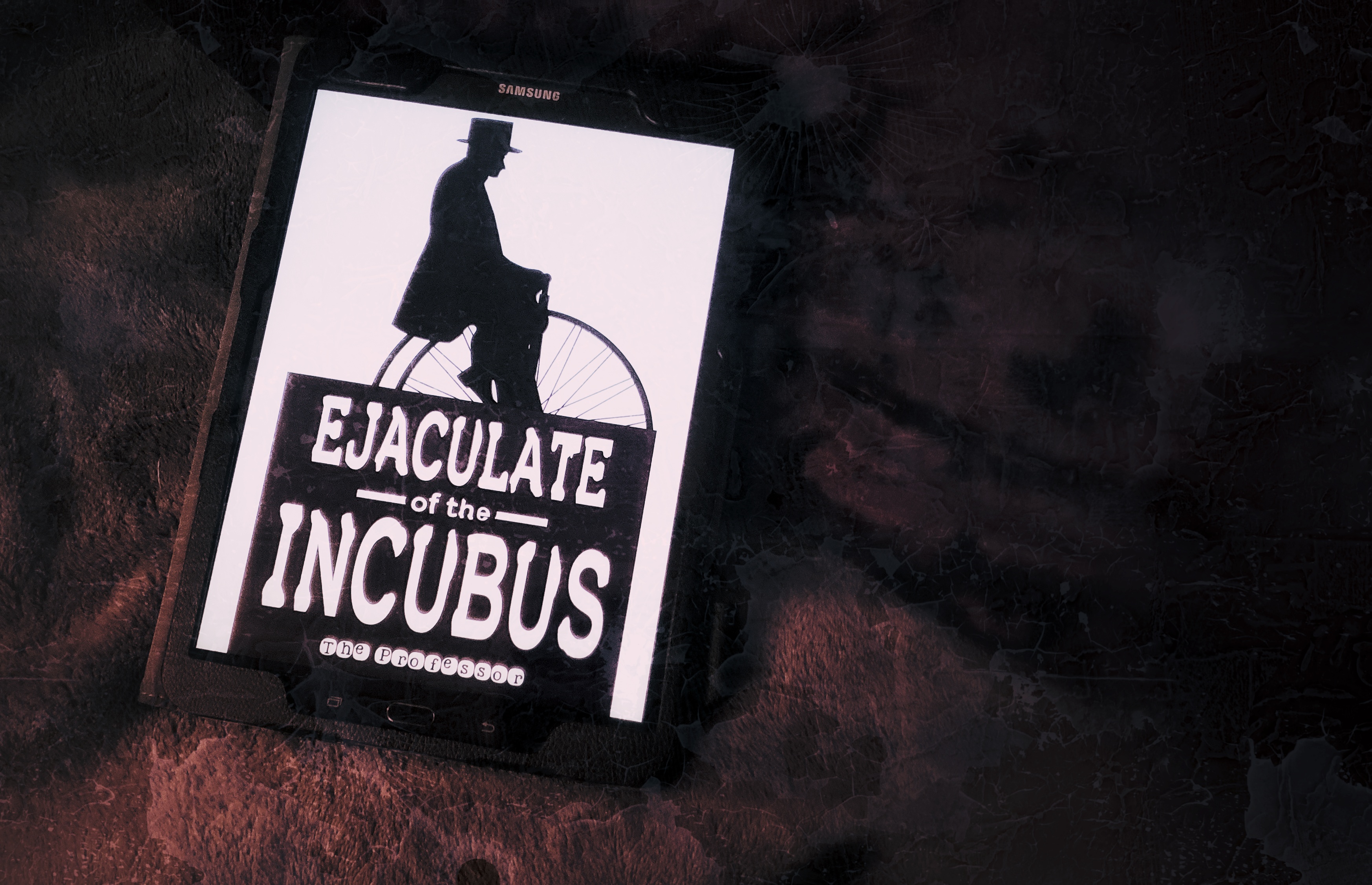
Oh dear me, Professor, dear me. I began Ejaculate of the Incubus with high expectations brought on by the, quite frankly, stellar performance during KillerCon 2021 of a separate, though no less graphic and revolting tale. As you can probably ascertain, I was most assuredly not disappointed. This lovely tale starts as an unnamed narrator meets with an old friend, Professor Roberts, for tea. Anticipating some minor transformation resulting from Roberts returning from his recent honeymoon, our narrator is taken aback by a far more startling and peculiar metamorphosis having taken place. A prim and proper, detached and naive gentleman no more, Roberts displays a wild-eyed intensity and disheveled condition as he begins to recount recent events. It was the honeymoon between Roberts and his bride, Lily, at an old monastery on the Sussex coast, that led them to discover a peculiar metallic object buried in the sand. Returning to their lodging, they caught a glimpse of a strangely proportioned man emerging from the surf, and they hurried to the security of human habitation. Upon inspection of their discovered object, Roberts discerned graphic depictions etched onto the surface that shocked his puritanical sensibilities. This is where the story truly blossoms into something altogether peculiar, blending eroticism and revulsion into a dizzying melange of fluids both human and infernal. The author, publishing under the nom de plume of The Professor, provides us with a deliciously vile story that lends sophisticated use of language and eloquence to acts of sexual depravity one typically finds when perusing the Urban Dictionary or Reddit forums. To say that I was impressed would be an understatement. I knew to expect something magnificent from this author, and I was still blown away. The audio narration of the same work, provided by the author, is a fantastic experience that adds a different nuance and enjoyment to the experience. I’ll be eagerly awaiting any new material from The Professor.
This title is available as part of the 31 Days of Godless event at http://www.godless.com for October of 2021. You can obtain this for yourself by going to the website or downloading the app for your mobile device.The link is below:
I’d been seeing a whole lot of hype about the Korean mini-series Squid Game on Netflix for a while before I took the time to watch it for myself. I hadn’t been dedicating much if any, time to watching movies or television shows for what turned out to be quite an extended interval. I have to say that Squid Game was a damn fine way to return to watching a series. While the overall narrative isn’t entirely original, its various components are assembled in such a way as to create a rather unique and exciting experience. Hugely reminiscent of Battle Royale, Squid Game incorporates elements familiar to fans of The Running Man, Tzameti, Series 7: The Contenders, and the old BBC series The Prisoner. While mingling all of these diverse elements–as well as other sources of inspiration–it transforms itself into a captivating and largely unpredictable story that retained this particular viewer’s attention throughout. Primarily following Lee Jung-jae’s Seong Gi-hun, we’re introduced to a man living a life of regret and poor decisions but who is, at heart, a genuinely decent guy. It would be easy to suggest he’s a degenerate gambler and a deadbeat father, but there’s a whole lot more to him than that, and it’s quite clear that there’s a stubborn streak of optimism and desire to do right that motivates him along the way. When presented with a mysterious opportunity to potentially change the course of his life and keep his daughter nearby, Seong Gi-hun accepts a fateful invitation that will certainly change his life forever, assuming he manages to survive. Along with 455 other people, including his childhood friend Cho Sang-woo (played by Park Hae-soo) and a pickpocket he only briefly encountered, Kang Sae-byeok (played by Jung Hoyeon), the numbered contestants wake up in a large auditorium, wearing jumpsuits. The collection of mostly strangers are greeted by armed and masked workers who carry out the commands of the even more mysterious Frontman. Led to the first game of the challenge, the sinister reality of their situation becomes terrifyingly real and the remaining contestants must determine whether the potential reward outweighs the all-too-real risks associated with the games they’re expected to play. It’s all but impossible to write anything more than this without giving away spoilers. I don’t know if I should even worry about that, knowing how popular the series happens to be, but I’m sure there are plenty of people still sitting on the fence and uncertain whether they should watch the series, and I can’t help but say that they’d be making a mistake by not settling in for the series. When the sixth episode concludes, only the most inhuman of us would be left unmoved and devastated. Consider that a fair warning, that you’re going to hurt while you’re watching the events unfold, helpless to do or say anything to change what we’re witnessing. The only thing I found disappointing in the whole nine-episode series was the final moments of that concluding episode, and that wasn’t enough of a disappointment to sour how I feel about the show as a whole. As a commentary on the predatory and toxic aspects of capitalist systems, Squid Game succeeds where plenty of other movies and series have failed to elevate the conversation. The mysterious Frontman says it best when he suggests that the goal is to give the 456 contenders an equal chance, where the outside world made equality a virtual impossibility.
I don’t know when–or even if–I’ll have a chance to play Aliens: Fireteam, but listening to the audiobook for Weston Ochse’s Aliens: Infiltrator certainly sets the stage for a fascinating and original action/horror gaming experience. If I never get around to playing the game, it won’t be for lack of interest, and it certainly won’t be due to this book disappointing me. The protagonist, Dr. Hoenikker, serves as a cipher of sorts, the lens through which we experience the introduction to the Weyland-Yutani scientific facility. While there’s ample character development across the board, Hoenikker being the newest member of the scientific team provides us with a great opportunity to experience everything through a fresh set of eyes. With his military experience, Ochse does a fantastic job bringing the supporting cast of characters to life, particularly the former Colonial Marines on staff at Pala Station. With Murphy’s Law in full effect, Dr. Hoenikker joins the crew of Pala Station just as an infiltrator begins a campaign of corporate espionage. As with the real world, this relatively small trouble of spying and theft escalates in a cascade effect that explodes into an utter nightmare by the conclusion. Laboratory experiments go horribly wrong, communication breaks down, and everything falls apart. Experimenting with what we’ve come to think of as the black goo from the Alien prequel films from Ridley Scott, we encounter some interesting and dangerous creatures produced from the local fauna, potentially more deadly than the Xenomorphs we’ve all come to know and love. This being an Alien novel, of course, there are Xenomorphs in the mix, and we get further exposure to how the black goo can modify the outcome of the genesis taking place. Bronson Pinchot’s narration is sufficiently skilled that the characters almost always sound distinctly separate and discernable as individual actors in the narrative playing out. I especially enjoyed the performance for Rawlings, who I couldn’t help but picture as an African American Matthew McConaughey. The only instances where Pinchot’s narration failed was concerning female characters, but I’ve heard worse over time.
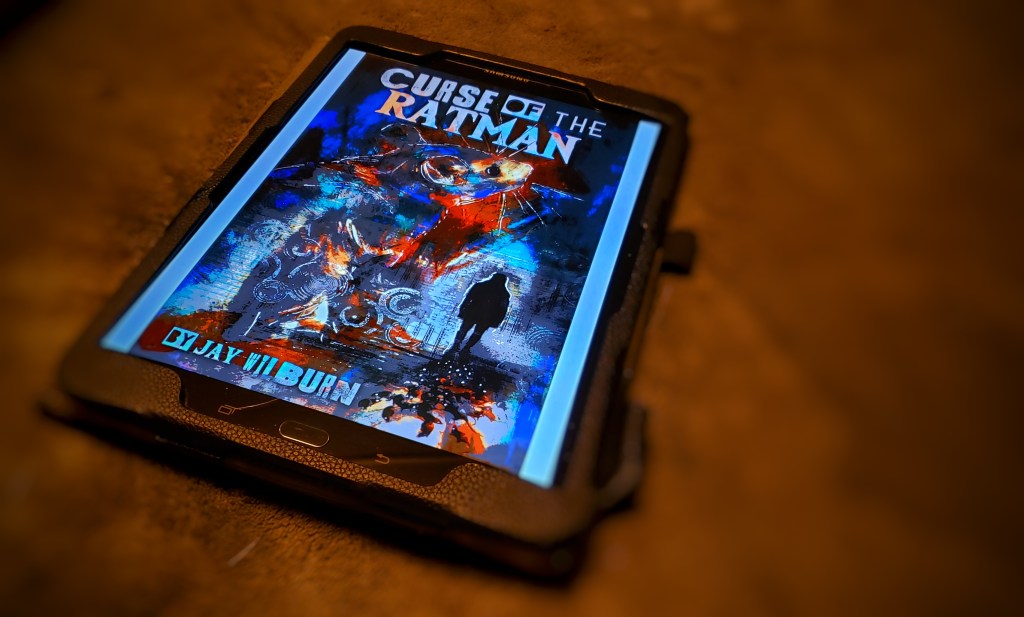
To set the stage for this story, the best I can think to suggest is that it’s a twisted abomination crafted by combining Willard (either the 1971 classic or the superior 2003 remake) with the Clive Barker story, “In the Hills, the Cities.” That doesn’t truly capture the sheer giant monster lunacy of what Wilburn’s created here, but it’ll whet the appetite and prepare the reader as best one can. A family curse comes on with a vengeance, rampaging across the southeast, leaving a swath of devastation that can only be explained as a natural disaster. To call it an act of God would be to beg the question of what sort of God would allow such a monstrosity to exist. The intense pacing of Wilburn’s tale propels us forward even as we want to turn back, knowing that nothing good can come of what he’s racing us toward. If he’d written a novel, including more of the family history and details of the events in the distant past, I’d have gleefully settled in to read the whole thing. As captivating as the story gets, with the expanding threat thundering its way across the landscape, I would love to dive into the origins of the curse in greater detail. There’s a thoroughly fascinating story to be told, and maybe if we beg Wilburn enough–in the form of spreading the word of the Ratman–he’ll find himself compelled to share that part of the tale with us in similar detail.
This novella was released as part of the 31 Days of Godless event at http://www.godless.com and you can pick it up for yourself by going to the website or by downloading the app. The link is below:
I’ve never looked at a dildo and mistaken it for a chest expander, but I’m not a priest, so there’s that. This is how Hawker and McHardy begin their novella, My Dildo Is a Serial Killer. A priest opens a box containing what he believes to be exercise equipment, and insanity ensues. Of course, this mistake arises because someone who couldn’t spell “exorcism” delivered the box with the expectation that someone associated with the church would be able to remedy the problem with the giant purple dildo possessed by the spirit of a serial killer. His name is Terry. Escaping from the exorcism performed by a couple of priests, Terry finds his way to Christina, a disgusting human being with potentially no redeeming qualities. She is the perfect tool for the fulfillment of Terry’s needs. It’s not totally her fault, though. Wait until you meet her parents because, as messed up as Christina happens to be, there’s no doubt they played a key role in nudging her along that path. I’m not telling you anything more about this one. You have to experience it for yourself. The deaths are over-the-top and gruesome, the humor is dark and perverse, and the blistering pace keeps the reader raw and sore as McHardy and Hawker bestow us with a barrage of absurd, graphic, and hilarious events from beginning to climax. These two are fantastic on their own. Combined, they craft a seamless narrative that captures the best of both worlds.
This title was released as part of the 31 Days of Godless event at http://www.godless.com for October of 2021. You can pick up a digital copy of this release by going to the website or by downloading the Godless app on your mobile device of choice.
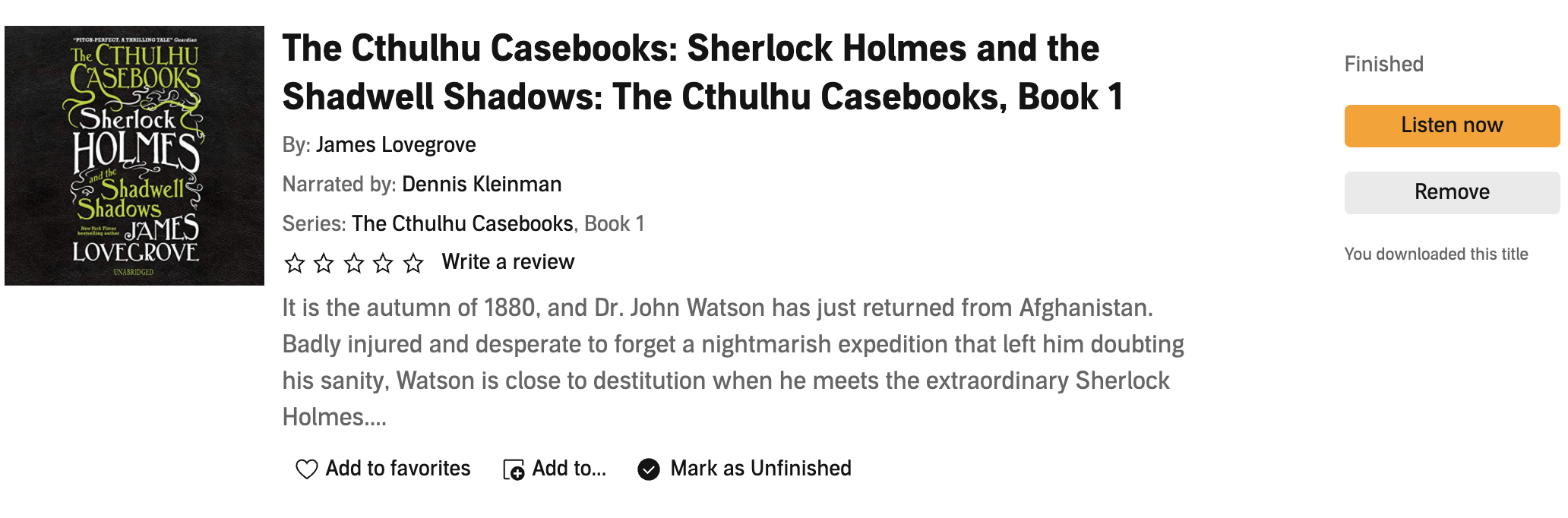
James Lovegrove writes himself into the narrative with The Cthulhu Casebooks, in a fictionalized account of his own life in the preface to this tale. As a distant relation to the former H.P. Lovecraft, a parcel finds its way to him upon the passing of another member of the Lovecraft family. Contained within is a trilogy of manuscripts penned by Dr. John Watson, confidant and partner of Sherlock Holmes. In the tale that unfolds, we learn that the meeting of Watson and Holmes did not transpire as we’ve come to believe. Additionally, further elements of Watson’s previously available documentation of the cases he and Holmes investigated have been fictionalized to protect the world from forbidden knowledge of things best left unknown. From the deserts and mountains of Afghanistan to long-forgotten catacombs beneath London, a global tale of unspeakable horror emerges. Upon meeting one another, Holmes and Watson find themselves in pursuit of answers to a rash of ritualistic deaths occurring during the new moon. What they discover will leave the pair, as well as other familiar characters from the Holmes’ archives, changed in ways never hinted at within the released accounts from Watson. All-in-all, this was a worthwhile mixture of the Lovecraftian mythos and the characters developed by Sir Arthur Conan Doyle. The writing style emulates Doyle’s prose surprisingly well, and the insertion of creatures like Nyarlathotep and Cthulhu into the narrative was performed seamlessly. The story itself didn’t impress me quite as much as I’d hoped, but it was decent enough to nudge me toward checking out the additional two volumes in this series. Dennis Kleinman’s narration of Watson was quite fantastic, as was his performance of Holmes’ dialogue. Sadly, the other characters felt perhaps a bit less set apart from the background. This is not to say that they weren’t distinct enough to tell them apart, because he managed that quite well, just that they weren’t brought to life in quite the same way the two protagonists were.
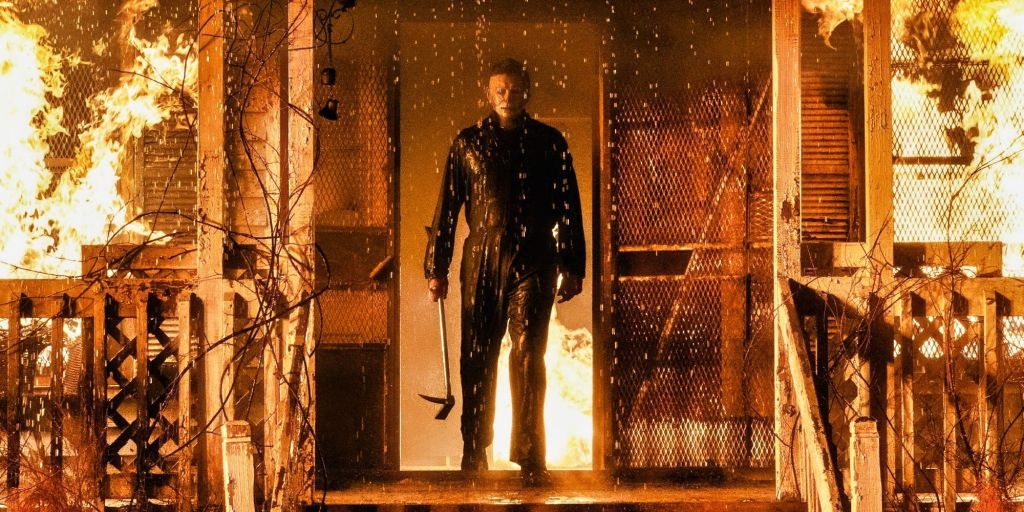
Halloween Kills picks up on the action only minutes after Halloween (2018) rolled credits. As Dylan Arnold’s Cameron walks home, upset with himself and wallowing a bit, he comes across Will Patton’s Officer Hawkins where he lies bleeding on the pavement as he’d been left to die in the final third of the previous installment. Though Hawkins appears to be dead at first, he is soon revealed to be clinging to life. We are treated to a surprisingly well-produced return to Halloween (1978) in a flashback that shares the concluding events of that night from the perspective of a younger Hawkins and his partner. In this, we discover that Hawkins has cause to feel no small amount of guilt over the events of that night 40 years before. We witness further events of that night, encountering children having an altercation before being sent home by police roaming the streets in search of Michael Myers. One of those children will be a familiar character to discerning viewers of the older Halloween. We meet up with Tommy Doyle (now played by Anthony Michael Hall), Nancy Stephens’s Marion (returning to the character for a fourth time in the series, though only the second in this internal timeline), and Kyle Richards’s Lindsey (reprising her role from the 1978 classic) at a bar where open mic night is in full swing. While I would have enjoyed seeing a nod to The Curse of Michael Myers, with Paul Rudd returning to portray Tommy Doyle, I was nonetheless pleased to see so many performers returning to roles they played in 1978 and 1981 respectively. This includes Charles Cyphers returning to take on the mantle of Leigh Brackett yet again. As emergency services race toward Laurie Strode’s burning home, Jamie Lee Curtis’s Strode shouts a desperate plea that they let it burn. If they had heard her and heeded her request, the movie would have turned out quite differently. A single firefighter falling through the floor into Strode’s trap basement provides the means for the still breathing Myers to remove himself from his imprisonment below the house. Carnage ensues in a scene that pits Michael against a group of firefighters, in which the killer’s prowess is displayed to be anything but diminished. This is something we experience more than once in this movie that has rarely, if ever, been incorporated in a slasher flick. In Halloween Kills, we are treated to one-against-many conflicts that are typically antithetical to the slow, methodical stalker and prey relationships we often expect from such stories. The Michael Myers of this movie is more a force of nature than we’ve come to expect, capable of bursts of intense violence directed, rather than toward singular targets, at groups of people. An economy of brutality is on display with murderous efficiency, as Myers dispatches multiple opponents with expedience and ruthlessness. I went into Halloween Kills with the expectation that it would suffer from middle movie syndrome, being the second of a planned trilogy of sequels following the events of Halloween 40 years before. What I experienced was more like The Empire Strikes Back than The Two Towers, a self-contained narrative that–while it is designed to carry the plot between beginning and end of the trilogy–manages to satisfy my needs as a standalone experience. The performances are spectacular, the kills are savage and visceral, the soundtrack/score was superb, and the story unfolding for the characters as Michael makes his way through Haddonfield toward his natural destination is a vivid enough assortment of threads as to make for a worthwhile tapestry. The sheer brutality of Michael’s murders is almost enough to distract the viewer from the underlying theme of fear spreading through a community primed for terror and harboring a certain tension just beneath the surface for nearly half a century. This explodes in a predictable fashion as the residents of Haddonfield create the conditions wherein Michael is able to thrive and flourish, feeding–as he seems to–on the very anger and horror being amplified by the mob mentality spreading like wildfire throughout the movie. A bit of dialogue near the end of the movie manages to sum things up nicely. When Hawkins expresses his regret at having made this possible by not letting Michael die back in 1978, Laurie Strode corrects him and explains that this is her fault, that her fear of Michael’s return has been allowed to spread and fester like an infection in the otherwise quaint community. I know that I am certainly looking forward to the release of Halloween Ends next October, and I truly hope a whole lot of you are as well.
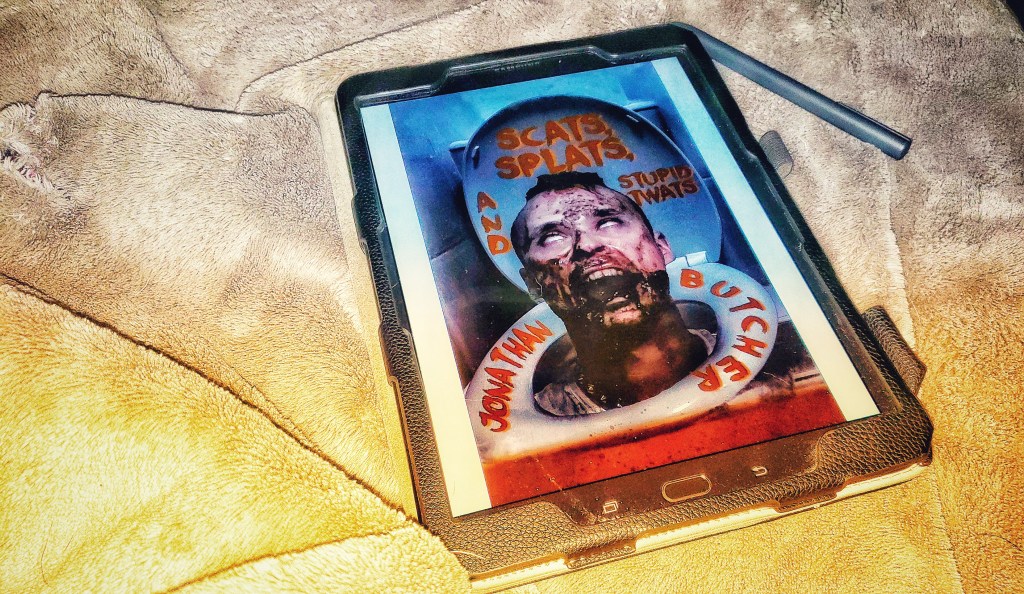
Jonathan Butcher has assembled quite the vile and visceral collection of stories in Scats, Splats, and Stupid Twats. It’s a quick read, but one that manages to leave one hell of an impact on the reader. The anchor of this collection, The Chocolateman, definitely has me anticipating the release of the novel inspired by this short. A disorienting and frankly revolting chance encounter in a public restroom sets the stage for a particularly filthy sort of horror befalling a man who despises any manner of filth. The stories Slop and Pretty Cunt showcase a certain graphic and visceral reaction to infidelity that will satisfy anyone who has been on the receiving end of that sort of treatment. Taking everything too far, Butcher provides a catharsis, penning fantasies that bring to light some of the darker thoughts people have experienced in times of pain and vulnerability. The other four stories run the gamut of topics. We experience the undying love between a mother and child, the harsh consequence of senility afflicting a wizard, a Halloween ritual of monstrous proportions, and a broken home struggling to stitch itself together. Butcher also includes a poem replete with fantastic descriptive elements and visually stunning imagery. This is a fantastic collection of shorts that will absolutely demand the attention of any reader brave enough to dive in.
This collection was released on http://www.godless.com as part of the 31 Days of Godless event. You can grab a copy for yourself by going to the website or by downloading the app. The link is below:
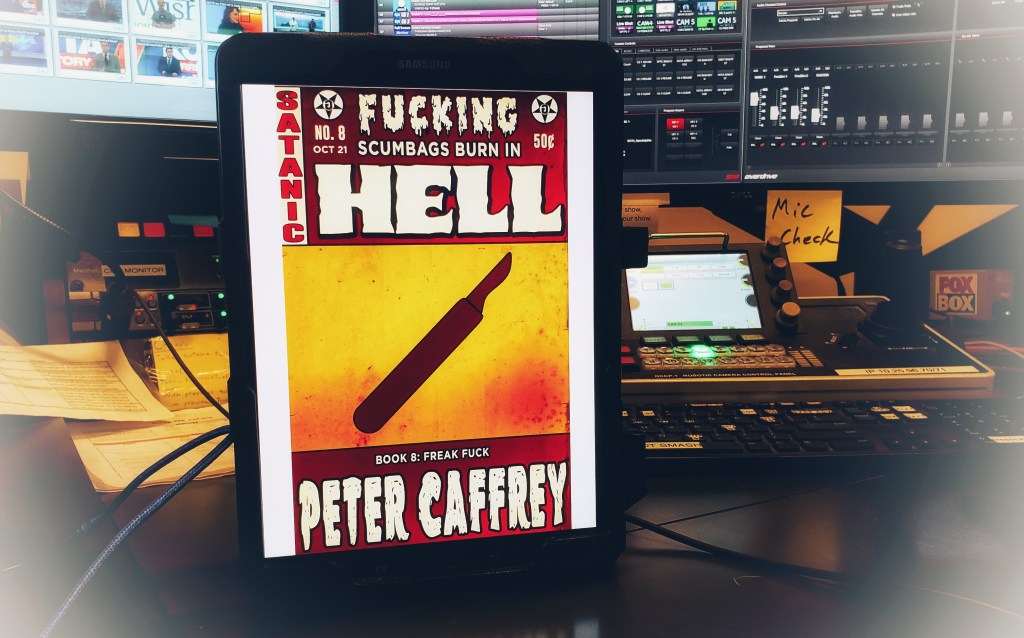
Peter Caffrey brings us a new tale of scumbaggery, and with it, a new glimpse of what Hooper is capable of in Freak Fuck. We meet Doctor Oliver/Doctor Fairweather just as he’s transitioning from one name to another, setting up shop in a new country. Our fly-by-night plastic surgeon dedicates his life to preying on the insecure and vulnerable, promising beauty and restoration of youth, only to take whatever he can swindle from his prospective clients/patients. As the story progresses, we discover that the good doctor has a great many unsavory and horrific appetites, the greatest of which being his desire to experiment on unwilling subjects, crafting monstrous perversions of natural, human beauty. When his accomplice nurse fails to arrive for work, Nurse Hooper arrives in just the nick of time, ready and willing to aid the man in his larceny and misdeeds. This is not the Hooper we’ve come to expect, and, arriving on scene as Hooper does, it sets a whole different tone to the interactions between scumbag and arbiter, showcasing Hooper as one who can adapt to whatever the circumstances require. Caffrey’s addition to the Hoopiverse brings us one of the more extreme and vile scumbags we’ve had the pleasure of seeing meet his fate, and Hooper seems to be a bit more hands-on in the application of judgment this time around. I wasn’t sure how this one would play out, and there were so many directions it could go, but Caffrey provides us with quite the unsettling, yet one of the most well-deserved punishments so far in the series.
This installment of the Fucking Scumbags series was released as part of the http://www.godless.com 31 Days of Godless event. You can procure this–and the other installments–by going to the website or by downloading the app to your mobile device of choice. The link is below:
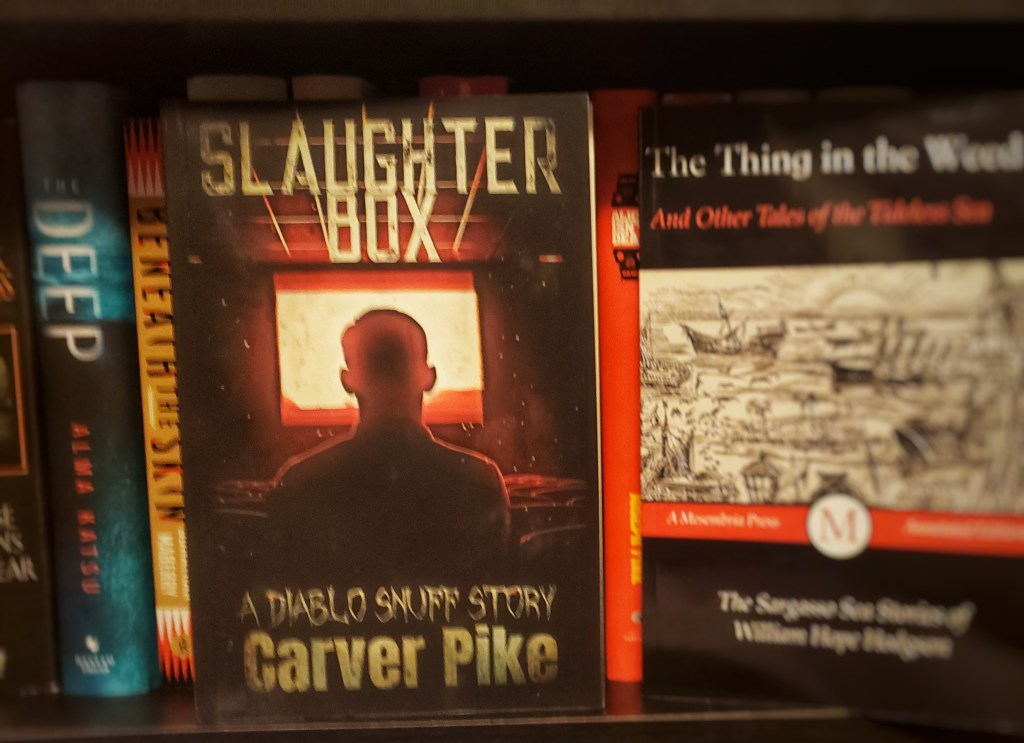
Readers of Carver Pike’s Diablo Snuff books will have first met Kong in Passion & Pain, after his first encounter with the sinister organization. His torture at their hands drove him to seek any information he could find, only to discover they were like ghosts. Our next meeting with Kong is near the end of The Grindhouse, where he appears as a member of Psalm 71. A lot had clearly taken place between those points in time, and Slaughter Box provides us with a glimpse of that missing period of Kong’s life. Still traumatized and emotionally damaged from his first experience with Diablo Snuff, Kong returns to his hometown where he finds a flier for the grand reopening of a local movie theater. Violating the trust of his childhood best friend, Kong invites that friend’s younger sister, Sammy, on a date. With the flier fresh in his mind, their venue is obvious. Unfortunately, as the reader suspects, this is a trap. William Castle, had he been a homicidal monster or a psychopath, would have fallen in love with the painstakingly engineered and hideously cruel alterations to the theater. Bringing the film to life in the most awful ways, Diablo Snuff intends to punish Kong for his persistent search. I won’t spoil anything, but we know Kong makes it through the events of this book, but will anyone else survive the malicious and inhumane machinations of Diablo Snuff? You’ll have to read it for yourself if you want to find out. Carver Pike does an excellent job of balancing high stakes, tense horror with more human elements of the story. We learn a great deal about Kong, his life before we first discovered him in that hellish warehouse, and the miserable life he’d been leading subsequent to his escape from the organization’s clutches. We get to know Sammy, and the deep affection between she and Kong is so well-crafted on the page as to feel as palpable and sincere as a relationship between two real people. As one might expect, Pike manages to fill the pages with a fair amount of sex and smut, in addition to the violence. If you’ve read The Grindhouse–as you certainly should have–you’ll be well aware of what Diablo Snuff is capable of when they’ve got a movie projector available. This is the penultimate Diablo Snuff book, leading the way into the (sure to be) intense conclusion, The Maddening. It’s been a long ride, getting here…but one cannot claim it hasn’t been enjoyable.




 Domus Necrophagous