Small Town Horror by Ronald Malfi, Narrated by Joe Hempel

Ronald Malfi excels in telling tales that center around mistakes we make as children coming back to haunt us, whether it’s a manifestation of our own guilt, someone exacting their revenge, a supernatural force, or a combination of those things. One of the most thrilling aspects of Malfi’s storytelling is that we’re often left to wonder which scenario(s) we’ll encounter in the story we’re reading. Small Town Horror is just such a story.

When a successful attorney, Andrew Larimer, receives an unexpected phone call from a childhood friend and agrees to return to the hometown he left in the rearview 20 years earlier, it sets him down a path of deception, mystery, and horror. Reuniting with former friends he hasn’t seen in decades, Andrew quickly learns that he might have been better off staying home than involving himself in the nightmare unfolding in Kingsport. As the shadow of an unspeakable event from the shared past of these five friends looms over their lives, they will find themselves tested and pushed to their limits.

Though it takes a while to discover the dark secret they’ve carried with them all these years, it’s fairly easy to figure out the broad strokes as the story unfolds. And while the revelations may not be a shock or surprise, I don’t think that was the point. It was the journey there that Malfi seemed to be focused on, building the tension as we wondered what would come next and who would suffer. We’re forced to wonder what might have happened if they’d only made different choices. Would honesty and accountability have produced a different outcome? I can only imagine that would be the case. That is, after all, the overarching theme–the danger of deception, and especially self-deception.

Even knowing the likely outcome, the conclusion hits like a punch to the gut. That is, after all, another of Malfi’s skills.

Joe Hempel, as always, brings the story to life as only the hardest-working audiobook narrator in the world (I can only assume) can manage.

Recursion by Blake Crouch, Narrated by Jon Lindstrom & Abby Craden

Blake Crouch guides us through a narrative full of twists and turns, switchbacks, and–well, obviously–recursions, as he tackles the well-trod ground of time travel, bringing a fresh new spin to the topic. False Memory Syndrome is becoming a plague, as people find themselves suddenly–and seemingly at random–overwhelmed by new memories of a life that wasn’t the one they’d been leading up until that moment. These memories are as vibrant and real as the ones they’d had access to only seconds earlier, and the confusion and contradiction are enough to drive people mad.

One detective’s obsession with the often disastrous impact of these false memories and the unknown vector by which the mental illness is transmitted leads him to an inevitable meeting with a research scientist focused on salvaging memories for those suffering from dementia, as she hopes to ease the horror of that debilitating condition. Unfortunately, a wealthy and powerful benefactor with seemingly unlimited capacity to predict market trends and so much more has his own goals for the technology, and he’s seemingly two steps ahead of both of them.

Crouch takes us from the seemingly innocent and altruistic beginning to the cataclysmic end, as the truth–and reality itself–becomes a tangled mess of interwoven timelines. At once thrilling and depressing in the way it captures the worst of human nature, this is a must-read.

The narration provided by Jon Lindstrom and Abby Craden is fantastic, and they thoroughly capture the characters and bring the listener into the story.

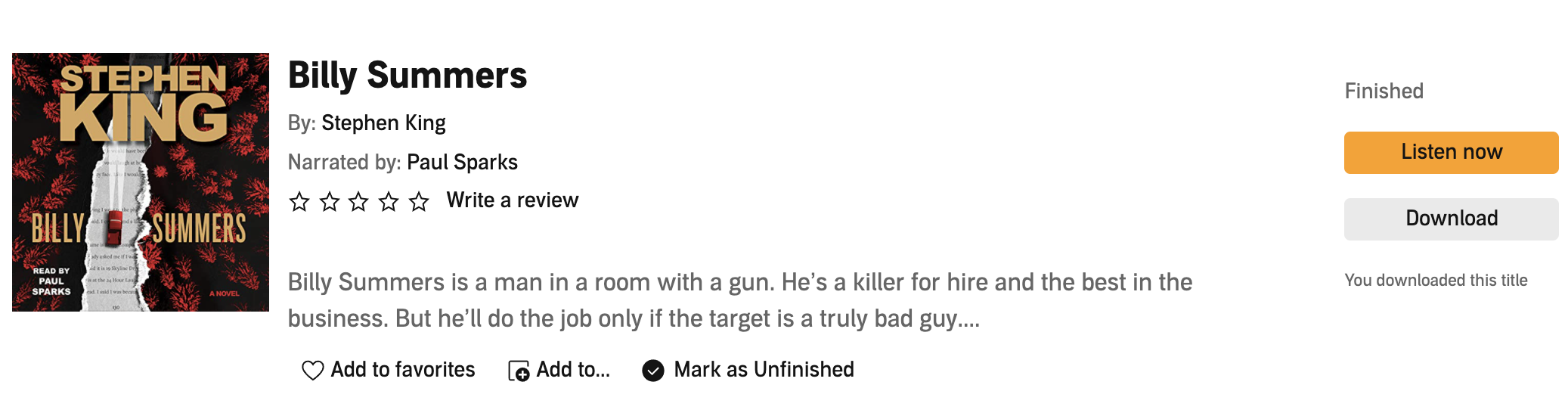
Billy Summers by Stephen King

Billy Summers is, in my opinion, the best book Stephen King’s written in a great many years. It also stands out as being one of the best non-horror books of 2021, probably of the past few years at the very least. I’m not one of those to denigrate King just because he’s King; there’s a reason he’s perhaps the best-selling horror author of all time. He knows what he’s doing, even if I sometimes question his ability to stick the landing concerning his endings. Botched endings aside, most of his oeuvre is pretty well stellar, and even the material that hasn’t aged well is still worth diving into.
With Billy Summers, while there are passing references to supernatural forces within the world (commentary on The Overlook Hotel), King has made what I consider to be his most pronounced deviation from the realm of horror and the supernatural. Beneath the surface, this novel has a lot to say about the subjective nature of morality, the fluidity of identity and self-identity, the importance of memory, and the relationships we develop in our lives. None of that overshadows the surface-level compelling narrative of Billy and Alice.
Billy is an almost unnaturally skilled killer. While he’s an expert with firearms, he’s written with such humanity and depth that he never crosses the line into being a caricature of the action heroes from film and television. Highly literate, prone to in-depth analysis of both himself and those around him, and always planning, Billy has nevertheless immersed himself within a character he refers to as his “dumb self” when interacting with the criminals for whom he acts as a shooter. Providing his employers with a false sense of confidence derived from apparent superiority has allowed Billy to avoid being perceived as a threat, and it’s potentially kept him alive through the years.
When Billy accepts what he imagines to be one last job, he’s provided with a long-term identity that brings to the surface a dream he’d never expected to pursue. As time passes and Billy immerses himself deeper within the fictional identity, he begins noticing some disturbing signs that everything might not be as smooth as expected when the time comes to complete the job. Thankfully for Billy, he’s much smarter and more capable than the people who hired him.
As Murphy’s Law takes over and anything that can go wrong does go wrong, Billy finds himself in a complex paternal relationship with a damaged young woman. As they help one another heal, Billy learns that he’s still got one last job to complete, and it’s far more dangerous than the one he’d signed up for.
The pacing is superb, and the balance of character study with narrative as we find ourselves led by King to the conclusion of the tale is about as perfect as one could hope to experience.
Paul Sparks expertly tackles the audiobook narration, thoroughly capturing the different sides of Billy as he slips from identity to identity throughout the story. He additionally captures the secondary characters well enough that there’s never any doubt who we’re hearing in the dialogue. Sparks exhibits fantastic cadence as he guides us along the path King has carved for us to follow.

Dreams, and the Places They Take Us

Have all of you dreamt of specific locations, or a singular location, so many times that you occasionally recall that place in your waking life as somewhere you momentarily believe you can return to? As if it’s somewhere you’ve actually been before?

You only finally stop thinking that way once you’ve reminded yourself that the location exists only in your dreams, though you feel like you’ve been there so many times before.

There are two locations like this for me, both of them situated in outdoor environments that bear a strong resemblance to regions of the Black Hills…or at least they feel like they’re situated somewhere in the hills.

One is a large cave system on private land that I’m able to enter by maneuvering my way along a cliff-side that others apparently don’t know about. It doesn’t keep me from trespassing, but it keeps me from being caught while doing so, as it provides me with an otherwise unknown entrance via a large grotto coming off the cliff wall. Descending from this hidden grotto is a sort of primitive staircase, something that could have been carved into the stone by an earlier culture. I’ve never followed the stairs down any further than the fissure that leads me into the cave system, but the stairs descend much deeper into darkness. The interior of the cavern is so familiar to me as to feel like I’ve been there dozens of times. In my dreams, I’ve taken other people there to experience the place in addition to making numerous trips on my own. The smells and taste of the air are so vividly recalled, as is the way sound reverberates from the walls. The chill of the water in a slow-moving underground stream that pools in a certain location where I’ve always had to strip down to traverse is as real to me as any memory.

Another location is similarly to be found along a cliff wall, this one rising up from an otherwise normal hiking trail that leads off into a narrow, mountain valley. By scrabbling along what would only be liberally described as a path up the early part of the cliffside, one can reach a small tunnel that pushes through to a sheltered cliffside on the opposite edge of what is actually a thin dagger of rock rather than a solid stretch of mountain like what is to be found in either direction to the side. From this sheltered cliff, one can see a whole different valley spreading out, far below. I’ve spent countless hours sitting there, enjoying the view, or so my memory tricks me into believing.

What’s particularly funny to me is that I rarely recall my dreams at all. And yet, when I find myself thinking of either of these two locations, sudden recollections of numerous visits come to mind from dreams I don’t even remember having.

That’s all, just a little bit of absent musing for the day.

What sort of locations do your dreams paint so vividly that you recall them in waking life as real places?