Political Violence and the Selective Acknowledgment of It

Political Violence comes in more shapes and sizes than Pokémon. And yet, it’s only ever a specific variety that most people seem willing to acknowledge, and then only when it suits the narrative they prefer to frame. When someone is killed in an act of direct Political Violence, hand-wringing, condemnation of physical violence, and proclamations that we are better than this inevitably follow closely behind. This is true, even (or especially) when the violence in question was a direct response to less overt forms of violence. You see, those more subtle forms of violent action are insidious in that people can easily dismiss them if they’re so inclined, but are often (if not always) more harmful.

Willhelm Frick, Joachim von Ribbentrop, Julius Streicher, and several others who were sentenced to death following the Nuremberg Trials had never killed anyone, and had (to the best of anyone’s knowledge) committed no acts of direct violence. In fact, Hermann Göring, Ernst Kaltenbrunner, and Martin Bormann were among the minority, in that they had committed acts of direct violence and murder during their tenure within the Nazi Party. But, in 1946, we recognized that Political Violence comes in many forms, and the guilt of the 12 men who were sentenced to execution was not open to debate. Adolf Hitler, himself, has never been connected with evidence that he personally murdered anyone aside from possibly Eva Braun, before taking his own life. The same can be said for Joseph Goebbels, though he and his wife killed their six children and then themselves. These men, and many others, had been complicit and had knowingly issued propaganda and orders that led to the deaths of countless others.

Would anyone like to present the defense that these men were killed (or killed themselves to avoid being killed) because of their political opinions? Is that the extent of cultural relativism that we should be applying to the architects of the Holocaust? That’s what I keep hearing lately: that people shouldn’t be threatened, persecuted, or harmed over a difference of opinion. All I can assume is that many people need to better acquaint themselves with the definition of “opinion” before they start concerning themselves with differences between them.

Opinions are just assumptions or judgments that an individual develops regarding any particular topic. They can be informed or uninformed, but they’re little more than a subjective viewpoint with greater or lesser value depending on the expertise and the degree of authority invested in the individual sharing said opinions. Critiques of policy and ideology are political opinions. Whether they’re right or wrong, they’re opinions, and people are entitled to their own. Hate Speech, however, is not an expression of an opinion. Hate Speech is an attack, using dehumanizing and demeaning language to target an individual or a group of people based on features of their identity: Ethnicity, Nationality, Skin Color, Gender Identity, Sexual Orientation, and so on. Hate Speech targets (often immutable) characteristics of the individual or group, for the purpose of expressing bigoted, biased, and prejudiced perspectives. Thus, we have the difference between those who condemn the actions of Benjamin Netanyahu and the Israeli Government, compared to those who condemn Jewish people or the people of Israel as a whole. One is a criticism of policy and the actions taken by a group, and the other is a condemnation of a group of people based on either Ethnicity or Nationality, depending on whether we’re talking about Jewish people or Israeli people. There is a massive difference between the two things, and yet we see colleges and universities losing funding because certain people want to conflate these two things with false equivalence.

Hate Speech is, in reality, a form of Political Violence that gets shrugged off as nothing more than a difference of opinion, typically by those who are not impacted by that violence. Hate Speech and hateful rhetoric paved the way for the Holocaust, along with the more recent Genocides in Rwanda, Myanmar, Bosnia, and Herzegovina.

Sheltering Hate Speech under an umbrella by treating it as if it’s nothing more than another legitimate opinion that one is entitled to share is just part of the weaponization of public discourse. It promotes discrimination and violence, especially when it’s combined with disinformation/misinformation campaigns designed to reinforce the bigotry involved.

Still, one might, of course, look at those guilty men I referenced above and argue that they were guilty of War Crimes. Therefore, the sentences were both just and appropriate. But, by the same standard, our current Administration should also face a tribunal.

Despite no evidence supporting the claims and the US Intelligence Apparatus contradicting them, the Trump Administration confidently states that Venezuelan President Nicolas Maduro is linked to Tren de Aragua, and that a U.S. strike on a foreign boat in international waters was justified because that boat was carrying cocaine to our border (sans evidence). By any standards, the killing of foreign civilians in international waters is (by definition) a War Crime. The Trump Administration is hardly alone in this. Every President in my lifetime has been guilty of actions that should constitute War Crimes. Why are we not holding ourselves to a higher standard than we held the Nazis in 1946?

But, of course, it’s not just War Crimes that we’re dealing with today. The current Administration repeatedly flaunts International and American Law, violates the Constitution, and works to erode the mechanisms of Democracy within America. Men like the late Charlie Kirk have been instrumental in both endorsing and encouraging those actions, as well as being directly involved in helping to place Donald Trump in the position of authority he presently holds.

Charlie Kirk fostered an environment of White Christian Nationalism throughout his time in the public eye. It takes little effort to find several instances of outright Racism, Sexism, Homophobia, Xenophobia, and myriad other forms of Bigotry in his Podcasts, Social Media posts, and Public Appearances.

He repeatedly expressed a baseless and racist endorsement of the Great Replacement conspiracy, wherein non-whites were coming to America (and other Western Nations) to replace whites. Just last month, he claimed, “The Great Replacement of white people is far more sinister than any redistricting project.” The Great Replacement theory is directly linked to several acts of Political Violence, targeting non-whites. More importantly, the Great Replacement is virtually identical to the White Genocide conspiracies that have been core aspects of neoNazi ideologies for a long time now.

Charlie Kirk accused Transgender people of being predators and actively encouraged his listeners/viewers to bully and harass them. Transgender people, while making up a tiny fraction of the population, are somehow substantially more likely to be victims of violence than cisgender people are.

He couldn’t even manage to consistently maintain his performative support for Israel and condemnation of antisemitism, despite knowing that he needed to tow that line because it might be a bridge too far for some of his audience. Nevertheless, he still managed to spout off tired old antisemitic talking points about Jewish people controlling everything from higher education to Hollywood, pointing the finger at Jewish financiers of “Cultural Marxism,” and acting aghast at Jewish people promoting anti-white hatred despite wanting white people to do away with that same kind of hatred against them.

To pretend that isn’t often Political Violence is tantamount to saying that violence perpetrated against Jewish people by German citizens in 1940s Europe was not Political Violence. When the apparatus of government endorses, however tacitly, the dehumanization of a group of people, it requires extensive mental gymnastics to pretend that the acts of violence perpetrated against that group of people are not acts of Political Violence. It also requires an impressive gymnastics routine to pretend that the propagandists who spread the dehumanizing message aren’t complicit in the outcomes.

Was it not Political Violence when Omar Mateen murdered 49 people and injured more than 50 others at the Pulse nightclub in Orlando, FL? He may have claimed to support the Islamic State, but his motivations (even according to his father) were based on the same anti-LBGTQ+ sentiment we hear expressed by White Nationalists regularly. Since LGBTQ+ rights (and the existence of LGBTQ+ people) are treated like a political football, that would make any violence arising from homophobia and anti-Trans perspectives Political Violence. And this is State-Sanctioned violence, because Republicans certainly dedicate a lot of bandwidth to demonizing LGBTQ+ people, while Democrats often turn a blind eye to the violence perpetrated against them. And, whether Liberals want to accept it or not, neglect and dismissal are forms of Political Violence as well. But that’s a discussion for another time.

Men like Charlie Kirk, Ben Shapiro, Nick Fuentes, and even Donald Trump have a particular skill, even if they lack any others. They can extrapolate from their own insecurities, fears, and failures to develop a form of demagoguery that plays on those same weaknesses in an audience. This only works when the demagogue is in the majority, because for some people, there’s always an undercurrent of resentment and fear associated with imagining the loss of the power that comes with being the majority. Some of that, I’m sure, arises from the assumption that (if the roles are reversed) they will be treated as poorly as they have treated the minority group(s) within society.

Men like Kirk taste fear and weakness in their audience the way a shark tastes blood in the water, and they’re just as predatory about it. They stoke that fear with misinformation and cruelty, dehumanizing anyone who isn’t part of that majority group, and assuring the audience that they can rest assured of their superiority. They make them feel threatened by the outsiders, regardless of the fiction required to do so, because they know these people won’t risk eroding the false confidence they’ve built up by digging too deep or tugging at threads that could unravel everything.

And, as that manipulation leads to the inevitable results, they hide behind the shield of Free Speech, insisting that they’re just asking questions, voicing their opinions, or engaging in healthy debate. We’ve seen this happen several times in the past, with January 6th, 2021, as one of the most vivid examples. The architects of the direct Political Violence are smugly distancing themselves and feigning a sense of horror at what’s happening, as they assume no one will recall how openly they encouraged all of it.

One way or another, there needs to be consequences for the Political Violence perpetrated by those who conveniently, like cowards, hide behind a misapprehension of what “Opinion” means. And, just as important, people need to learn that calling for violence against one’s oppressors and those who have wished or encouraged violence against them is not at all the same thing as wishing harm on people just because they have a different opinion. Malcolm X wasn’t the same as the white racists who fought to maintain segregation and oppose the Civil Rights Act, because he called for reactionary violence. He was already the victim of Political Violence, and was only speaking the same language as those who perpetrated that violence. If you threaten someone or encourage others to act violently toward them by dehumanizing them and manipulating others into thinking they are a threat, you are not expressing an opinion. That isn’t merely a matter of differing political viewpoints.

Regarding the present situation, and the aftermath of Charlie Kirk’s apparent assassination, we don’t even know if it was an act of Political Violence. It stands to reason that it probably is, but it’s just as likely to be someone who agreed with him on most accounts as it is to be someone who was politically opposed to his ideology, stripped of the Hate Speech and hateful rhetoric. After all, the same people storming the Capitol on January 6th, 2021, were the same people most vocally supportive of “Back the Blue” perspectives, yet they assaulted police officers without any compunction. When one promotes an atmosphere of hate and fear, in which violence is encouraged, we’re just as likely to see that violence turned upon people in the same group, the moment fractures appear. It’s worth keeping that in mind.

Salt Of My Blood by Jae Mazer

Jae Mazer’s Salt Of My Blood is a tale of two vastly different characters, revealed through snapshot windows into their respective lives as we wait for what we’re sure will be a tumultuous meeting when the two come together. From childhood through the setbacks and disappointments of adult life, we witness the two characters grow and evolve along separate paths. Living in post-war Denmark, Lærke and Harald are deeply tied to the treacherous North Sea, but their relationships with the water are as distinctly different as their personalities.

Lærke’s lifelong love of the sea transforms into something far more peculiar–equally disturbing and beautiful in the way Mazer tackles a fascinating taboo–when she discovers her only true friend where the sand meets the sea. Harald’s love of the sea is deeply tethered to his cruel and predatory nature, and piracy becomes his sole passion. When their two worlds collide, it is truly captivating; a spectacle sure to feel like a reward to the reader.

Mazer addresses heavy topics in this modern-day fairy tale; sexual assault, mistreatment of women, the antiquated concept of the wife’s role within marriage, and the misogyny that underpins all of those things.

This story can be found on the Godless platform by clicking on the link below:

Slashtag by Jon Cohn, Narrated by Lauren Ezzo

Jon Cohn invites us to Slashtag, a multiplatform reality program that promises to take horror to new, previously undreamt heights. The Propitius Hotel, once the home of America’s most notorious and prolific serial killer, Arthur Wilson, is the setting for this nightmare-inducing challenge that pits seven celebrities (or what passes for celebrities) against the clock as well as the malevolent entities that wander the haunted hotel.

The characters are all believable and distinct from one another, especially as their carefully crafted facades begin to crumble under the strain of life-or-death stakes, and the people beneath are gradually revealed. Cohn handles that character development/dismantling with masterful skill. As self-awareness kicks in and self-preservation becomes essential, we witness these people transforming before our eyes, even as they struggle to maintain the personae they know their fans are logging in to see.

Tawny and April are amazing characters, fascinating and fleshed-out, and the rest of the cast Cohn introduces us to is no less vibrant and interesting in their own ways, even if their personality is bland (yes, I’m talking about Britt). In some instances, the clear analogs to real-life people are a lot of fun, especially as we meet the wealthy board members of Krentler Media.

The uncertainty of whether what’s happening is real or contrived is deftly handled, as characters react in vastly different ways, depending on where they fall along that spectrum of belief…until they’re all in the loop, and fully cognizant of the danger they’re in.

The premise behind the reality program itself, the purpose behind the torture and slaughter, and the mythology that’s brought to bear are enjoyable and metered out with just the right pacing.

Lauren Ezzo’s narration is spectacular, providing each character with their own delivery and cadence. Her narration made the book all the more enjoyable.

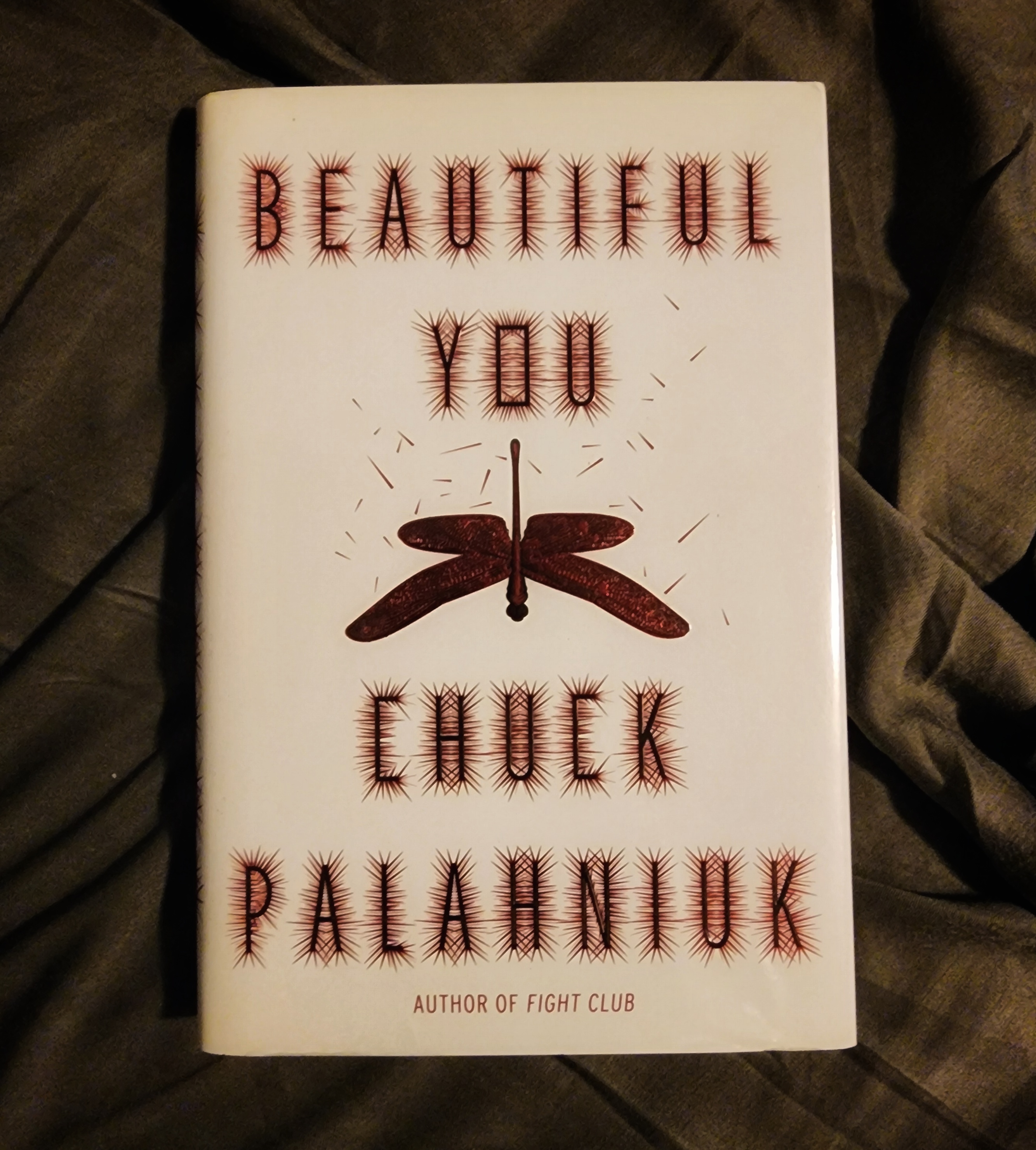
Beautiful You by Chuck Palahniuk

I’m a long-time reader of Palahniuk’s work, and I’ve rarely found anything disappointing in his writing. Beautiful You, I’m happy to say, was no exception. As always, his unique literary voice and cadence shine through, while still managing to avoid seeming repetitive or tired.

This novel introduces us to Penny Harrigan, a woman whose life seems to be an unending series of disappointments, whether it’s her career or her love life. All of that changes when tech billionaire C. Linus Maxwell takes an interest in her. She’s as surprised as everyone else, as she lives out a Cinderella fantasy that most girls would only dream of. Unfortunately, the dream is quickly revealed to be more of a nightmare, as she begins to feel less like a romantic partner and more like a guinea pig. Maxwell is not the man the tabloids make him out to be, perhaps because he secretly owns them.

As this intensely sexual tryst continues, Penny silently watches the clock ticking down to the inevitable conclusion that awaits all of Maxwell’s romantic partners. And when that end arrives, it’s as jarring and disorienting as the beginning was.

It’s soon revealed that Maxwell has his eyes set on an objective with global repercussions, and Penny has been ignorantly complicit in the horrors that await the women of the world. By the time she realizes what’s going on, is it too late to get anyone to hear her?

As she struggles to put a stop to the plan already in motion, she’s hammered with revelations that force her to question her life, her identity, and the extreme limits of human sexuality.

As sexually explicit as Beautiful You happens to be, there’s nothing remotely erotic about it. That’s the magic of Palahniuk’s writing. He was able to approach a topic so steeped in sexual content without making it feel smutty or even remotely sexy. He takes us right to the verge and then turns away…like literary edging. There’s a perversity in the clinical detachment of it all, and the sense of impending awfulness that the reader or listener is impossible to dismiss. In a sense, it makes us feel superior to the characters, because we see the trap that awaits and convince ourselves we could escape it. It forces you to wonder if we’d succumb to the same terrible outcome if this sequence of events played out in the real world.

The moral of the story, I suppose, is that men need to focus more on the pleasure their partners are experiencing…otherwise, the Beautiful You line of products might just take our place.

Carol Monda’s narration definitely captures the initially neurotic and out-of-her-depth qualities of Penny’s character as well as who she becomes as the events of the story transform her.

All I Want Is To Take Shrooms and Listen To the Color Of Nazi Screams by John Baltisberger

That title’s a mouthful, right? Well, I challenge you to come up with a more appropriate title for the book after you’ve had an opportunity to read it. This is going to be a challenge to review because it’s so many different things. There’s so much going on within these pages. At the core, it’s a collection of short fiction and poetry, much of which is focused on kaiju–I’ll return to that later. But this collection is unique in that it’s assembled in a framing story that tells us a colorfully embellished autobiography of Mr. Baltisberger himself.

Colorfully embellished is certainly one way to describe it. This is the autobiography of John Baltisberger if he took off the restraints that civilized society has shackled him with. There is violence galore–violence we certainly hope isn’t an accurate representation of John’s life. If it is, then we should probably keep our mouths shut and let him go about his business. Because his business is killing neo-Nazis, fratboy rapists, corrupt police, klansmen, and other people the world might be better off without…and ingesting copious amounts of hallucinogenic substances. Of course, as we learn later on, much of his attention has shifted to focus on his intensely sexual relationship with his loving wife and the fantastic daughter they’ve produced. But maybe there’s still room for killing bad guys. There’s always room for that, right?

So, regarding the kaiju-focused short fiction and poetry. A few years ago, Mr. Baltisberger offered to write personalized kaiju poems or stories taking place in locations of your choosing. I was one of the individuals who took advantage of that offer, and I was pleased to see that the brief tale was included in this collection. They’re a lot of fun, and it’s hard not to enjoy giant monsters going on monstrous rampages as such creatures are wont to do.

One feature that stood out for me was roughly two-thirds of the way into the book, where there’s a hugely epic poem that will surely satisfy fans of Baltisberger’s stand-alone poetry. It tells a tale of history and war, intrigue and mysticism. That alone is worth the price of admission. It is best thought of as admission because Baltisberger is going to take you on a dizzying, kaleidoscopic thrill ride that rivals anything you’ll find at Six Flags.

You can also find this title, along with many others by the same author as well as the publisher, Planet Bizarro Press, by going to http://www.godless.com or following the link below:

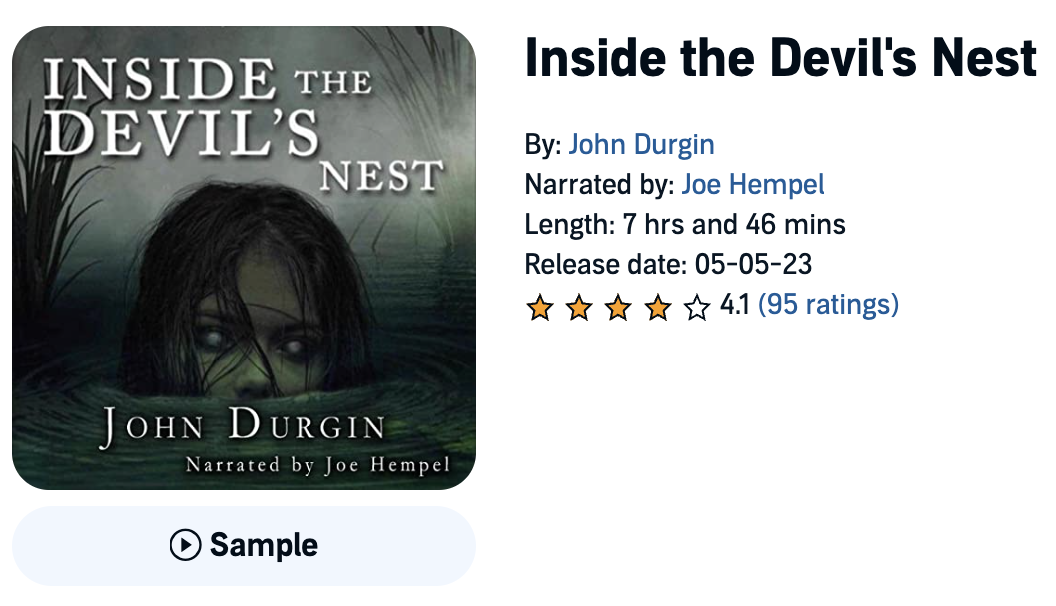
Inside the Devil’s Nest by John Durgin, Narrated by Joe Hempel

Anthony Graham is a successful real estate agent. That success is due–in no small part–to a deal he made with the devil, in the form of an agreement made with a mob boss who wants to use vacant properties for a variety of purposes, no questions asked. When Anthony stumbles upon one of his properties being used in an entirely predictable way–though one he never expected–it all comes crashing down around him in a barrage of sudden violence. On the run with his family, knowing he’s only postponing the inevitable, Anthony heads for a former campground he’s been unable to sell–hoping it’ll buy him some time to figure out what to do next. Unfortunately, for Anthony and his family, this campground holds dark secrets far worse–and more dangerous–than the men hunting them down.

John Durgin paints us a portrait of a family struggling to hold it together despite years of acrimony, strain, and secrets…and then he thrusts that family into a situation sure to unravel the worn threads that hold them together. Before they arrive at the campground the family is already falling apart, and it only gets worse from there. Good intentions spectacularly pave the way to Hell as two broken families with secrets buried deep come together, and Anthony learns first-hand why he’s never been able to sell the property.

We’re forced to witness as six people find themselves caught between two evils that mean nothing but harm, and we’re left wondering which of those two evils will exact their toll first as we descend toward a conclusion that can be nothing but violent and cruel. We may want to look away, but there’s some part of us that keeps us watching as everything approaches perhaps the only ending there could be.

Joe Hempel’s narration of the tale brings it to terrifying life and gives each character their own place in the listener’s imagination while we join them on their journey to the depths.

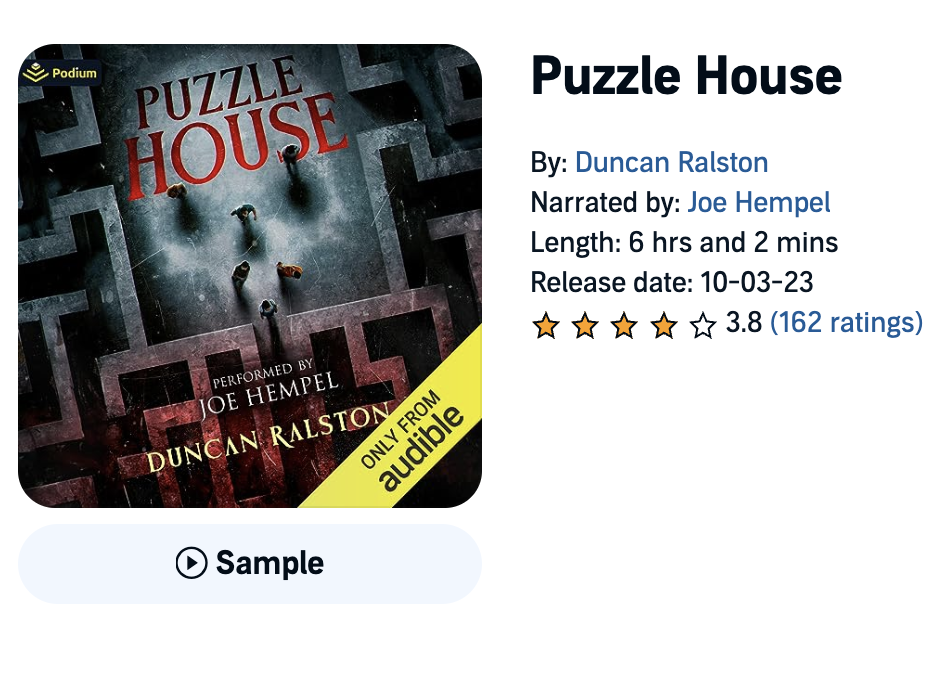
Puzzle House by Duncan Ralston, Narrated by Joe Hempel

One part Cube, one part Saw, one part The Ninth Gate, and a dash of House On Haunted Hill, Duncan Ralston’s Puzzle House is an excellent book for fans of those movies. If you’re the kind of person who enjoys escape rooms, puzzles, and character studies–you’re in for one hell of a treat. When a mysterious puzzle master dies, his will brings together an assortment of strangers (all but his ex-wife, unfamiliar with the deceased as well)…but that is only the beginning of the mystery.

These people find themselves called to a house that has become something far more sinister, a series of escape rooms with a hefty toll to be paid and life-or-death consequences riding on the solutions. As they struggle to survive the sadistic gauntlet from which the only way out is through, secrets are revealed that connect these apparent strangers in ways that can’t be a coincidence. Somewhere at the core of it all is a mysterious organization with occult origins, and the rats in this maze are battling not only the clock but their own preconceived notions of what is–or can be–real. But will they be able to solve the puzzles that await them, and who will survive the journey into the Puzzle House? And is everyone who they seem to be? You’ll have to dare entry on your own to find out.

This one has one hell of an ending, and it leaves you wishing that you could stay with the story just a little bit longer–to find out what happens next. Ralston does a great job of leaving you hanging but feeling satisfied just the same–forced to decide how you, as the reader, might proceed.

Joe Hempel’s narration of the audiobook is spectacular as always…which should go without saying. He successfully brings the characters to life and pulls the story from the page, leaving the listener immersed in the nightmare environment.

Monochrome Noir: A Gathering Storm by Jack Wells

Monochrome Noir: Book 1 (A Gathering Storm) introduces us to a world just like our own, but where everything is black and white, and color is of such priceless rarity that people will kill to own items that have been imbued by those who have the gift to bring color to life in the monochromatic items of everyday life.

When a strange and grisly series of killings begins, private detective Henry Hardcastle is hired by a mysterious woman with secrets to keep, and a deeply personal stake in the resolution of these terrible murders. As Henry struggles to navigate a world that isn’t quite what he believed it to be, a young woman, Charlie Grant is struggling with her own nightmare. As their independent journeys for understanding spiral around the central crux of the deranged killer stalking Angel City, we’re forced to wonder if they can fill in pieces of the puzzle for one another if they’re able to come together before one or both of them winds up dead.

Jack Wells does a fantastic job of building a world that’s as captivating as it is unreal, populating this world with characters sure to appeal to readers from a wide variety of tastes, and breathing new life into the hardboiled detective genre many of us adored when we were younger–and some of us never stopped adoring.

This is only Part 1 of the four book series, so there’s much more to come if you manage to weather the gathering storm.

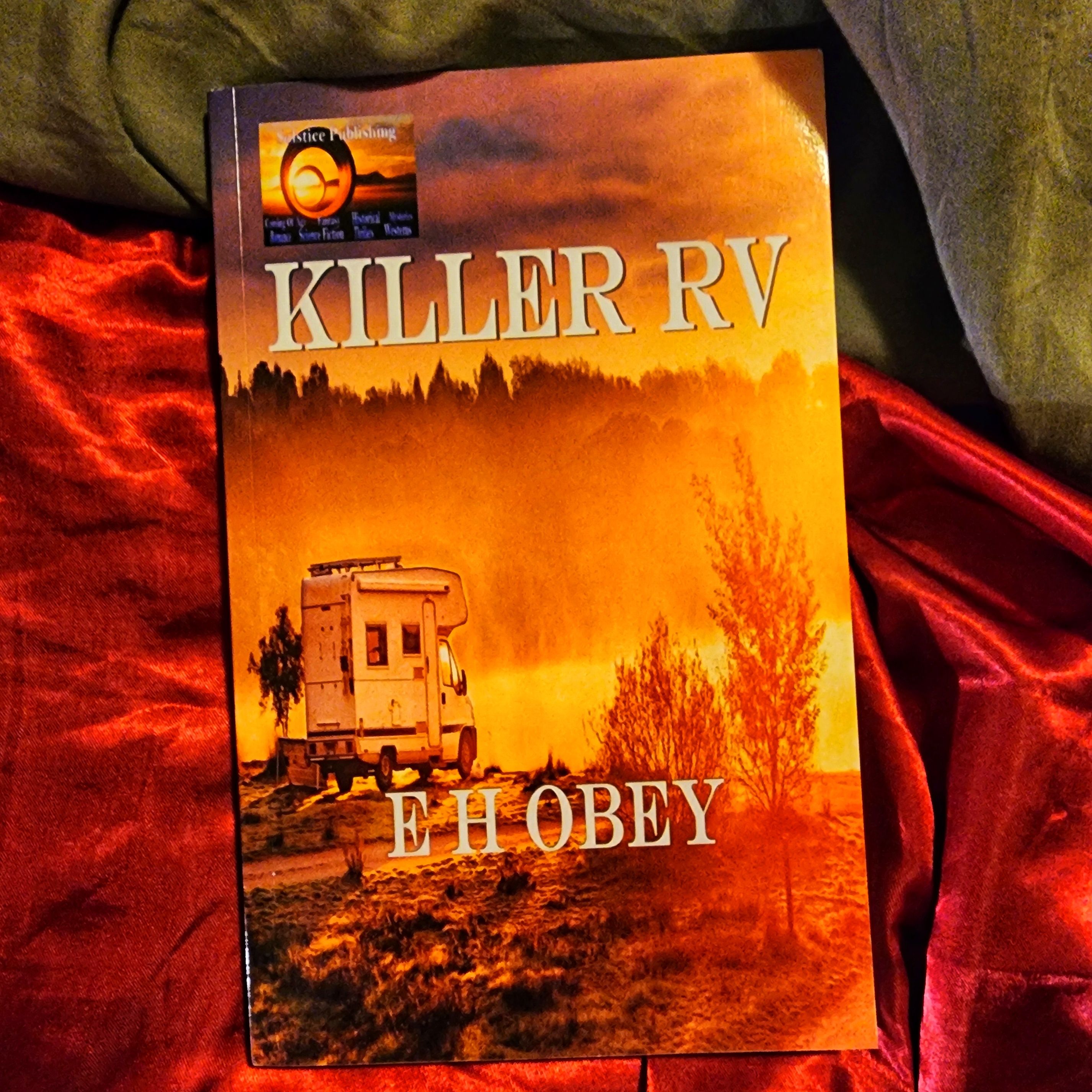
Killer RV by E. H. Obey

Killer RV is not the first book to tackle the subject matter at the core of this story, but it’s also not the worst. What would you do if you were diagnosed with terminal cancer and had only months to live? If you have at least a momentary urge to suggest that you might hunt down and torture and/or kill sex offenders–first of all, you’re not alone, but secondly, this book is for you. I suppose you’ve guessed what this one’s about.

Delilah is a bored housewife/music producer who happens to notice a new RV parked in her neighborhood, and she decides she wants to be a friendly neighbor. This is how she meets Peggy and also how her life takes a turn she couldn’t have anticipated. Peggy is dying, and she has a bucket list she wants to fulfill before the cancer takes her down…but we don’t learn what the items on that list happen to be until a little further into the story. Initially, it’s mostly focused on Delilah–her marriage and her burgeoning friendship with the mercurial Peggy. It isn’t until after Chekhov’s epilepsy makes an appearance, that Delilah becomes an integral component in Peggy’s mission. You’ll understand why I say that if you read the book.

Once things start going down the violent path, they never really stop until the book concludes. We’re introduced to a world where sexual predators of all stripes lurk wherever one chooses to look…and it’s a veritable buffet of monsters just waiting to be tossed into the bucket.

I have a certain sentimental connection with this story, in that a significant portion of it takes place in South Dakota, where I spent most of my life…and most of that portion of the narrative is in the Black Hills and Badlands region that I called home for most of my 45 years. The seemingly neverending path that I-90 carves across the state, through Wyoming, and into Montana is one I’m intimately familiar with–so I could visualize a lot of the surroundings into which the characters were placed.

It’s a short read and well-paced…so you don’t have much excuse to avoid it.

The Shadow Within by Eric Butler, Narrated by Micah Cottingham

Eric Butler takes us on a soothing vacation to small-town America in The Shadow Within. Like many small towns, there aren’t a lot of amenities available, law enforcement is minimal and the members are unprepared for major events, sinister forces influence the people, the land and people are cursed, and horrors lurk in the shadows. If this isn’t your idea of what small towns are like, then we’ve been reading vastly different books. Nevertheless, when Jack and Jill go up this hill, there’s little more than disaster and trauma awaiting them.

Jack heads to the countryside with his children and new girlfriend, hoping to introduce them to each other under relaxing and peaceful conditions at the family home he hadn’t visited in years. Everything seems like it might be going well, and then Butler pulls the rug out from under you. Of course, you had to know this was going to happen. It’s that kind of book, isn’t it?

There’s no way Jack and his family could be prepared for what happens when a monster comes home. A centuries-old evil presence that found a host within a troubled young man with a propensity for violence has returned to the place they were bound…and the kindred spirits delight in the graphic torture and murder of anyone who crosses their path.

Butler introduces you to his characters, lets you get to know them, and then proceeds to put them through absolute hell in the most captivating ways. He pulls no punches and forces you to witness the atrocities…sometimes after the fact, but often while they’re happening. You may find yourself discomforted at times…but again, it’s that kind of book, isn’t it?

The narration from Micah Cottingham is fantastic, and it does the narrative justice.

You can also obtain this title for yourself by going to http://www.godless.com