Fiction Treated As Fact: The Myth of Race

To bring an end to Racism, we need to successfully deconstruct the 17th-century notion of “Race” as a thing. Race, as we commonly think of it, is nothing more than a relatively modern and simplistic categorization based on conveniently visible markers that are both biologically irrelevant and lacking in anything like nuance.

The concept of Race is a Social Construct, not a Biological one, much like Gender. Of course, in both of those arenas, we latch onto these simple Social Constructs because the Biological elements are altogether too complicated and far less conveniently organized. We’re a lazy species that relies far too frequently on simplistic (and often erroneous) Pattern Recognition, as opposed to negotiating with reality on the novel terms required if we aim to be more intellectually honest.

The Enlightenment Era was a time of great advancement in the realms of social and political theory, scientific principles, taxonomy, and philosophy. There’s no disputing the value that arose from the great thinkers and educational centers of the time. I’m personally a great admirer of several of the great thinkers of the time. It is, however, important to note that little of what came from that era is without flaws and errors. There were severe limitations in both the technology available and the understanding of the natural world that even the greatest minds of the time faced.

While much of what we gained from pre-Industrial studies was based on observation, scientific methodology, reason, speculation, and extrapolation, the observable world and scientific tools available to people of the time were not the same ones we have available (and take for granted) today. The great minds of the time certainly performed their duties to the best of their abilities with the information they had available, but we shouldn’t be assuming they had all the answers. Similarly, we shouldn’t assume they didn’t have biases that influenced their findings, conscious or unconscious, as they may have been.

There is arguably no area where that is more true than with the development of concepts regarding Race. And yet our modern notions of Race are virtually indistinguishable from those of Enlightenment Thinkers, despite a plethora of evidence that should dismantle all of it. The biggest problem, and one that great minds could hardly avoid, is that those notions are derived from a White, Eurocentric perspective. Of course, some are deeply invested in maintaining that antiquated worldview, in large part precisely because it is assembled around a White, Eurocentric perspective.

But before modern concepts of Race developed, there was nothing like it in place. Separation between people was based on Political, Religious, and Regional differences. Egyptian, Chinese, Greek, and Roman cultures, for example, had no hierarchical bias regarding the myriad skin tones of their people. It was solely by happenstance that people of similar skin color were lumped together. Their status within the given society was based on where they were from, the society to which they belonged, and the gods they worshipped, not the lightness or darkness of their skin tone. It was instead the assumption that anyone not belonging to one’s culture was some manner of barbarian, but that this cultural defect wasn’t an immutable characteristic. Physiological differences were recognized and somewhat accurately perceived as the result of environmental factors, such as the specific geography where those groups originated, and heritable traits.

Of course, the Greek and Roman societies collapsed, and for a time, the differences were analyzed through a Biblical lens. Medieval thinking led to different skin tones being associated with descending from one of the three sons of Noah. This way of thinking was particularly dominant in Christian and Islamic societies. This showcased a rather large step backward from the earlier recognition that environment and geography were the primary drivers behind those superficial differences. It wasn’t until the 14th Century in Islamic society and the 17th Century in Europe that people began to restore the recognition that a person’s geographic origin played the biggest role in the differences in skin color. That, combined with a moderately greater understanding of heritability, allowed late 17th-century European Naturalists to glimpse the nature of humanity with greater accuracy. Unfortunately, there was still a great deal of error in the interpretations of what they glimpsed.

As White Europeans began to explore the world to a greater extent, they started to consider and explore the superficial differences between people of different regions and cultures in greater detail. It stood to reason, to the scientific minds of the day, that there must be some scientific explanation for the surface-level differences between those other people and themselves, and that required classification. Naturally, these classifications were often based on misapprehensions and limited comprehension of the natural world.

And since they considered themselves to be the arbiters of what constituted civilization and culture, it was just as natural that these classifications were utilized to reinforce the belief that White Europeans were superior, a result that became increasingly imperative as Colonization and Slavery came to the forefront of that White, Eurocentric negotiation with the world surrounding them. With the sociopolitical belief in human equality becoming increasingly widespread, a race was on to define non-white races as somehow subhuman, and thus not deserving of that equality.

It should go without saying that there was no basis in scientific reality for these new Racial Classifications indicating superiority of any group over another. In fact, arguably the greatest single contributor to the concept of Racial Taxonomy, German anthropologist Johann Blumenbach, clearly and concisely showed that there was greater variation within any individual Race than between any two Races (a result later proven by the study of genetics). Even with Christian mythology tainting his research, Blumenbach still arrived at the (correct) conclusion that there was nothing in his findings that reinforced the belief that any Race was superior to another. He actively opposed slavery and those who used his Taxonomy as justification for the poor treatment of non-whites.

But so much hinged on hierarchical thinking that the scientific advancements that should have dismantled it were hampered by assumptions and preconceived notions. Operating from the starting point of White European superiority, several Naturalists spent the late 18th and early 19th Centuries shoring up those assumptions and reinterpreting the data in whatever way was necessary to assure themselves that they were, in fact, superior.

It was the late 19th Century when Charles Darwin advocated for the common ancestry of all humans, regardless of Race, and definitively stated that the characteristics used to separate by Race were exclusively superficial. When writing The Descent of Man, Darwin made it clear that the difficulty in discerning clear delineations between various races should be taken as evidence that distinctive characteristics separating one Race from another simply do not exist. He further argued that non-white people were equal in intellectual capacity to whites.

And yet, to this day, we still suffer fools who will argue that Race is a thing and that there are differences between one Race and another.

Some will attempt to undermine this argument by pointing to Genetics, using everything from inherited traits to predisposition to certain illnesses as a basis for their assertion that Race is a thing. Reality, of course, is more complicated and nuanced than all of that.

Sickle Cell Disease is an excellent example, because it is not (contrary to what many assume) connected to Race, but to Ancestry. Sickle Cell Disease is the result of Natural Selection, due to the Genetic Trait providing a natural defense against Malaria. Thus, this Genetic Trait is exclusive to individuals with Ancestry originating primarily in Sub-Saharan Africa, where Malaria was common. It should be obvious already where I’m going with this, but that means not only is Sickle Cell Disease not something all Black persons are susceptible to, but that it isn’t exclusively Black persons who are susceptible to it. Of course, the predisposition is higher within the Black population, but that’s solely due to the demographic breakdown of the regions where Malaria was most common. It is Genetic, in that it is based on Ancestry, but it is irrespective of Race.
Similar misapprehensions have people believing that Tay-Sachs Disease is something exclusive to Jewish people; however, that is untrue on several fronts.

Originally linked to the Ashkenazi Jewish people of Europe, we know that it is far from exclusive to individuals with that Ancestry. French Canadians, some Amish communities, and Cajuns are also highly susceptible to Tay-Sachs, because it (and other Genetic Diseases) are tied to insular communities with a higher than average historical incidence rate of what geneticists refer to as the Founder Effect, wherein the gene pool is limited and certain forms of Genetic Drift are likely to take place.

Thus, this could arise in any sufficiently isolated population with cultural or environmental factors promoting insularity and lack of interbreeding with other populations. This is why Tay-Sachs is not common in Middle Eastern Jewish populations.

Again, this displays that Race is not a factor, but Ancestry is.

If we want to pretend that Race is a Scientific and Biological categorization, then we’re just as well off breaking the population down by those who can roll their tongues. Or maybe we can draw the line at those who believe cilantro tastes like soap, for all the relevance it has. The amount of Melanin Production only serves as a conveniently visible form of differentiation, no more valuable than eye color, hair color, height, left or right-handedness, or any of the other things we could arbitrarily apply value assessments to.

These things are in no way indicative of any reasonable or useful separation, and I hope the premise helps to showcase how ridiculous and meaningless it is to separate people into groupings based on the things we do utilize.

As it stands, we already do enough segregating based on geographical or national origin, religious beliefs, economic status, and so on. We should focus less on what makes us different than on what we have in common. We should embrace the differences in the same way we embrace the diverse landscapes and ecosystems around the world.

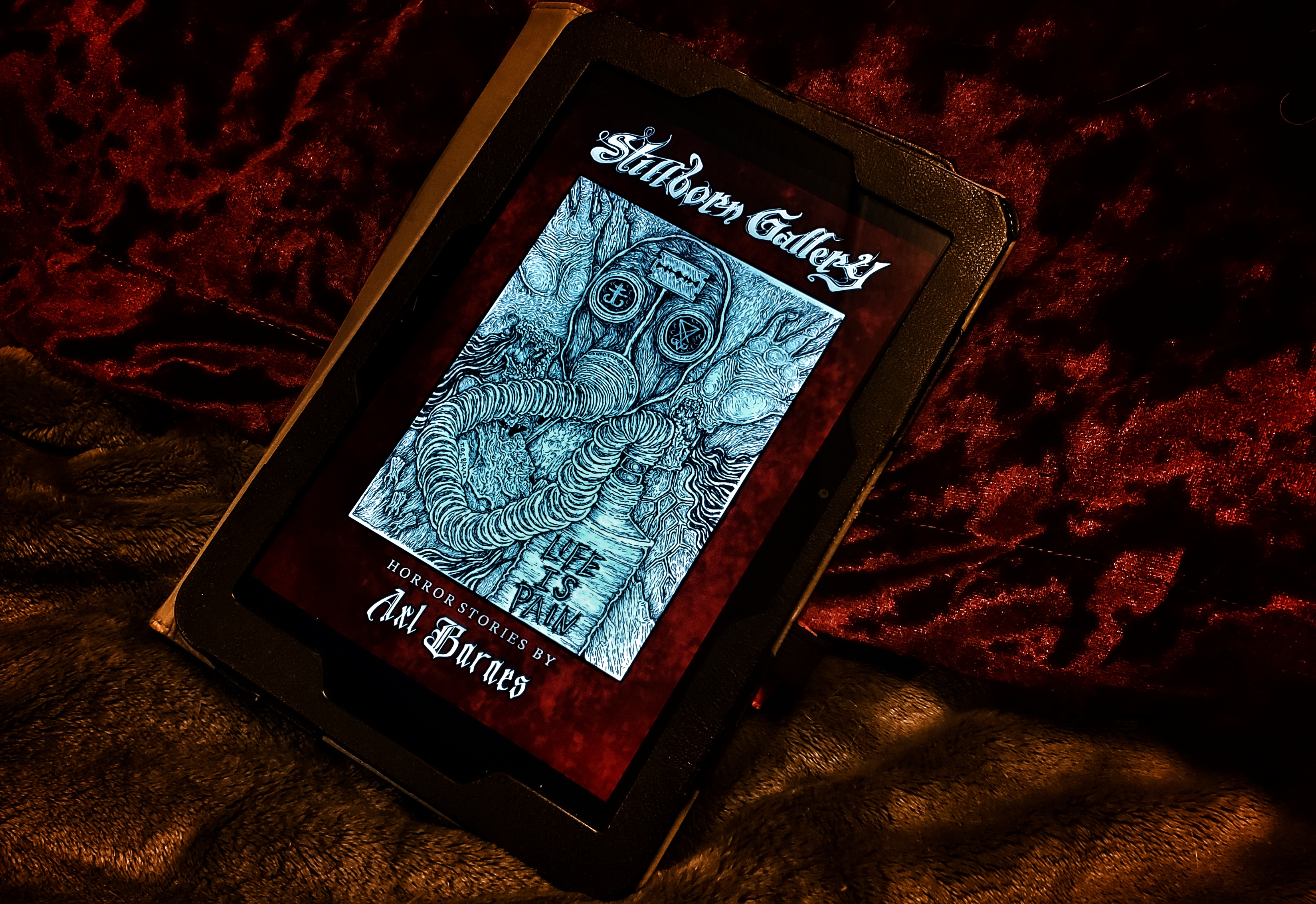
Stillborn Gallery by Axl Barnes

The nine stories collected in Barnes’s Stillborn Gallery make for an almost uniformly bleak, nihilistic deep dive into the horrors of banality, the depths of depression, heavy metal, and suicide. If you’re familiar with Axl Barnes, you shouldn’t be altogether surprised by any of that.
Barnes utilizes almost poetic prose at times, almost exclusively when applied to the most awful of things. He has a knack for painting vivid and breathtaking pictures of things the reader might not want to see, and it makes for a fantastic experience.
There’s a great deal to look forward to, for the discerning reader, from the almost Kafka-esque “Numbskull” to the morbidly romantic “Sunday Exit” in these pages.
For me, “A Perfect Day” sort of sums up the whole experience. We get to witness a day that is going smoothly for our protagonist, a man who has a vacation on the near horizon that he’ll be sharing with a clearly devoted lover. Suddenly he begins fixating on an experience from his childhood, wherein a doctor had to lance an infected wound. This fixation does nothing to spoil his mood–the way I’m about to spoil this single story–but he proceeds to kill himself in a graphic, single-minded act…perhaps because it’s best to leave on a high note.
The illustrations provided by Thomas Stetson are captivating, bringing to life a certain grimy, filthy element that flows naturally with the stories provided by Barnes.

Odin Rising by Axl Barnes

Before reading this book, I made the mistake of reading some of the reviews. Admittedly, that made me apprehensive about what I was going to be reading.
I really didn’t need to be concerned and, based on the interpretations of this book on display in many of those reviews, I’m fairly certain many of those people either did not read this or didn’t read more than what was available as a sample.
I’ll say it right away that this is not a book for everyone. It’s heavy in tone and in style…heavy like a brick at times, and equally hard to swallow.
At its core, this is a book about a juvenile delinquent, his delinquent friends, and their desperate, fumbling attempts to find a place for themselves in the Eastern European world around them.
Tudor, the initial focus of the story, is arrogant and self-assured in the way only the least self-aware and incompetent can be. He is a bitter, resentful young man who feels like he is too good for the life he’s subjected to by the inferior parents who are raising him. He finds solace in the interests shared with his small group of friends; heavy metal, occultism, anarchism bordering on nihilism, and ultimately he finds himself influenced by the neo-Nazi philosophy adopted and promoted by the one friend he actually admires and respects, Alex.
All of this changes after a series of poor choices and impulsive actions leads to a dramatic, violent mistake.
Tudor, being the maladjusted boy he is, spends his time retroactively justifying and rationalizing what he’s done, to the extent that he begins fixating on further violence and killing.
This drives the whole final third of the story.
Tudor finally goes over the edge, experiencing the first seeming spark of self-reflection, as Alex seeks to go the other direction and displays nothing but contempt and disdain for Tudor.
We finally arrive at a climax that feels both feverish and well thought out. It’s as much a conflict of opposing philosophies as Tudor and his remaining friends against Alex.
While the story may feel slow at times and it’s difficult to want to continue, with protagonists/antagonists who are far from sympathetic. Think of it as a supernatural horror story mixing in elements of A Clockwork Orange, Stand By Me, and Gone Girl, and you’ll probably have a decent idea of what you’re getting into.
The further into the story you get, the further the lines become blurred between fantasy and reality, waking life and dreams. There are flashes of brilliant prose that draw your attention but you should be prepared, as I said above, it’s a thick and heavy book to read.