Fiction Treated As Fact: The Myth of Race

To bring an end to Racism, we need to successfully deconstruct the 17th-century notion of “Race” as a thing. Race, as we commonly think of it, is nothing more than a relatively modern and simplistic categorization based on conveniently visible markers that are both biologically irrelevant and lacking in anything like nuance.

The concept of Race is a Social Construct, not a Biological one, much like Gender. Of course, in both of those arenas, we latch onto these simple Social Constructs because the Biological elements are altogether too complicated and far less conveniently organized. We’re a lazy species that relies far too frequently on simplistic (and often erroneous) Pattern Recognition, as opposed to negotiating with reality on the novel terms required if we aim to be more intellectually honest.

The Enlightenment Era was a time of great advancement in the realms of social and political theory, scientific principles, taxonomy, and philosophy. There’s no disputing the value that arose from the great thinkers and educational centers of the time. I’m personally a great admirer of several of the great thinkers of the time. It is, however, important to note that little of what came from that era is without flaws and errors. There were severe limitations in both the technology available and the understanding of the natural world that even the greatest minds of the time faced.

While much of what we gained from pre-Industrial studies was based on observation, scientific methodology, reason, speculation, and extrapolation, the observable world and scientific tools available to people of the time were not the same ones we have available (and take for granted) today. The great minds of the time certainly performed their duties to the best of their abilities with the information they had available, but we shouldn’t be assuming they had all the answers. Similarly, we shouldn’t assume they didn’t have biases that influenced their findings, conscious or unconscious, as they may have been.

There is arguably no area where that is more true than with the development of concepts regarding Race. And yet our modern notions of Race are virtually indistinguishable from those of Enlightenment Thinkers, despite a plethora of evidence that should dismantle all of it. The biggest problem, and one that great minds could hardly avoid, is that those notions are derived from a White, Eurocentric perspective. Of course, some are deeply invested in maintaining that antiquated worldview, in large part precisely because it is assembled around a White, Eurocentric perspective.

But before modern concepts of Race developed, there was nothing like it in place. Separation between people was based on Political, Religious, and Regional differences. Egyptian, Chinese, Greek, and Roman cultures, for example, had no hierarchical bias regarding the myriad skin tones of their people. It was solely by happenstance that people of similar skin color were lumped together. Their status within the given society was based on where they were from, the society to which they belonged, and the gods they worshipped, not the lightness or darkness of their skin tone. It was instead the assumption that anyone not belonging to one’s culture was some manner of barbarian, but that this cultural defect wasn’t an immutable characteristic. Physiological differences were recognized and somewhat accurately perceived as the result of environmental factors, such as the specific geography where those groups originated, and heritable traits.

Of course, the Greek and Roman societies collapsed, and for a time, the differences were analyzed through a Biblical lens. Medieval thinking led to different skin tones being associated with descending from one of the three sons of Noah. This way of thinking was particularly dominant in Christian and Islamic societies. This showcased a rather large step backward from the earlier recognition that environment and geography were the primary drivers behind those superficial differences. It wasn’t until the 14th Century in Islamic society and the 17th Century in Europe that people began to restore the recognition that a person’s geographic origin played the biggest role in the differences in skin color. That, combined with a moderately greater understanding of heritability, allowed late 17th-century European Naturalists to glimpse the nature of humanity with greater accuracy. Unfortunately, there was still a great deal of error in the interpretations of what they glimpsed.

As White Europeans began to explore the world to a greater extent, they started to consider and explore the superficial differences between people of different regions and cultures in greater detail. It stood to reason, to the scientific minds of the day, that there must be some scientific explanation for the surface-level differences between those other people and themselves, and that required classification. Naturally, these classifications were often based on misapprehensions and limited comprehension of the natural world.

And since they considered themselves to be the arbiters of what constituted civilization and culture, it was just as natural that these classifications were utilized to reinforce the belief that White Europeans were superior, a result that became increasingly imperative as Colonization and Slavery came to the forefront of that White, Eurocentric negotiation with the world surrounding them. With the sociopolitical belief in human equality becoming increasingly widespread, a race was on to define non-white races as somehow subhuman, and thus not deserving of that equality.

It should go without saying that there was no basis in scientific reality for these new Racial Classifications indicating superiority of any group over another. In fact, arguably the greatest single contributor to the concept of Racial Taxonomy, German anthropologist Johann Blumenbach, clearly and concisely showed that there was greater variation within any individual Race than between any two Races (a result later proven by the study of genetics). Even with Christian mythology tainting his research, Blumenbach still arrived at the (correct) conclusion that there was nothing in his findings that reinforced the belief that any Race was superior to another. He actively opposed slavery and those who used his Taxonomy as justification for the poor treatment of non-whites.

But so much hinged on hierarchical thinking that the scientific advancements that should have dismantled it were hampered by assumptions and preconceived notions. Operating from the starting point of White European superiority, several Naturalists spent the late 18th and early 19th Centuries shoring up those assumptions and reinterpreting the data in whatever way was necessary to assure themselves that they were, in fact, superior.

It was the late 19th Century when Charles Darwin advocated for the common ancestry of all humans, regardless of Race, and definitively stated that the characteristics used to separate by Race were exclusively superficial. When writing The Descent of Man, Darwin made it clear that the difficulty in discerning clear delineations between various races should be taken as evidence that distinctive characteristics separating one Race from another simply do not exist. He further argued that non-white people were equal in intellectual capacity to whites.

And yet, to this day, we still suffer fools who will argue that Race is a thing and that there are differences between one Race and another.

Some will attempt to undermine this argument by pointing to Genetics, using everything from inherited traits to predisposition to certain illnesses as a basis for their assertion that Race is a thing. Reality, of course, is more complicated and nuanced than all of that.

Sickle Cell Disease is an excellent example, because it is not (contrary to what many assume) connected to Race, but to Ancestry. Sickle Cell Disease is the result of Natural Selection, due to the Genetic Trait providing a natural defense against Malaria. Thus, this Genetic Trait is exclusive to individuals with Ancestry originating primarily in Sub-Saharan Africa, where Malaria was common. It should be obvious already where I’m going with this, but that means not only is Sickle Cell Disease not something all Black persons are susceptible to, but that it isn’t exclusively Black persons who are susceptible to it. Of course, the predisposition is higher within the Black population, but that’s solely due to the demographic breakdown of the regions where Malaria was most common. It is Genetic, in that it is based on Ancestry, but it is irrespective of Race.
Similar misapprehensions have people believing that Tay-Sachs Disease is something exclusive to Jewish people; however, that is untrue on several fronts.

Originally linked to the Ashkenazi Jewish people of Europe, we know that it is far from exclusive to individuals with that Ancestry. French Canadians, some Amish communities, and Cajuns are also highly susceptible to Tay-Sachs, because it (and other Genetic Diseases) are tied to insular communities with a higher than average historical incidence rate of what geneticists refer to as the Founder Effect, wherein the gene pool is limited and certain forms of Genetic Drift are likely to take place.

Thus, this could arise in any sufficiently isolated population with cultural or environmental factors promoting insularity and lack of interbreeding with other populations. This is why Tay-Sachs is not common in Middle Eastern Jewish populations.

Again, this displays that Race is not a factor, but Ancestry is.

If we want to pretend that Race is a Scientific and Biological categorization, then we’re just as well off breaking the population down by those who can roll their tongues. Or maybe we can draw the line at those who believe cilantro tastes like soap, for all the relevance it has. The amount of Melanin Production only serves as a conveniently visible form of differentiation, no more valuable than eye color, hair color, height, left or right-handedness, or any of the other things we could arbitrarily apply value assessments to.

These things are in no way indicative of any reasonable or useful separation, and I hope the premise helps to showcase how ridiculous and meaningless it is to separate people into groupings based on the things we do utilize.

As it stands, we already do enough segregating based on geographical or national origin, religious beliefs, economic status, and so on. We should focus less on what makes us different than on what we have in common. We should embrace the differences in the same way we embrace the diverse landscapes and ecosystems around the world.
Adding Some Identity To Identity Politics

I would like people to dedicate some time and energy to self-reflection and evaluation of what they sincerely believe, as opposed to what they’ve been conditioned to accept. It would be unfair of me to ask that without sharing some things I’ve managed to discover in my own extensive intervals of self-assessment, if only because I suspect more people see things similarly to how I see them than I’ve typically assumed to be the case. I’ve spent a fair amount of time discussing diverse aspects of Politics and the shortcomings of various Political Figures as well. In doing all of that, I’ve still provided little regarding my own Political Ideology. Some elements of it, of course, are clear through inference, but to engage in any kind of authentic and intellectually honest discourse, I need to provide something more than I have already.

When I turned 18 and registered to vote, I did so as a Communist. I thought it was amusing, considering the lingering stigma still prevalent in America during the late 1990s. I registered as a Communist despite not being a Communist. I’d read the works of Marx and Engels; I was even familiar with the philosophies of Antonio Gramsci and Vladimir Lenin. I had read the work of Noam Chomsky and thoroughly agreed with much of it. But still, I was not a Communist when I turned 18 and registered to vote as one. I agreed with the underlying philosophy, but I considered it to be hopelessly naive. I was raised Catholic, and was familiar with many of the major writers from Church history, and Communism, to me, resembled Sir Thomas More’s Utopia in many respects. Much like More’s Utopia, a Communist Society struck me as being a fanciful thing that could exist only in fiction. Capitalism, after all, is not going anywhere.

Years later, I changed my voter registration to Independent.

Yet again, years after that, I switched my registration to Democrat, which is where it remains. Much like when I was registered as a Communist, I’m not really a Democrat either. Of the two major parties in American Politics, I feel that the Democratic Party more closely aligns with my personal politics, but it also ranges far afield in several ways.

I’ve cast my ballots for Republicans, Democrats, Libertarians, Green Party Candidates, and Independents over the years. I rarely based my decisions on Party Affiliation, but on the individual and what I could discern of their platform and previous voting record (if available). This is to say that I’ve never been one to assume that one’s Political Party is the best metric by which to judge them.

Personally, I think that (as a whole) we need to stop thinking of everything in terms of Left or Right, Republican or Democrat, Conservative or Liberal. Breaking away from the illusory binary system of partisan politics would benefit us all. We could focus on the issues that matter to us individually. and the individuals who align with us on those issues, as opposed to the Party that we believe will align with and uphold our personal political ideals. Partisan Politics forces people to adhere to monolithic thinking as opposed to independent thinking. Partisan Politics encourages groupthink and “in vs. out group” mentalities that are ultimately more harmful than they ever could be beneficial. That way of thinking erases Cognitive Processing from the voting process. It nurtures the laziness required to simply look for a candidate conveniently marked with a D or an R, and to put no further thought into the consequences that might be tied up in blindly endorsing someone based on Party Affiliation.

In my ideal version of the American political system, individuals seeking office would need to provide a detailed checklist: indicating where they stand on the most salient issues, how they intend to act on behalf of the interests of those who support them, and what their priorities are. They would have to actively think about the issues, arrive at solutions, and propose those solutions as a platform. You see, it’s not simply the voters who have checked their brains at the door when it comes to American Politics; the people we’re voting for are guilty of doing the same thing. Politicians assume (often rightly so) that their Party Affiliation will guarantee the votes of a particular cross-section of the voting demographic.

This, I must admit, is one of the reasons I’ve remained registered as a Democrat for the last few years. The Democratic Party, more so than the Republican Party, is a large tent. There’s none of the blind obedience to Party Affiliation that we see on the Republican side of the American Political Spectrum. That’s why “Vote Blue, No Matter Who” became a rallying call from the establishment Democrats, because they knew it wouldn’t happen. The problem with having a large tent is that there’s more diversity in not only cultural and ethnic backgrounds, but also in political ideologies. There are Democrats who are barely distinguishable from Republicans, and, at the opposite end of the spectrum, there are Social Democrats (or Justice Dems). This leads to a dichotomy within the one party that is actually greater than the dichotomy between the two major parties. Republicans, of course, should be thrilled by this. It gives them an advantage that they otherwise don’t have. As far as voter registrations are concerned, there are roughly ten million more registered Democrats than Republicans. If Democratic voters and politicians were as willing to conform to the will of party leadership, there would quite possibly never be any Republicans in the White House. The same would be true if the Electoral College didn’t exist, which gives voters in Wyoming more individual weight in their votes than those in California. If we’re being honest, it’s the equivalent of DEI Policies (as Republicans have misunderstood them) applied to rural voters.

I don’t believe either Major Party in America is anywhere near upholding the basic standards I expect from a Democratic Government, and the smaller parties are ultimately non-entities (with ineffectual leadership) that have no chance of overcoming the chokehold the Republicans and Democrats have in place. So, while I am most assuredly not a Democrat, it just so happens that Democrats more closely align with my principles and acknowledgement of our shared reality. The importance of a shared reality is something you’ll see again.

In an ideal America, it wouldn’t just be the Political Parties that disappear. There would be no more campaigns and no advertisements. We could host public debates wherein the contenders could challenge their opponents, and they would be forced to defend their premises. They would be moderated and fact-checked, and intellectual dishonesty (as well as the more traditional dishonesty) would not be tolerated.

When it came time for the election, the voting public would be provided with a list of candidates and their platforms, and they would use ranked choice ballots to cast their votes. There would be no Electoral College to manipulate the outcome in favor of land over people. The people who express concerns over the Tyranny of the Majority never seem to have those concerns if/when they are in the majority, so what’s good for the goose is what’s good for the gander, as they say.

The Elected Officials would then be expected to act according to the platform they proclaimed, or they could be removed by a vote of no confidence. No more towing a party line and no more threats of being primaried, and less impact from gerrymandering bullshit. I’m sure it would be harder on all of us. We might have to become informed voters, and politicians might have to work for the votes they receive and display a little bit of integrity. But we would be a better and more functional society for it. For purely personal reasons, I would take delight in the fact that much of the perceived and actual bias in the Media would disappear because there would be no explicit party lines to adhere to, and we could expect the Fourth Estate to fulfill its purpose of holding those in power accountable.

My perspective on politics may seem complicated (even convoluted), but that’s a byproduct of navigating the needlessly problematic nature of our modern political environment and the dialogue surrounding it. Were we not forced to maneuver our way through a quagmire of obfuscation, double-think, manipulation, and outright fabrications, I suspect many of us would have substantially pared-down stances on most matters.

What I mean to say is that, in all reality, my politics are simple and straightforward.

My ideology boils down to one single principle: that the role (and purpose) of the Government in any Democratic Society is to provide for the Common Good and Common Defense of the People. I’m essentially a believer in Utilitarianism, in that I believe the Guiding Moral Principle of any Democratic Government should be, “The Greatest Good for the Greatest Number.” Hand-in-hand with that, I believe in minimizing harm at the societal level, with a focus on justice and human rights.

That’s it.

That is the basis of my underlying political identity.

How it manifests is just as simple. The Rights and Liberties of each Individual should be respected and protected, and it is the responsibility of the Government to guarantee that they are. And where Conflict arises between one or more individuals, it’s the purpose of the Government to ensure that the negative impact on the individuals and on society as a whole is minimized.

I recall a conversation with my oldest two children around the time Barack Obama was elected President in 2008. I told them that if they encounter a scenario in which one group is forcing others (not part of their group) to live as if they are part of that group, then there is a clear indication that they are wrong. Whether certain people want to accept it, that’s the most common method by which one group inflicts harm on others. I’ll return to the topic of inflicting harm again shortly.

If I do not believe what you believe, you do not have the right to tell me that I must behave as if I accept your beliefs in place of my own. I also do not have the right to impose my beliefs upon you. That seems simple enough, and one would think we could all agree with that as a solid substrate upon which to build a social structure. Unfortunately, there are large groups of people who believe they should have the right to dictate to others what they are entitled to think and how they’re allowed to behave, based on their beliefs.

This applies to many things in our current political climate, in which everything from science to math has been transformed into a political football. Belief in scientific and professional consensus is not a political stance, but a practical one based on centuries of methodology and increased understanding of the world around us.

When Law Enforcement Statistics, collected and collated from all parts of the Nation, indicate that Immigrant Communities (including those with large numbers of Undocumented Immigrants) are less likely to be plagued with violent crime, it’s not subject to interpretation. This is especially true when one considers just how entrenched White Supremacy happens to be. Systemic Racism is a thing, and decades of data back that up. So, even with an implicit bias against Ethnic Minorities, the numbers supplied by Law Enforcement Agencies across the board show that crime and criminality are not correlated with Immigration or the presence of Immigrants. You don’t get to say otherwise without supplying equally valid and unassailable facts to reinforce your statements.

How you feel about a topic doesn’t impact the reality of a thing. If you claim that reality is other than what has been well-documented and proven, you are either misinformed or lying. What you are not entitled to is a difference of opinion, because we’re not talking about opinions.

When the overwhelming consensus of well-educated and established biologists, doctors, and psychologists explains that biological sex is not binary and that it is not the same thing as gender identity, you don’t get to come back with what you learned in Elementary School as an equally valid viewpoint. You should know by adulthood that the deeper you look into a thing, and the more research and study you perform, the more detailed and complicated the picture of that thing becomes. That is true for every field of science and life in general. Whether it upsets your rudimentary comprehension of something is irrelevant.

Now, I suppose I am operating under the assumption that people have learned something throughout their lives, whether that was a foreign language or something relating to their career fields, but in everything, we begin with the simplest, surface-level knowledge, and then we drill down and expand on those things. People dedicate years of their lives to studying these topics for a reason, because the better we understand them, the better equipped we are to navigate the universe in which we live.

We inhabit a shared reality, and whether you like it or not, we are subject to all of the same natural laws and principles. The sooner everyone chooses to get back on board, the sooner we can begin moving forward instead of standing still and wasting time attempting to negotiate on things where there’s no negotiation to be done. It’s not elitist for an expert to state that they know more about a subject than you do. They’re an expert for a reason.

One’s inability to understand something doesn’t make it fictional.

It’s well past time for us to stop entertaining lies, willful ignorance, and outright stupidity as a valid point of view. All perspectives are not equal, and do not share equal footing.

A trained pilot is going to do a better job of flying a plane than someone who played Microsoft Flight Simulator a couple of times.

A trained surgeon is safer to have in the operating theater than someone who played Operation a lot when they were growing up.

A chemist is better suited to break down what a substance is made of than someone who spent a few years cooking meth in their kitchen.

A physicist can tell you more about the universe than a self-help guru who overheard some people talking about quantum mechanics one afternoon in a restaurant.

Teams of scientists from diverse fields studying the data are better suited to tell us whether climate change is happening, if it is accelerating, how much impact human beings have on it, and whether it is dangerous and potentially deadly than someone who watches The Weather Channel a lot.

The consensus of medical doctors and researchers, psychologists, and pediatric specialists is better suited to determine what’s in the best interests of your child’s health and well-being than you are. This is true, no matter how much you love your child. And that absolutely includes vaccinations.

I know a fair amount about a good many things. I’ve been an avid reader since early childhood, and that included college textbooks while my mother was studying to become an English teacher, with a minor in psychology. I read a lot, and I frequently go down research rabbit holes in the process. My career as a Journalist (and Author) requires that I dedicate time to researching even topics that aren’t of any particular interest to me. And yet, even with all I know, I’m inclined to defer to the experts on matters for which they happen to have expertise. I’m going to briefly dismiss some of my false humility and the tendency to second-guess and doubt myself for long enough to say that I’m probably smarter than several of the people who might read this. I’m not being arrogant or self-aggrandizing, and it makes me feel a little bit dirty saying what I just did, but it needed to be said, that (as smart as I might be) I still choose to trust the consensus opinions of experts unless what they’re saying literally makes no sense (and that is seldom the case).

It may hurt your feelings to hear that you aren’t some brilliant and special savant who knows more about everything than the actual experts, but there’s only room for one Donald J. Trump in this world. And he’s already certain that he knows more about every subject under the sun than anyone else ever has. And, unfortunately, like Mr. Trump, you aren’t Will Hunting, because he was a fictional character. Neither you nor Mr. Trump will be impressing the MacArthur Foundation.

And while your feelings and ego might be hurt by that, it’s nothing compared to the actual harm you cause when you refuse to accept reality and grow the fuck up. This is where the second part of my political philosophy comes into play. We must ask who is being harmed by opposing sides of any discourse that’s taking place.

Who is harmed by the respectful acceptance and freedom for LGBTQ+ people to be who they are or to love who they love?

I can’t think of anyone being harmed by those things, and especially not when compared to the harm that is done by ostracizing and taking rights away from them. Does it, in some way, hurt non-LGBTQ+ people that those people exist? Is their very existence somehow threatening to people who are not part of the LGBTQ+ Community?

Is it hurting children to allow books into our schools and libraries that provide representation that reflects lived experiences that are familiar to them? As a child, would you not want to see reflections of yourself or those you love in the media made available to you?

Does it harm our children to expose them to the reality that a world of experiences, both cultural and individual, exists outside of their limited–but expanding–worlds? I would argue that it’s far more harmful to insulate them and raise them in a way that they’re subjected to discomfort or cognitive dissonance when they are later exposed to people and cultures unlike their own. That primes them to cause conflict, intentional or not. And I have to ask, who does that conflict benefit?

Does permitting abortions hurt the people who oppose the medical practice?

I fail to see any way in which it’s harmful to anti-abortion proponents when a woman and her doctor (and sometimes her partner) make the decision to go through with the procedure. I do see a great deal of harm inflicted upon the women (and girls) who are forced to go through with pregnancies that are either unwanted or unviable. In this case, it seems like a clear-cut answer, that only one side is actively choosing to harm other people and infringe upon their rights. Using bumper sticker simplicity, if you oppose abortion, don’t fucking have one.

This same thinking can be applied to virtually every topic we think of as being Political, and the reality is that only one end of the albeit limited spectrum of American Politics is invested in harming other people. Mostly, that harm is focused on marginalized groups: women, the LGBTQ+ community, ethnic minorities, cultural minorities, religious minorities, and so on. So, while I don’t believe that either Major Party has our best interests at heart, I will say that only one of them is actively opposing our Freedom and the Rights we’re presumably granted by the Constitution, which is intended to enshrine them.

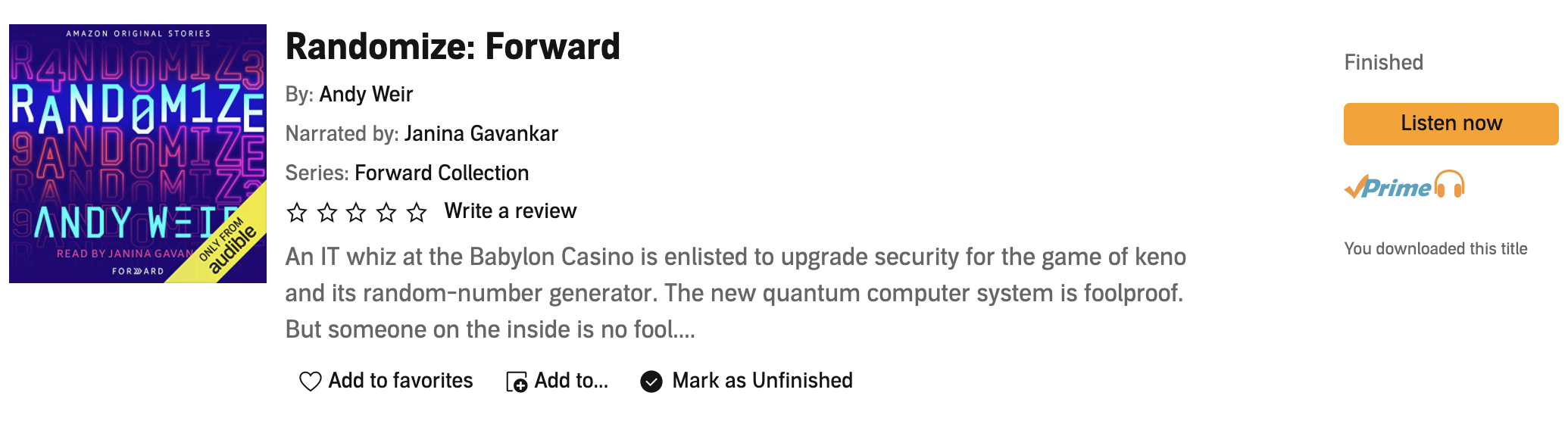
Randomize by Andy Weir: Narrated by Janina Gavankar

Andy Weir’s Randomize is a fascinating exploration of the superficial topics regarding advancements in and increasing availability of quantum computing devices as well as the impact those things could have on a world not yet prepared for those things. More than that–and the saving grace of the story–it’s a layered story about predictability vs. unpredictability and human nature. That human element is the important thing to focus on.
There’s a lot to unpack in this short story about the capacity to apply pattern recognition to things with seemingly no patterns.
The science behind the technology in this story is lacking in several ways, but that’s often going to be the case in fiction. I’ve grown accustomed to overlooking those elements to enjoy the stories I read regularly. It does sort of invalidate the premise underpinning the whole narrative if you pick away at it too much.
I rather like the final message I took away from the story, in that it wasn’t the highly advanced computational device that got the protagonists/antagonists what they wanted, but the computational abilities of a brilliant human mind. There’s a moral to this morally questionable tale, in that a great piece of advanced technology will never be half as useful without a similarly great mind behind the operation.
Janina Gavankar’s narration is effective, especially in her portrayal of Sumi Singh.

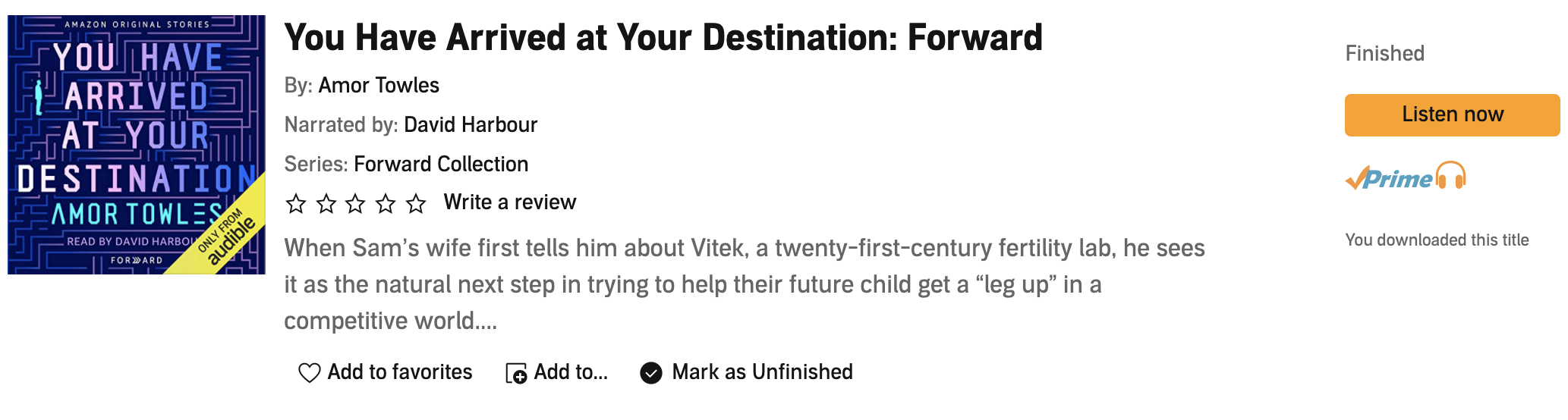
You Have Arrived At Your Destination by Amor Towles: Narrated by David Harbour

You Have Arrived At Your Destination by Amor Towles is, in my opinion, the weakest of the installments in the Forward collection assembled by Blake Crouch.
The story proposes an interesting premise regarding eugenics, the effects of combined nature and nurture on our offspring, evaluation of one’s life in retrospect, self-determination, and relationship dynamics. Sadly, that premise full of promise seems to peter out and go not too far at all.
It could be the author’s intention to have tossed several potential red herrings into the narrative for the purpose of making the reader/listener assume they know where it might be going from this point or that, but ultimately it led to a fairly disappointing overall experience. I’m not otherwise familiar with the author, beyond having heard that they’re quite well-respected for other material they’ve written…so I might have a greater appreciation for what they were attempting if I had a better handle on the author’s style as a whole.
We join our protagonist at a pivotal moment in his life, as he’s faced with one of the most important decisions of his life. He and his wife are considering an enhanced version of family planning, but it all appears to be too much for him. That’s it. That’s how one could sum up the story, and that’s precisely what I’m going to do.
The narration of the audiobook by David Harbour is great. His voice works particularly well for the middle-aged protagonist and the slick, salesman pitching the offerings from his company. That narration alone is the thing that makes the audiobook worthwhile…but that’s about all it had going for it.

Here We Go Again! Another Semi-Religious Discussion Transpires

It happens again, my “friend” from the earlier religious discussions lets loose with something that I found impossible not to address. In this case, he posted the statement, “If a single living cell was found on a distant planet, scientists would exclaim that we have found life elsewhere in the universe. So why is a single living cell found in the womb of a pregnant woman not considered life?” I’m loath to even refer to that as a specious contention.

Upon seeing this, I reply by saying, “That’s a pretty god awful loose correlation to draw. No one disputes that bacteria are life, but we kill them wholesale when we’re feeling ill. I love your capacity for oversimplification of things in such a way. Now, if we found a cell on another planet and exclaimed that it was “human life” you would have a leg to stand on with this sort of nonsense.”

He accuses me of sticking up for the murder of a child in the womb and tells me that I am weak, further he states that I am “a loose correlation of what strength should mean.” He proclaims himself a voice for the voiceless and protection for those who cannot protect themselves.  He follows that by saying, “If you were to stand for human life then you would not be full of nonsense you would be full of truth. A baby is not bacteria but bacteria is life makes no sense.”

I respond with, “No…It isn’t murder, first of all. Let’s say that, yes, you’re correct and a single cell produced from intercourse is a human life…and imbued with a soul. If that were true, then identical twins share one soul…because that process doesn’t begin until well after germination (and you claim life begins). Conversely, we have chimera…which is far more common than you probably suspect…when two cells are germinated but one absorbs the other during the process. In those cases, is the surviving organism a cannibal? Are they guilty of murder, since they did (by every standard that you uphold) take a human life? Or, since some of the genetic material of the other twin remains, do we have one person with two separate souls? After all, where in the human form is the soul located? Which piece of the body contains the tether to the soul? Because maybe my kidney has one soul, and the rest of me another? I’m not being flippant either, I really want you to share with me the great wisdom that you have regarding what a soul is, and when exactly it supposedly becomes a part of me or you or anyone else.”

A mutual friend of ours gets involved in the conversation by telling our friend that ‘life’ is a loaded term, that sperm and egg are individually both considered alive yet we don’t grant them personhood and we kill or allow them to die all the time.

To which our friend replies by saying, “a sperm and egg together make life!”

I say, “Actually, my friend, the sperm and egg are alive in and of themselves…prior to conception.”

This mutual friend responds likewise, by saying, “Yes but separately they are still alive and yet not a person, neither is a zygote or embryo a person.”

Our friend responds by admitting that life exists without fertilization, following that with, “but yet bacteria is a baby, genius. Wish I would have thought of that myself!”

Frustrated, I reply, “You did! You’re the one who posted that nonsense about finding a cell on another planet and equating it to human life.

“You are exhibiting the very definition of circular logic. You don’t even pay attention to what you profess as truth…”

He ignores what I said and tells me to explain the human eye to the “enth degree” and then claims that I can’t, because no one can. (Misspelling is his)

To which, I say, “Yes we can…there is no irreducible complexity argument. There are varying stages of eye from single cells on an organism that are photosensitive all the way to eyes that are more complex than our own.”

He replies by stating that this means nothing and demands that I explain the human eye.

I decide that I will do my best to explain it in such a way as to get through to him, “Everyone can explain the eye…you start with an organism that happens to have a cell that is slightly more photosensitive than the surrounding cells…it is capable of evading a predatory organism or an obstacle…and is able to breed more successfully (and more frequently) than an organism without said cell…the cells breed true and the next generation has said “eye” as well. Down the road we have a descendant with a cluster of said cells…and they are better able to survive than their kin…they breed that trait on…and so on…that is how evolution works, my friend…it’s actually quite simple.

“The trait that improves survival is the trait that is most frequently bred into the next generation…and so on…mutations occur over time…most of them harmful, some of them beneficial…

“That still happens today. It’s not really so difficult.”

I finalize with, “Hell, my focus in school was physics and chemistry…but I know enough about biology to comprehend all of that.”

He follows that by claiming that I am, “circular speaking nonsense, “ and that he finds me hilarious.

I don’t know how to respond to that but to say,  “There is no circular logic there. You do understand what circular logic is, right?

“That wasn’t nonsense at all…there are presently organisms with essentially every stage of eye development from the most rudimentary to our own and beyond.”

Our mutual friend states, “Saying no one can explain the eye is just silly. How many PhDs in biology or genetics do you know? How many scientific papers have you read on the topic?”

He goes on to say, “Take a 5 minute break from scouring the Internet for anti-Obama propaganda and pictures of dead babies and learn something.” And he takes that time to share a brief video from Richard Dawkins: http://youtu.be/mb9_x1wgm7E

I thank him for sharing that, stating that I had actually forgotten that Dawkins had gone into that.

I continue by saying, “I just don’t understand why our friend seems to think that understanding and accepting science is any sort of negative thing. If anything, I would suspect that God would want humans to explore and admire the wonder of the natural world and the universe…and the best way to do that is to strive to understand it better and better.”

The mutual friend provides a possible explanation by saying, “Look at the stars…Goddidit. Look at the ocean….Goddidit. Look at the extreme variety of life….Goddidit. There is no creativity in religion. Only blind acceptance, which is why the Republican Party has no problem lying constantly to their own constituents. They know they have already been brainwashed and well-trained by their religious handlers to accept whatever is put in front of them without question.”

I follow that with, “Hell, I used to be primarily conservative…but this pandering and bowing to the religious right is precisely what made me distance myself from the Republican Party. I don’t have a problem with people practicing whatever damn religion they choose…but when they decide that it’s their place to force other people to live as if they believed the same things…that’s where I take exception. Abortion being legal would never impose abortion onto those who wanted to carry a child…homosexual marriage being legal would never force a man to marry a man or a woman to marry a woman. It’s funny that there are religious people who would call me arrogant for being an atheist…but I’m not the one parading around under the mistaken assumption that the whole universe exists just for me and that my choice of lifestyle should be imposed upon everyone else. I don’t think that they understand what “arrogant” means.”

Our friend responds by questioning how we two douches think he doesn’t like science. He goes on to say that he loves science. He continues by saying, “What I don’t love is people who think it answers everything science is merely a way to try to understand things that are far beyond us. So you posted some dude explaining the human eye. He still didn’t explain the human eye to the enth degree it is humanly impossible to do. It is for understanding things that is it. Arrogance is thinking you can fully explain something with science and math for that matter. You can’t even explain it fully with math you just cant not yet anyway. Take 5min and LEARN something!!!”

I decide that the conversation has probably gone about as far as it can go and I finalize by saying, “No, my friend, maybe he didn’t explain it to the nth degree to your liking…but if he had, you wouldn’t have followed a good portion of it anyhow, not when you instantly begin by claiming (incorrectly, I might add) that no one can. It is explained, and thousands of times over, in numerous college level biology textbooks, classrooms, and elsewhere. The workings of the human eye are well understood by numerous medical practitioners, biologists, neurologists, and others…and most of those people also understand how it developed by stages. There’s nothing magical about the human eye. You tossed out the old irreducible complexity argument without bothering to check your facts and learn that it had been more than dismissed a good, long time ago. You call it arrogant to believe that science can fully explain something, when science does a better job of explaining anything than your Bible ever has. For one second, think about the Bible (a book supposedly crafted by God, a being of infinite wisdom). In the Bible there is no information even alluded to that is beyond the superstition of a bunch of primitive agrarian people. There’s even an inaccurate calculation of pi to be found within the Bible with respect to the Temple of Solomon, even though Greek mathematicians of 250BC (and earlier) had already calculated Pi with greater accuracy. Babylonians and Egyptians had just as good of calculations of pi as early as 2,000BC as you find within the Bible. If it was actually the book of God, you would think that maybe God could do better math than the primitives who were making the same calculations a thousand years before. There is no information, no wisdom, no science mentioned in the Bible that was even advanced for the people of the Hebrew culture of the time. Science does explain things, more things every day…whereas the source of your wisdom explains pretty much nothing unless you look at it as a cultural relic that tells us a bit about one particular primitive group at the time. You can’t claim to love science but then dismiss all of it that doesn’t fit into your argument. Science and scientists do understand the human eye, how it came about, how it works, and can (and do) explain it on a regular basis (in classrooms every semester).”