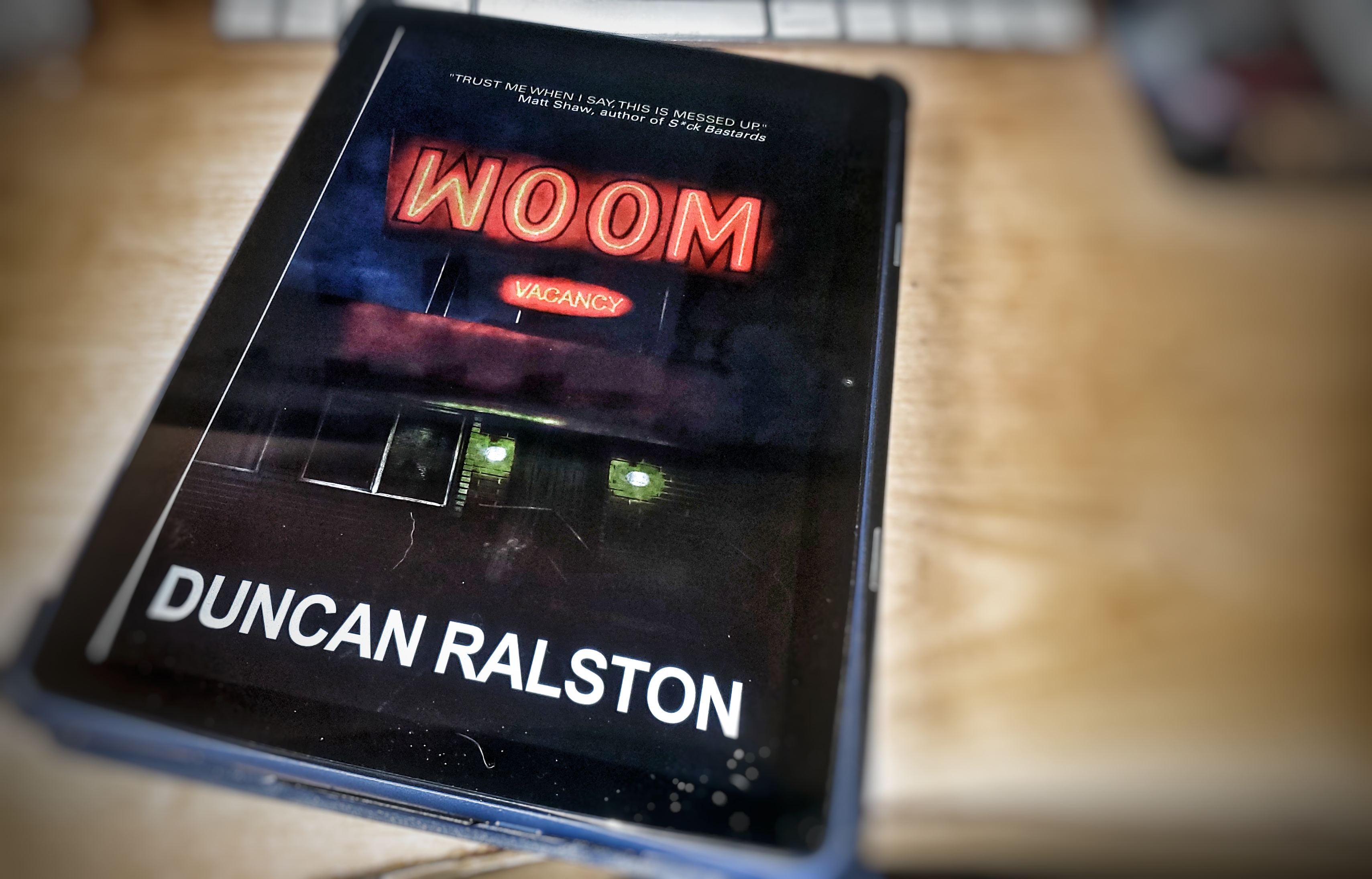
Duncan Ralston’s Woom is a masterpiece of an anthology tale with the most seamlessly incorporated framing story I’ve had the pleasure of reading. It’s like Campfire Tales if that movie had been X-rated and situated in a run-down, no-tell motel room. While Woom works as a single, longer-form piece of literature, it’s also a series of vignettes that flows together surprisingly well. As Angel and Shyla share their respective stories, the content becomes progressively more unsettling and vile. That shouldn’t bother you, though. It’s what you checked in for, after all. When Angel checked in to Room 6 at The Lonely Motel and requested a big girl from the escort service, he expected disappointment. It’s what he’d experienced previously, both in life and in his previous attempts to find the right woman for the objective he has in mind. When Shyla arrives at the door, it seems like Angel might have found just the woman he’s been looking for. As the night progresses, and he opens up to her as she opens up for him, it becomes increasingly likely that Shyla will be uniquely suited to provide Angel with what he needs. Mental illness, childhood and adult trauma, sexual fetishes, graphic violence, and a desperate need for redemption and rebirth swirl together into a perversely entertaining book. Woom is a story that dares the reader to continue reading, the whole time knowing that things are only going to get worse but that the way out is through. What follows might be a spoiler, but I’m not sure I’d consider it one. While it’s obvious from the outset that Angel was telling stories from his own life, I don’t think that was meant to be a surprise to the reader, so I feel comfortable commenting on that without worrying that it’s too much of a spoiler. I suspect Shayla might have been the only person taken aback by that revelation. She wasn’t the brightest character, after all.
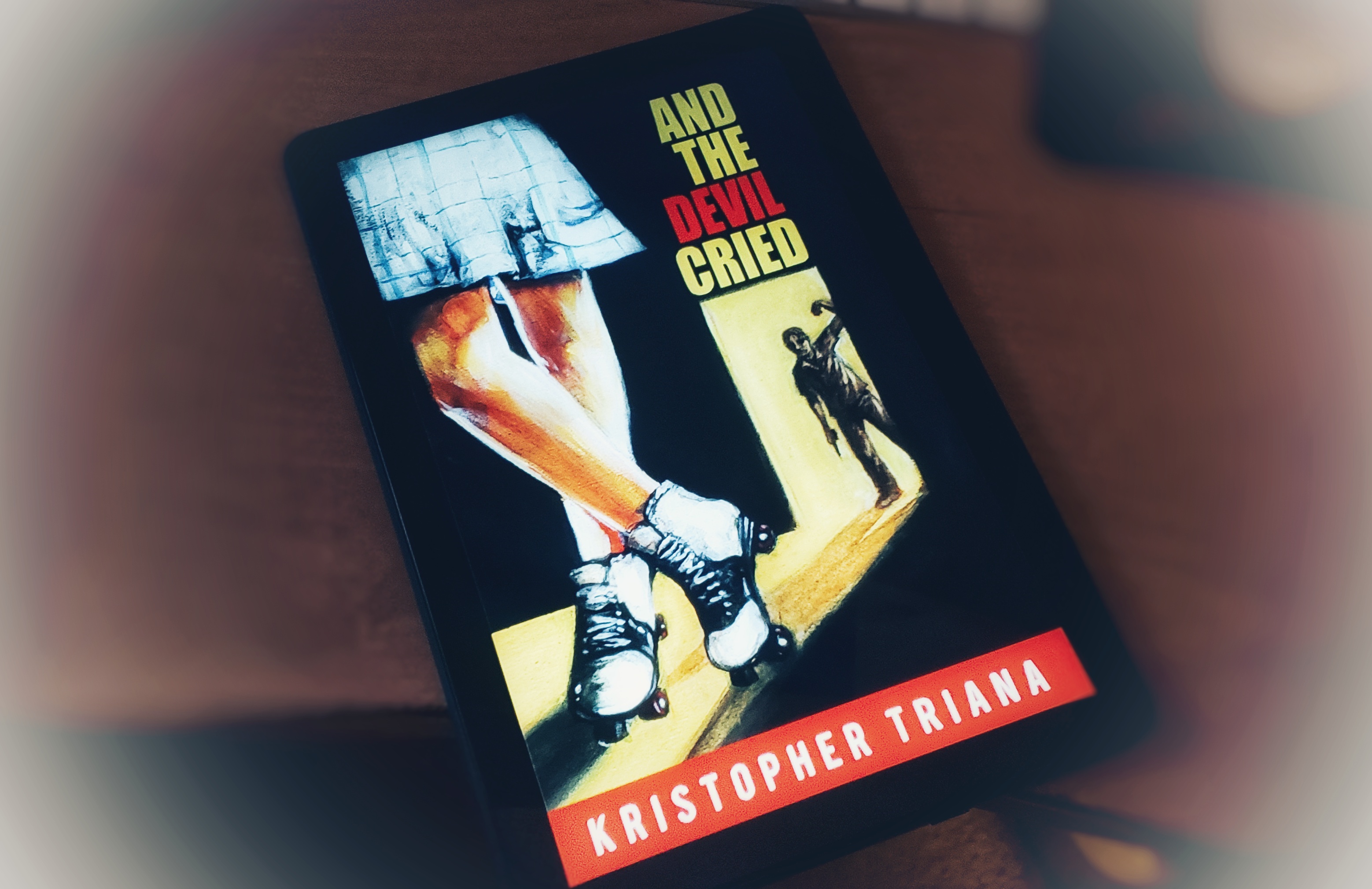
The release of Kristopher Triana’s And the Devil Cried is one of those examples of strangely serendipitous timing. It serves as an odd juxtaposition with Stephen King’s Billy Summers. Both stories are about men who became involved with organized crime after committing a murder during their youth and enlisting with the military. That is, of course, where the similarities end, as the characters themselves couldn’t be more different. Triana excels in crafting unlikeable characters. His true skill is in developing these characters who manage to be entirely captivating precisely because of how unlikeable they are. Jackie is a prime example of that. Committing his first murder at the age of 17 for no better reason than greed and bitterness over the good fortune of the victim, Jackie never strives to be a better person. After his time in the Army, Jackie never adjusts to civilian life, and he gets arrested for an attempted armed robbery. The story picks up as he’s being released and reacquainting himself with bad people he met while on the inside. As the story unfolds, you find yourself wishing he’d never been released, but there wouldn’t be much of a book if that were the case. Misogynistic, abusive, sexist, violent, bigoted, and fundamentally heartless, there’s not much about Jackie that resembles a human being, and that’s what makes him an excellent protagonist for this particular story. While this isn’t one of Triana’s extreme horror or splatterpunk tales, he brings those sensibilities to the pulp crime genre with a character so devoid of decency that he’s almost a caricature of what one might expect a hardened criminal to be. There are components of this story that are difficult to read. I’d suggest those are notably Jackie’s treatment of homosexuals in prison and his unabashed fixation on young girls, but it’s worth sticking it out to the end. Triana showcases a talent for writing hardboiled pulp crime that transcends the genre conventions. It’s a little bit Scarface, a little bit The Godfather, and all Triana. While it’s not my favorite of his books, it’s well worth reading and it displays a side of Triana as an author that I’d never witnessed previously. It’s encouraging to see him stepping outside of his comfort zone and exploring new ground, and that makes me curious about what he’ll have in store for us next.
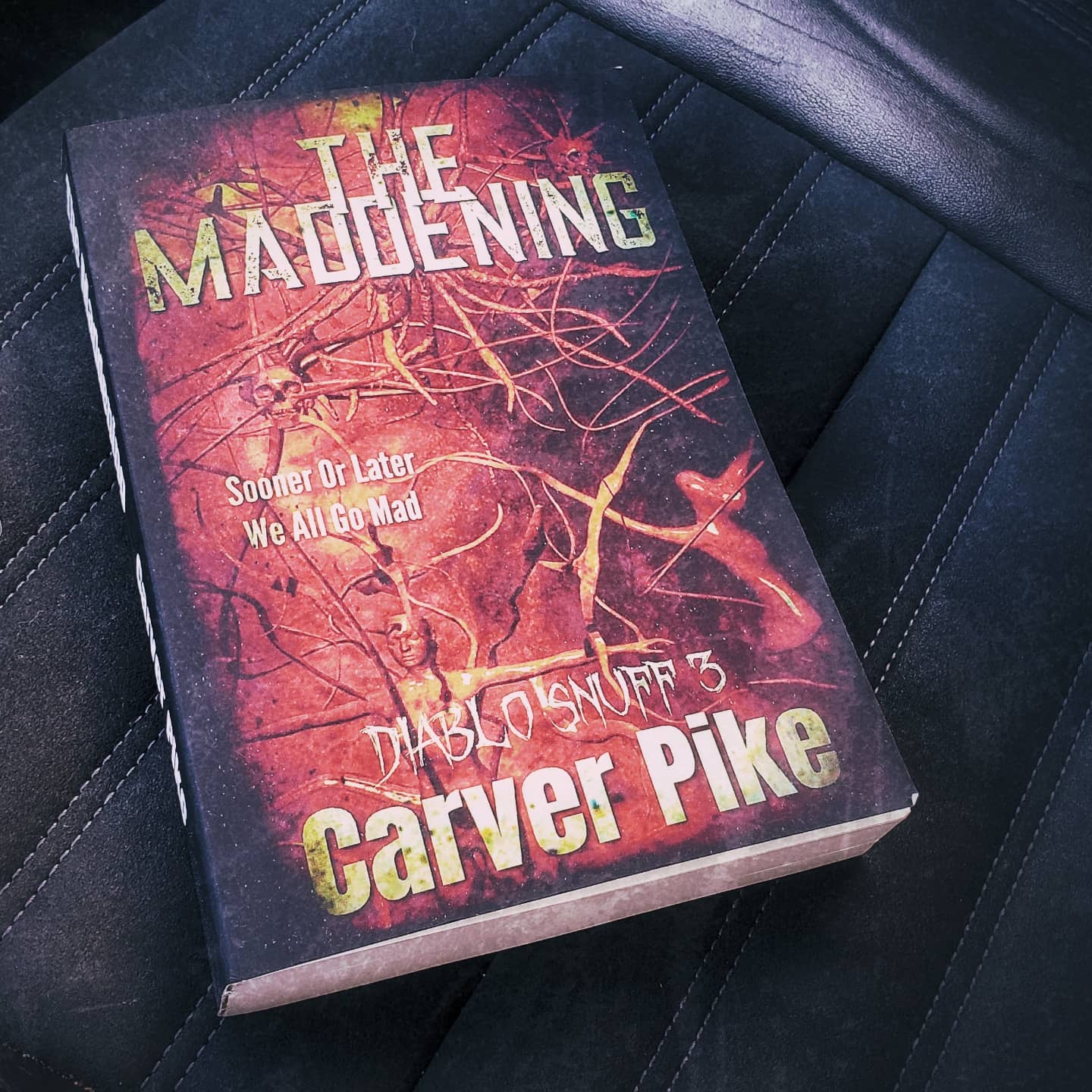
The story begins with tightropes and titties, as Perry and his best friend, Devin, enjoy a vacation in a small Mexican town alongside college students from all over America–and the rest of the world. Their enjoyment doesn’t last long, as Diablo Snuff has plans for the revelers, at least the ones they find attractive enough to press-gang into the same sort of service Kong and Nick “Lucky” Luciano were providing in Passion & Pain. If you haven’t read Passion & Pain, hopefully, you’ve read A Foreign Evil, The Grind House, and Slaughter Box. You should still have some idea what I’m talking about if you’ve at least read those three. Personally, I recommend going back and reading both Passion & Pain and Grad Night as well, because they all come together in the pages of The Maddening. It’s wrong to say this story begins with tightropes and titties. It all begins in the pages of A Foreign Evil when Michael drunkenly follows a beautiful woman to a push-button hotel for a night of carnal pleasures that swiftly devolves into a nightmare of unearthly evil and sinister conspiracies. You’ve come all this way, though, so you know all about that. The journey here left its mark on you, I imagine. The Maddening is Carver Pike’s conclusion to the Diablo Snuff series, and this man knows how to end things with a bang. The best way I can think of to describe the events taking place in this novel is to suggest that it’s John Carpenter’s In The Mouth of Madness meets The Purge while managing to be both more horrific and graphic than either of those movies. If that doesn’t sell you on diving into this book, I honestly don’t know why you’d be reading my reviews in the first place. You might not be my target audience, in which case you’re almost definitely not the target audience for Pike’s Diablo Snuff books. The movies were bad enough, allowing incarnations of evil creatures on the screen to infiltrate our world, stalking and murdering the viewers unfortunate enough to witness even small portions of each film. The release of the novels written by the authors who disappeared from The Grand Georgina signals the next stage of the Diablo Snuff master plan as the madness spreads throughout society, irrespective of nation or culture. This plague of lawlessness and insanity is amplified with the release of The Maddening, the book Tobias desperately hoped he could keep from distribution. None of these things are fast or dramatic enough in dismantling society and sewing chaos, and that’s where the app comes into play. Across the world, psychopaths and damaged people compete with one another to commit the most creative and devastating horrors, racking up more money with each rape and murder. Against this horrific backdrop, the members of Psalm 71 must make their way to the heart of the evil that is Diablo Snuff, saving as many innocent lives as they can along the way. Knowing this is the final volume in the Diablo Snuff series, it should come as no surprise that the tale culminates in a battle between the forces of good and evil that crosses the border separating our world from unearthly planes of existence. This is a spiritual clash that would make Frank Peretti envious. If you’re unfamiliar with Frank Peretti’s Christian horror novels, you might be missing out because some of them are surprisingly good; but they’re nowhere near as good as what Pike has laid out for us in the pages of The Maddening. This book is punctuated with set pieces of such depravity and cruel imagination that the reader can’t help but wonder at the apparent limitless creativity brought to the table by Carver Pike where horror is concerned. At its core, this is a story of hope, though. The Maddening–as with the Diablo Snuff series as a whole–is about facing a terrifying evil and refusing to flinch. It’s about standing ground and fighting, even when the easiest solution would be to turn away or to give in. Knowing that you may not survive, that those you love and who stand by your side may fall as well, but persisting in doing what you know must be done; that is the core of it all. In that respect, as in all others, Carver Pike has succeeded in crafting a masterpiece with this book.
 Domus Necrophagous