Demon Theory by Stephen Graham Jones, Narrated by Richard Ferrone

Like much of what Jones has written, Demon Theory defies easy classification and mixes subgenres with fluidity and skill that borders on awe-inspiring. There’s a little bit of Watcher In the Woods, a touch of Jacob’s Ladder, a hint of Scream, and perhaps a taste of the first two Return of the Living Dead films serving as inspiration behind this book–that in turn serves as the novelization of three fictional films constituting the “Devil Inside” trilogy. Filled with pop culture references and nods to obscure horror flicks (for today’s audience), witty dialogue, meta-commentary, and as much dark humor as there is horror, this book is an excellent experience for fans of Stephen Graham Jones.

We begin on Halloween night as a group of medical students goes to Hale’s childhood home where his diabetic mother needs assistance. When they arrive, with Hale’s mother nowhere to be found, they soon discover they’re stuck in the secluded and rundown house as a snowstorm rages outside. As the story progresses, we discover the six med students aren’t alone, and it takes on a sort of slasher narrative as we learn more about Hale’s family, his childhood trauma, and the presumed identity of the killer. As the body count rises and the possible supernatural elements are introduced, we speed toward a conclusion that feels fitting, though slightly ambiguous.

The second installment of the trilogy begins with a familiar scenario that’s been touched on in the first, but things aren’t quite right. The deck has been shuffled and we’ve moved forward in time and simultaneously backward, it seems. Familiar faces appear but in different roles. The names may be the same, but the details are off…however, it isn’t long before we learn that recollection of the previous story’s events are clear to at least one of the returning characters–though Nona is treated as if these “false” memories are indicative of mental illness. It’s almost Christmas, and we ultimately find ourselves in a hospital where the staff prepares for a performance to entertain the patients. This installment skips the slasher element and dives right into the supernatural aspect we experienced in the earlier tale, amplifying the stakes and the danger. It’s no longer simply the cast of six facing the horrors that we witness arising in the hospital corridors–but how many people would believe that demonic entities are afoot before it’s too late?

The final piece of the trilogy comes as a direct sequel to the second installment, but following another time jump. We’re three years further along and many familiar faces have returned, this time taking the fight back to Hale’s childhood home, hoping to stop whatever nightmare they’ve been living in since they first stepped foot into that house. Nona has a plan, but can her judgment be trusted? Can anyone be trusted, as we delve deeper into the events that brought all of this about? Supernatural horror meets slasher meets brazen scientific experimentation as we learn the truth about Hale’s father, his sister, and the identities of the friends who accompanied Hale home in the first place. This one starts off with a splattery, violent bloodbath to up the ante as a group of punk criminals first arrive at the isolated house as a sort of initiation rite, setting the stage nicely for what awaits our returning cast of characters when they show up only a short while later.

Richard Ferrone’s narration is phenomenal, conveying a sort of homage to the voice of Ghostface from the Scream movies, which feels as perfect as could be with the self-awareness and referential nature of the characters contained within the narrative as well as the writing itself.


The Backbone of the World by Stephen Graham Jones, Narrated by Charlotte Flyte

Stephen Graham Jones has a knack for forcing his readers to look at the world–and aspects of it–in wholly different ways. The Backbone of the World will have you looking at prairie dogs (of all things) and our perceptions of time differently. If this installment of the Tresspass Collection is indicative of what the rest of the stories have in store for me, it’ll be one hell of a trip.
Millie Two Bears is a lonely, socially isolated living on property that she’s about to lose with her husband in prison and his family breathing down her neck to parcel up the land. When she invites a peculiar stranger to rent the camper on the property, she has no idea what sort of repercussions it’ll have and how it ties in with the peculiar prairie dogs plaguing the distant edge of her land…and something growing deep in the earth below.
Jones’s knack for taking the seemingly prosaic and transforming it into the mysterious and sinister is on full display. The simple reservation life of a woman with all-too-familiar troubles gets upended as her everyday environment becomes increasingly unsettling.
Charlotte Flyte’s narration of Millie’s story is superb, and she makes the listener feel as if they’re hearing the story from the woman living it.

The Babysitter Lives by Stephen Graham Jones, Narrated by Isabella Star LaBlanc

In The Babysitter Lives, Stephen Graham Jones tackles the haunted house theme with the same unique style and flair readers have come to expect. When Charlotte arrives at the Wilbanks’ house to babysit their twin six-year-olds, she has no idea she’s walking into a place more dangerous and horrifying than anywhere else she’s been. In what could be described as House of Leaves meets Stranger Things, Jones weaves a disorienting tale that leaves the reader questioning what’s real just as much as the narrative forces the same confusion on Charlotte.
Charlotte, Ron, and Desi are not alone in the house, and there’s a depth to the shadows and dark corners that threatens to swallow anyone who ventures into the dark spaces without caution.
Ultimately, the story succeeds in being a unique and tense haunted house story, capturing the highest stakes on a small scale. The natures of reality and identity are questioned in a big way, but Jones isn’t satisfied simply leaving us with questions. He wants to delve into the how and why of it all. Jones forces us to think about everything happening through the lens of Charlotte’s analysis and the horrors of the past she’s forced to witness.
This might be my second favorite story from the author, following the masterpiece that was The Only Good Indians, and with good reason.
The narration provided by Isabella Star LaBlanc combines with Jones’s writing to make Charlotte feel like a real girl. She’s smart, funny, and thoroughly out of her depths but too stubborn to give up. The supplemental material from Jones himself adds a nice touch, touching on his inspirations and what he hoped to accomplish with The Babysitter Lives. I’d say he was more than successful.

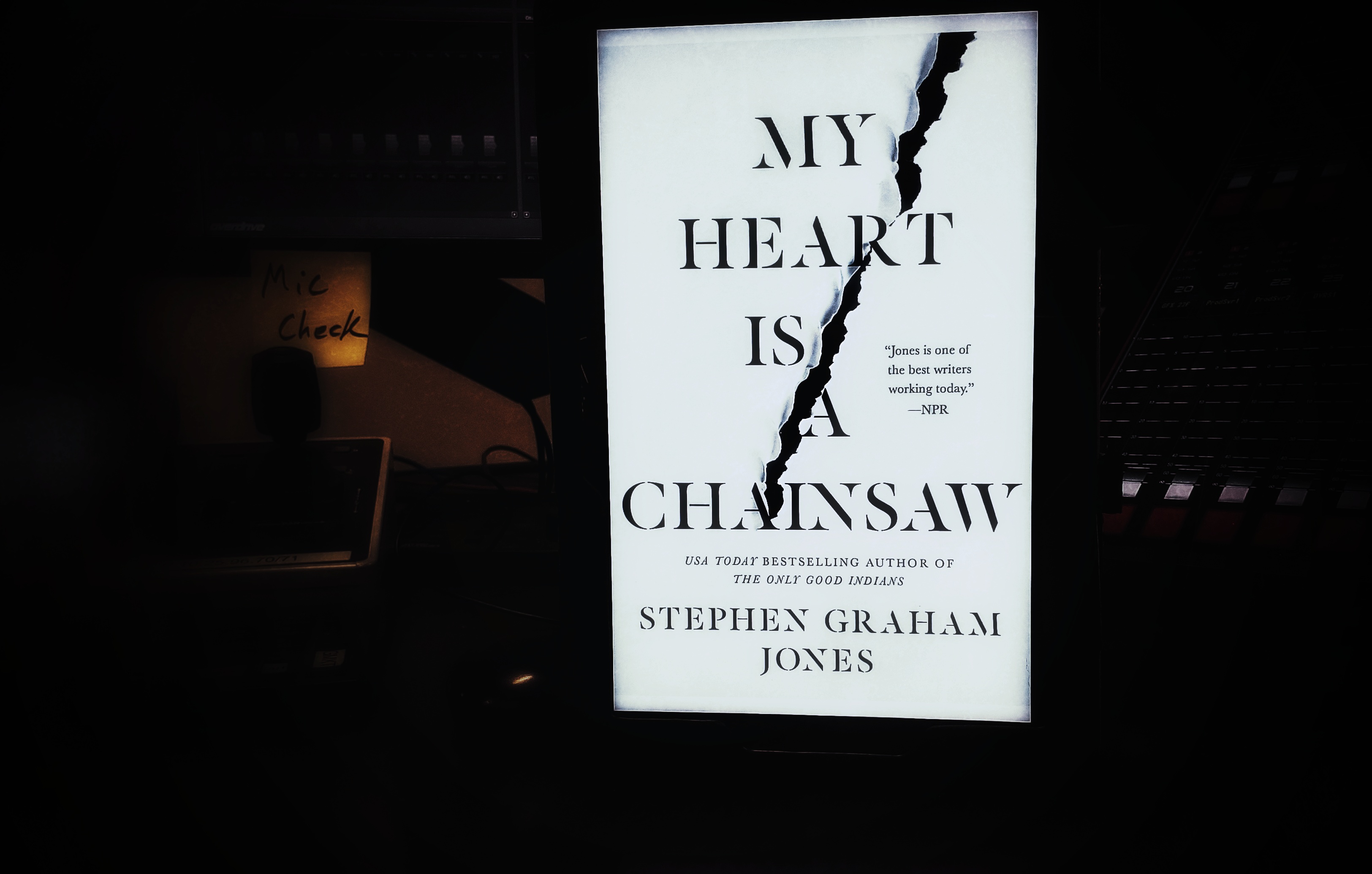
My Heart Is a Chainsaw by Stephen Graham Jones

After The Only Good Indians last year, Stephen Graham Jones set the bar higher than most authors could dream of achieving. I say that because The Only Good Indians was easily one of the best novels I’ve had the pleasure of reading, regardless of the genre…ever. My Heart Is a Chainsaw isn’t likely to leave quite as profound of a lasting impact as that book, but it’s a different sort of beast altogether. And boy, is it a beast.
Jade Daniels is a walking, talking archive of all things slasher-related, or even slasher-adjacent. She’s a socially awkward outcast who speaks to others in slasher genre shorthand. To her, everything in life can be easily compared and contrasted with plot points of one or more of her favorite movies. Every occasion has an appropriate quote from the slasher genre. As a person, she’s equal parts aggravating and endearing to the reader–assuming the reader, like me, is a hardcore slasher fanatic.
Finally, her dead-end life in a dead-end Idaho town appears to be heading toward a fantasy come true. With the arrival of Lethe Mondragon, the final piece falls into place as Jade determines she’s located the archetypal “final girl” for the real-life slasher horror to play out.
Is Jade another Cassandra, doomed to warn everyone of the impending nightmare and tragedy, only to be dismissed as all youth are in the movies she so adores? Is she simply a troubled girl who has lost the capacity to differentiate between fantasy and reality, on the verge of returning to the institution from which she’d only recently been released? You’ll have to read the book to find out. If you’re familiar with Jones as an author, you should know you won’t be disappointed.
As you reach the halfway point of this novel, everything begins cascading out of control with a feverish pace and such a dizzying assortment of horrors that you’ll hardly see the next twist coming–and there are indeed twists.
The novel is so much more than a slasher story. I’d love to tell you more, but I’d be giving too much away. My Heart Is a Chainsaw is also a coming-of-age tale about an indigenous girl haunted by her past and fixated on the haunted history of the mountain town she calls home. This is a story of friendship, a dysfunctional family, and an even more dysfunctional community.
My Heart Is a Chainsaw should assure any readers that Stephen Graham Jones is–I say this without a doubt in my mind–perhaps the single greatest writer currently active in the horror genre.