We Need To Talk About Portland…

We need to address some serious misconceptions and outright lies that are circulating regarding Portland, OR, and the allegedly embattled Department of Homeland Security. I’ve heard this city referred to as a “War Zone,” “Under siege from attack by ANTIFA, and other Domestic Terrorists.” President Trump claimed he was acting to “protect War Ravaged Portland” when he declared that he would be mobilizing the Oregon National Guard against the wishes of Governor Tina Kotek. Trump’s fictional narrative is so pervasive that right-wing propagandists and Trump supporters are uncritically repeating it left and right, even (and perhaps especially) when provided with evidence that he has no idea what he’s talking about.

If someone (myself included) from Portland shares photos and videos that counter this deluded perspective that the city is a “War Zone,” they’ll be condemned for “Cherry Picking,” and either not sharing evidence of the correct locations, or at the right times. They’ll come back with video clips from FOX News, OAN, Newsmax, or right-wing influencers that selectively focus on moments of conflict, ignoring the context. They also often overlook the fact that several of these videos are from the 2020 BLM protests or from three or four months ago, as is clear from the background, in which one can easily see that the windows of the Portland ICE Facility are not boarded up, as they have been since mid-June of 2025.

I can only assume this disingenuous, bad-faith distribution of selectively edited media is what the President was referencing when he discussed the fires and devastation supposedly in evidence throughout Portland (and especially in proximity to the Portland ICE Facility), because none of that is presently relevant.

Other people will respond by sharing photos and videos of homeless people, tents and litter on the street, graffiti, or people using drugs openly. This, of course, has nothing at all to do with the premise behind President Trump’s deployment of troops and the increase in Federal Law Enforcement in the city. The homeless population, tents on sidewalks, and drug users are not (in any sense) related to the supposed siege of the Portland ICE Facility. It’s the equivalent of an Ad Hominem attack or tossing a Red Herring into the discussion of the city. It’s irrelevant to the conversation at hand, and it ignores the fact that all American cities (including those much smaller than Portland) have homeless individuals and families, drug use, and graffiti.

No one with any intellectual honesty or integrity will deny that Portland has a problem with homelessness. I don’t think I’ve ever heard anyone suggesting otherwise. What they will say is that it’s not worse than other large American cities, which is accurate. As of January 2024, Portland didn’t even crack the Top Ten, and as of this year, Portland is the 28th most populous city in the United States. Denver has only 100,000 more people, but has twice as many homeless people, according to the same numbers from January 2024. Seattle has only about 150,000 more people, but had more than twice the homeless population of Portland last year.

But Portland, Denver, and Seattle combined barely reach half the homeless population of Los Angeles, which is roughly half again the homeless population of New York City.

Homelessness is a complicated issue. The contributing factors are manifold, and the solutions (while comparatively simple) aren’t things anyone in a position to do so wants to seriously address.

Are these National Guard troops and Federal Law Enforcement Officers coming to Portland to address issues like homelessness?

No, they are not.

Which means anyone trying to distract from the topic at hand by tossing that into the mix needs to shut the fuck up and let the adults talk. Bad faith bullshit is not welcome.

So, let’s talk about the alleged assault on ICE that Kristi Noem, Tom Homan, Donald Trump, and others want to claim is taking place.

Before we move on, I’d like to dedicate some time to Kristi Noem, though. I have a relatively unique perspective in that I lived in South Dakota while Kristi Noem served as Governor, and previously as a U.S. Representative, before I moved to the Portland Metro. She was much-maligned by even Conservatives I knew in South Dakota, as a corrupt and undemocratic force in State Government. Of course, that didn’t stop them from voting for her, because she happened to be a Republican.

Noem’s histrionic portrayal of the protests in Portland is not novel. She has a long history of opposing the First Amendment right to Speech and Assembly, stretching back to the protests against the Keystone Pipeline. She was also investigated for Corruption regarding the circumstances surrounding her daughter and the Real Estate Appraisal Licensing system in South Dakota.

Perhaps most egregious, when South Dakota voters passed a Ballot Measure to legalize Recreational Cannabis in 2020, she and two members of Law Enforcement filed a lawsuit to overturn the results of the election, which passed by a margin of 54 to 46%. It’s particularly amusing when you compare it to her Gubernatorial Victory in 2018, of only 51%. The courts sided with Noem and the two Law Enforcement officials, claiming the Ballot Measure violated a “single-subject” provision. Never mind that any Ballot Measures in South Dakota undergo a legal review by the Secretary of State to confirm that they conform to state statutes.

I don’t entirely blame Noem. South Dakota has a history of corruption and anti-democratic practices. It was only two years before she was elected Governor when voters approved an Anti-Corruption measure that would have led to an independent ethics commission, campaign finance reform, restrictions on gifts from lobbyists, and increased transparency regarding campaign contributions. The Governor at the time, Dennis Daugaard, and the State Legislature repealed the Initiated Measure only a few months later, with Daugaard suggesting that voters hadn’t really thought things through.

As you can see, Noem comes from an environment where corruption and undemocratic sentiment run rampant. It should have been a warning sign about the Trump Administration that she would be so readily welcomed into the fold. For some of us, it was. Of course, for many of us, there had already been several warnings.

Placing her in charge of Homeland Security has been an unmitigated disaster, as anyone could predict. But it’s not the disaster she might propose. Since Donald Trump returned to office in January, at least 15 people have died while in ICE Custody. This does not include the two detainees who were murdered by the shooter in Dallas last month. That number also doesn’t include individuals who died shortly (or immediately) after they were released from ICE Custody, nor does it include individuals who have died since being deported or falling victim to the Administration’s new take on Extraordinary Rendition.

But, guess what, a total of zero ICE agents have been killed in that same time frame. This, despite President Trump’s wild claim that people have died in Portland. Unless he’s speaking of unrelated deaths (or deaths from years ago), no one has died as a result of protests happening in Portland. The last death of anyone involved with the Department of Homeland Security (not an ICE agent) was a U.S. Customs and Border Protection agent who was shot on January 20th, during a traffic stop in Coventry, Vermont.

Most recently, the only injury of note was when an ICE officer was dragged by a car driven by an undocumented immigrant attempting to evade him. The immigrant in question was killed; the ICE officer was not.

Still, all the talk from the Administration has been focused on how ICE agents are under attack. But, it certainly sounds like it’s far less dangerous to work for ICE than it is to be taken into their custody.

Noem and Homan like to talk about large percentages when they discuss the increase in assaults on ICE agents. Of course, those numbers are readily subject to scrutiny, because that percentage reported by DHS has fluctuated dramatically, sometimes within hours: 500%, 700%, 1,000%. It’s almost as if they’re just tossing large numbers in front of a percentage sign to appeal to the average person’s inability to contextualize what a percentage increase actually means. A keen observer might notice they’re loading the statements to make people afraid.

Let’s break down how percentage increases work for those of you who need some assistance.

If there were hypothetically only one ICE agent assaulted between January and September of 2024, it would mean that five, seven, or ten had been attacked during the same time frame this year to reach those previously mentioned percentages of 500, 700, or 1,000%. But to say it was ten agents that had been assaulted over the course of an eight or nine-month interval doesn’t have the same dramatic flair to it. Most recently, they’re claiming it’s a more than 1,000% increase, but without providing any actual numbers to contextualize what that percentage means. The real numbers (according to all official records) were something to the effect of ten assaults in 2024 compared to 79 in 2025. This is also far less dramatic than using a percentage increase to trigger an emotional response. After all, we could refer to it as a 790% increase. Which number sounds scarier to you?

Mind you, only a small percentage of these assaults involved protesters, and an even smaller number had anything at all to do with Portland. These attacks are largely coming from people they are detaining.

And, of course, the numbers have spiked. ICE is more active and aggressive, and is utilizing tactics that are absolutely going to increase violent reactions. When masked men with no official insignia are grabbing people and hauling them into unmarked vehicles, it looks more like a kidnapping than anything official or legal. Never mind that there have been several documented incidents this year of people being assaulted, kidnapped, and raped by people pretending to be ICE agents. There’s even one reported killing by a fake ICE officer. Knowing all of this, would you simply accept that this is a legitimate, state-sanctioned detainment?

There’s also the deeply concerning fact that several of the things that constitute assault in the eyes of DHS have been categorically ludicrous in many instances. The official claim was that the New York City Comptroller, Brad Lander, had assaulted agents when he was detained at an Immigration Court proceeding in June, though the available video evidence shows no assault of any kind. Garbage dumped on an ICE agent’s lawn was also one example of “assault” on DHS, while another was a sign that included an individual ICE agent’s name and a great deal of profanity. There was even an incident here in Portland where an Indigenous woman was charged with Assault because an ICE officer claimed to get a headache because she was blowing a whistle on the sidewalk in front of the Portland ICE Facility. Even if those examples were the only questionable ones, they would present a huge issue when discussing relatively small numbers of incidents.

And, of course, it could be argued just as easily that assaults performed by DHS agents have increased by similarly huge percentages, but Noem and Homan are disregarding that. The very real likelihood, though, is that more people are being assaulted by ICE agents than are assaulting them.

Several of these assaults have been without cause or provocation, unless you claim standing in place, holding a sign with mean words on it, and yelling profanities at these masked men constitutes a clear threat. Based on how fragile and sensitive the Administration seems to want us to believe the people working for ICE happen to be, I guess those things might just be adding to the assault statistics.

Of course, all of this escalation on the part of the Administration is a painfully transparent attempt to trigger a response. The same thing was done in Los Angeles earlier this year. The same tactic was also on display during the BLM protests in 2020. President Trump, Kristi Noem, Tom Homan, and others are gambling on the likelihood that increased Federal Agents and the addition of Military Personnel will be sufficient to push the situation past a tipping point. At that point, they will have the flimsy justification required to impose greater Authoritarian control over Portland, Chicago, and wherever else they decide they want to add pressure.

It’s an absurd truth, and one that got Portland’s Mayor, Keith Wilson, laughed at and mocked, but the best thing protesters can do is to refuse to take the bait, to stay home, and to make the Administration look like the scaremongering force it absolutely is. Of course, that may not solve anything, since right-wing agitators have been masquerading as protesters and journalists already. It would hardly be a stretch to imagine them inciting violence just to ensure it adversely impacts their opponents. Some of them also have a documented history of instigating fights, both within the protest groups and as counter-protesters. They also have a history of fabricating violent altercations and even going so far as to start fights just to selectively capture the retaliation on camera for the purpose of furthering their propaganda objectives.

Either way, what we end up with is a situation wherein protesters are expected to behave in a way that is beyond reproach, or they’re condemned for inciting violence. That may sound painfully familiar to anyone who has dedicated time to studying the Civil Rights Movement. But the uniformed individuals who are supposedly trained to de-escalate situations are deploying pepper spray and gas canisters despite the law clearly stating the use of force must be reasonable, necessary, and proportionate. They’re intended to adhere to the same standards required for self-defense on the part of the average person.

In fact, on July 25th, Assistant Chief of Operations for Portland Police Bureau, Craig Dobson testified, “It makes it extremely difficult for us to deal with, as the folks that are on the other side of this fence have been, night after night, actually instigating and causing some of the ruckus that’s occurring down there…” and that DHS agents are not following best practices.

It’s also on record that ICE had been witnessed firing pepper balls on the crowd without any apparent warning or provocation on June 12th. Then, it was back on June 14th when protesters shattered the glass of the front door, subsequently leading to the boarding up of all windows. DHS officials panicked and used indiscriminate force against the protesters at that time. The one ICE agent who was hurt had abrasions and nothing worse. The same kind of disproportionate and indiscriminate attack by ICE agents was documented on June 23rd and 24th, when an ambulance had to be called because a protester was hit in the head with a gas canister. It can get dangerous out there, but the vast majority of the danger is directed at the people exercising their Constitutional Right to protest the actions of the Administration and the Department of Homeland Security.

If someone intends to protest, they need to understand their rights. But that’s not enough; they also need to know the limited power bestowed upon the people they are protesting against. It’s essential to recognize that Department of Homeland Security officers have significant limitations. No one within ICE has the authority to arrest, detain, or restrain any American Citizens. There are several examples of ICE agents violating this explicit limitation in their purview. There are exceptions regarding Citizens who assault an ICE agent or who actively interfere with ICE performing the duties that are within their scope. U.S. Customs and Border Protection officers have fewer restrictions. But a Citizen would have to commit a Federal Criminal Offense in the officer’s presence before they can restrain, arrest, or detain someone. Finally, Federal Protective Services has similar authority to Customs and Border Protection, but its scope is focused on Federal Facilities.

It’s imperative to recognize that, unless a protester is actively breaking the law in some way related to the “work” DHS performs, these officers are not permitted to so much as lay a hand on any Citizen. Assuming the protester has not trespassed onto the Federal Property, damaged the same, assaulted an officer, or obstructed them in their lawful duties, no one working for DHS has any authority to use physical force against the protester.

They can (and should) be sued each and every time they violate the limited authority they have. Further, though I want to be clear that I am not encouraging violence, if someone is attacked by an employee of DHS without provocation, they are well within their rights to defend themselves. Even though they may be wearing uniforms, their authority as Law Enforcement ends the moment they violate the restrictions associated with their role. If someone does fight back (and some would suggest they should), I will offer the same recommendation I’ve received from individuals who specialize in self-defense; if they’re threatened to the extent that they have to defend themselves, they need to make sure it’s safe for them to turn their back on the threat to walk away. The threat can no longer be a threat.

If you find yourself in a situation wherein you have to fight back (and I believe you should), that fight doesn’t end in the street. Keep fighting their attempts to prosecute you for assault as well, because if they’ve stepped outside of bounds, they’re just some asshole, not an actual cop. In Oregon, you’re legally entitled to use physical force if you believe it’s necessary to protect yourself, another person, or your property from Unlawful physical force. You are permitted to use whatever force is proportionate to the perceived threat. Just keep in mind that you cannot be the initial aggressor.

Political Violence and the Selective Acknowledgment of It

Political Violence comes in more shapes and sizes than Pokémon. And yet, it’s only ever a specific variety that most people seem willing to acknowledge, and then only when it suits the narrative they prefer to frame. When someone is killed in an act of direct Political Violence, hand-wringing, condemnation of physical violence, and proclamations that we are better than this inevitably follow closely behind. This is true, even (or especially) when the violence in question was a direct response to less overt forms of violence. You see, those more subtle forms of violent action are insidious in that people can easily dismiss them if they’re so inclined, but are often (if not always) more harmful.

Willhelm Frick, Joachim von Ribbentrop, Julius Streicher, and several others who were sentenced to death following the Nuremberg Trials had never killed anyone, and had (to the best of anyone’s knowledge) committed no acts of direct violence. In fact, Hermann Göring, Ernst Kaltenbrunner, and Martin Bormann were among the minority, in that they had committed acts of direct violence and murder during their tenure within the Nazi Party. But, in 1946, we recognized that Political Violence comes in many forms, and the guilt of the 12 men who were sentenced to execution was not open to debate. Adolf Hitler, himself, has never been connected with evidence that he personally murdered anyone aside from possibly Eva Braun, before taking his own life. The same can be said for Joseph Goebbels, though he and his wife killed their six children and then themselves. These men, and many others, had been complicit and had knowingly issued propaganda and orders that led to the deaths of countless others.

Would anyone like to present the defense that these men were killed (or killed themselves to avoid being killed) because of their political opinions? Is that the extent of cultural relativism that we should be applying to the architects of the Holocaust? That’s what I keep hearing lately: that people shouldn’t be threatened, persecuted, or harmed over a difference of opinion. All I can assume is that many people need to better acquaint themselves with the definition of “opinion” before they start concerning themselves with differences between them.

Opinions are just assumptions or judgments that an individual develops regarding any particular topic. They can be informed or uninformed, but they’re little more than a subjective viewpoint with greater or lesser value depending on the expertise and the degree of authority invested in the individual sharing said opinions. Critiques of policy and ideology are political opinions. Whether they’re right or wrong, they’re opinions, and people are entitled to their own. Hate Speech, however, is not an expression of an opinion. Hate Speech is an attack, using dehumanizing and demeaning language to target an individual or a group of people based on features of their identity: Ethnicity, Nationality, Skin Color, Gender Identity, Sexual Orientation, and so on. Hate Speech targets (often immutable) characteristics of the individual or group, for the purpose of expressing bigoted, biased, and prejudiced perspectives. Thus, we have the difference between those who condemn the actions of Benjamin Netanyahu and the Israeli Government, compared to those who condemn Jewish people or the people of Israel as a whole. One is a criticism of policy and the actions taken by a group, and the other is a condemnation of a group of people based on either Ethnicity or Nationality, depending on whether we’re talking about Jewish people or Israeli people. There is a massive difference between the two things, and yet we see colleges and universities losing funding because certain people want to conflate these two things with false equivalence.

Hate Speech is, in reality, a form of Political Violence that gets shrugged off as nothing more than a difference of opinion, typically by those who are not impacted by that violence. Hate Speech and hateful rhetoric paved the way for the Holocaust, along with the more recent Genocides in Rwanda, Myanmar, Bosnia, and Herzegovina.

Sheltering Hate Speech under an umbrella by treating it as if it’s nothing more than another legitimate opinion that one is entitled to share is just part of the weaponization of public discourse. It promotes discrimination and violence, especially when it’s combined with disinformation/misinformation campaigns designed to reinforce the bigotry involved.

Still, one might, of course, look at those guilty men I referenced above and argue that they were guilty of War Crimes. Therefore, the sentences were both just and appropriate. But, by the same standard, our current Administration should also face a tribunal.

Despite no evidence supporting the claims and the US Intelligence Apparatus contradicting them, the Trump Administration confidently states that Venezuelan President Nicolas Maduro is linked to Tren de Aragua, and that a U.S. strike on a foreign boat in international waters was justified because that boat was carrying cocaine to our border (sans evidence). By any standards, the killing of foreign civilians in international waters is (by definition) a War Crime. The Trump Administration is hardly alone in this. Every President in my lifetime has been guilty of actions that should constitute War Crimes. Why are we not holding ourselves to a higher standard than we held the Nazis in 1946?

But, of course, it’s not just War Crimes that we’re dealing with today. The current Administration repeatedly flaunts International and American Law, violates the Constitution, and works to erode the mechanisms of Democracy within America. Men like the late Charlie Kirk have been instrumental in both endorsing and encouraging those actions, as well as being directly involved in helping to place Donald Trump in the position of authority he presently holds.

Charlie Kirk fostered an environment of White Christian Nationalism throughout his time in the public eye. It takes little effort to find several instances of outright Racism, Sexism, Homophobia, Xenophobia, and myriad other forms of Bigotry in his Podcasts, Social Media posts, and Public Appearances.

He repeatedly expressed a baseless and racist endorsement of the Great Replacement conspiracy, wherein non-whites were coming to America (and other Western Nations) to replace whites. Just last month, he claimed, “The Great Replacement of white people is far more sinister than any redistricting project.” The Great Replacement theory is directly linked to several acts of Political Violence, targeting non-whites. More importantly, the Great Replacement is virtually identical to the White Genocide conspiracies that have been core aspects of neoNazi ideologies for a long time now.

Charlie Kirk accused Transgender people of being predators and actively encouraged his listeners/viewers to bully and harass them. Transgender people, while making up a tiny fraction of the population, are somehow substantially more likely to be victims of violence than cisgender people are.

He couldn’t even manage to consistently maintain his performative support for Israel and condemnation of antisemitism, despite knowing that he needed to tow that line because it might be a bridge too far for some of his audience. Nevertheless, he still managed to spout off tired old antisemitic talking points about Jewish people controlling everything from higher education to Hollywood, pointing the finger at Jewish financiers of “Cultural Marxism,” and acting aghast at Jewish people promoting anti-white hatred despite wanting white people to do away with that same kind of hatred against them.

To pretend that isn’t often Political Violence is tantamount to saying that violence perpetrated against Jewish people by German citizens in 1940s Europe was not Political Violence. When the apparatus of government endorses, however tacitly, the dehumanization of a group of people, it requires extensive mental gymnastics to pretend that the acts of violence perpetrated against that group of people are not acts of Political Violence. It also requires an impressive gymnastics routine to pretend that the propagandists who spread the dehumanizing message aren’t complicit in the outcomes.

Was it not Political Violence when Omar Mateen murdered 49 people and injured more than 50 others at the Pulse nightclub in Orlando, FL? He may have claimed to support the Islamic State, but his motivations (even according to his father) were based on the same anti-LBGTQ+ sentiment we hear expressed by White Nationalists regularly. Since LGBTQ+ rights (and the existence of LGBTQ+ people) are treated like a political football, that would make any violence arising from homophobia and anti-Trans perspectives Political Violence. And this is State-Sanctioned violence, because Republicans certainly dedicate a lot of bandwidth to demonizing LGBTQ+ people, while Democrats often turn a blind eye to the violence perpetrated against them. And, whether Liberals want to accept it or not, neglect and dismissal are forms of Political Violence as well. But that’s a discussion for another time.

Men like Charlie Kirk, Ben Shapiro, Nick Fuentes, and even Donald Trump have a particular skill, even if they lack any others. They can extrapolate from their own insecurities, fears, and failures to develop a form of demagoguery that plays on those same weaknesses in an audience. This only works when the demagogue is in the majority, because for some people, there’s always an undercurrent of resentment and fear associated with imagining the loss of the power that comes with being the majority. Some of that, I’m sure, arises from the assumption that (if the roles are reversed) they will be treated as poorly as they have treated the minority group(s) within society.

Men like Kirk taste fear and weakness in their audience the way a shark tastes blood in the water, and they’re just as predatory about it. They stoke that fear with misinformation and cruelty, dehumanizing anyone who isn’t part of that majority group, and assuring the audience that they can rest assured of their superiority. They make them feel threatened by the outsiders, regardless of the fiction required to do so, because they know these people won’t risk eroding the false confidence they’ve built up by digging too deep or tugging at threads that could unravel everything.

And, as that manipulation leads to the inevitable results, they hide behind the shield of Free Speech, insisting that they’re just asking questions, voicing their opinions, or engaging in healthy debate. We’ve seen this happen several times in the past, with January 6th, 2021, as one of the most vivid examples. The architects of the direct Political Violence are smugly distancing themselves and feigning a sense of horror at what’s happening, as they assume no one will recall how openly they encouraged all of it.

One way or another, there needs to be consequences for the Political Violence perpetrated by those who conveniently, like cowards, hide behind a misapprehension of what “Opinion” means. And, just as important, people need to learn that calling for violence against one’s oppressors and those who have wished or encouraged violence against them is not at all the same thing as wishing harm on people just because they have a different opinion. Malcolm X wasn’t the same as the white racists who fought to maintain segregation and oppose the Civil Rights Act, because he called for reactionary violence. He was already the victim of Political Violence, and was only speaking the same language as those who perpetrated that violence. If you threaten someone or encourage others to act violently toward them by dehumanizing them and manipulating others into thinking they are a threat, you are not expressing an opinion. That isn’t merely a matter of differing political viewpoints.

Regarding the present situation, and the aftermath of Charlie Kirk’s apparent assassination, we don’t even know if it was an act of Political Violence. It stands to reason that it probably is, but it’s just as likely to be someone who agreed with him on most accounts as it is to be someone who was politically opposed to his ideology, stripped of the Hate Speech and hateful rhetoric. After all, the same people storming the Capitol on January 6th, 2021, were the same people most vocally supportive of “Back the Blue” perspectives, yet they assaulted police officers without any compunction. When one promotes an atmosphere of hate and fear, in which violence is encouraged, we’re just as likely to see that violence turned upon people in the same group, the moment fractures appear. It’s worth keeping that in mind.

Alpha: Chaos Awakens by Aleron Kong, Narrated by Pavi Proczko

While his readers, listeners, and fans await the next installment of his The Land series, Aleron Kong has released another tangentially related title, Alpha. This one takes us back in time to before the opening scenes of God’s Eye: Awakening, and sometime following the events that kicked off the adventure in The Land. With some manipulation from certain Lords of Chaos, the Earth is connected to The Labyrinth, and all hell breaks loose. The changes are immediate, but the extent to which these changes alter the planet (and the life living here) is relatively gradual. Of course, those of us who have made it through God’s Eye: Awakening are aware of how this turns out for Earth and the human species. It is interesting to see how it all starts off, though.

We’re introduced to Fin and Lauren, a couple deeply in love and tragically bearing witness to the force of chaos piercing the planet and opening the bridge to The Labyrinth. Fin served in the military during the Third World War and became an ER doctor in his civilian life afterward, setting him up to be a more capable protagonist than our previous main characters in Kong’s books. The tone of this book shifts accordingly, as Fin (our narrator) is a man inured to violence and capable of cruelty when properly motivated.

I personally found Fin to be a reasonably compelling, three-dimensional character. He’s frequently at odds with his personal history and the way it shaped him, as he struggles to be the man Lauren helped him see he could become. This internal conflict and the dichotomy of the soldier vs. the physician is ever-present throughout the narrative and adds a bit more depth to the whole.

The introduction to the interface system on Earth is interesting, though occasionally a bit on the tedious side…but this is an introductory story, so that’s to be expected. There are definite differences from what we’re acquainted with in The Land and God’s Eye, and the fact that the planet itself is incorporated into the system was a nice touch.

Unfortunately, there isn’t much meat to this story. It largely takes place in a hospital as Fin explores the new features that have changed the world. Though they are satisfying, there’s not much movement as far as the plot is concerned, as the focus remains almost exclusively on character development. The conflict, when it arrives is a pleasant change, but the cliffhanger ending is an issue I have with most of Kong’s work. His books aren’t self-encapsulated and that leaves them feeling incomplete and mildly frustrating as we wait for the next installment that will invariably suffer from the same characteristic abrupt conclusion.

My other issue is with unattributed pop culture references. Notably, a cribbed section from High Fidelity really struck me as off-putting. It’s fine to incorporate pop culture references in fiction. Farscape, a television series from 20 years ago, handled it phenomenally well. The protagonist acknowledged that he was referencing things other characters would not recognize, and it was done with a wink and a nod. In Alpha, that particular reference was treated as if it was some witty thought process of the character. That didn’t sit well with me. There’s also the reality that people now hardly recognize references to High Fidelity, and it seems highly unlikely that a soldier from a good distance into our future would have no reason to have read or seen it.

Pavi Proczko’s narration is excellent. All three of the narrators who signed on to work with Kong have brought his works to life in a way that I consider admirable. Narrating a LitRPG title can’t be the easiest thing. Proczko does a great job of conveying the emotional fluctuations Fin experiences as the story progresses, and that’s definitely something different narrators struggle with.

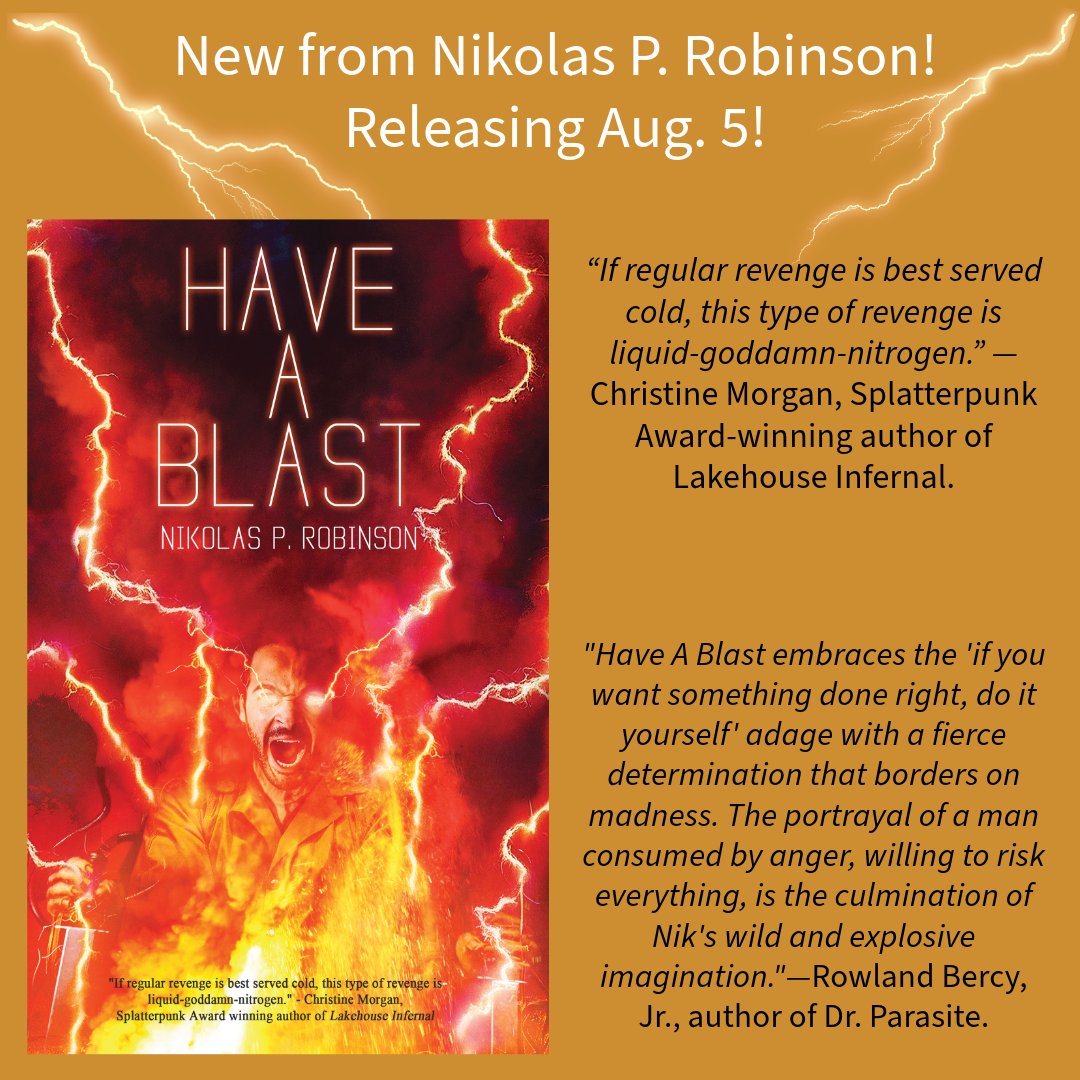
Have A Blast

In 2022 I was invited to write a short story to be featured in an anthology focused on Wrath, as part of a series of anthologies centered around the Seven Deadly Sins. I was enthusiastically on board. Revenge and wrath are close to my heart, where fiction is concerned.

Unfortunately, I ran into a couple of issues that led to my inability to submit the story I’d been writing–not the least of which was that, upon rewriting the story, it exploded to almost double the word count expected by the publisher. I felt defeated and like I’d let the publisher in question down by not getting them the story I’d eagerly anticipated sending their way.

When Candace Nola started talking with me about rewriting/revising Innocence Ends, she asked if there was anything new I’d be interested in sending her way. I quickly wrapped up the loose threads I hadn’t tied off in the revenge story and sent it her way.

She wanted it! She had some requests and suggestions for areas she wanted me to expand on, and the story grew to just about the short end of what’s considered a novella.

And so, on August 5th of 2024, Have A Blast explodes onto the scene.

Molded by war and disfigured by a roadside bomb, Oliver Clark doesn’t hold out much hope for the future. Then he meets Jayne, and all of that changes. But when she’s taken from him, Oliver sets his sights on revenge.

No matter who it was, he’s determined that they’ll learn how far someone will go when they have nothing holding them back, and nothing left to lose.

Advance Praise for Have A Blast:

Salt Of My Blood by Jae Mazer

Jae Mazer’s Salt Of My Blood is a tale of two vastly different characters, revealed through snapshot windows into their respective lives as we wait for what we’re sure will be a tumultuous meeting when the two come together. From childhood through the setbacks and disappointments of adult life, we witness the two characters grow and evolve along separate paths. Living in post-war Denmark, Lærke and Harald are deeply tied to the treacherous North Sea, but their relationships with the water are as distinctly different as their personalities.

Lærke’s lifelong love of the sea transforms into something far more peculiar–equally disturbing and beautiful in the way Mazer tackles a fascinating taboo–when she discovers her only true friend where the sand meets the sea. Harald’s love of the sea is deeply tethered to his cruel and predatory nature, and piracy becomes his sole passion. When their two worlds collide, it is truly captivating; a spectacle sure to feel like a reward to the reader.

Mazer addresses heavy topics in this modern-day fairy tale; sexual assault, mistreatment of women, the antiquated concept of the wife’s role within marriage, and the misogyny that underpins all of those things.

This story can be found on the Godless platform by clicking on the link below:

All I Want Is To Take Shrooms and Listen To the Color Of Nazi Screams by John Baltisberger

That title’s a mouthful, right? Well, I challenge you to come up with a more appropriate title for the book after you’ve had an opportunity to read it. This is going to be a challenge to review because it’s so many different things. There’s so much going on within these pages. At the core, it’s a collection of short fiction and poetry, much of which is focused on kaiju–I’ll return to that later. But this collection is unique in that it’s assembled in a framing story that tells us a colorfully embellished autobiography of Mr. Baltisberger himself.

Colorfully embellished is certainly one way to describe it. This is the autobiography of John Baltisberger if he took off the restraints that civilized society has shackled him with. There is violence galore–violence we certainly hope isn’t an accurate representation of John’s life. If it is, then we should probably keep our mouths shut and let him go about his business. Because his business is killing neo-Nazis, fratboy rapists, corrupt police, klansmen, and other people the world might be better off without…and ingesting copious amounts of hallucinogenic substances. Of course, as we learn later on, much of his attention has shifted to focus on his intensely sexual relationship with his loving wife and the fantastic daughter they’ve produced. But maybe there’s still room for killing bad guys. There’s always room for that, right?

So, regarding the kaiju-focused short fiction and poetry. A few years ago, Mr. Baltisberger offered to write personalized kaiju poems or stories taking place in locations of your choosing. I was one of the individuals who took advantage of that offer, and I was pleased to see that the brief tale was included in this collection. They’re a lot of fun, and it’s hard not to enjoy giant monsters going on monstrous rampages as such creatures are wont to do.

One feature that stood out for me was roughly two-thirds of the way into the book, where there’s a hugely epic poem that will surely satisfy fans of Baltisberger’s stand-alone poetry. It tells a tale of history and war, intrigue and mysticism. That alone is worth the price of admission. It is best thought of as admission because Baltisberger is going to take you on a dizzying, kaleidoscopic thrill ride that rivals anything you’ll find at Six Flags.

You can also find this title, along with many others by the same author as well as the publisher, Planet Bizarro Press, by going to http://www.godless.com or following the link below:

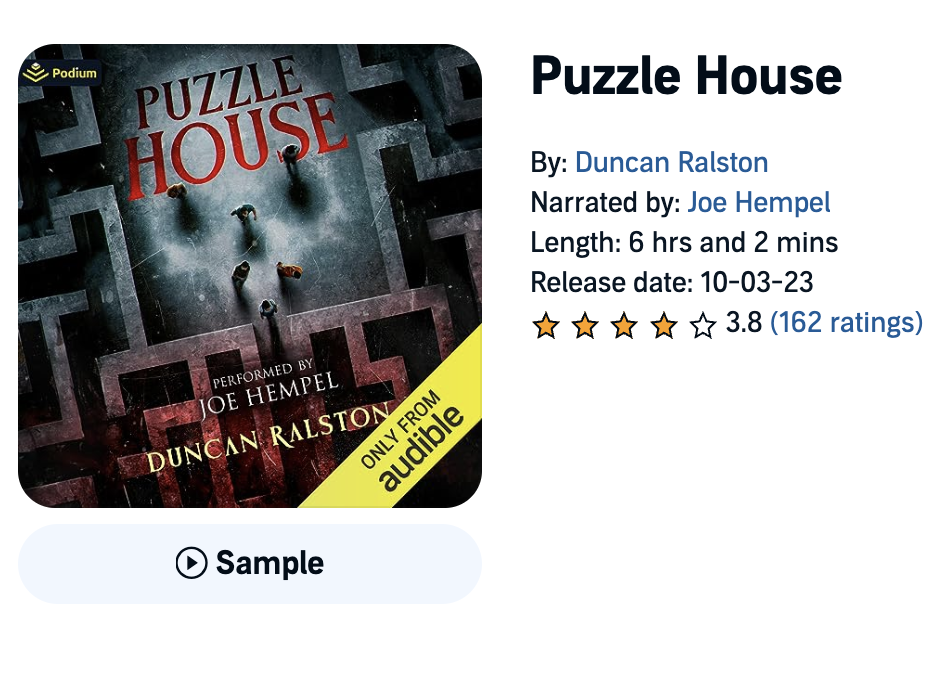
Puzzle House by Duncan Ralston, Narrated by Joe Hempel

One part Cube, one part Saw, one part The Ninth Gate, and a dash of House On Haunted Hill, Duncan Ralston’s Puzzle House is an excellent book for fans of those movies. If you’re the kind of person who enjoys escape rooms, puzzles, and character studies–you’re in for one hell of a treat. When a mysterious puzzle master dies, his will brings together an assortment of strangers (all but his ex-wife, unfamiliar with the deceased as well)…but that is only the beginning of the mystery.

These people find themselves called to a house that has become something far more sinister, a series of escape rooms with a hefty toll to be paid and life-or-death consequences riding on the solutions. As they struggle to survive the sadistic gauntlet from which the only way out is through, secrets are revealed that connect these apparent strangers in ways that can’t be a coincidence. Somewhere at the core of it all is a mysterious organization with occult origins, and the rats in this maze are battling not only the clock but their own preconceived notions of what is–or can be–real. But will they be able to solve the puzzles that await them, and who will survive the journey into the Puzzle House? And is everyone who they seem to be? You’ll have to dare entry on your own to find out.

This one has one hell of an ending, and it leaves you wishing that you could stay with the story just a little bit longer–to find out what happens next. Ralston does a great job of leaving you hanging but feeling satisfied just the same–forced to decide how you, as the reader, might proceed.

Joe Hempel’s narration of the audiobook is spectacular as always…which should go without saying. He successfully brings the characters to life and pulls the story from the page, leaving the listener immersed in the nightmare environment.

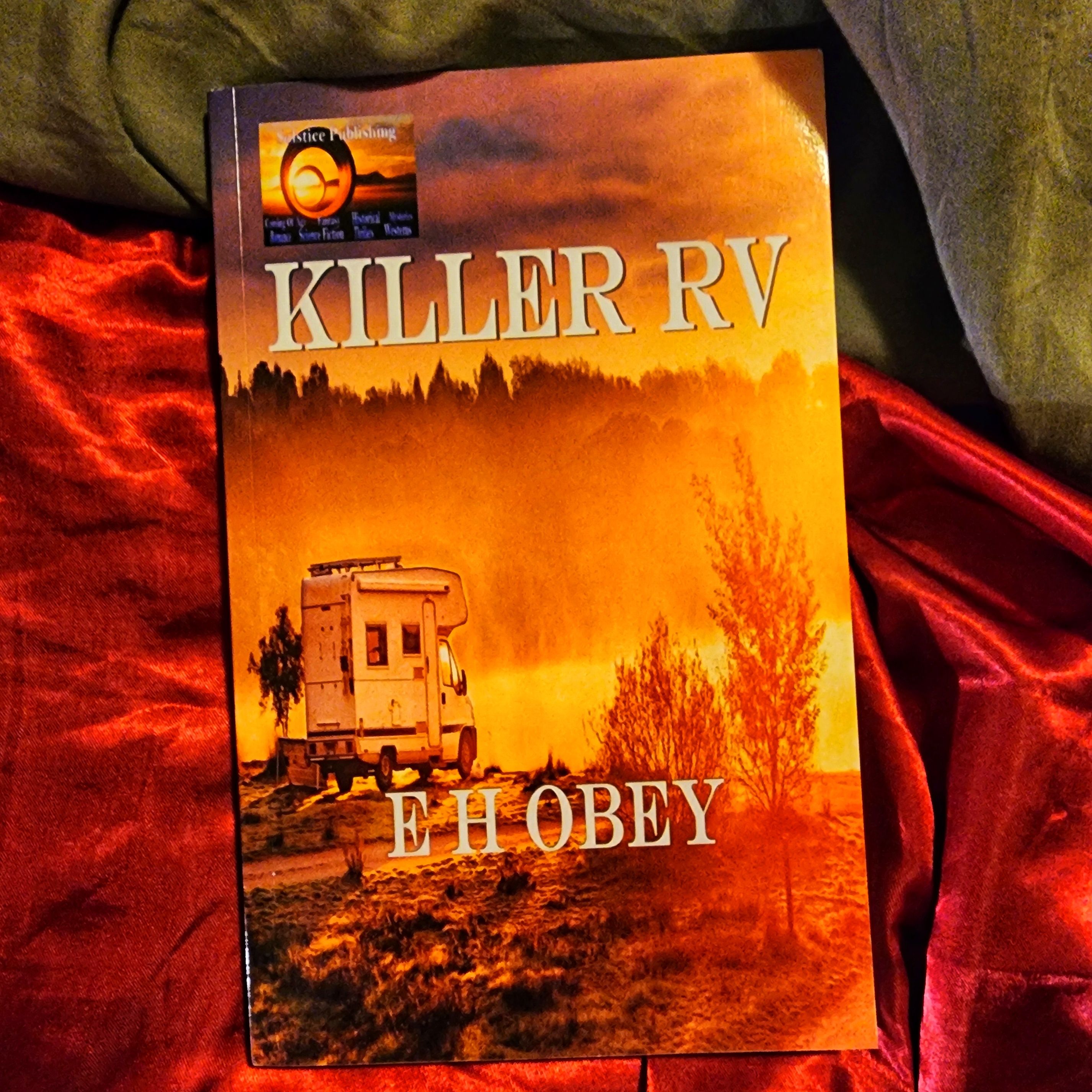
Killer RV by E. H. Obey

Killer RV is not the first book to tackle the subject matter at the core of this story, but it’s also not the worst. What would you do if you were diagnosed with terminal cancer and had only months to live? If you have at least a momentary urge to suggest that you might hunt down and torture and/or kill sex offenders–first of all, you’re not alone, but secondly, this book is for you. I suppose you’ve guessed what this one’s about.

Delilah is a bored housewife/music producer who happens to notice a new RV parked in her neighborhood, and she decides she wants to be a friendly neighbor. This is how she meets Peggy and also how her life takes a turn she couldn’t have anticipated. Peggy is dying, and she has a bucket list she wants to fulfill before the cancer takes her down…but we don’t learn what the items on that list happen to be until a little further into the story. Initially, it’s mostly focused on Delilah–her marriage and her burgeoning friendship with the mercurial Peggy. It isn’t until after Chekhov’s epilepsy makes an appearance, that Delilah becomes an integral component in Peggy’s mission. You’ll understand why I say that if you read the book.

Once things start going down the violent path, they never really stop until the book concludes. We’re introduced to a world where sexual predators of all stripes lurk wherever one chooses to look…and it’s a veritable buffet of monsters just waiting to be tossed into the bucket.

I have a certain sentimental connection with this story, in that a significant portion of it takes place in South Dakota, where I spent most of my life…and most of that portion of the narrative is in the Black Hills and Badlands region that I called home for most of my 45 years. The seemingly neverending path that I-90 carves across the state, through Wyoming, and into Montana is one I’m intimately familiar with–so I could visualize a lot of the surroundings into which the characters were placed.

It’s a short read and well-paced…so you don’t have much excuse to avoid it.

This All Ends Horribly by Mike Salt

I had the pleasure of reading this novella before the official release date to provide the author with a blurb. When I say it was a pleasure, I am absolutely sincere. The title is by no means misleading…everything does come to a horrible end, but that should be no surprise once you’ve made your way even a quarter of the way through the hellishly phantasmagoric tale Mike Salt has shared with us.

Coming home from vacation can often feel like returning to Hell. I think, upon reading this story, you might have a different perspective on that matter. A group of old friends spend a drunken and debauched vacation at a Disney theme park, sans children–only to return home, exhausted and thoroughly unprepared for the gift that awaits them. As they struggle to contend with forces they neither understand nor invited into their lives, they quickly learn that there are things in the darkness that are far worse than anything they might have imagined.

Salt holds little back in his depictions of torture, both physical and psychological–and he packs a whole lot of both into this slim volume. The characters come to life before your eyes only for you to witness as those lives are devastated and ripped apart with the same confusion and uncertainty the people on the page experience for themselves. Each step of the way, you find yourself wondering what comes next…and how much worse it can get. I assure you, it does get worse.

Three Little Pigs by Edward Lee

When you frequent literary circles you find yourself asked questions like, “What is the best opening line you’ve ever read?”

For many years now, my answer to that question has invariably been The Pig by Edward Lee. I won’t include the quote here, because it’s sure to force one algorithm or another to reject my review of this single-volume trilogy. Suffice it to say, it’s irreverent, humorous, captivating, and vile…all things that virtually insist that the reader keep on going. The discerning reader will be satisfied to discover that the rest of the tale is similarly irreverent, humorous, captivating, and vile. I had the pleasure of reading The Pig and The House in a single volume quite some time ago, but this new edition from Evil Cookie Press is a trifecta, in that it includes an additional installment, picking up the loose threads left behind and running with it until anything sane is unraveled. If there’s a trigger warning out there, this volume contains the associated trigger.

The meta commentaries from the perspective of the author are an excellent touch in this new installment, providing an amusing insight into the creative mind behind this perverse and sordid tale of an isolated house on an isolated tract of land where truly awful things have taken place over a handful of decades. If you had the pleasure of experiencing this unlikely vacation spot in the previous glimpses of the 1970s and the early 2000s, you won’t be disappointed. There’s a sense of coming home as Lee invites us to revisit the haunted house in the modern day–when everything comes full circle and we are truly introduced to the monstrous forces at work. If this is your first visit–well, then–I truly envy you the opportunity that awaits.