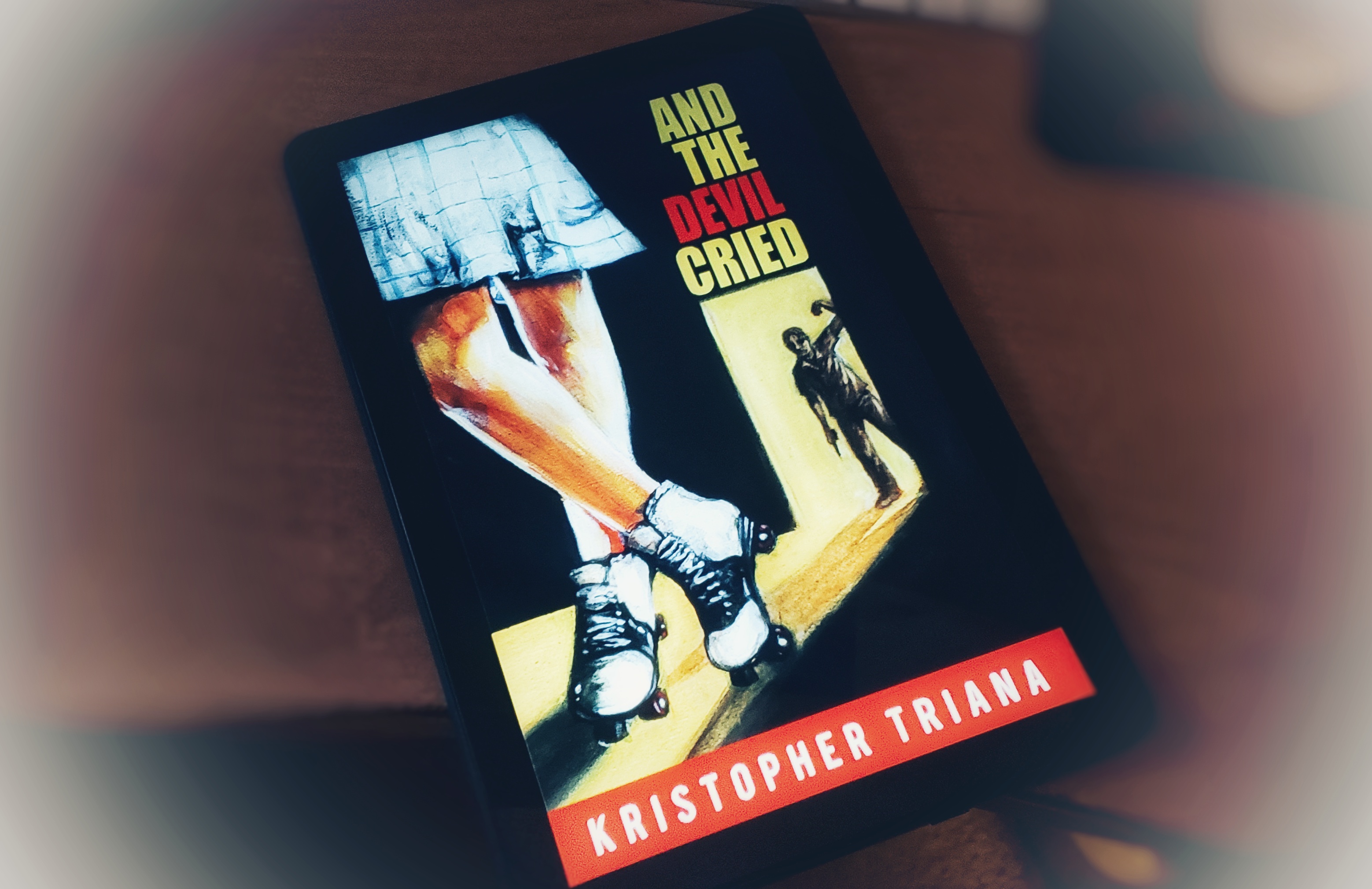
And the Devil Cried by Kristopher Triana

The release of Kristopher Triana’s And the Devil Cried is one of those examples of strangely serendipitous timing. It serves as an odd juxtaposition with Stephen King’s Billy Summers. Both stories are about men who became involved with organized crime after committing a murder during their youth and enlisting with the military. That is, of course, where the similarities end, as the characters themselves couldn’t be more different.
Triana excels in crafting unlikeable characters. His true skill is in developing these characters who manage to be entirely captivating precisely because of how unlikeable they are. Jackie is a prime example of that. Committing his first murder at the age of 17 for no better reason than greed and bitterness over the good fortune of the victim, Jackie never strives to be a better person.
After his time in the Army, Jackie never adjusts to civilian life, and he gets arrested for an attempted armed robbery. The story picks up as he’s being released and reacquainting himself with bad people he met while on the inside. As the story unfolds, you find yourself wishing he’d never been released, but there wouldn’t be much of a book if that were the case.
Misogynistic, abusive, sexist, violent, bigoted, and fundamentally heartless, there’s not much about Jackie that resembles a human being, and that’s what makes him an excellent protagonist for this particular story. While this isn’t one of Triana’s extreme horror or splatterpunk tales, he brings those sensibilities to the pulp crime genre with a character so devoid of decency that he’s almost a caricature of what one might expect a hardened criminal to be.
There are components of this story that are difficult to read. I’d suggest those are notably Jackie’s treatment of homosexuals in prison and his unabashed fixation on young girls, but it’s worth sticking it out to the end. Triana showcases a talent for writing hardboiled pulp crime that transcends the genre conventions. It’s a little bit Scarface, a little bit The Godfather, and all Triana.
While it’s not my favorite of his books, it’s well worth reading and it displays a side of Triana as an author that I’d never witnessed previously. It’s encouraging to see him stepping outside of his comfort zone and exploring new ground, and that makes me curious about what he’ll have in store for us next.


Nobody (2021)

The best–and simplest–way I can think of to describe this movie is that it’s essentially John Wick with more humor and perhaps a bit more heart, as well as a far more unlikely hero. It’s that unlikely hero, portrayed by Bob Odenkirk, that also makes Nobody feel more down-to-earth and believable, even though it is far from being either of those things.
Hutch Mansell initially appears as a broken, downtrodden suburban father and husband, with a routine that erodes his sense of self and–more importantly–his sense of self-worth. As it turns out, this is merely a role he’s been playing for years, a character he’s adopted and immersed himself within, sleepwalking through a life that’s been designed to keep him sedated and subdued.
After a burglary in his home appears to have led to his daughter losing a kitty cat bracelet, Hutch begins losing his facade of suburban normality. Dipping his toes briefly in something that reminded him of his old life, it seems like it just wasn’t enough, as a bus ride home from the anticlimactic confrontation with the burglars provides him with an outlet for pent-up frustration.
The subsequent fight taking place on the bus showcases a man who has been out of practice and separated from his former life of violence by more than a decade in a visceral and altogether realistic way. Muscle memory and a lifetime of training for precisely that sort of confrontation manifest in his capacity to take a beating and keep on going, but his years of banal and mundane accountant work has taken a bit of his finely-honed edge off.
From that point on, the movie descends into a series of violent and violently amusing set pieces that never once disappoint the viewer. Comparisons to the John Wick films are appropriate, as are comparisons to the Ben Affleck vehicle, The Accountant, but Nobody maintains originality and a quirky narrative that sets it apart from other films with similar themes.
It’s worth the price of admission, just to reach the final scene when Odenkirk is joined by RZA and Christopher Lloyd in what plays out as a thoroughly ridiculous but equally entertaining ballet of violence and brutality.
Learning that some of this story derived from experiences in Odenkirk’s life, wherein he suffered two separate break-ins within his own home, one of which concluding with the trespassers locked in his basement, allows the story to take on a whole new level of authenticity. Writer, Derek Kolstad, and director, Ilya Naishuller, worked together spectacularly well in crafting a story that’s both compelling and darkly hilarious.

Demophobia by Gerhard Jason Geick

As peculiar, violent, and perversely humorous as Demophobia happens to be–and it is all of those things–it is also a deeply sad story about survivor’s guilt and an insightful discourse on being an outsider.
Mr. Foicus is a Pus-Eater, or as he prefers, an Eiterfresser. A packed auditorium watches his multimedia lecture on the history of his kind, distorted and sanitized to elicit sympathy and hopefully engender less of a freakshow aspect to his existence. He’s one of the last of his kind, and he’s regretful of that. While he may be an inhuman, vicious monster, he suffers from the same melancholy any human might experience under similar circumstances.
All of this doesn’t change the fact that Mr. Foicus is still a monster, and it doesn’t take long before the story takes a violent and revolting turn when the Pus-Eater shows his true colors. Through the perspective of someone hoping to capture images amid the panicked crowd, we experience the dread of knowing that everyone should have left when things turned sideways. That’s the problem with a crowd, though; they feel safety in numbers, and if a large number of the individuals begin to relax, everyone else will go along with it, even if they think there’s something wrong.
I’ve never been more grateful for the fact that I loathe being in crowded spaces with large groups of people than when I imagined the carnage and wash of bodily fluids in the lecture hall.
Geick does an excellent job of building the reader up to a conclusion that feels both fitting and depressing.

This title was released as part of the 31 Days of Godless event at http://www.godless.com for October of 2021. You can obtain it for yourself by going to the website or by downloading the Godless app to your mobile device of choice. The link is below:

Casey’s Vengeance: A Killstreme Prequel by Rayne Havok

Casey’s Revenge might just be one of the rarest of things, a prequel story that surpasses the narrative it precedes. If you’ve read Killstreme for yourself, you know just how high a bar Rayne Havok set with that title, and how challenging it would be to do what she’s done here. If Casey’s Revenge isn’t better, it’s certainly no worse. It really just depends on what you look for in a story. For me, this had everything I’d have hoped for and more.
Packed with the brutality and violence one comes to expect from her writing along with the well-drawn characters and exceptional storytelling, we also have a heartbreaking story of innocence reclaimed and shattered.
Casey wanted a new start, at a new school with none of her previous mistakes haunting her or hanging over her head, and that’s precisely what she believed she had. Prom night was the night she promised herself she would give Evan the night they both wanted. unfortunately, it turned out that Evan’s wishes were altogether more terrible than she could have imagined. He didn’t want sex, he wanted her to suffer, and he wasn’t alone.
What could have broken her, simmered within her instead. Casey realized that revenge was the only thing that would give her back the power Evan and his friends had stolen from her. Her vengeance is brutal and perfect, directed toward vile young monsters who deserve every bit of what they receive.
Bonus points for the unique curb stomp that involves an altogether different head than what readers might associate with the term. Also, having one’s head up someone’s ass has never seemed quite so visually stimulating.

This title is available as part of the 31 Days of Godless event at http://www.godless.com for October of 2021. You should pick it up for yourself by going to the website or downloading the Godless app to your preferred mobile device. The link is below:

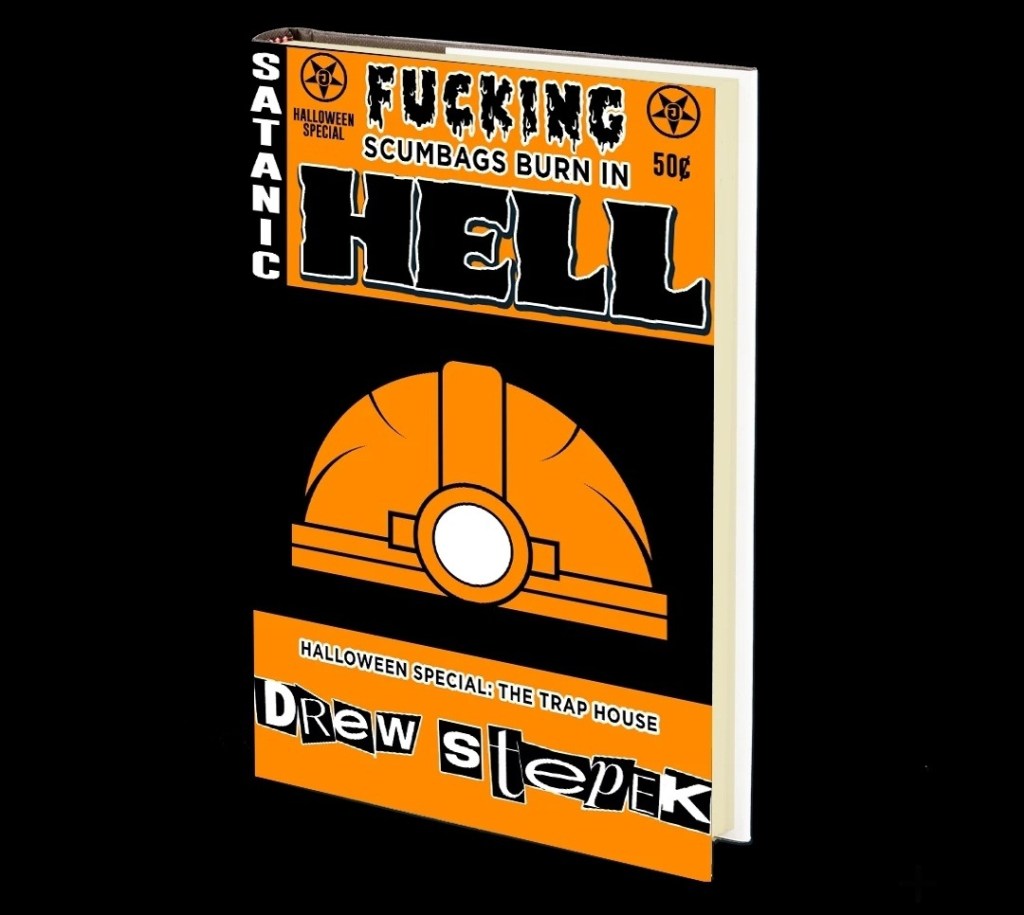
Fucking Scumbags Burn In Hell: Halloween Special by Drew Stepek

The Trap House provides us with a story of squandered potential, pissed away by an inconsiderate jackass. We’ve all known people who peaked in high school–or sooner–who never evolve past that point, and who can’t seem to recognize that the rest of the world has moved on around them. Get ready to see that taken to an extreme.
Lil Snap was seemingly a golden child, with a great future ahead of him, until he tripped over his own ego and shit the bed in a spectacularly public display of ignorance and bigotry. Of course, one can never be too sure just how accurate that recollection is, seeing as how the character is a selfish psychopath with delusions of grandeur.
With everyone turning their backs on him out of self-preservation and dignity, an embarrassing altercation in a check-out lane shatters the last vestiges of humanity in the vile cretin.
Enter Hooper, with a deal that’s too good to be true. For someone accustomed to expecting everything handed to them, there’s no consideration that it can’t be that easy.
The punishment in this installment is one I didn’t see coming until it had already been enacted. It’s become a thrill, trying to figure out from the narrative which direction the comeuppance will take, but this one hit me out of the blue, even though the clues were there.

The Trap House is Drew Stepek’s contribution to the 31 Days of Godless event at http://www.godless.com, released on his birthday of October 21st. You can pick it up for yourself by going to the website or downloading the app. The link is below:

Trap House (Fucking Scumbags Burn in Hell: Halloween Special) by Drew Stepek – OCTOBER 21st

Halloween Kills (2021)

Halloween Kills picks up on the action only minutes after Halloween (2018) rolled credits. As Dylan Arnold’s Cameron walks home, upset with himself and wallowing a bit, he comes across Will Patton’s Officer Hawkins where he lies bleeding on the pavement as he’d been left to die in the final third of the previous installment. Though Hawkins appears to be dead at first, he is soon revealed to be clinging to life.
We are treated to a surprisingly well-produced return to Halloween (1978) in a flashback that shares the concluding events of that night from the perspective of a younger Hawkins and his partner. In this, we discover that Hawkins has cause to feel no small amount of guilt over the events of that night 40 years before.
We witness further events of that night, encountering children having an altercation before being sent home by police roaming the streets in search of Michael Myers. One of those children will be a familiar character to discerning viewers of the older Halloween.
We meet up with Tommy Doyle (now played by Anthony Michael Hall), Nancy Stephens’s Marion (returning to the character for a fourth time in the series, though only the second in this internal timeline), and Kyle Richards’s Lindsey (reprising her role from the 1978 classic) at a bar where open mic night is in full swing. While I would have enjoyed seeing a nod to The Curse of Michael Myers, with Paul Rudd returning to portray Tommy Doyle, I was nonetheless pleased to see so many performers returning to roles they played in 1978 and 1981 respectively. This includes Charles Cyphers returning to take on the mantle of Leigh Brackett yet again.
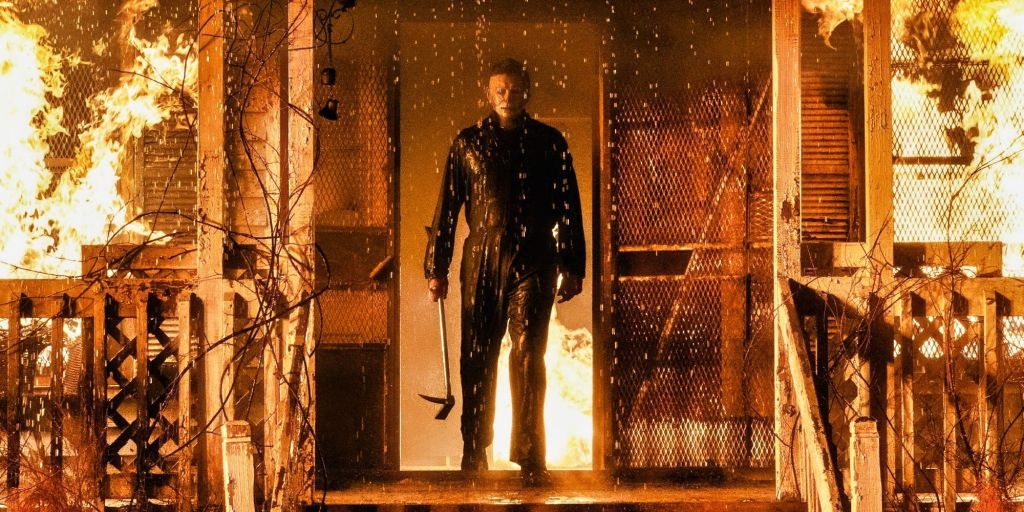
As emergency services race toward Laurie Strode’s burning home, Jamie Lee Curtis’s Strode shouts a desperate plea that they let it burn. If they had heard her and heeded her request, the movie would have turned out quite differently. A single firefighter falling through the floor into Strode’s trap basement provides the means for the still breathing Myers to remove himself from his imprisonment below the house.
Carnage ensues in a scene that pits Michael against a group of firefighters, in which the killer’s prowess is displayed to be anything but diminished. This is something we experience more than once in this movie that has rarely, if ever, been incorporated in a slasher flick. In Halloween Kills, we are treated to one-against-many conflicts that are typically antithetical to the slow, methodical stalker and prey relationships we often expect from such stories. The Michael Myers of this movie is more a force of nature than we’ve come to expect, capable of bursts of intense violence directed, rather than toward singular targets, at groups of people. An economy of brutality is on display with murderous efficiency, as Myers dispatches multiple opponents with expedience and ruthlessness.
I went into Halloween Kills with the expectation that it would suffer from middle movie syndrome, being the second of a planned trilogy of sequels following the events of Halloween 40 years before. What I experienced was more like The Empire Strikes Back than The Two Towers, a self-contained narrative that–while it is designed to carry the plot between beginning and end of the trilogy–manages to satisfy my needs as a standalone experience.
The performances are spectacular, the kills are savage and visceral, the soundtrack/score was superb, and the story unfolding for the characters as Michael makes his way through Haddonfield toward his natural destination is a vivid enough assortment of threads as to make for a worthwhile tapestry. The sheer brutality of Michael’s murders is almost enough to distract the viewer from the underlying theme of fear spreading through a community primed for terror and harboring a certain tension just beneath the surface for nearly half a century. This explodes in a predictable fashion as the residents of Haddonfield create the conditions wherein Michael is able to thrive and flourish, feeding–as he seems to–on the very anger and horror being amplified by the mob mentality spreading like wildfire throughout the movie.
A bit of dialogue near the end of the movie manages to sum things up nicely. When Hawkins expresses his regret at having made this possible by not letting Michael die back in 1978, Laurie Strode corrects him and explains that this is her fault, that her fear of Michael’s return has been allowed to spread and fester like an infection in the otherwise quaint community.
I know that I am certainly looking forward to the release of Halloween Ends next October, and I truly hope a whole lot of you are as well.

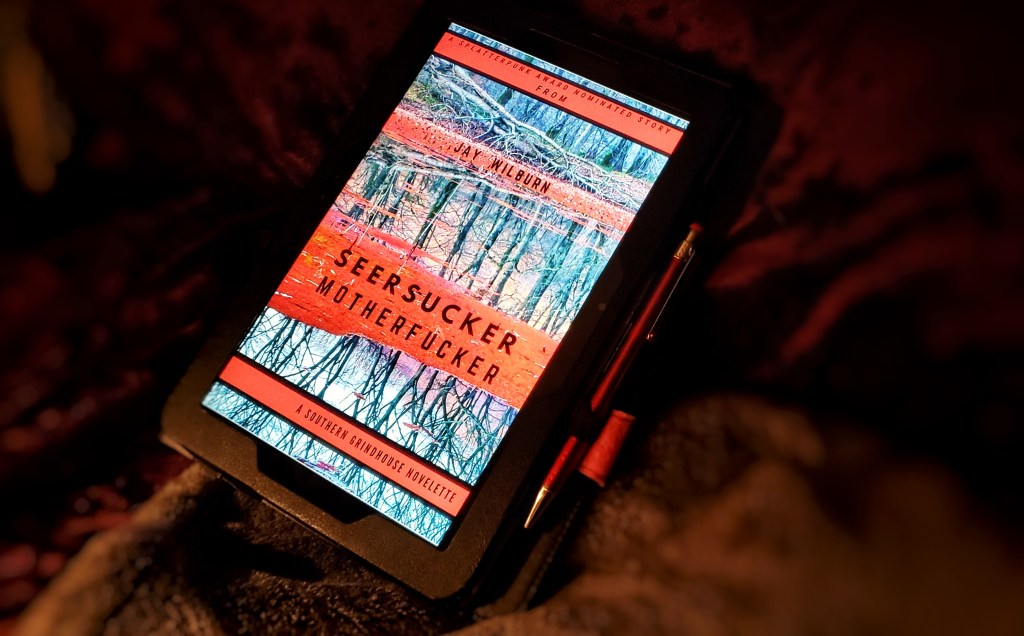
Seersucker Motherfucker by Jay Wilburn

With Sally French firing a .45 slug through the window of the Harper house, aiming for Kelly Harper, but killing Coop Bainbridge instead, Jay Wilburn’s Seersucker Motherfucker kicks off a bloody feud that makes the Hatfields and McCoys seem quaint by comparison.
The unrelenting, stylized violence that unfolds in the pages of this story is the sort of thing that would surely give Tarantino an erection. In fact, it might be a good idea to get this story in his hands, because this is just the sort of thing he could direct without leaving his wheelhouse. All that’s missing is the banter, 60s & 70s nostalgia, and pseudo-witty dialogue, and we’d have a fantastic Tarantino film in the making.
Shifting perspectives as we follow one burst of bloodshed to another are handled so expertly by Wilburn that the reader never loses track of what’s happening as the tempo steadily increases. One might expect a sort of “fog of war” to gloss over the fine details, obscuring the brutality unfolding, but the clarity of purpose setting these families against one another is extended to the reader, and we’re blessed–or cursed–with an unflinching vision of the staccato rampage.
The old adage, often attributed to Confucius, might have understated things when suggesting one should dig two graves, at least when Wilburn is at the helm.

You can pick up a copy of this story from http://www.godless.com or by downloading the Godless app on your favorite mobile device. The link is below:

Seersucker Motherfucker by Jay Wilburn

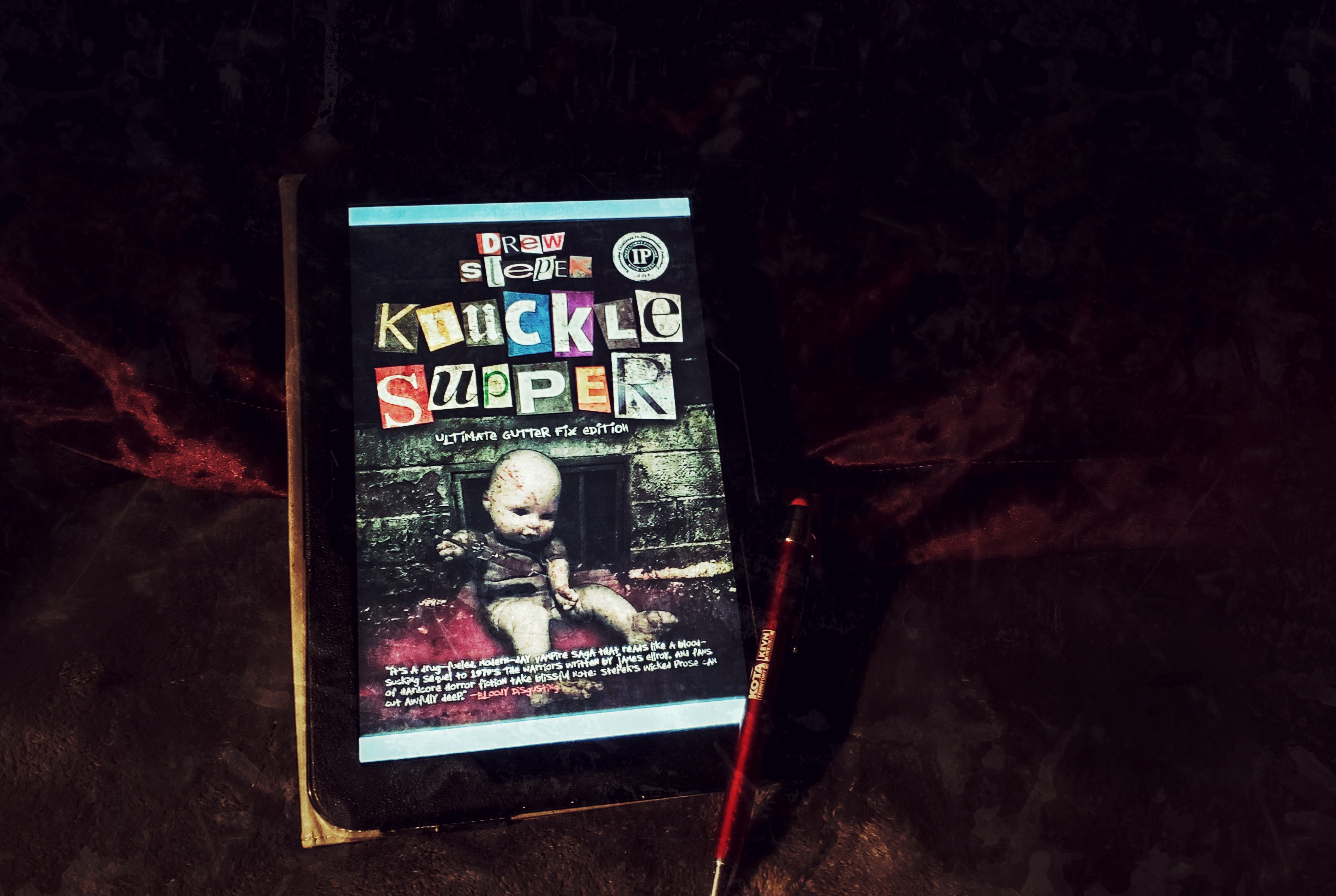
Knuckle Supper: Ultimate Gutter Fix Edition by Drew Stepek

If like me, of the two major vampire films released in 1987, you prefer the Kathryn Bigelow directed Near Dark over Joel Schumacher’s The Lost Boys, Knuckle Supper is the vampire novel for you. The Lost Boys may have had the audience and the soundtrack, but Near Dark had the brutality, originality, and grittiness that befitted the monsters at the heart of the story. Knuckle Supper carries that tradition into 21st-century horror literature.
Stepek writes vampires the way one might expect from someone who wants to take the monsters back from the L. J. Smiths and Stephenie Meyers of the world, restoring them to the darkness and underground where they belong. It’s difficult for me to describe what he’s put together in these pages that race past the reader at a rapid-fire pace. Knuckle Supper is, in effect, Anne Rice meets Irvine Welsh, Near Dark meets Requiem for a Dream, and a little bit The Warriors meets 30 Days of Night. If that doesn’t intrigue you, I honestly don’t know how else I can try to describe it without just reading the book to you, and we know I’m not going to do that.
We meet RJ and Dez as they’re preparing to murder a pimp in the home they’re squatting in, a steadily depreciating house once belonging to a former child star turned heroin addict.
RJ, Dez, and the rest of the Knucklers aren’t your typical Hollywood vampires, even though they live in Los Angeles. Blood isn’t their only addiction. They need heroin to survive. Unfortunately, it’s not as simple as spiking a needle into their veins to get their fix. They need blood to carry the high into their starving, desiccated internal organs. Enter the pimp they’re about to have for supper.
The (almost) 13-year-old prostitute carelessly tossed into the bathroom is all but forgotten as RJ and Dez make a mess of the place in their desperate chase for a fix. Against his better judgment, and displaying more humanity than his peers, RJ decides not to kill the young girl. This act of uncharacteristic decency is how Bait becomes part of his family. It’s also how everything begins to spiral out of control, ultimately bringing RJ face-to-face with The Cloth, an organization he’d dismissed as nothing but a vampire’s boogeyman, and the painful truth at the core of what RJ actually is.
Drew Stepek introduces readers to a Los Angeles populated by a different sort of gang, consisting of a wholly different kind of gangster from what we’ve become familiar with from popular culture. The city is divided up between tenuously allied gangs of vampires, each feeding and dealing on their own turf. Brutal, far from immortal, and impulsive, Stepek’s vampires are prone to massive errors in judgment, and it’s only a matter of time before the flimsy alliances fracture and violence ensues.
There’s more to this story than drug addiction and graphic violence, though there’s plenty of both. There’s also a depth and character to this story that underscores the superficial, splattery elements of the narrative.

You can obtain a copy of Knuckle Supper as well as the sequel, Knuckle Balled, by going to http://www.godless.com or by downloading the Godless app to your preferred mobile device: The link to this title on both Godless and Amazon are below:

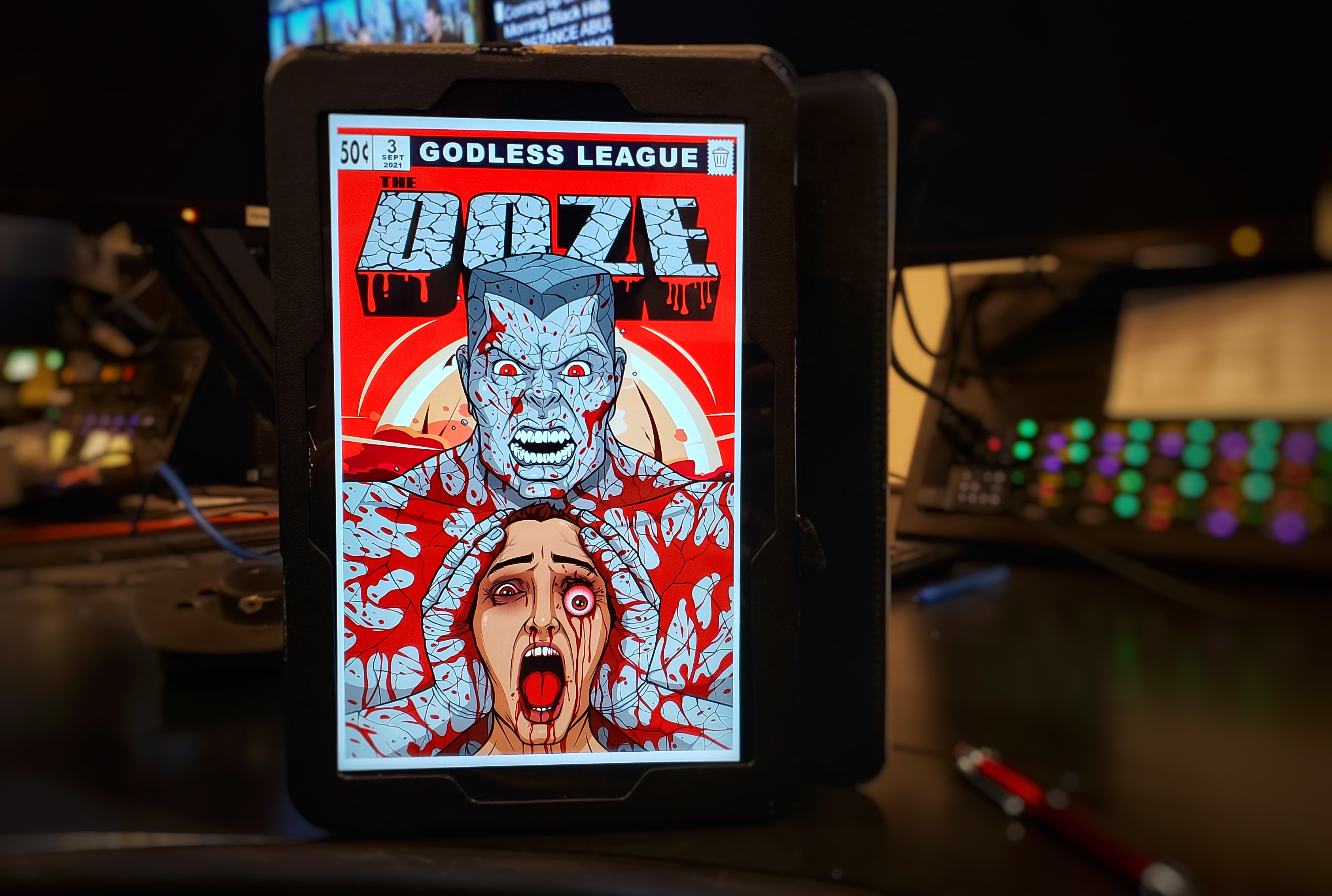
The Doze by Drew Stepek

The Doze takes the unrelenting violence and satisfying splash of gore and viscera from the previous two Godless League installments and runs headlong into a concrete wall with it. Of course, this concrete is the fluid manifestation of Jack Slaughterdozer.
If you’re trying to figure out just what sort of superhero The Doze might be, think a little bit Sandman, a little bit Green Lantern, maybe a touch of Venom, and a whole lot of Hulk–plus just a smidge of Lennie Small, for those who read Of Mice and Men. The Doze can transform himself from an already dangerous man into a giant formed of living concrete, able to transform himself into seemingly anything he can imagine–and his imagination for causing damage is virtually unlimited. When assholes from Construction Mercenary Union Local 222 show up to demolish Slaughterdozer’s home in the landfill on behalf of Globoshame Construction Corporation, all hell breaks loose in the most graphic, over-the-top manner one could imagine. I’m pro-union, but these guys deserve what’s coming to them.
Running counter to the excessive violence and concrete climax, there’s a story of tragedy and pain, with the loss of Slaughterdozer’s family and the painful cost of illiteracy.
Stepek takes readers on a rollercoaster of highs and lows that shouldn’t even be possible within such a short tale, but he guides us masterfully through the loops and whirls, and we reach the end exhausted and fighting back tears.

You can pick up The Doze, as well as the other Godless League titles, by going to http://www.godless.com or by downloading the Godless app on your mobile device. The link is below:

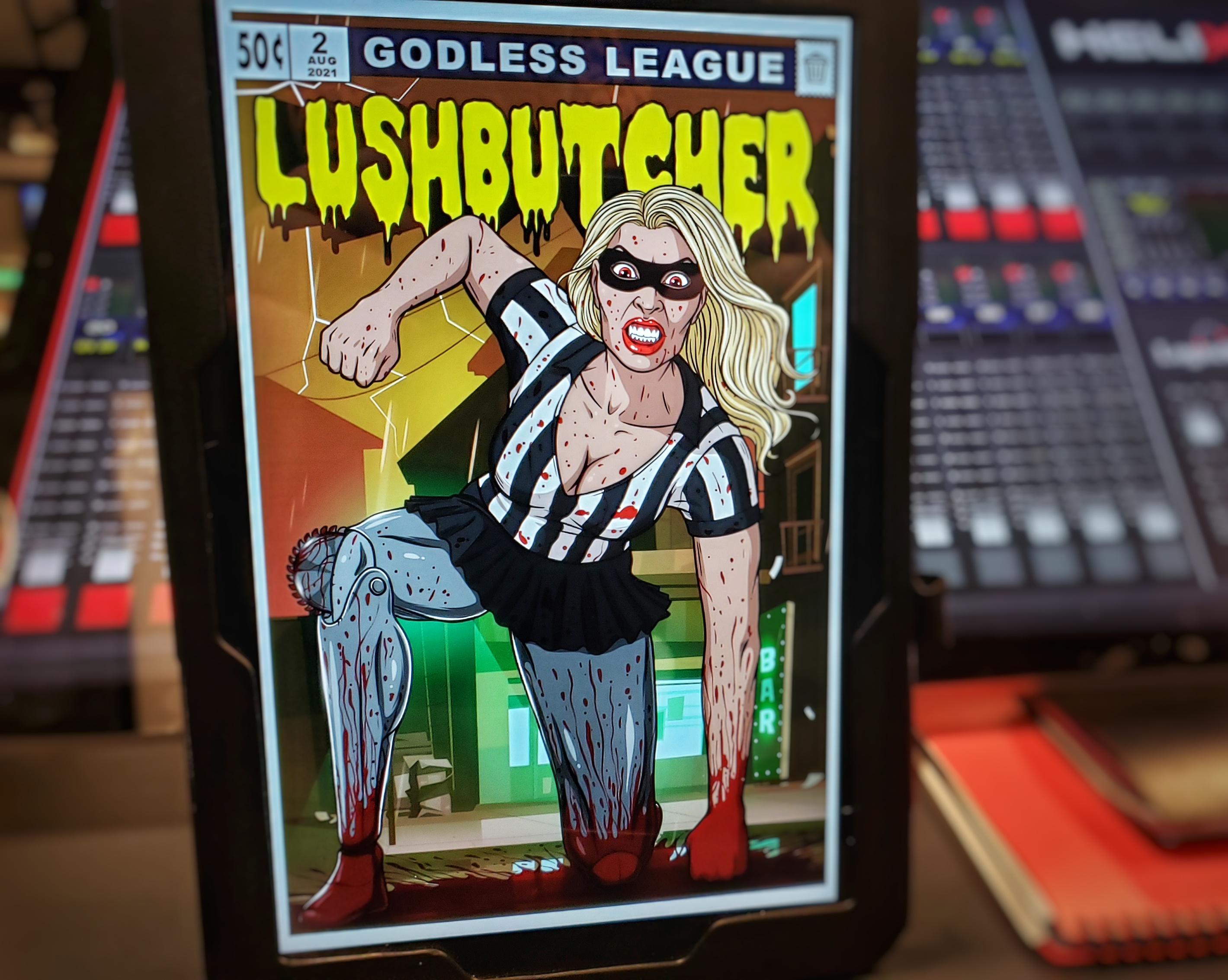
Lushbutcher (Saturday Night’s Alright for Butchering) by Lucy Leitner

Lushbutcher expands on The Godless League in a wildly different direction from the first installment. Where John Stabberger seemed like a sane, albeit homicidal, character, Jane Lushbutcher–not her real name–seems far more indiscriminate in her targeting of drunks, and her state of mental health is questionable, to put it nicely.
With a motivation born from the combination of childhood tragedy and a mission bestowed on her by God–who speaks to her through various inanimate objects and discarded food items–she seems initially sympathetic. The execution of her single-minded objective to stop drunk drivers wherever she can find them seems to be a bit more flexible in Lushbutcher’s interpretation–as well as the perspective of her God.
There’s no denying that this is a fun, violent joyride through the seedy streets and rooftops of Pittsburgh. But with victims less cut and dried as bad guys, Lushbutcher doesn’t come across as quite as focused and relatable as Stabberger. Don’t let that turn you away from the story, though. It’s still an exciting, delirious adventure.

You can check this one out for yourself by going to http://www.godless.com or by downloading the Godless app for Android and Apple. The link for this title is below: