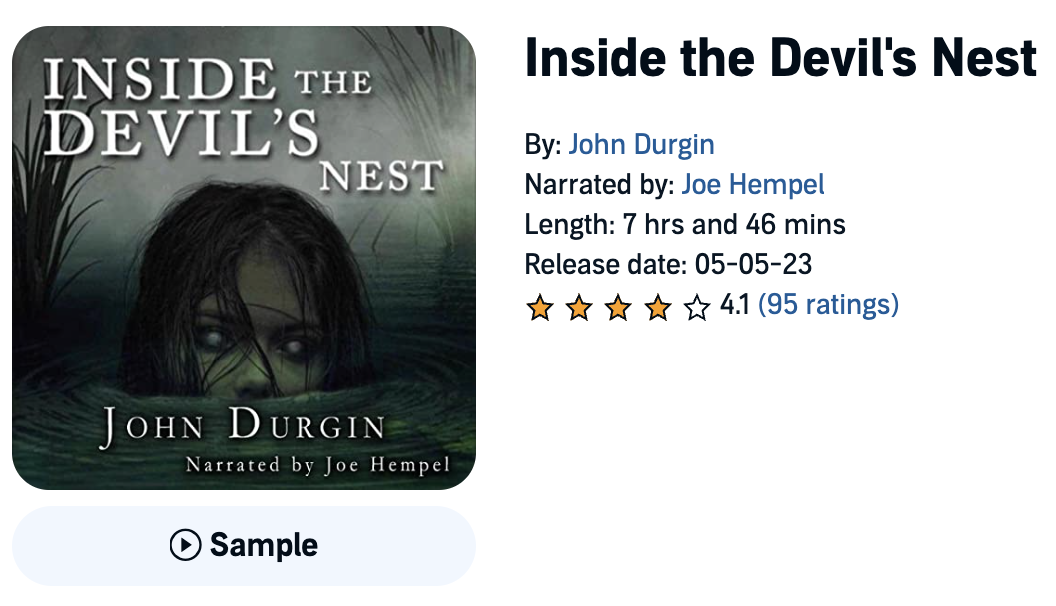
Inside the Devil’s Nest by John Durgin, Narrated by Joe Hempel

Anthony Graham is a successful real estate agent. That success is due–in no small part–to a deal he made with the devil, in the form of an agreement made with a mob boss who wants to use vacant properties for a variety of purposes, no questions asked. When Anthony stumbles upon one of his properties being used in an entirely predictable way–though one he never expected–it all comes crashing down around him in a barrage of sudden violence. On the run with his family, knowing he’s only postponing the inevitable, Anthony heads for a former campground he’s been unable to sell–hoping it’ll buy him some time to figure out what to do next. Unfortunately, for Anthony and his family, this campground holds dark secrets far worse–and more dangerous–than the men hunting them down.

John Durgin paints us a portrait of a family struggling to hold it together despite years of acrimony, strain, and secrets…and then he thrusts that family into a situation sure to unravel the worn threads that hold them together. Before they arrive at the campground the family is already falling apart, and it only gets worse from there. Good intentions spectacularly pave the way to Hell as two broken families with secrets buried deep come together, and Anthony learns first-hand why he’s never been able to sell the property.

We’re forced to witness as six people find themselves caught between two evils that mean nothing but harm, and we’re left wondering which of those two evils will exact their toll first as we descend toward a conclusion that can be nothing but violent and cruel. We may want to look away, but there’s some part of us that keeps us watching as everything approaches perhaps the only ending there could be.

Joe Hempel’s narration of the tale brings it to terrifying life and gives each character their own place in the listener’s imagination while we join them on their journey to the depths.

The Water Knife by Paolo Bacigalupi: Narrated by Almarie Guerra

Paolo Bacigalupi paints a grim portrait of America’s future in The Water Knife. It feels substantially grimmer when one considers just how plausible it might be.
We’re introduced to a global warming prediction come and gone, where the fertile regions for farming and ranching have shifted hundreds of miles to the North of where they are today, as the desert inexorably reclaims the land we’d believed we tamed. Water has become the most valued resource we have and is finally treated as being as precious and necessary as it has always been.
Southern states have sealed their borders against one another and the National Guard of those respective states have become the private military forces enforcing those border separations and the water rights of the territories they patrol.
Perhaps more horrifying than the abject human misery and exploitation we find within this narrative, there’s a bleak dystopia that’s taken hold. The separation between corporate interests and the interests of the state has become more blurred than they are in the world we see around us today.
The characters we meet and follow through this twisted tale of espionage, cruelty, and power struggles are well-developed and fully three-dimensional in a way that breathes a searing, dust-filled life into the story. As the Nevada water knife, the journalist, and the Texas refugee follow their separate threads throughout the story, those threads become a tangled web of intrigue, betrayal, and murder.
Bacigalupi displays a keen understanding of people, human nature, and the drastic toll we’ve taken on the world around us to an extent that is both depressing and almost awe-inspiring. It’s virtually impossible not to love this book even as the story itself leaves the reader/listener feeling hollowed out and helpless. Unlike so many dystopian glimpses of our future, this one lacks some magic solution to resolve the underlying failures of the society involved. The mystery is solved for the readers, but we’re left with no sense of satisfaction that resolution is just around the corner, and that makes this book more honest than many.
The narration of the audiobook is expertly performed by Almarie Guerra, tackling the characters well enough that they all feel as if they’re distinctly separate voices within the audio edition of this novel.