Between Two Fires by Christopher Buehlman, Narrated by Steve West

Christopher Buehlman’s Between Two Fires transports readers to the region now known as France during the peak of the Black Death. The world was ending. Sickness had emptied whole villages, leaving nothing behind but decaying remnants and ghosts that haunted the vacant homes. The survivors, few and far between, were living through horrors no one had ever seen. Amid this nightmare of disease and human predation, a war unlike any witnessed on Earth was taking place. This tableau of terror, both human and spiritual, is the world Buehlman brings to life.
When Thomas, a crude and disgraced knight, takes it upon himself to shelter and protect a young girl–who knows things she should not know and sees things others cannot see–he knows he’s set himself on a path that might end in tragedy. But nothing can prepare him for the madness and cruelty awaiting them on their journey to Avignon.
The boundaries of reality are repeatedly blurred throughout the narrative, forcing the reader to question–as Thomas does–whether he’s awake or dreaming. The dead haunt the living, tormenting them with cruel assertions and distorted recollections of the past. Ghosts appear and disappear, leaving us to wonder which of these apparitions are truly beyond the veil, and which are drawn from the memories of Thomas and the weary priest who joins him on his quest.
Will the trio arrive where they intend, or will the gates of Hell await them instead. Is there a difference?
Steve West narrated this audiobook almost perfectly. The delivery of dialogue and narrative components were both handled with great attention to detail. The narration was almost as gripping as the story itself.

The Town by Bentley Little, Narrated by David Stifel

In a career punctuated by numerous surreal horror stories, The Town might be Bentley Little’s most surreal book of them all–and that says something. Steeped in the Russian spiritualism and mysticism of the Molokan immigrants to the United States and Mexico, Little introduces readers to a religious sect about which most people know little to nothing. I’m well-versed in world spirituality, and even I had little understanding of Molokan philosophy and culture.
When Gregory Tomasov won the California lottery, he didn’t necessarily strike it rich. He did earn enough to move his family back to his hometown in rural Arizona, where he believes his children are safer than in Los Angeles. At first, the homecoming seems to work out nicely, though strange occurrences are popping up.
It isn’t long before the whole world around them appears to be going mad. It all has something to do with Jedushka di Mudvedushka, the Owner of the House–a Russian superstition–and the banya (bathhouse) on the property where the Tomasovs moved.
Little manages to keep the reader guessing what might come next as he ratchets up the tension and defies expectations at every opportunity. Nothing can be taken for granted as the narrative propels us toward a ghastly and horrific conclusion from which only some will walk away.
David Stifel’s narration suitably captures the accents of various characters, and he provides listeners with a thrilling experience while at the same time delivering the narrative with an unusual drawl and cadence that is occasionally off-putting. It works for the story in question, but I’m not sure how much of that was intentionally applied for this audiobook and how much was just the narrator’s manner of speaking.

December Park by Ronald Malfi, Narrated by Eric G. Dove

It’s a tradition for horror authors to write at least one coming-of-age tale that takes place during the golden years of the author’s youth. December Park is Ronald Malfi’s thrilling and heartbreaking contribution to the trend. It should come as no surprise that Malfi would manage to produce something that doesn’t feel derivative or even comparable to the work of other writers within the genre.
When children begin disappearing from the coastal community of Harting Farms, rumors spread that the missing children are victims of a singular, sinister figure, the Piper. After one girl is found dead, Angelo Mazzone and his friends take it upon themselves to investigate the disappearances, believing that they are uniquely suited to unravel the mystery and locate the monster stalking the streets of their small town.
The author authentically captures the period of the early-to-mid 1990s, and the young men populating his narrative feel like boys we might have known and befriended during those years. Each boy’s personality is distinct and fleshed-out, clearly setting them apart from one another while avoiding generic archetypes.
As much a story of self-discovery and friendship as it is about the hunt for a murderer and the discovery of his identity, it’s likely the author utilized Angie’s character as a stand-in for himself. A gifted writer and avid reader who shyly worries that his friends will think less of him if he embraces his talent and takes the necessary steps to fulfill his potential, Angie underestimates the bonds between himself and his closest friends. The teenage years are a minefield of uncertainty and insecurity, and Malfi hasn’t forgotten what that felt like as he crafted the tale he tells in December Park.
The heartbreaking conclusion is one that he successfully avoids telegraphing while navigating with attention to detail that keeps it from feeling contrived. Upon reaching the end, so much of the story up to that point is cast under a wholly different sort of bleak and somber darkness. He invites us all to join him at the corner of Point and Counterpoint, where we can watch the story unfold, not knowing what’s coming but filled with dread and tension the whole time.
Eric G. Dove provides excellent narration, carefully providing each character with a voice all their own and drawing us into the world of Harting Farms.

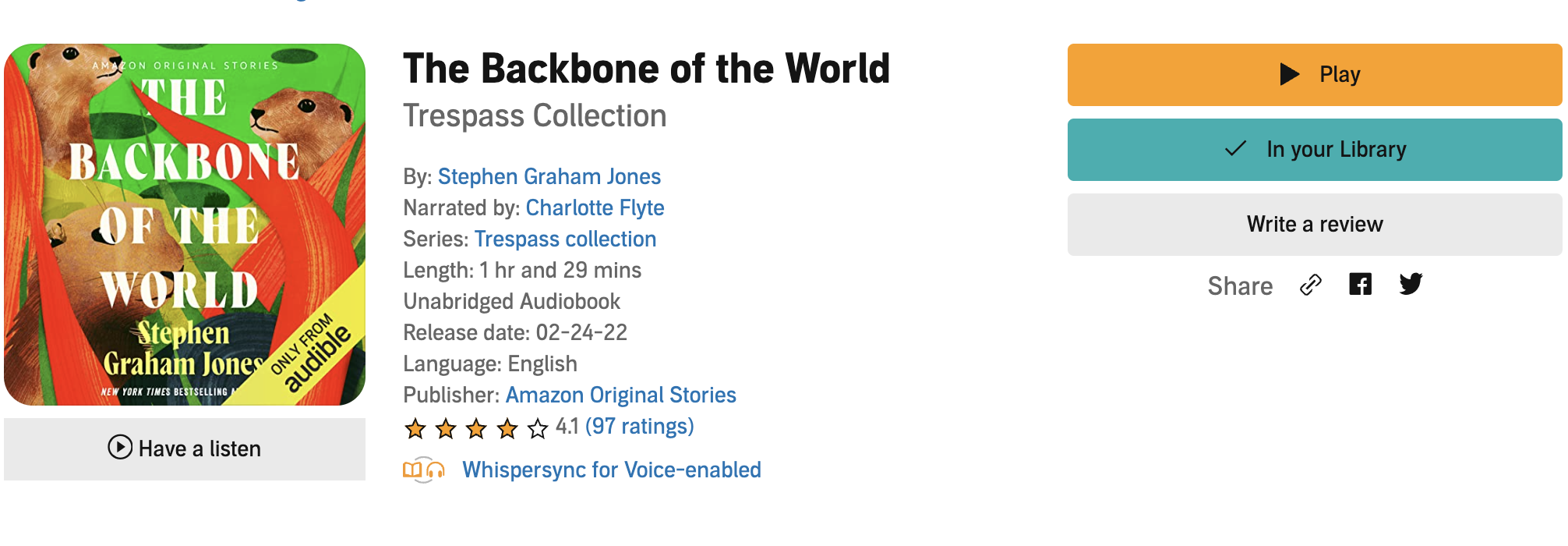
The Backbone of the World by Stephen Graham Jones, Narrated by Charlotte Flyte

Stephen Graham Jones has a knack for forcing his readers to look at the world–and aspects of it–in wholly different ways. The Backbone of the World will have you looking at prairie dogs (of all things) and our perceptions of time differently. If this installment of the Tresspass Collection is indicative of what the rest of the stories have in store for me, it’ll be one hell of a trip.
Millie Two Bears is a lonely, socially isolated living on property that she’s about to lose with her husband in prison and his family breathing down her neck to parcel up the land. When she invites a peculiar stranger to rent the camper on the property, she has no idea what sort of repercussions it’ll have and how it ties in with the peculiar prairie dogs plaguing the distant edge of her land…and something growing deep in the earth below.
Jones’s knack for taking the seemingly prosaic and transforming it into the mysterious and sinister is on full display. The simple reservation life of a woman with all-too-familiar troubles gets upended as her everyday environment becomes increasingly unsettling.
Charlotte Flyte’s narration of Millie’s story is superb, and she makes the listener feel as if they’re hearing the story from the woman living it.

Cerberus Exploitation: A Grindhouse Triple Feature by Patrick C. Harrison III, M. Ennenbach, and Chris Miller, Narrated by Daniel Caravetta

In Cerberus Exploitation: A Grindhouse Triple Feature, Patrick C. Harrison III, Mike Ennenbach, and Chris Miller nail the storytelling aesthetic of grindhouse exploitation cinema with a Troma flair. It’s particularly appropriate that I mention Troma since this book begins with an introduction provided by none other than Lloyd Kaufman. Like proper triple-feature experiences, the book contains trailers, film credits (with dream casting choices from the authors), and everything a fan could hope for…aside from the popcorn.
Electro-Satan Comes To Wolfe City introduces us to a group of kids hoping to enjoy a summer camping trip, only to have everything disrupted by mutant hillbillies. Ennenbach’s contribution to this collection gets the reader/listener’s attention almost immediately with a musical performance that should have anyone in stitches. From there, it’s a barrage of violence, humor, and all the splattery goodness fans of the genre adore.
Patrick C Harrison III then hits us with his twisted take on the women in prison genre with Vampire Nuns Behind Bars. Replete with lesbianism, sadism/torture, scientific experimentation, rebel uprisings/prison riots, and–of course–vampires. Terrible things are taking place at this women’s prison, where political dissidents and troublemakers–and a handful of nuns–are swept under the rug and channeled into one of two secret chambers where horrors await. When a prison break’s attempted, the balancing act that kept the facility functional gets disrupted hugely, and the halls and cell blocks become a slaughterhouse.
And finally, we arrive at Chris Miller’s Sons of Thunder, focused on a military recovery mission in the dystopian Hellscape outside of the “safely” bubbled cities owned and operated by corporations. Escape From New York and Assault on Precinct 13 come together, producing a malformed and grim, action-packed adventure. Mutants, terrorists, and doomsday cultists stand in the way of an elite team and one man bent on revenge at any cost.
There’s no point in trying to describe the escapades these authors have assembled. It’s something one just has to experience for themself…and I recommend doing so as soon as possible.
Daniel Caravetta’s narration is spot-on, capturing the lunacy and low-budget mayhem of grindhouse cinema in a way only a fan of the films could manage.

The Silence by Tim Lebbon, Narrated by Marisa Calin and Ralph Lister

A couple of years before the release of A Quiet Place, Tim Lebbon gifted the horror community with his novel, The Silence. Exploration of a previously isolated cave ecosystem in Eastern Europe culminates in the emergence of a predatory species that spreads across the continent like a plague. Blind from evolving in a lightless environment, the creatures–dubbed vesps–attack anything that produces sound. In a noisy world dotted with population centers, humanity doesn’t have long to prepare for the nightmare speeding across the skies.
The focus on Ally, a teenager who has been deaf since an accident that took the lives of her paternal grandparents in early childhood, is a nice touch. Lebbon tackles the challenges associated with hearing loss with excellent detail, providing both Ally and her family with backgrounds and relationships that feel more than two-dimensional. Even with their well-established history of communicating in silence, their struggles as the family attempts to reach a secluded–and hopefully safe–location in the Northern UK are dramatic commentaries on how difficult silence is for human beings.
Lebbon spins a tense and harrowing tale that explores the highs and lows of human nature and our capacity to adapt to conditions beyond our control. The only problem I have with The Silence is that it ends, and there doesn’t appear to be a sequel forthcoming. Be sure not to gasp as you’re reading this one. Whatever you do, remain silent.
I was satisfied with the narration provided by Marisa Calin and Ralph Lister, though I felt like Marisa’s performance stood out as being a bit more authentic across the board, while Ralph’s narration was most exceptional with the dialogue from Hugh but lacking where the female characters were concerned. Overall, it was still a top-tier audiobook narration.

The Babysitter Lives by Stephen Graham Jones, Narrated by Isabella Star LaBlanc

In The Babysitter Lives, Stephen Graham Jones tackles the haunted house theme with the same unique style and flair readers have come to expect. When Charlotte arrives at the Wilbanks’ house to babysit their twin six-year-olds, she has no idea she’s walking into a place more dangerous and horrifying than anywhere else she’s been. In what could be described as House of Leaves meets Stranger Things, Jones weaves a disorienting tale that leaves the reader questioning what’s real just as much as the narrative forces the same confusion on Charlotte.
Charlotte, Ron, and Desi are not alone in the house, and there’s a depth to the shadows and dark corners that threatens to swallow anyone who ventures into the dark spaces without caution.
Ultimately, the story succeeds in being a unique and tense haunted house story, capturing the highest stakes on a small scale. The natures of reality and identity are questioned in a big way, but Jones isn’t satisfied simply leaving us with questions. He wants to delve into the how and why of it all. Jones forces us to think about everything happening through the lens of Charlotte’s analysis and the horrors of the past she’s forced to witness.
This might be my second favorite story from the author, following the masterpiece that was The Only Good Indians, and with good reason.
The narration provided by Isabella Star LaBlanc combines with Jones’s writing to make Charlotte feel like a real girl. She’s smart, funny, and thoroughly out of her depths but too stubborn to give up. The supplemental material from Jones himself adds a nice touch, touching on his inspirations and what he hoped to accomplish with The Babysitter Lives. I’d say he was more than successful.

Bishop by Candace Nola, Narrated by Jamison Walker

Candace Nola’s Bishop takes us to the wilderness of Alaska, on and off the beaten path in Tongass National Forest, where Troy Spencer is about to begin a desperate search for his sister and niece. Erin and Casey have been missing for a couple of days, and they’ve been alone in the wilds for nearly a week by the time Troy arrives in Ketchikan to begin the search. Venturing deep into the mountainous wilderness, racing against the clock, he’ll settle for nothing less than the best guide he can find. Unfortunately, the most knowledgable guide for those parts of Alaska is a gruff, solitary indigenous man who goes by the name of Bishop, and Bishop is a man of few words and many secrets.
Troy knows he’s running out of time, but he has no idea how much danger his family is in, as an ancient and terrible presence exists in the forest, stalking and terrorizing Erin and Casey. Bishop knows it’s there, but Troy’s proximity limits his ability to do anything about it, and nothing will stop the evil from taking what it wants unless Bishop can free the beast inside of himself.
Candace Nola brings the cold Alaskan wilderness to life, immersing us in the damp, chilly environment from which there might be no escape. Bringing her fascination with survivalism and the tools necessary for survival to bear, Nola brings Casey, Troy, and Bishop to life in vivid detail and three-dimensional depth, forcing us to experience the same tense, disquieting struggle as her characters.
Jamison Walker does a decent job of providing the characters with voices of their own, distinctly separating them.

The Beasts of Vissaria County by Douglas Ford, Narrated by Jenn Lee

The Beasts of Vissaria County is not what you expect. It doesn’t matter what your expectations might be as you approach this narrative; I can guarantee that you’ll probably find yourself shocked and surprised. The nature of Douglas Ford’s book is as ephemeral and challenging to nail down as the narrative itself, but you’ll find yourself propelled along as if you were in a dream, with Ford as the feverish and abstract architect.
Maggie McKenzie escapes the nightmare of her marriage and, along with her son, seeks a transient sort of safety and solace with her disagreeable father in the backwoods of Florida. She’s a damaged woman–bitter and unhappy–but stronger than she knows. Cursed with an unquenchable curiosity, she’ll soon find herself at the heart of a mystery that becomes more convoluted the deeper she digs.
Any sense of normalcy gets disrupted when she encounters her elusive and peculiar neighbor, WD. The lines that separate reality from fiction, dreams from waking, and myth from fact become increasingly blurred as the story continues from there.
While I wasn’t a big fan of Jack Williamson’s Darker Than You Think, I can’t help but feel that Ford has crafted a sort of spiritual successor to that 1940s novel. The Beasts of Vissaria County takes that same dreamlike, blurry quality and improves upon it in almost every way. In its strange and surreal storytelling, we capture hints and fleeting glimpses of beasts that may or may not be there–or may not be fully there.
The narration provided by Jenn Lee fully brought Maggie to life, embodying her indomitable spirit and the blend of skepticism and curiosity that drives her along the meandering paths she follows.

This title is also available on Godless. You can find it by going to http://www.godless.com or by downloading the Godless app to your mobile device of choice. The link is below:

Ferocious by Jeff Strand, Narrated by Scott Thomas

Ferocious is a perfect blend of witty dialogue, quirky characters, and nightmarish horror. But what else could we expect from Jeff Strand?
When Mia’s parents die in an accident, it’s up to her reclusive, misanthropic uncle Rusty to step up and care for his baby niece. He’s in no way equipped to take on the role of parent, and it’s nothing he ever expected of his life, but he’s determined to do the best job he can.
Surprisingly enough, he manages to do a fine job, home-schooling Mia and teaching her his woodworking trade as they live a life of quiet solitude in the forest. He may not have believed it possible at first, but Rusty managed to raise her almost to adulthood, and he’s proud of how she’s grown up.
Just as Rusty begins to question whether he’s shortchanged Mia by raising her in such isolation, their world is shattered by wildlife gone mad. Squirrels, birds, deer, wolves, bears, and other creatures have become aggressive and determined to kill Rusty and Mia–but the aggression isn’t the hardest part to comprehend, it’s the fact that they’re all dead.
Strand drags us at breakneck speed through a sequence of events that would be horrible under the best of circumstances; but miles into the woods without any hope of salvation nearby, these are far from optimal conditions.
Scott Thomas’s narration captures the wry wit of the two protagonists even as they grow increasingly exhausted and violated as the narrative progresses. The quality of the narration never took away from this being a Jeff Strand story, and that’s something to be proud of.