Fuzzy Nation by John Scalzi, Narrated by Wil Wheaton

I’ve never had the pleasure of reading Little Fuzzy by H. Beam Piper, the 1962 science fiction novel that John Scalzi’s reimagined with Fuzzy Nation. Knowing Scalzi’s work and that the Piper estate approved of this reinterpretation of the material, I suspect he managed to capture the most important elements of the original novel while making it definitively his own by adding his particular brand of irreverent wit and snappy dialogue.
Jack Holloway, disbarred lawyer and independent surveyor for the ZaraCorp, is an antagonistic, impulsive, and peculiarly funny protagonist. When he stumbles upon what might be the largest seam of valuable sunstone on the planet when he allows his dog to detonate explosives yet again, Holloway maneuvers himself into a position to become far more wealthy than he’d ever imagined. Of course, everything changes when Holloway discovers an intruder in his remote cabin.
Appearing to be something in between a cat and a monkey, the intruder quickly ingratiates itself with Holloway, and it’s not alone. Encountering the previously unknown animals he decides to call Fuzzys, Holloway has no way of knowing how much upheaval he’s about to create when he shares the discovery with his ex-girlfriend, a biologist working for ZaraCorp.
Entertaining, heartwarming, and heartbreaking at different points, Scalzi’s reimagining of the introduction to the Fuzzys is a scathing commentary on capitalist predation, an evaluation of our humanity, and an exploration of the nature and presentation of sentience.
Wil Wheaton was the perfect choice for the narrator of this audiobook edition of the story. He captures the sarcasm and wit better than anyone else likely would have. His narration is captivating, articulate, and all-around fantastic.

The Armies of Those I Love by Ken Liu, Narrated by Auli’i Cravalho

My first exposure to Ken Liu was through his superbly readable translation of Liu Cixin’s The Three Body Problem and the third novel of the Remembrance of Earth’s Past trilogy, Death’s End. To have translated those information dense and character rich narratives from Chinese to English required an impressive literary skill on the part of the translator. When The Grace of Kings, the first novel of Ken Liu’s The Dandelion Dynasty series was released, it was a given that I had to pick that massive book up for myself.
The Armies of Those I Love is definitely a smaller story than the books Liu has been releasing, though only in page count. The size of the story packed into this relatively brief tale is a huge one, taking us to a post apocalyptic Earth that is both familiar and impressively original. On the surface, one can see similarities to stories like Mortal Engines and The Matrix as the narrative unfolds, but Liu molds those familiar elements into something thoroughly his own.
Franny lives on BOS, a massive roaming city that prowls the war torn and ravaged landscape of what was once North America. An orphan, she exists on the outskirts of the rigid society most BOS residents fall into, and this is fine for her. Franny has an unwelcome fascination with old world artifacts and remnants of the world before the Pilots set the major cities adrift to wander.
When a stranger, escaped from LAX, stumbles upon her home and sends her world spiraling out of control, Franny embraces the opportunity to learn more about the world in which she lives as she and the fugitive struggle to escape the BOS citizens hunting them while evading the biomechanical Guardians who protect the city from internal and external threats.
Though it may be best not to seek answers to the questions Franny has been dying to resolve, there’s something magnificent and beautiful in the hope and faith the young woman exhibits even in the face of nightmarish truths.
Auli’i Cravalho’s narration seems perfectly suited for Franny and the story of her adventure. She captures the innocence and desperate hunger for knowledge quite expertly.

https://www.amazon.com/dp/B08S75Z8CR/ref=cm_sw_r_apan_glt_1FW4M2880WEDVBVSJDTT

Billy Summers by Stephen King

Billy Summers is, in my opinion, the best book Stephen King’s written in a great many years. It also stands out as being one of the best non-horror books of 2021, probably of the past few years at the very least. I’m not one of those to denigrate King just because he’s King; there’s a reason he’s perhaps the best-selling horror author of all time. He knows what he’s doing, even if I sometimes question his ability to stick the landing concerning his endings. Botched endings aside, most of his oeuvre is pretty well stellar, and even the material that hasn’t aged well is still worth diving into.
With Billy Summers, while there are passing references to supernatural forces within the world (commentary on The Overlook Hotel), King has made what I consider to be his most pronounced deviation from the realm of horror and the supernatural. Beneath the surface, this novel has a lot to say about the subjective nature of morality, the fluidity of identity and self-identity, the importance of memory, and the relationships we develop in our lives. None of that overshadows the surface-level compelling narrative of Billy and Alice.
Billy is an almost unnaturally skilled killer. While he’s an expert with firearms, he’s written with such humanity and depth that he never crosses the line into being a caricature of the action heroes from film and television. Highly literate, prone to in-depth analysis of both himself and those around him, and always planning, Billy has nevertheless immersed himself within a character he refers to as his “dumb self” when interacting with the criminals for whom he acts as a shooter. Providing his employers with a false sense of confidence derived from apparent superiority has allowed Billy to avoid being perceived as a threat, and it’s potentially kept him alive through the years.
When Billy accepts what he imagines to be one last job, he’s provided with a long-term identity that brings to the surface a dream he’d never expected to pursue. As time passes and Billy immerses himself deeper within the fictional identity, he begins noticing some disturbing signs that everything might not be as smooth as expected when the time comes to complete the job. Thankfully for Billy, he’s much smarter and more capable than the people who hired him.
As Murphy’s Law takes over and anything that can go wrong does go wrong, Billy finds himself in a complex paternal relationship with a damaged young woman. As they help one another heal, Billy learns that he’s still got one last job to complete, and it’s far more dangerous than the one he’d signed up for.
The pacing is superb, and the balance of character study with narrative as we find ourselves led by King to the conclusion of the tale is about as perfect as one could hope to experience.
Paul Sparks expertly tackles the audiobook narration, thoroughly capturing the different sides of Billy as he slips from identity to identity throughout the story. He additionally captures the secondary characters well enough that there’s never any doubt who we’re hearing in the dialogue. Sparks exhibits fantastic cadence as he guides us along the path King has carved for us to follow.

Bone White by Ronald Malfi, Narrated by Charles Constant

Ronald Malfi’s Bone White is as devastating as it seemed like it might be. When we learn that Paul Gallo’s brother, Danny, had disappeared near Dread’s Hand, Alaska, only a year before a serial murderer wandered into town and turned himself in, we hope for closure as the best-case scenario. The author teases us with the potential for a happy-ish ending, only to string us along through a tale that crosses back-and-forth over the lines between supernatural and superstitious, thriller and horror.
Embedded within the larger story of Bone White, Malfi introduces us to multiple, smaller tales that would make for fascinating stories in their own right. This attention to detail and world-building for the remote Alaskan wilderness setting makes the story all the more engaging and impossible to set aside.
As we’re dragged through the cold and snow near central Alaska, it’s something you begin to feel in your bones. It’s not just the chill of the environment that gets under your skin, but the chill emanating from the locals who live insular lives with no interest in the outside world or having intruders from the outside digging through their secrets and the fears that underpin them. Paul’s tension and frustration are palpable, and anyone would likely feel the same if they knew their search for the truth about their missing sibling was being stymied by the superstitions and mistrust of the only people who might have the answers.
The narration provided by Charles Constant is terrific, his voice weaving the fantastic writing into a thoroughly captivating experience.

Aliens: Bug Hunt Edited by Jonathan Maberry

When Jonathan Maberry assembles an anthology, a discerning reader should expect a certain degree of excellence from the final product; that is doubly so when that anthology includes material from authors like Christopher Golden, Weston Ochse, Brian Keene, Scott Sigler, and Maberry himself. Aliens: Bug Hunt is certainly no exception.
Pitched by Maberry to the decision-makers handling the literary universe that’s evolved from Ridley Scott’s Alien universe as a series of vignettes, deep-diving into the lives and experiences of the men and women of the Colonial Marines, it’s a magnificent thing to behold.
The collection is kicked off with Paul Kupperberg’s Chance Encounter. He takes us to a far-off planet where low gravity provides a lattice for massive trees to spear the sky and equally impressive jellyfish-like creatures to float amid the highest branches. Unfortunately, for the expedition on-site to collect samples, there’s another lifeform preying on those Floaters and happy to prey on any other lifeforms making themselves available. Like many of these stories, this one focuses on greed and selfishness, and the disastrous consequences when we allow those traits to guide our actions, much as James Cameron’s Aliens did.
Reaper by Dan Abnett introduces us to a world where the corporation’s attempt to grow and harvest grain awakens a swarming colony of organisms with no objective but to consume all available organic material before returning to hibernation, awaiting new growth and new food for the swarm.
Rachel Caine’s Broken introduces us to Bishop, detailing his first minutes of awakened existence and the fateful mission that ultimately brings him into the company of Apone and crew.
Reclamation introduces us to Hicks, long before the events of Aliens, as Yvonne Navarro shares the story of his marriage and his desperate struggle to understand what happened to his wife on a mission that stole her from him five years earlier.
Christopher Golden’s Blowback takes us into the life of Dietrich, quite some time before her fateful mission to LV-426. We witness first-hand the turmoil of romance within the Colonial Marines as death can come from any direction, at any time. Numerous familiar faces populate this story, from Apone and Hicks to Hudson and Vasquez.
Exterminators by Matt Forbeck provides us with another glimpse into Dietrich’s life as she and Frost make their way to a bar on an out-of-the-way colony, only to discover that R&R is not in the cards for them.
Ray Garton’s No Good Deed takes us to LV-426 before the events of Aliens, as a bounty hunter and her sarcastic android chase two escaped prisoners to a colony under siege by xenomorphs. But it may turn out that the aliens aren’t necessarily the most dangerous creatures on the planet.
A most peculiar and horrifying encounter with a different sort of alien sucks us into Zero To Hero by Weston Ochse. As a cowardly Colonial Marine discovers untapped reservoirs of heroism, he discovers that he might have been better off staying home and playing video games.
David Farland’s Dark Mother shares the final hours of Burke’s life after he failed to get Ripley and Newt impregnated as hosts during the events of Aliens.
Episode 22 by Larry Correia details the history of the M41A pulse rifle in a fictional documentary format that is strangely captivating.
Keith R. A. DeCandido provides us with a glimpse into the hazardous life of an embedded journalist in Deep Background, as a group of Colonial Marines investigates a potential attempt by Weyland-Yutani to cultivate and study the xenomorphs on another planet, with another unsuspecting group of civilians.
Brian Keene’s Empty Nest takes us to another xenomorph infestation and provides us with a glimpse of just how far a mother will go to be a mother.
Darkness Falls introduces us to a retired Colonial Marine, desperate to find peace and security in a colony where she expected never to see xenomorphs again. Heather Graham’s is the only story where we get to witness the adaptations of the xenomorph depending on the organism they’re using for a host, and it’s a horrifying outcome.
Hugs To Die For by Mike Resnick and Marina J. Lostetter showcases a fine example of corporate hubris, as a small group of Colonial Marines receives a tour of a facility where xenomorph blood is being harvested for industrial use.
Maberry’s own Deep Black returns us to the prison colony from Alien 3, long after the events from the movie. A three-man team arrives on the planet, learning that all has not been as quiet as expected.
Distressed by James A. Moore introduces us to what is the most horrifying and indescribable alien lifeform of this collection, dragging us along on a surreal, disorienting battle against something virtually impossible to fight.
Scott Sigler’s Dangerous Prey takes us into the alien minds of xenomorphs themselves, and the experience is altogether more captivating than one might expect, becoming part of the hive.
Spite by Tim Lebbon takes a squad of Colonial Marines into conflict with a species of alien with a scorched earth methodology.
The narrators for these stories were superb in almost all respects, most notably James Anderson Foster, Priya Ayyar, Suzanne Elise, Michael David Axtell, and Grover Gardner. Those were just my personal favorites of the narrators involved, but there wasn’t a single one who didn’t thoroughly immerse the listener.

A Wizard of Earthsea by Ursula K. Le Guin, Narrated by Rob Inglis

I’d never finished reading Ursula K. Le Guin’s Earthsea Cycle when I was growing up. I’d somehow just never gotten around to it. Waiting for the final novel of Patrick Rothfuss’s Kingkiller Chronicle trilogy got me in the mood to revisit this series–and hopefully finish it–as it was one of Rothfuss’s major influences when he began writing The Name of the Wind.
I’d forgotten how much I enjoyed Le Guin’s capacity to blend minimalism with exquisite prose, crafting a streamlined narrative that never bogs itself down with minutiae and long-winded deviations from the main story. In that and her sheer imaginative quality, Le Guin remains an iconoclast in the realm of fantasy literature.
We join Ged on his journey from childhood through young adulthood as he finds his place in the larger world of Earthsea. We experience his mistakes and misplaced pride as if they’re our own, and we feel both his terror and exultation as he travels to lands familiar and far distant in his quest to evade and subdue the shadow he set loose on the world.
The narration provided by Rob Inglis made the audiobook a vastly different experience from simply reading the book decades ago, and I’m pleased to see that he continues as narrator for the subsequent volumes in this epic series.

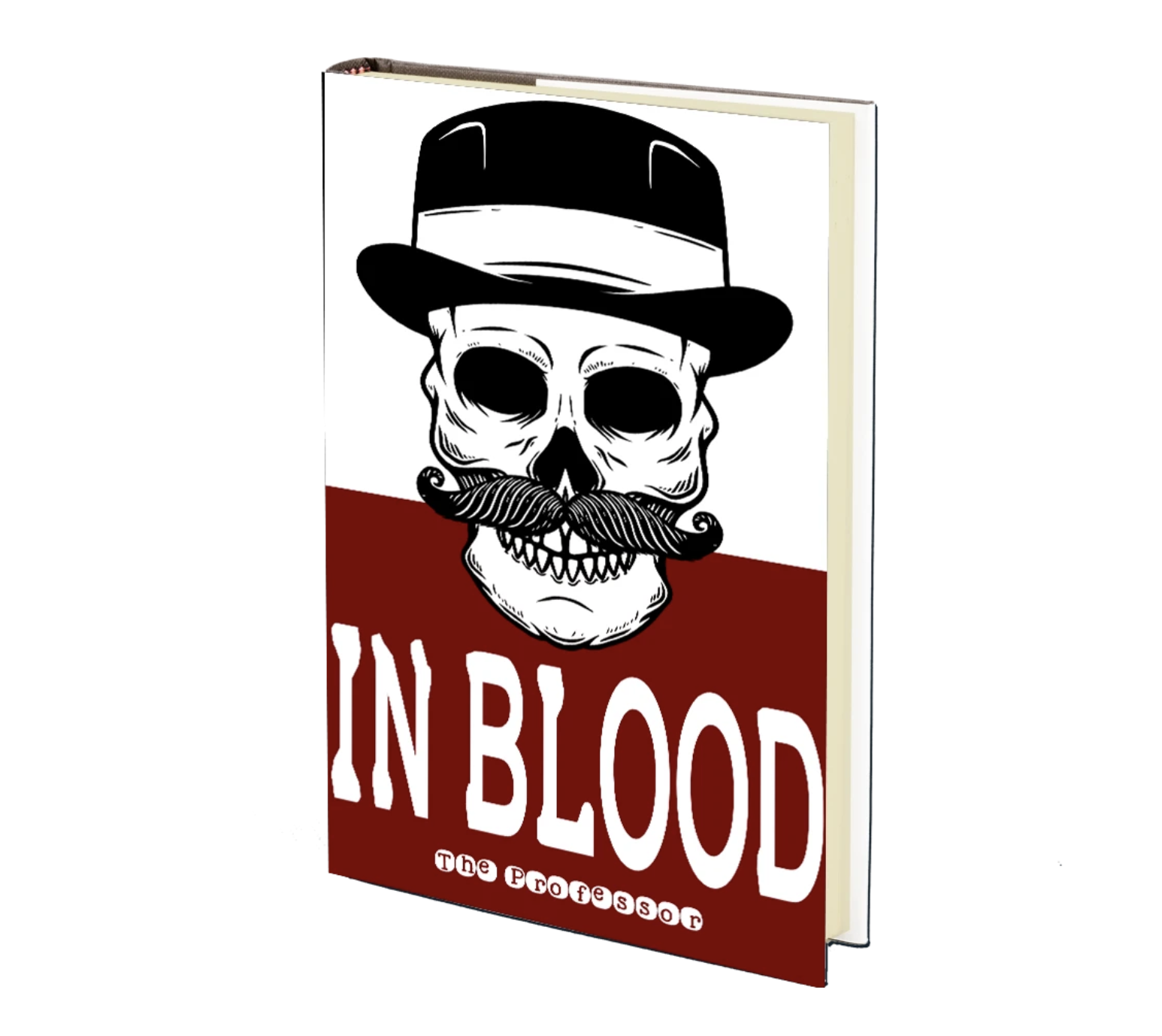
In Blood by The Professor

In Blood immerses us within an epistolary horror penned by Sir Henry Irving, owner of the Lyceum Theatre, to his friend and assistant, Bram Stoker. It is a tale of murder, insidious plots, and the evolution of what would become Dracula.
It all revolves around a Masonic conspiracy surrounding the Duke of Clarence and Avondale, his part in the pregnancy of a Catholic girl of low birth, and the prostitutes murdered by Jack the Ripper. As our narrator describes it, his authentically terrified performances in Macbeth are informed and influenced by an all-too-real haunting wherein he sees the deceased ladies of the night in place of the three witches on stage with him.
From there, he finds himself driven by strange and monstrous compulsions and a need to witness unspeakable things in an appalling attempt at method acting. As his missive to Stoker continues, it becomes clear that something awful has awakened within him, leading inexorably down the path toward damnation and inhuman brutality.
The Professor’s narration of this sordid tale makes the story all the more compelling, its deranged and lunatic protagonist leaping from the page in such a way that the listener feels his frantic, unhinged need propelling the narrative forward. The strangely beautiful prose comes to life in cruel, vivid detail as the exquisitely described savagery spirals out of control.

You can obtain a copy of In Blood by going to http://www.godless.com or by downloading the Godless app to your mobile device of choice. The link is below:

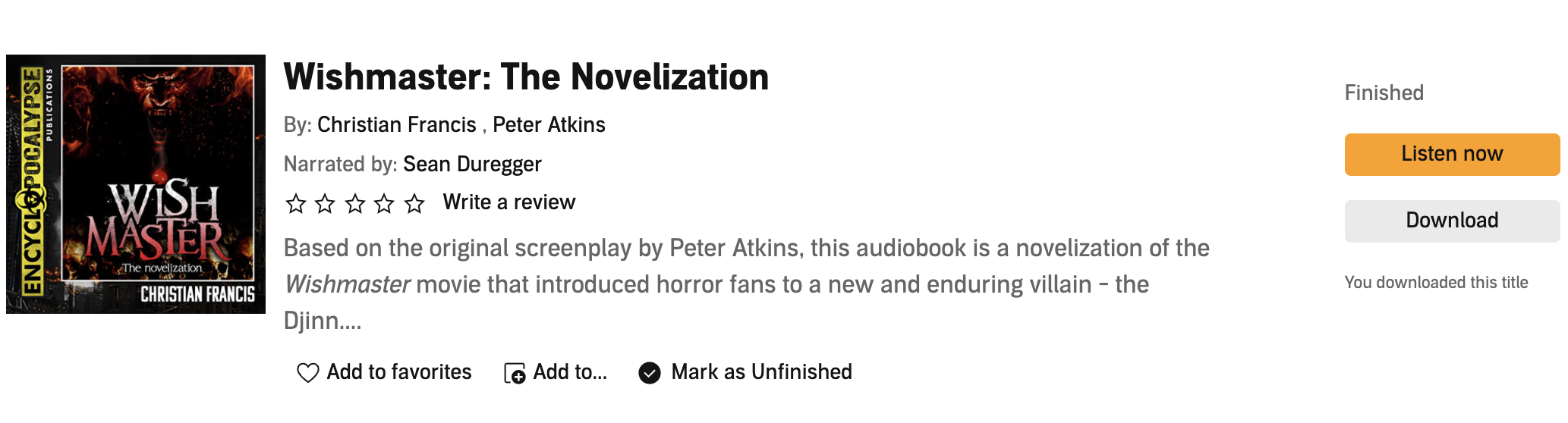
Wishmaster: The Novelization by Christian Francis, Narrated by Sean Duregger

The novelization of Wishmaster verifies something for me that I’ve long suspected to be true. While I own it, and I’m able to enjoy it for what it is, I never cared for the 1997 movie altogether too much. It just felt all too cheesy and poorly put together, like it was building on the worst aspects of the Nightmare On Elm Street series. It wasn’t the story that was the problem–I now know for sure–because I thoroughly enjoyed this novelization based on the screenplay.
From the tumultuous devastation in ancient Persia to the symmetrical horrors of the climax at Beaumont’s party, the descriptions from the narrative–and the visions elicited in my imagination–were far superior to what was executed on the screen under Robert Kurtzman’s direction. While the casting choices for the movie weren’t bad, Andrew Divoff being a particularly fantastic choice, most of the decisions seemed to be less focused on who would be right for the role and more aimed at drawing in a preexisting audience from other intellectual properties. The absence of performers who felt shoehorned into their roles also made for a better experience through the novelization.
It was enjoyable, following along as an ancient evil was set loose in a modern city, a city unprepared for a creature of magic and malevolence like the djinn.
Sean Duregger’s narration was excellent. He especially captured the demonic tone and texture of the djinn’s voice, both in its natural form and in the guise of Nathaniel Demerest. He had some pretty impressive shoes to fill, lending his voice work to a character originally played by Andrew Divoff, but he managed to pull it off successfully. Additionally, with a movie that had been narrated by Angus Scrimm (the Tall Man himself), Duregger was biting off a lot more than most would dare…but again, he did it, and he did it justice. There’s a reason he’s steadily become one of my favorite audiobook narrators.

Until the Sun by Chandler Morrison, Narrated by John Wayne Comunale

You’re a 15-year-old boy living with a foster family when you awaken to the sounds of shattering glass followed by what can only be violence. This isn’t the first time your short life has been punctuated with instances of horrific bloodshed, and if you choose to join the band of peculiar killers reveling in the chaos they’ve created in what is your third home in only a third as many years, this most certainly will not be the last. Don’t worry, this isn’t a choose-your-own-adventure story, and this pivotal decision is taken out of your hands and placed in the skilled, albeit sadistic custody of Chandler Morrison.
Entering the dizzying narrative of Until the Sun, you’ll be swept along currents of blood, strange drugs, and adolescent hormones until you find yourself standing dazed, in the sunlight of a new day, waiting for the ride to end. Morrison thoroughly captures that sense of being caught up in a life that feels entirely out of your control. This extends so far as to include the fact that, as a reader, you’ll see the final moments coming long before our protagonist does…and you’ll experience sensations that range from pity to heart-wrenching sympathy as you witness events unfolding.
We’re forced to wonder–if we’re being honest with ourselves–whether we’d be any more capable of wresting control from those who steer us along the destructive path ahead of us if we’d experienced the same tragic and disorienting life of young Casanova. I suspect we’ll never know, and we should be grateful for the fact that the dreadful sequence of events befalling that young man could only happen in fiction.
Morrison provides us with a vampire story that is both more and less than that. Until the Sun is a dark, twisted, and perverse coming-of-age tale that abruptly detours us through the worst possible paths to reach the conclusion. A conclusion, I might add, that is equal parts hilarious and cruel in both its predictability and subversion of what a reader might expect when first choosing the book.
John Wayne Comunale’s narration is effective in bringing to life the characters who often feel like caricatures of people we might have known in our own lives, or maybe people we’ve been at different points in our lives. There probably isn’t a narrator who would have been better suited for this drug-fueled, bloody, and irreverent combination of various horror subgenres.

The Ritual by Adam Nevill, Narrated by Matthew Lloyd Davies

The Ritual is a fantastic journey into the realm of folk horror, a literary exploration into the sort of narrative that evokes themes familiar to fans of movies like The Wicker Man or Midsommar. As four friends hike into the autumn wilderness of Sweden, they discover that not all shortcuts are meant to be taken, that there are secrets and horrors in hidden places, and they find tensions that refuse to remain beneath the surface as stress and fear take a heavy toll on the men.
The gloomy, sinister forest is brought to stark, claustrophobia-inducing life as Adam Nevill draws us deeper into the trees and brush as the relentless rainfall paints everything gray and lifeless. The characters of Hutch, Dom, Phil, and Luke are similarly well-drawn and three-dimensional in their portrayal. This realism serves to make the narrative all the more captivating as we become invested in the drama playing out between the hikers and the overwhelming sense of unease as we experience the disquieting events through Luke’s perspective.
By the time the four men discover they’re not alone in the woods, it’s far too late to turn back, and the desperate push forward presents challenges that grow increasingly difficult.
Now, because I’ve seen the movie adaptation as well, I’m going to compare the two. This portion of my post will include spoilers, so anyone seeking to avoid spoilers of either book or film should stop here.
The movie would have benefitted a great deal from incorporating elements that were exclusive to the novel, such as the multi-generational graveyard and the ancient, decrepit church Luke discovered when he ventured off on his own. I loved that whole section of the story, and I think it added something to the atmosphere of the narrative moving forward. Similarly, the familiarity Hutch had with some of the architecture and runic writing was a nice touch that I felt could have made the movie better. I also preferred the absence of the cowardice subplot, wherein Luke did nothing and allowed a fifth friend to die. Unfortunately, with the absence of that subplot, we also lost the element of blurred reality that I enjoyed a great deal in the movie, wherein the god of the forest used illusions and hallucinations to manipulate the men.
The movie was superior once Luke made it to the village near the end. The addition of Dom being present and alive for a portion of that section of the story was a nice touch that I think made for a better overall story. Sure, we had the reconciliation between Luke and Dom in the novel as well, but it felt more appropriate at the point when the men were in captivity and facing the very real probability of death. Removing the irritating caricatures of Loki and Fenris was a great choice, as I almost stopped with the book when those characters insisted on remaining present for altogether too much of the narrative. The random insertion of the fictional, murderous nordic black metal band, Blood Frenzy, felt like a pointless way to share the author’s familiarity with contemporary bands within the genre. Additionally, the portrayal of the god/monster within the movie was spectacular and exceeded anything I imagined from the book.
Overall, I think I enjoyed the movie a bit more than the book, which is an uncommon thing…but it does happen.
The audiobook narration provided by Matthew Lloyd Davies was spectacular. He even managed to superbly capture the accents of the characters I’d have preferred to do without. The narration certainly served to add depth and texture to the narrative, something that leapt from the page, so to speak, bringing an extra quality to the words penned by Nevill.