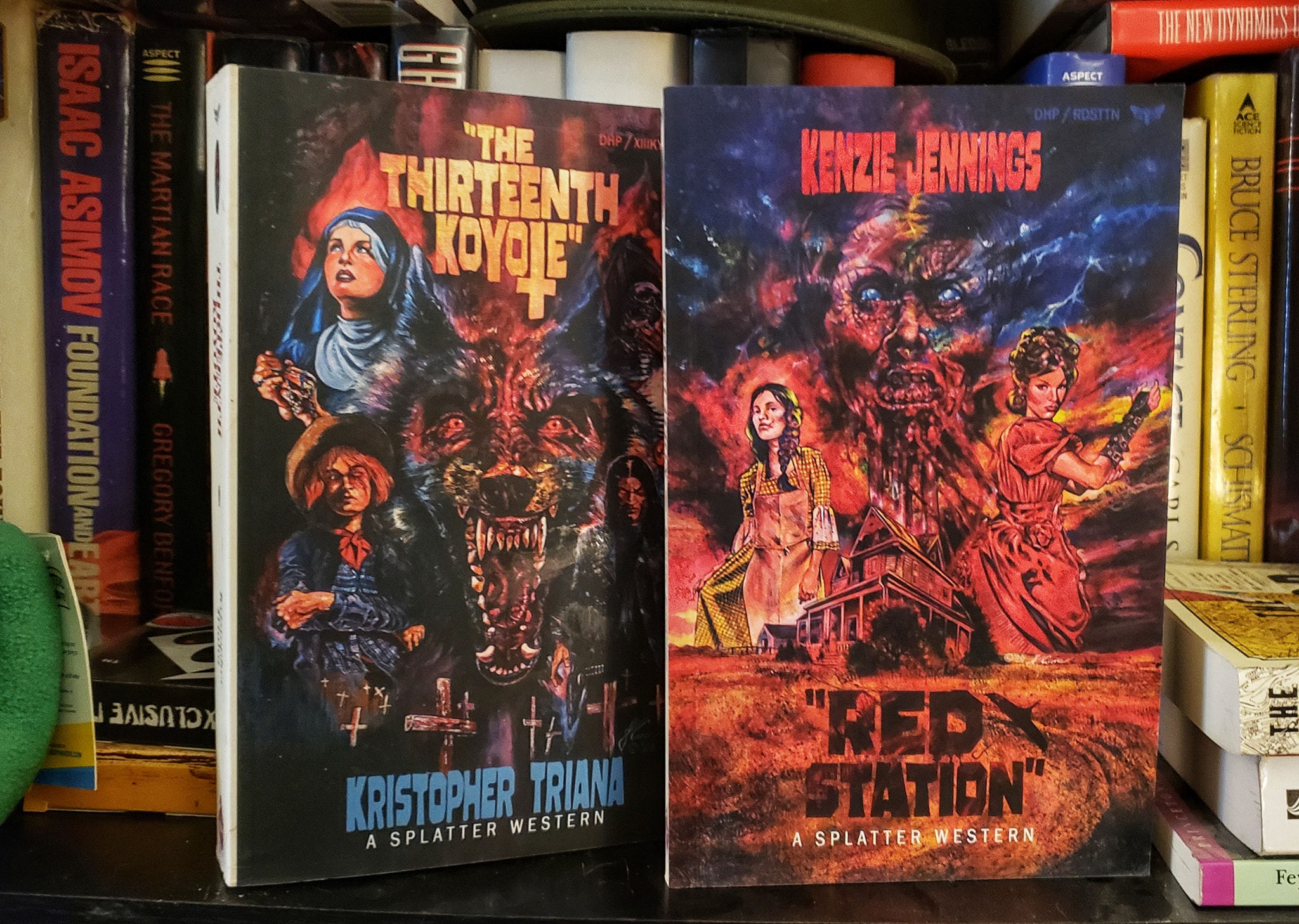
While Red Station by Kenzie Jennings lacks something of the authentic tone of pulp westerns Christine Morgan’s The Night Silver River Run Red captured with such surprising grace, it never feels inauthentic in its period depiction. We join four travelers in a stagecoach, crossing countless miles of prairie as they arrive to find shelter and sustenance for the night in an isolated manor serving as a waystation. Unfortunately for the passengers, the family residing in this waystation is more sinister and unsettling than they seem, harboring awful, bloody secrets. They aren’t the only ones with a secret, however. As these various mysteries unfold within the story, we bear witness to increasingly violent confrontations and satisfying moments of surprising action. To call Red Station a thrilling read is a bit of an understatement. It’s suspenseful, action-packed, and populated with fascinating characters…a must-read for anyone looking for bloodshed and cruelty in the untamed American West, with a delightful dose of vengeance.
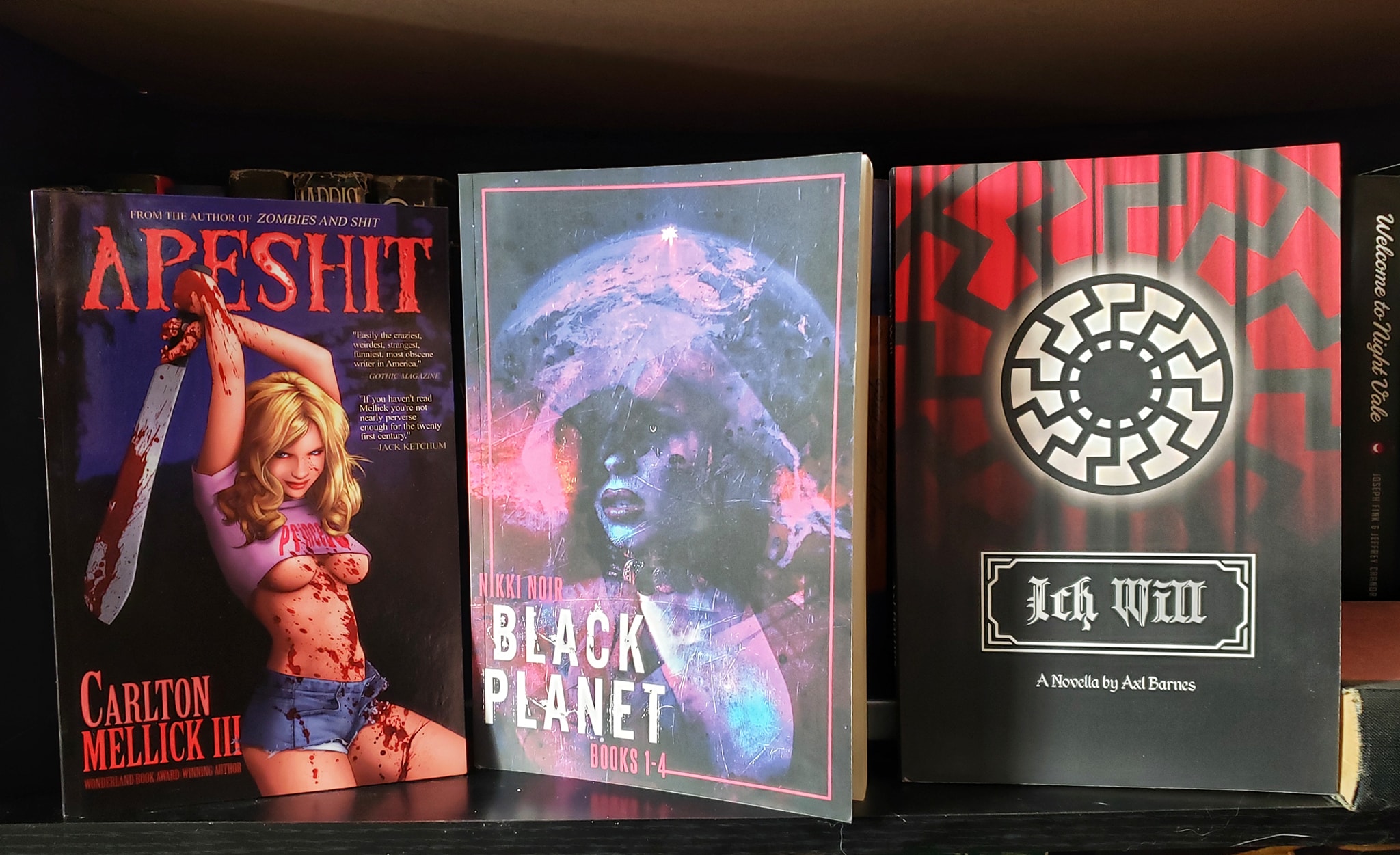
Nikki Noir’s Black Planet: Books 1-4 collects together in one volume a sequence of novellas and short stories introducing us to a handful of residents of a Northern Arizona town and the sinister events corrupting and controlling those people, brought about by a mysterious, otherworldly object and the black goo that seems to be spreading through the North Woods. Alternating between perverse sexual depravity, brooding cosmic horror, occult fanaticism, murder, and family drama, Noir manages to avoid missing a beat as she weaves a tale that keeps the reader begging for more…and then the final page arrives, and you can only hope for more to come. She paints a portrait with the delicacy of a scalpel while utilizing a pallet produced by a hammer blow to the head and the arterial flow of a severed penis as she draws you into this world she’s created. If that description doesn’t make you want to read this book, I really don’t know what else I can say. Spoiling this particular story would be virtually impossible without dragging you, kicking and screaming all the way through the narrative itself, it’s such a feverish and surreal experience. Keep in mind, as you read…the owls are not what they seem, a statement somehow more true in this novel than in Twin Peaks.
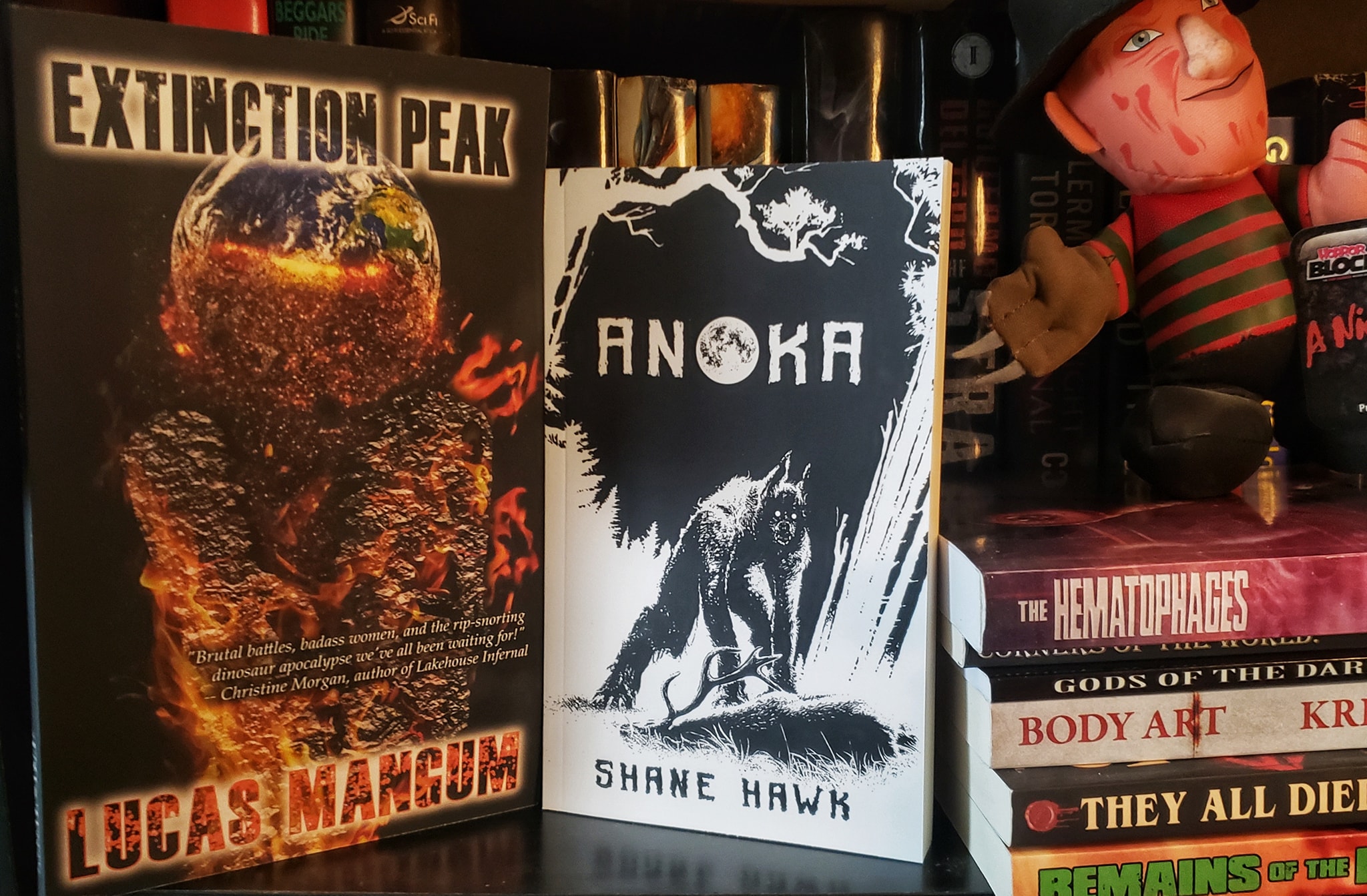
Lucas Mangum’s Extinction Peak borrows heavily from themes familiar to fans of Jurassic Park/World franchise, Dino Crisis, and Land Of The Lost while painting a dizzying portrait of an apocalypse no one could have seen coming (except for those who made it happen, but that’s a bit of a spoiler, so I’ll leave it at that). We’re first introduced to Deandra and her brother, Johnny, as they plan to leave the basement they’ve been sheltering in as the world outside descends into a carnage-filled nightmare Michael Crichton wouldn’t have dared explore, even in writing. Children of a deceased drug lord, neither Deandra nor Johnny are well adjusted or particularly sympathetic characters, particularly Johnny. I found myself wanting both of them to be devoured by dinosaurs almost immediately but knowing there wouldn’t be much of a story to tell if that were how it played out. As we follow those two (and other characters we encounter along the way, many of them equally flawed and broken), we see far more detail of just how terrible and dangerous the world has become as these beasts emerged, seemingly from Hell, through the sinkholes around the world. As with most monster-themed horror, we soon find that the worst monsters aren’t the obvious ones, that it’s other people we really need to worry about. Fueled by greed, contempt derived from old world biases, and sadistic impulses that shouldn’t surprise any of us (but somehow always do), the story continues its fast-paced and character-driven journey through an increasingly unreal end to the world as we know it. In all honesty, I would love to see Mangum explore this particular apocalypse in greater depth and detail, through the struggles of other people in other places, but this book is so detailed as to make it simple to close our eyes and imagine precisely what it might be like for others, even ourselves when the holes in the Earth begin opening up. This book is filled with graphic violence, gruesome deaths, and subject matter that absolutely nudges it into splatterpunk territory…be warned that this is not a book for your dinosaur-loving children…unless you parent the way I would…and did.
Before reading this book, I made the mistake of reading some of the reviews. Admittedly, that made me apprehensive about what I was going to be reading. I really didn’t need to be concerned and, based on the interpretations of this book on display in many of those reviews, I’m fairly certain many of those people either did not read this or didn’t read more than what was available as a sample. I’ll say it right away that this is not a book for everyone. It’s heavy in tone and in style…heavy like a brick at times, and equally hard to swallow. At its core, this is a book about a juvenile delinquent, his delinquent friends, and their desperate, fumbling attempts to find a place for themselves in the Eastern European world around them. Tudor, the initial focus of the story, is arrogant and self-assured in the way only the least self-aware and incompetent can be. He is a bitter, resentful young man who feels like he is too good for the life he’s subjected to by the inferior parents who are raising him. He finds solace in the interests shared with his small group of friends; heavy metal, occultism, anarchism bordering on nihilism, and ultimately he finds himself influenced by the neo-Nazi philosophy adopted and promoted by the one friend he actually admires and respects, Alex. All of this changes after a series of poor choices and impulsive actions leads to a dramatic, violent mistake. Tudor, being the maladjusted boy he is, spends his time retroactively justifying and rationalizing what he’s done, to the extent that he begins fixating on further violence and killing. This drives the whole final third of the story. Tudor finally goes over the edge, experiencing the first seeming spark of self-reflection, as Alex seeks to go the other direction and displays nothing but contempt and disdain for Tudor. We finally arrive at a climax that feels both feverish and well thought out. It’s as much a conflict of opposing philosophies as Tudor and his remaining friends against Alex. While the story may feel slow at times and it’s difficult to want to continue, with protagonists/antagonists who are far from sympathetic. Think of it as a supernatural horror story mixing in elements of A Clockwork Orange, Stand By Me, and Gone Girl, and you’ll probably have a decent idea of what you’re getting into. The further into the story you get, the further the lines become blurred between fantasy and reality, waking life and dreams. There are flashes of brilliant prose that draw your attention but you should be prepared, as I said above, it’s a thick and heavy book to read.
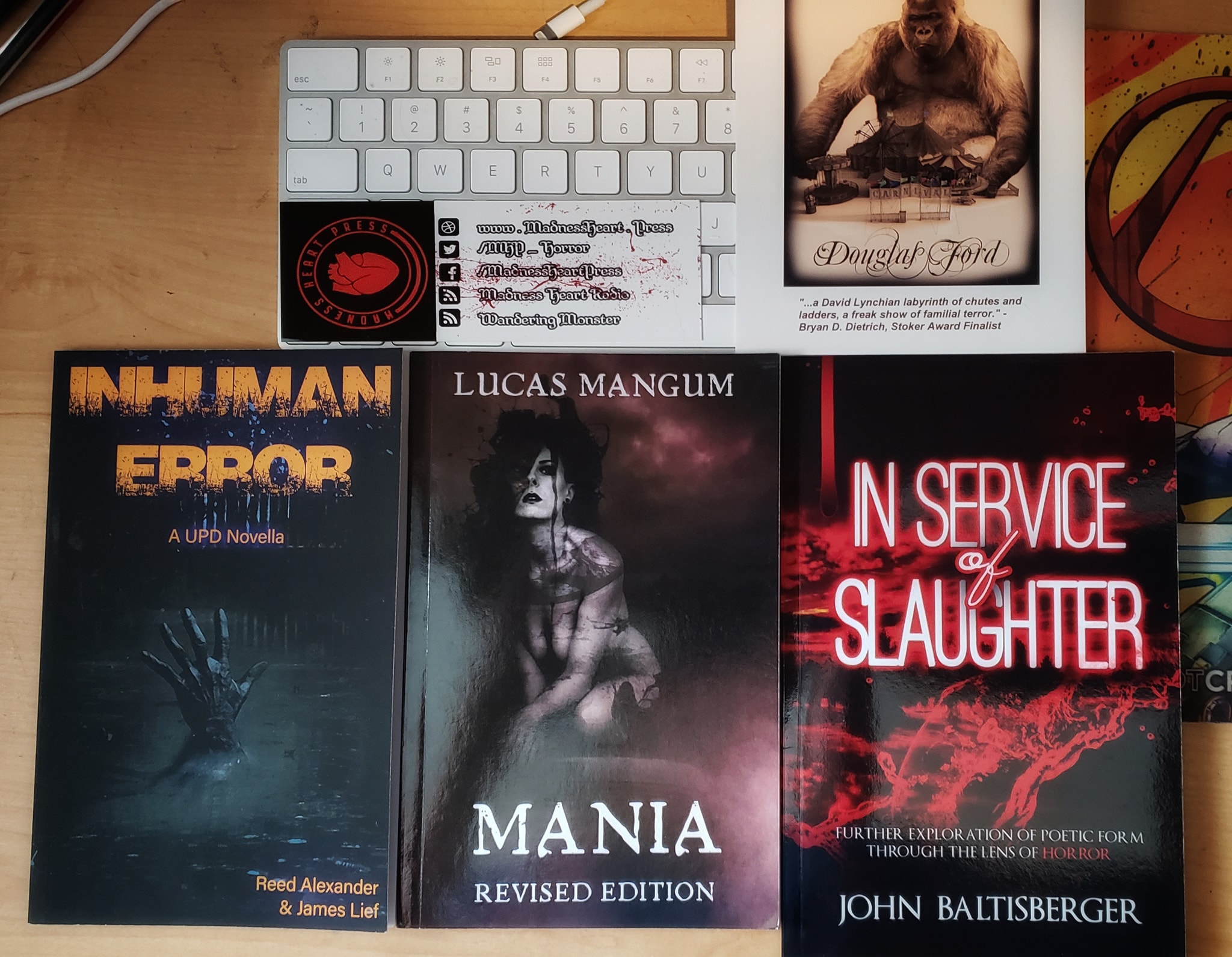
Mania [Revised Edition] by Lucas Mangum feels altogether too short by the time you reach the end. The story of a cursed screenplay and the absolute nightmare that accompanies that curse is told in a way that can only be described as cinematic. It’s smutty, gory, and depraved…and not in turns, but all at once. I really don’t want to spoil anything, but there’s a scene before the halfway point where a character witnesses a dead and disemboweled woman masturbating with a length of her own intestine. Keep in mind, that isn’t even halfway into the story. I recommend this one for my more depraved and horror-obsessed friends…but I have to admit that some aspects of this particular book might go too far for different people. Read it at your own risk, of course…but read it either way.
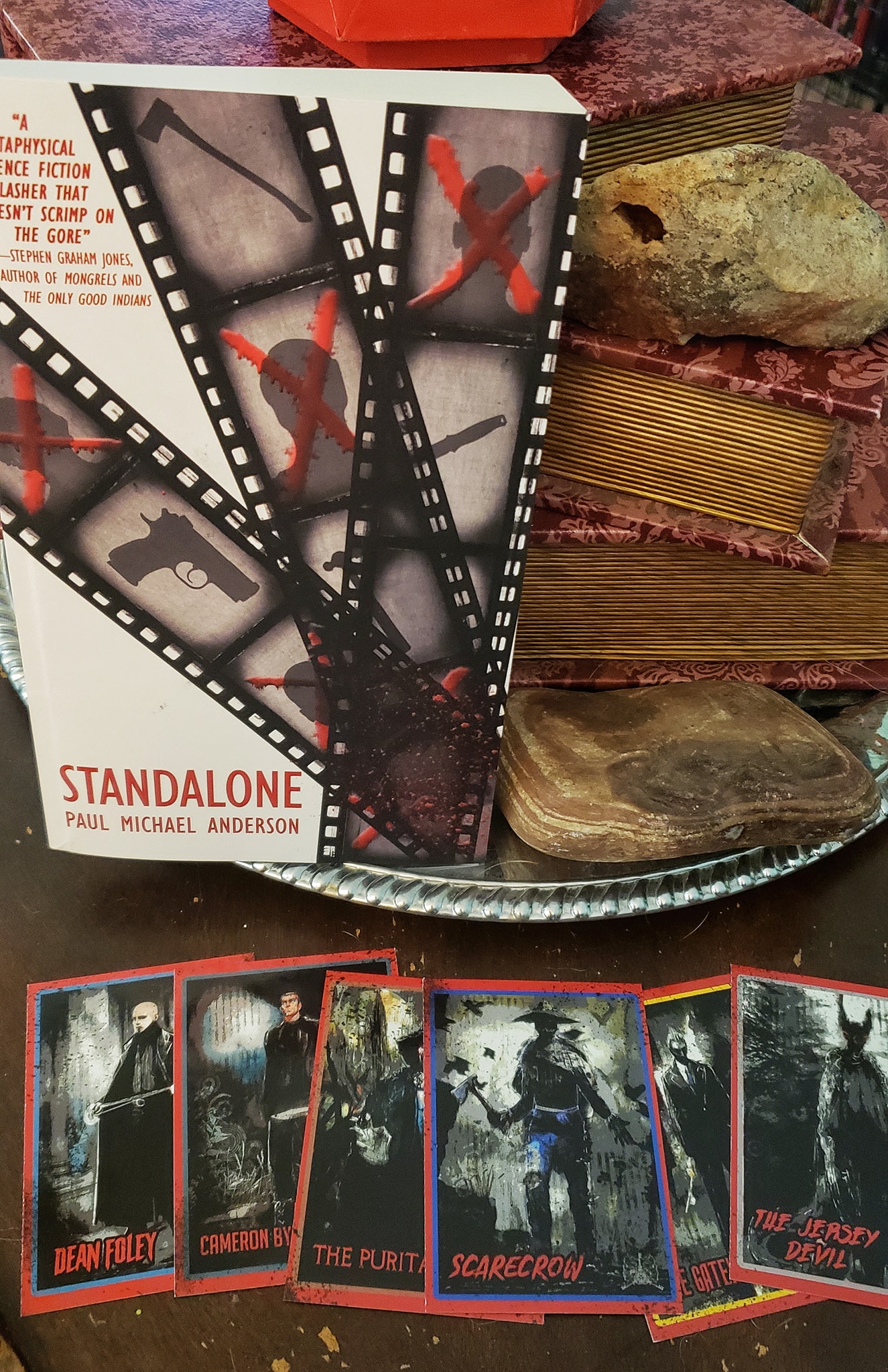
I was torn between giving this one 4 or 5 stars and I had to lean into 5 stars because of the sheer creative audacity of the author. Standalone by Paul Michael Anderson is not what I expected. I don’t think anyone will be able to read this book and feel differently than that by the time they reach the end. There’s no way to anticipate what this book really is based on a synopsis without that synopsis being half the length of the story itself. I’m certainly not going to try and explain it. It’s better if you experience it for yourself anyhow. It’s a book that, at its core, manages to weave together a bizarre and surreal science fiction tale with an old school slasher narrative and a nice dose of body horror. It’s difficult to adequately describe, is really what I’m trying to say. It’s fun, fast-paced, and intense…and I absolutely recommend that you read it for yourself. Plus, you get the bonus of an additional short story at the end that has a sort of touching “Monkey’s Paw” or “Tales From the Crypt” feel to it.
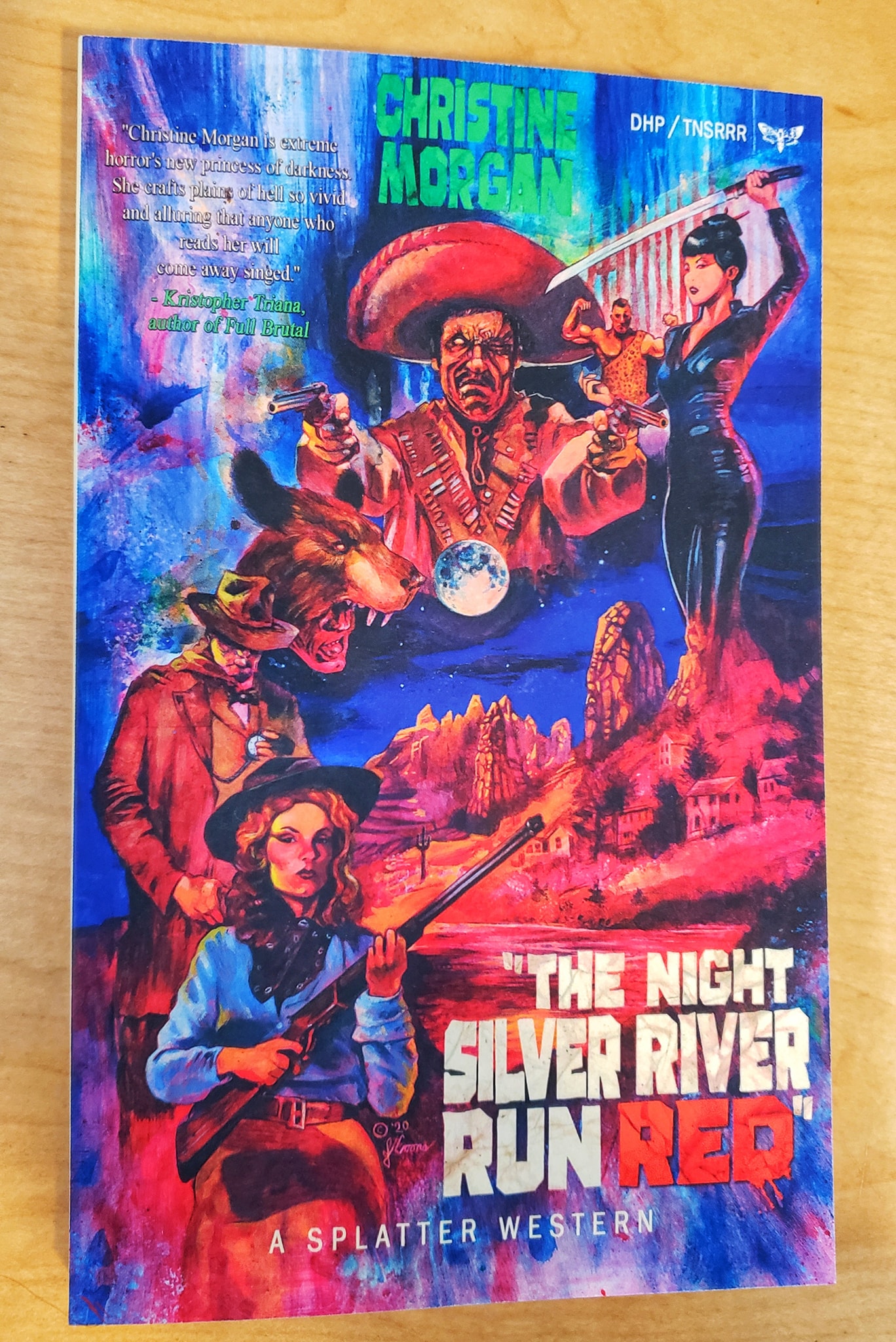
My maternal grandfather was a big fan of Louis L’Amour and he had a massive assortment of paperback westerns when I was growing up. I developed a deep appreciation for those stories and others, as well as western movies and television as a whole. The Night Silver River Run Red is absolutely not one of those westerns. Christine Morgan nails the language, the descriptions, and the tone of authentic western authors…but that is where the similarities end. It starts off like a tale that could have been a Halloween-themed Laura Ingalls Wilder story from her Little House series. Kids in a rapidly depopulating town sneak out together at night to try and catch a glimpse of carnival attractions their puritanical parents oppose. The only element that wouldn’t fit is the presence of a religious cult a short distance outside of town, but I didn’t say it was a perfect comparison. It doesn’t feel like one of those stories for long anyhow. The violence erupts and any thought that this could have been a western story you might have read while growing up is dispelled quite rapidly and that sense of familiarity never returns…plus, there is a uniquely psychotic rapist named Horsecock in the book, so there’s that. I can only hope the other Splatter Westerns published by Death’s Head Press are this good…because Christine Morgan expertly weaves her own brand of extreme horror and visceral violence into an almost perfect replica of the pulp westerns a lot of us know quite well. This is the fourth of the books, but it had to be the first I read, just because of this particular author.
If you are a fan of both horror and western literature, I highly recommend checking out the whole series of Splatter Westerns released by Death’s Head Press. There are currently eight installments to fulfill your filthiest, most bloodthirsty desires.
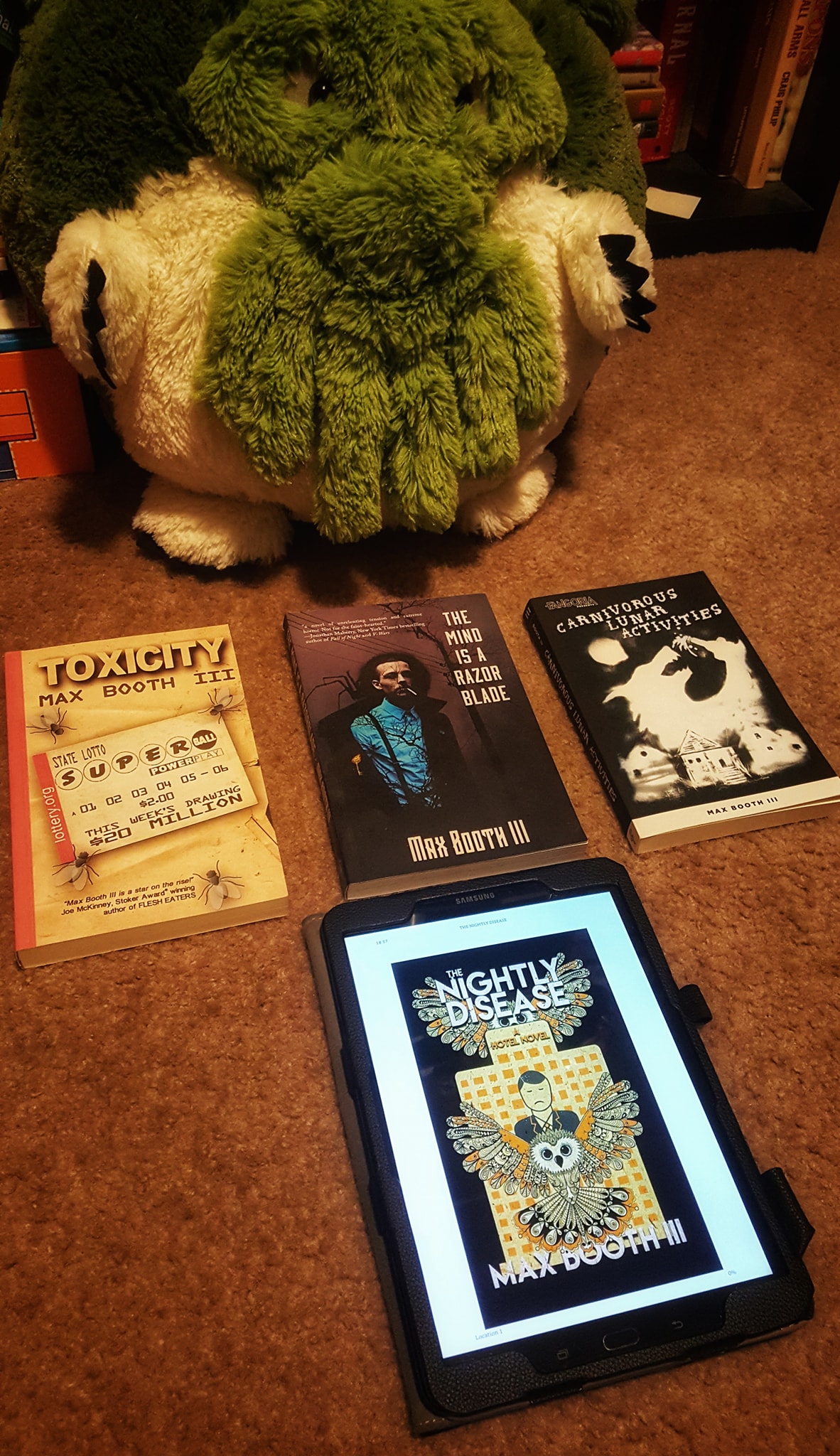
Carnivorous Lunar Activities by Max Booth III is a jaw-droppingly good book. I will avoid spoilers as best I can, because I sincerely want everyone to at least sincerely consider reading this book for themselves. There are definite nods to An American Werewolf In London as a point of inspiration beyond the obvious title derived from dialogue in that amazing piece of cinema and multiple points wherein the characters reference the film. Infused with black comedy and dialogue that brings the characters to life, the first two thirds of the novel lull you into a certain sense of comfort in the discomfort of the whole scenario. Neither of these men are what one might call stable and they both have their own demons they are dealing with as the story progresses. As two friends who’d grown apart come back together again under the most unlikely and bizarre circumstances, you begin to feel that the story will continue along in that same vein…maybe that the whole tale might have some sort of happy ending in that Justin, who insists he’s become a werewolf, will be proven to be nothing more than the delusional jackass Ted believes him to be. But no, as the pages ahead become fewer Ted is hit with perhaps some of the most devastating news a person could imagine and the chance of anything even remotely happy coming out of the book is discarded like a used condom and stomped into the dirt. That’s where it really gets interesting and the intensity doesn’t let up until the final page. I don’t know that I can conceivably recommend this book enough.
Since originally writing this review in May of 2019, there have been some issues with respect to the publisher who released Carnivorous Lunar Activities, and it is recommended that anyone interested in reading the book wait until such a time as a solution has been found. This is unfortunate, as the book in question is a fantastic werewolf tale.
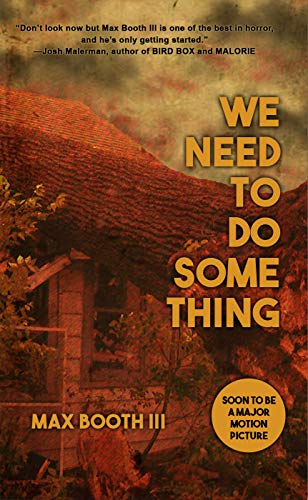
I’ve read multiple books by this author and each one is somehow so vastly different from the one before it that they could have been written by a totally different author. Other books have been surreal, mysterious, even hilarious at points. This one is brutal. It’s bad enough to imagine a family of four needing to huddle together in a cramped, windowless bathroom during a tornado warning. That scenario, in and of itself, is sufficient to serve as horror. When the father is a mean-spirited alcoholic, things get less pleasant. Now, imagine a tree falling through the roof and blocking the only exit from that bathroom, the door only opening enough to slip an arm through the gap as rain and wind blow through what once was a bedroom. And this is only the beginning. Max Booth III manages to obscure the lines between past and present as well as delusion and reality to the extent that the latter half of the novella becomes a dizzying blur. Claustrophobic discomfort, occultism, and familial tension blend together until, like the characters, you begin to forget how long you’ve been there with them. Looking back, I’m still uncertain just how long these people are trapped in that bathroom, but it’s surely a week or two. The fragmentary glimpses of the world outside of the bathroom itself are enticing and they leave you simultaneously wanting to see it for yourself and turn away and remain where it’s safe (relatively). This novella is not for the overly sensitive or the squeamish, because there are some aspects of it that are sure to make a lot of readers uncomfortable…but it is so excellent.
Since originally writing this review of the novella in May of 2020, the author has adapted it to a screenplay that has since been made into a major motion picture, currently in post-production.
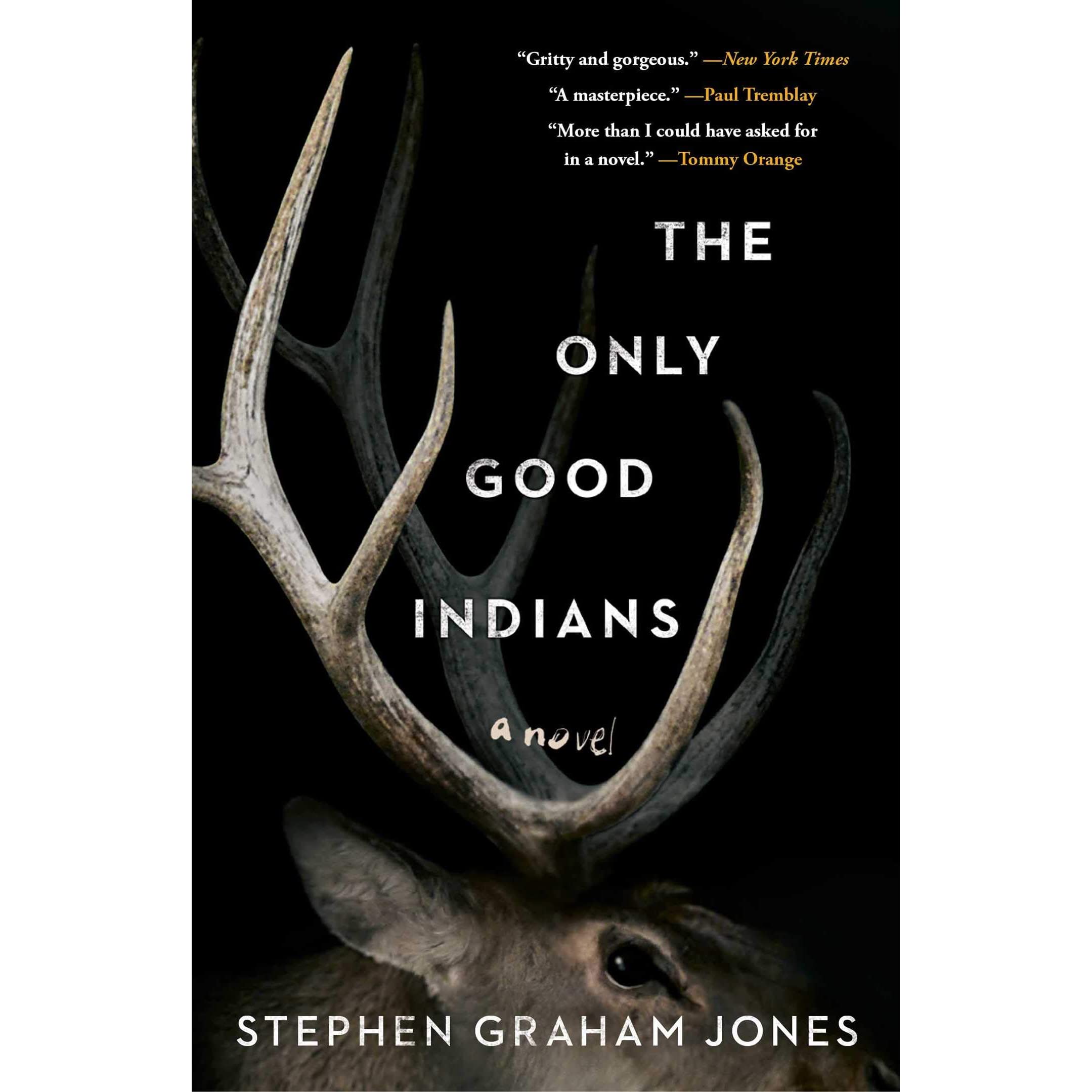
Stephen Graham Jones tells a fascinating and original story of four friends who made a horrible mistake and how the choices years before come back to haunt the men one-by-one. He weaves together life on and off of the Blackfeet reservation for these men who’s lives never quite turned out the way they expected, painted expertly on a tapestry of indigenous spirituality and culture, as well as the way nature and the supernatural can intermingle in the most interesting and horrifying ways. The way Jones manages to make even the most mundane things somehow beautiful and captivating is perhaps the most amazing thing about him as a writer. His storytelling and descriptive elements are unrivaled by most. What we end up with, in The Only Good Indians, at the core is an unconventional tale of revenge and motherhood that I couldn’t put down if I’d wanted to.

 Domus Necrophagous