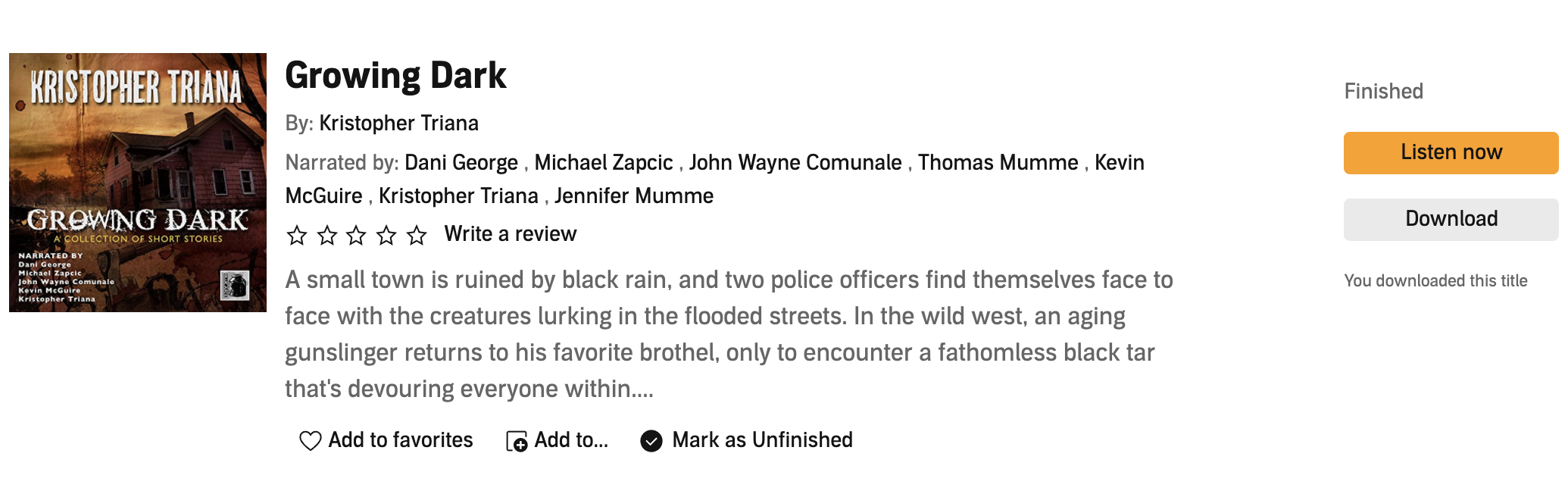
Growing Dark by Kristopher Triana, Narrated by Kristopher Triana, Dani George, John Wayne Comunale, Michael Zapcic, Kevin McGuire, Thomas Mumme, and Jennifer Mumme

Growing Dark truly showcases the eclectic range Triana is capable of in a way a reader would otherwise only discover if they took the time to read half a dozen books. Running the gamut from intense cosmic horror to something that could be considered kid-friendly, there’s no doubt any lover of dark fiction will find something to love in this short collection.
From the Storms, A Daughter kicks everything off, sharing the story of a town that’s been going through hard times, and they’re only getting harder as the region gets flooded. First responders in boats are struggling to locate stragglers to take them to safety, but what they find instead is evidence that there’s more to fear than the water.
Eaters is a post-apocalyptic excursion into the remnants of the old world, as a small party of hunters is clearing the area of zombies. As with most tales like that, things don’t go smoothly. Triana manages to bring some originality to the topic, and an ending that readers/listeners are unlikely to see coming.
Growing Dark is a coming-of-age tale gone wrong, as a farm boy surrounded by sickness and decay desperately wants to prove to his father that he can be a man. Sometimes being a man involves making some hard choices, and sometimes they’ll be bad choices as well.
Reunion is an insightful story of childhood regrets and how the mistakes we make can haunt us well into adulthood, altering the courses we travel and where we ultimately end up.
Before the Boogeymen Come was the most surprising inclusion in this collection. Triana entertains readers as he breathes life into the monsters who plague the imaginations of young children before media and experience provide new monsters to replace the old.
The Bone Orchard is a heartbreaking western tale that could be read, depending on the reader’s perspective, as being either pro-life or pro-choice in its message. An old shootist returns to an old haunt and old love, only to discover there’s a sinister secret behind keeping the brothel running smoothly.
Soon There’ll Be Leaves is a character study framed by multiple horrors, the most potent of which being reflection on a life not well-lived and the looming loss of family. Returning to a place he’d sooner never see again, our protagonist is approached by an old flame who proves the adage that one can never go home again, as an attempted affair takes an unforeseen twist.
Video Express is a nostalgic exploration of the video rental stores of our youth and condemnation of how we quickly turned our back on the family-run establishments in favor of places where we could easily snag the newest titles.
Giving from the Bottom is another character study, this time focused on the horrors of everyday life and the gradual erosion of both one’s ability to care and one’s will to live when nothing seems to turn out as expected.
The collection ends with the strangely epic Legends, a vision of an afterlife that is not at all what one might expect. In Triana’s captivating narrative, we discover that the dead–if they’re famous or infamous enough–become eidolons of a sort. Charles Bronson and Lee Marvin come together as paragons of what generations of moviegoers and fans imagined them to be, and as such, they are bestowed with purpose and power to protect the world from infernal entities who may have similarly familiar faces. For me, Legends was the best of the whole collection, providing a glimpse into a world I could see the author fleshing out into a much longer piece.
The narrations provided by Dani George, John Wayne Comunale, and Kristopher Triana himself were the best of the bunch. Triana especially did an excellent job of providing his characters with distinctive voices, and in the case of Before the Boogeymen Come a level of caricature that was enjoyable. The additional narrators, Michael Zapcic, Thomas Mumme, Jennifer Mumme, and Kevin McGuire were satisfying as well, just not as memorable as those provided by the three previously mentioned.

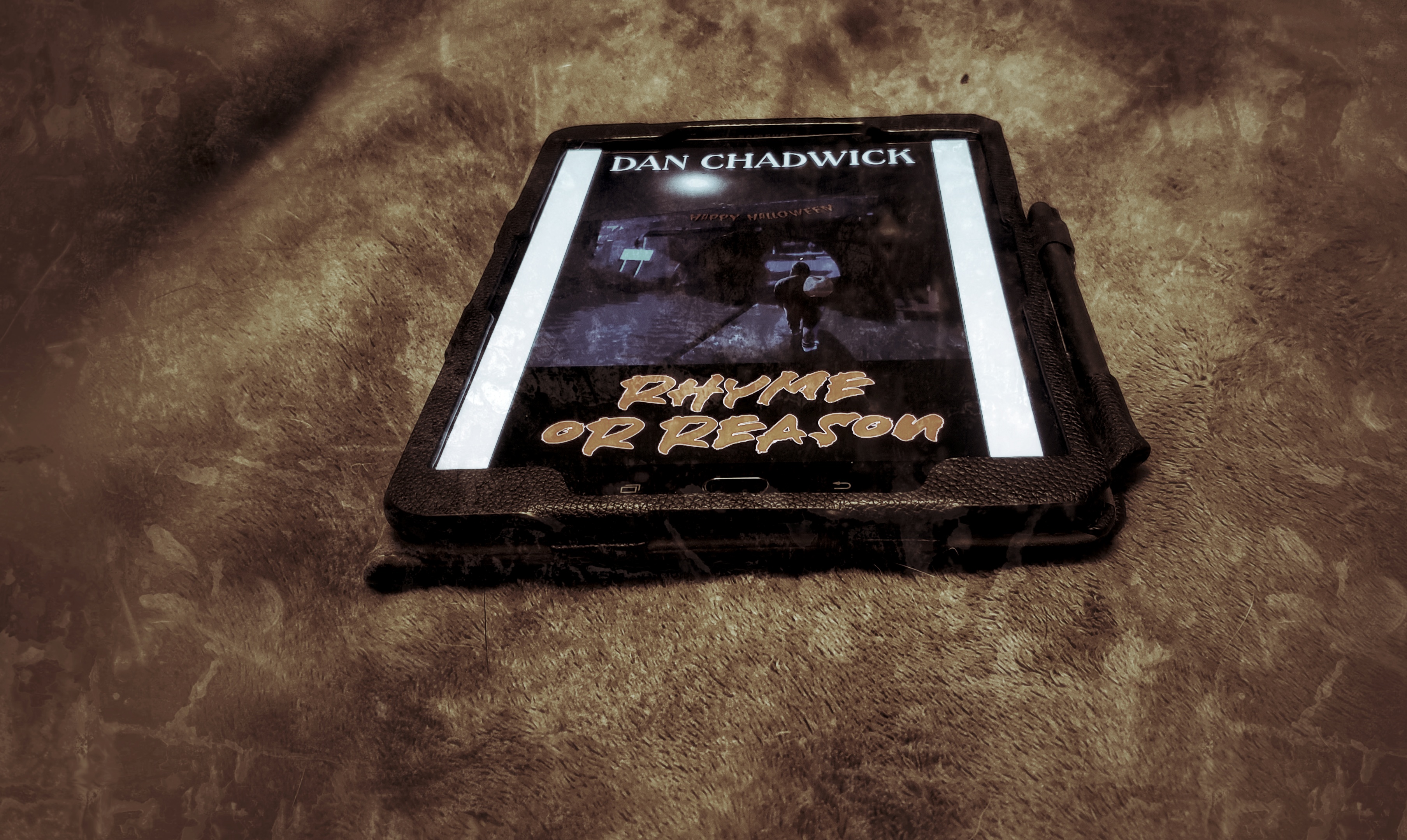
Rhyme Or Reason by Dan Chadwick

Have you ever gotten a ridiculous song stuck in your head?
Of course, we’ve all experienced that.
There’s a reason I mention this, but you’ll know that if you’ve already had the pleasure of reading this surprising story. If you haven’t read it yet, skip the rest of this review and remedy that mistake ASAP.
I’d hate to spoil the surprise.
Rhyme Or Reason details a series of gruesome murders taking place during the nights leading up to Halloween. The victims are horrifically dismembered while still alive to experience most of what’s being done to them. I would certainly hope I’d be long gone before the torture reached an end, but the people being slaughtered while the killer hums his eerily familiar tune are not blessed with that small mercy.
The brilliance of Dan Chadwick’s story is that every bit of the story is building up to a punchline that almost had me laughing out loud. It’s a horror/comedy that the reader doesn’t realize is a comedy until they’ve reached the end.
Does the killer commit these atrocities because the song is stuck in his head? Did the earworm drive him to do the things he does? Is he just a killer who finds humor in what he’s doing, irreverent and cruel enough to make light of it in such a way? Perhaps we’ll never know…and perhaps the author was just hoping to elicit a groan from the readers as they reached the end.
This is a fun story that sneaks up on the reader in a delightfully absurd way.

You can grab this one for yourself by going to http://www.godless.com or by downloading the Godless app on your mobile device of choice. Rhyme Or Reason was released as part of the 31 Days of Godless event for October of 2021. The link is below:

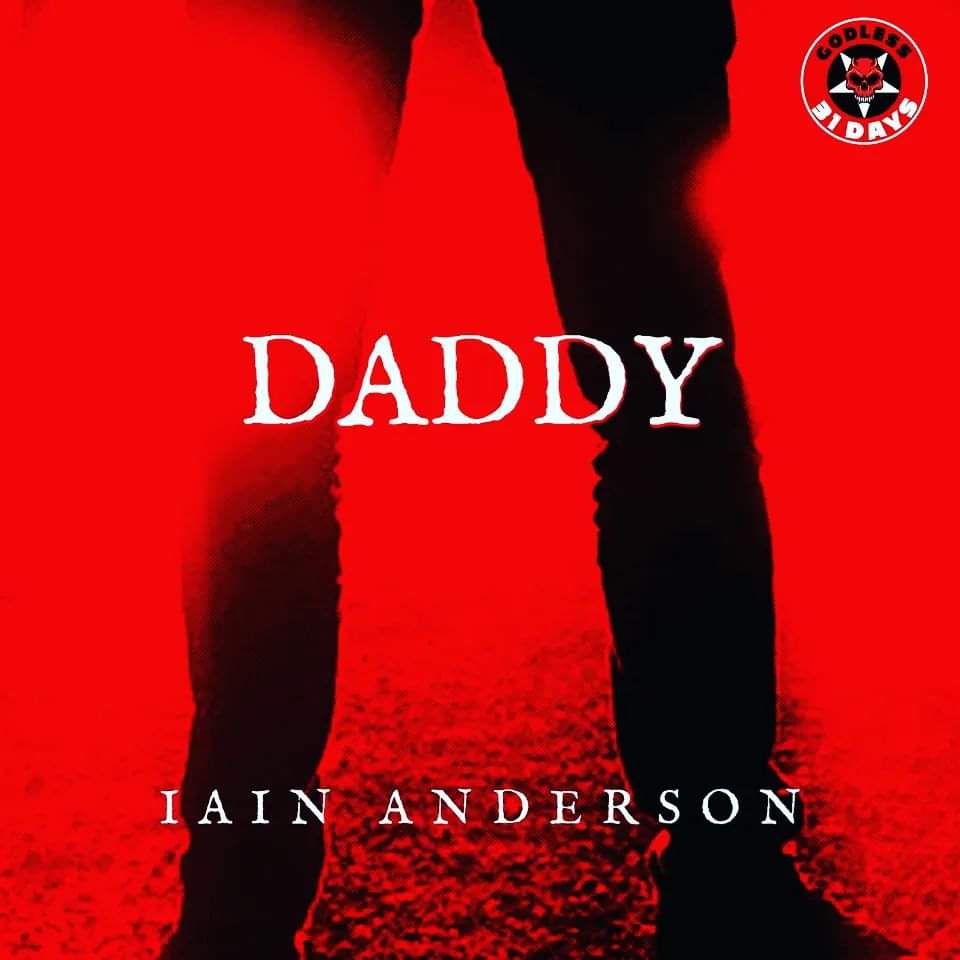
Daddy by Iain Anderson

Iain Anderson’s Daddy was as surprising as it was captivating, keeping the reader–in this case, me–guessing until just before the shocking pivot in the narrative.
Lauren is kidnapped and she’s certain it’s the work of a brutal murderer the press has dubbed The Callendar Man. Forced into a small, dark shed, Lauren soon learns she isn’t alone in the confined space.
This story has something for everyone. We have a father’s love. There’s a sinister string of missing people turning up dead in a gruesome fashion. And, finally, we have the mystery of who or what is in the shed with Lauren.
Iain Anderson might just answer the question that’s been plaguing you your whole life. Who’s your daddy?

Daddy is the Day Four release for the 31 Days of Godless event celebrating October 2021 at http://www.godless.com and you can obtain this story for yourself by going to the website or by downloading the app. The link is below:

Daddy by Iain Anderson

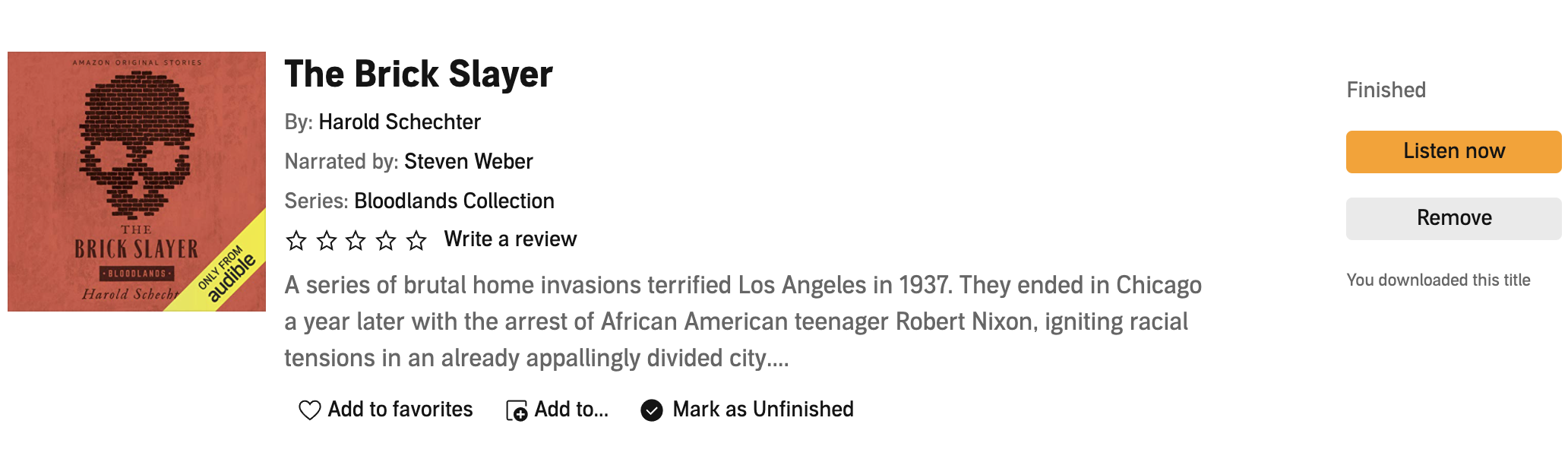
Panic by Harold Schechter, Narrated by Steven Weber

Harold Schechter’s Panic showcases an early American example of moral panic, mass hysteria, and pattern recognition gone horribly awry.
This well-researched narrative begins with details of a tragic event, the result of the sort of irrational, hysterical panic arising in the 1930s surrounding the fear of child rapists and murderers surging across the American landscape. One father’s need to protect his daughters from a danger he perceived as being right around the corner erupts in a disastrous and heartbreaking conclusion.
From that awful event, Schechter traces backward to the small number of isolated incidents that had been blown up and made to seem like part of a growing trend. Each of these individual cases was certainly terrible, but they were hardly part of a nationwide surge in that sort of criminal activity.
Looking at the world we live in today, one can see that we haven’t grown beyond this sort of outrage-driven crusade where we perceive the boogeyman du jour in every shadow.
Steven Weber’s narration is perfectly suited to this gripping non-fiction essay. I’m pleased to see that he continues to narrate other short samples of Schechter’s larger body of work contained in Bloodlands.

Night Shift by Lindsay Crook

Lindsay Crook tells us a tale that’s a little bit Hostel, a little bit Nightcrawler, and a whole lot of unpleasantness. Does that sound amazing to you? It really should!
As important as it is to love what you do, Hank loves his job perhaps a little too much. As a guard in the high-security facility where the most depraved desires are fulfilled, Hank witnesses atrocities that would shatter the spirit of most people. He is not like most people.
What happens when watching simply isn’t enough?
We’ve all taken liberties at work. There’s no sense in pretending we’re innocent of that. Unfortunately for Hank, his employers are far less forgiving than most. One might expect such a thing from a shadowy, secret organization that caters to only the ultra-wealthy and decadent when legal pleasures are no longer sufficient.
Come walk the halls with us and tune into the monitors as we watch horrors unfold.

Day 2 of 31 Days of Godless brings us this fantastic title from Lindsay Crook. You can pick it up for yourself by going to http://www.godless.com or by downloading the Godless app. The link is below:

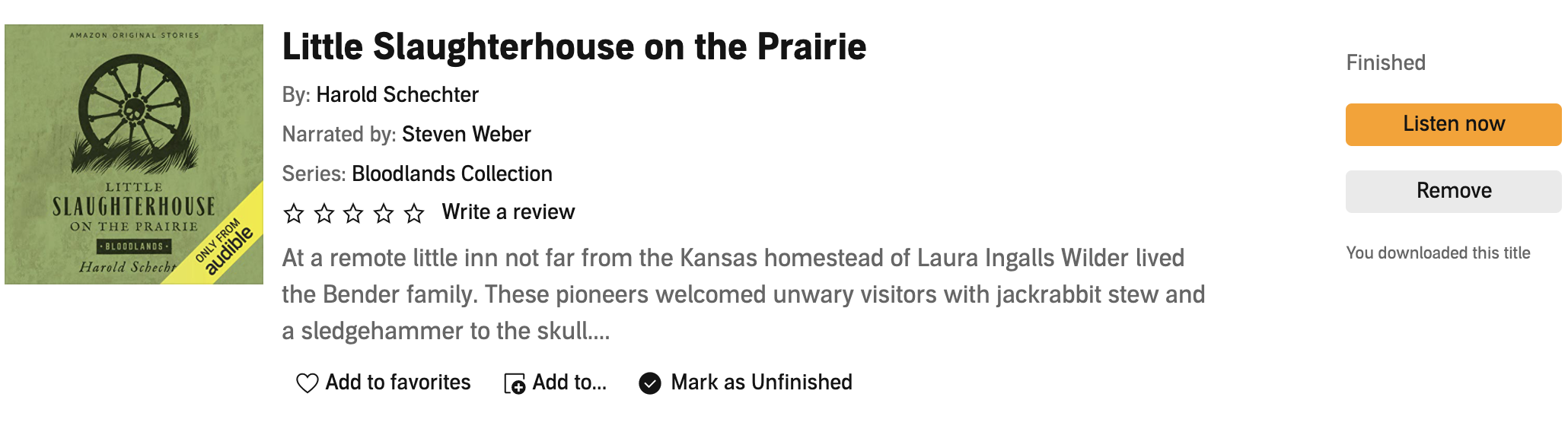
Little Slaughterhouse On the Prairie by Harold Schechter, Narrated by Steven Weber

Little Slaughterhouse On the Prairie shares the story of the Bender family, contemporaries of Laura Ingalls Wilder’s family in Kansas during the late 1800s. A family of serial killers operating an inn in the remote, seemingly endless fields and plains of Kansas, the Benders were responsible for an unknown number of missing persons.
Like something out of the fictional Splatter Western tales published by Death’s Head Press, the Benders were a monstrous family. Inviting guests into their inn for dinner and sleeping accommodations, those guests would frequently be greeted with a sledgehammer to the head before being further mutilated, robbed, and disposed of on their sprawling homestead. Men, women, and children alike fell victim to the predations of the Bender clan.
The mystery of where the Benders disappeared, and what might have happened to them as they evaded justice was the primary focus of this narrative. Unfortunately, Schechter doesn’t seem to have any answers, even after all of his research. Ultimately, we’re left with more questions as multiple theories are proposed, some more appealing than others.
Steven Weber’s narration is, again, fantastic. His delivery of these gruesome, historical details is satisfying and articulate.

Dark Places by Gillian Flynn: Narrated by Rebecca Lowman, Cassandra Campbell, Mark Deakins, & Robertson Dean

Dark Places indeed.
This book takes the reader/listener to some truly dark places.
A Kansas family was slaughtered in the middle of a cold January night in 1985. The only survivor was the youngest daughter, Libby Day.
The oldest child, Ben, is the easy suspect for everyone. He’s a troubled teenage boy with a darkness inside of him that easily feeds into the Satanic Panic running rampant in those days. But was he guilty? Was Ben just as innocent of these horrific crimes as he was of the sexual assault accusations being leveled against him by numerous grade school girls?
We join Libby as an adult, running out of money from the donations sent her way as a sympathetic child survivor of the Day family massacre. No longer the sympathetic, victimized young girl, Libby lives in squalor and never quite figured out how to properly take care of herself. This desperate situation is what leads her to The Kill Club, a group of true crime fanatics who imagine themselves to be investigators.
Ripping off painful bandages and digging into a past she only barely recalls, Libby begins to question her courtroom testimony from all those years before. Some mysteries are better left in the shadows, though. Proving Ben’s innocence might lead to nothing more than further death and horror.
Gillian Flynn has a knack for developing interesting characters without making them feel particularly sympathetic. The characters populating Dark Places are no less captivating than others she’s developed, in large part because of precisely how flawed and sometimes awful they happen to be. Despite those flaws and the fact that it’s hard to care about the characters, you can’t help but find yourself invested in what’s happening.
The narrations performed by Rebecca Lowman, Cassandra Campbell, Mark Deakins, and Robertson Dean are fantastic. We experience different characters, at different times, with distinctly different voices…and it’s a nice touch.

Is That Guy a Murderer? The Answer Is He Might Be.

Once upon a time, I used to do a great deal of shopping at our local Best Buy…back in the days before I realized just how much money I was wasting buying things there instead of doing so online. There was a sales representative there who frequently struck up conversations with me and we seemed to have fairly similar areas of interest. Admittedly, being not the most social person, I did find this individual a little bit annoying…but he seemed to just be sort of lonely or socially awkward (like I have room to talk), so I didn’t go out of my way to avoid him and the ensuing conversations when I saw that he was working.
In addition to those encounters at Best Buy, I began running into him while standing in line for Midnight releases of video games from GameStop. Yes, I was one of those people for quite some time. We chatted when we saw each other there was well, which wasn’t infrequent since we both appear to have wanted a lot of the same video games on release night. Again, refer back to my comment about he and I having similar tastes.
A couple of years later, after not running into him at all, a girl I was dating at the time invited me to join her at a friend’s house. This friend happened to be dating the individual in question. Naturally, we recognized one another and chatted a bit more. I wasn’t comfortable there, and I chalked that up to my normal discomfort in other people’s homes. It turned out, as I discovered later, this guy was abusive toward his girlfriend and the household was indeed filled with a good deal of tension. They broke up a short while later and I didn’t see him again. I was not unhappy about that.
Another couple of years pass.
The next time I see this man is in a photo of him attached to a news story about how a friend of his had hired him and another mutual friend of theirs to murder his girlfriend. They picked her up in their car ostensibly to give her a ride somewhere, and after they were away from civilization, the guy I’d chatted with so many times stabbed his friend’s girlfriend and killed her while the other man held her down. He and the other fellow drove her body out into the Black Hills and buried her before returning to their lives for the following year or so until the story broke.
There’s a whole lot more to that story, including the fact that the boyfriend who’d hired the killer(s) then convinced a couple more friends to dig her up and bury her body somewhere more remote, thus making it impossible for the killer(s) to lead authorities to the body if they were so inclined (after he didn’t pay them).
I’m not going to delve into it any further than this, it’s been reported in great detail in various South Dakota newspapers and on television news programs. I just thought it was interesting to know that you or I could, at any point, during any interaction, be talking to a person capable of cold-blooded murder.

The idea to write this blog post came from the fact that a friend of mine who works in local television had recently written a story for the station, providing updates on the court case in question.

An Interesting Religious Discourse

This afternoon, before leaving for work, I became invested in a conversation that an old friend of mine was having. The conversation began when he posted something on Facebook that claimed that the Islamic culture condones rape, murder, terrorism, necrophilia, pedophilia, and bestiality; while simultaneously arguing that no such thing could be claimed with respect to the Christian faith which he adheres to. I couldn’t resist becoming involved.

“Actually”, I replied, “Rape is condoned in the bible…in multiple places throughout the Old Testament. Murder is repeatedly condoned and even pushed upon the chosen people as the right course of action; in fact, Abraham was asked to murder his own son only to have God step in and tell him that he was only testing him. Bestiality wasn’t and neither was necrophilia, you’re right there, but neither of those things are actually condoned in the Koran either…and pedophilia was condoned in all cultures at that time, up until recently (because what we consider pedophilia was nothing more than the usual time when children were of age to marry and bear children).”

At this point, someone else involved in the conversation stated that what I was saying would make no difference as the ‘friend’ in question does not believe in the Old Testament and considers it to be the word of the Jews.

To which I was forced to respond, “Well, Jesus himself stated quite clearly that he didn’t come to change a word of the law that came before him, that he wasn’t changing anything about what God had bestowed through the Old Testament.”

The response to my statements was to suggest that he was glad that I knew my Bible and that it was also a curse for me, he was sure.

Not knowing what he meant, I had to ask, “A curse? I’m afraid that I don’t follow your reasoning behind that.”

His response was that I would forever struggle, while suggesting that he would like to know of any ‘rape’ that could be found in the Bible.

“Struggle?” I asked, “I don’t experience any struggle from knowing the Bible or any other holy books. I guess that I just don’t know what you mean. As far as incidents of condoned rape…you can look to Judges 21, Deuteronomy 20, 21, and 22, Numbers 31, and easily another dozen or so places. Some of the same chapters have some very straightforward references to murder and infanticide as well. I’m curious as to how the repeated pushes for the murder of infants corresponds with the anti-abortion sentiments expressed by modern Christians.”

Another participant in the conversation then mentioned a Biblical reference from Numbers 31 which included multiple rapes, some genocide, as well as a great deal of murder and destruction.

“2nd Samuel has some really pleasant imagery regarding what was just stated,” was my follow up to that.

My ‘friend’ stated that none of this was condoned.

I was forced to return with, “God told them expressly to commit the rape. How is that not condoned?”

I opted to share the following verse:

Deuteronomy 21: 10-14:

10When thou goest forth to war against thine enemies, and the LORD thy God hath delivered them into thine hands, and thou hast taken them captive,
11And seest among the captives a beautiful woman, and hast a desire unto her, that thou wouldest have her to thy wife;
12Then thou shalt bring her home to thine house, and she shall shave her head, and pare her nails;
13And she shall put the raiment of her captivity from off her, and shall remain in thine house, and bewail her father and her mother a full month: and after that thou shalt go in unto her, and be her husband, and she shall be thy wife.
14And it shall be, if thou have no delight in her, then thou shalt let her go whither she will; but thou shalt not sell her at all for money, thou shalt not make merchandise of her, because thou hast humbled her.

“That, my friend, is rape. Forcibly taking a woman from her home after slaughtering her family (including possibly her husband), keeping her as property and having your way with her…that is rape. Try it today and you will spend a long time in prison (for murder, kidnapping, and rape).”

He replied by saying that those actions were not condoned by God or by Jesus.

I felt compelled to remind him, “That was God issuing those commands…according to the Old Testament. That is more than condoning it, that is forcing it.

“I hate to say this, my friend…but you really don’t seem altogether too familiar with anything pertaining to the Bible…seems a bit absurd to call yourself a Christian while knowing almost nothing about what your holy book happens to say about pretty much anything.”

He replied by insisting that those actions were from the Old Testament which was meant for Jews who were the only ones saved at that time and who got mad when God game the same grace to gentiles and changed the rules, that the old rules were no longer true. He continued by suggesting that those who know the Bible and do not live by the word and humble themselves before God are twice as bad off as those who do not.

I had no choice but to respond with, “There is no Christian faith that doesn’t accept the Old Testament. And Matthew 5 makes it very clear that Jesus did not change a word from the law of the Old Testament or of the prophets. And there is no place that says that those who know the Bible and do not live by the word are worse off than those who do. I do a better job of living a moral and respectable life than most of the Christians that I know…maybe because I actually do know what their Bible says and they simply accept the word of a man who interprets it and spits out twisted variations to suit their desires.”

His response was to say that he accepts Old Testament teachings as well as all Christians, that what he didn’t accept is my using the laws of the Old as those of the New because I know that this is not the truth.

“You really should take the time to actually read the book that you base your faith upon, I replied. “I was raised in a Catholic household, attended catechism classes every weekend throughout my childhood, and even attended Catholic school for two years. I have read the Bible from beginning to end, and snippets of different versions of it to compare them…as well as English translations of numerous other religious texts from other cultures. It is precisely because I am so familiar with these books and that I have studied various sciences and happen to use a good amount of common sense and critical reasoning that I don’t believe what you believe.

“The words of the Old Testament are no less valid than those of the New…nowhere in any version of the Bible does it claim that the New Testament supersedes the Old, replaces it in any way, or invalidates anything written within it.

“In addition to reading the Bible, my friend, I would recommend that you read Misquoting Jesus by Bart D. Ehrman…he’s a religious scholar from Chapel Hill. You might benefit from reading that as well. And, on the subject of reading, I’ll use this as a chance for shameless self promotion and recommend that you read Unspoken, by yours truly…there is no correlation between my novel and anything referenced in this conversation, but I’m trying to weasel in a plug for my book anyhow.”

His immediate reply was to state that Jews don’t believe in or study the New Testament and yet they still do not practice the same way that they used to. Further, he stated that Jesus never paid attention to the laws of the Old Testament, which was why the Jews were mad, and eventually had him killed.

“The Romans actually had him killed,” I returned, “the Jews were subordinates to the Roman rule of Jerusalem. There were some of a scholarly class of Jew that weren’t pleased with Jesus, but they didn’t have him killed. They had neither the political pull to force the Romans to do such a thing nor the sway within even the Jewish community.

“They don’t follow the New Testament because they don’t believe that Jesus was the promised messiah…and early Christianity was hugely conflicted on what they believed as well. It was only because of a Roman, Constantine (hundreds of years after the death of Christ), that the modern form of Christianity exists today…if you were to look back at the various forms of Christianity that existed prior to that, you would consider most of them absurd.”

My ‘friend’ accused me of cherry picking the Bible for the bits that best fit my argument and then proceeded to do precisely that with the Koran, pulling up references to Aisha and using them to promote his earlier argument about Islam condoning pedophilia.

I replied with, “Numbers chapter 31 has multiple references to young girls being taken by the chosen people at God’s behest. But I’m not saying that the Bible promotes pedophilia, nor the Koran. These young girls are no younger than the girls who were getting married during the settling of this country…it wasn’t pedophilia or considered to be at all wrong or unnatural until recently (and only in some cultures, even today).

“To try and state that either the Bible or Koran promotes pedophilia is to misinterpret what was said through a lens of our culture today. Today, it’s not acceptable for a man to take a 12 or 13-year-old girl as a wife, but that was totally fine less than 200 years ago, here in America. You’re wasting your time trying to argue that the Koran promoted pedophilia, my friend…it’s apples and oranges at best…and your own religious heritage promoted the same behavior.”

His retort was that I could condone anything when I believe in nothing.

“I don’t condone it,” I stated, “not in the least…but had any of us been living during the times of Jesus, Muhammad, or Abraham that is precisely what we would have been doing. It was the cultural norm for essentially every culture of the time…and it is still the norm for numerous cultures around the world.”

At this point he returned to commenting on Aisha, stating that she was 6.

I replied with what I had always believed to be true, “Actually, she was either 9 or 10 when she married Muhammad…which was a common age for marriage in the culture…and it wasn’t consummated until after that.”

His reply, which may be correct, was that she was 6 when she married Muhammad but that he didn’t penetrate her until she was 9 and that this sort of thing was still in practice in Islamic culture.

I was getting frustrated by this point when I responded by saying, “Hell, throughout European and American history we have countless examples of girls being promised to men well before the age of maturity…which is the same thing.”

His response was to insist that by arguing for it, I did in fact condone it.

“No, I argue that you’re distorting the facts in order to claim that there is a cultural precedent for pedophilia within the Islamic people…when the same precedent could be argued for your own faith and culture. There are still religious sects within Christianity (not mainstream, by any means) where young girls are promised to older men before they reach physical maturity as well. To argue that there are still Bedouin sects that do the same and apply it to all of that culture is no better than someone looking at those splinter branches of modern Christianity and accusing you of being complicit because you are also a Christian.”

I continued, “I don’t condone a number of things that are practiced in countless different cultures. I don’t condone a lot of what is done by our own culture here, but I’m not blind to it happening. Being aware and non hypocritical about it doesn’t equal condoning it. I’m in no position to judge the actions of a culture that I am removed from by a millennium or more…I can’t even properly comprehend the lifestyle of the people that lived in those days.”

He opted to change the subject then, by stating that he was glad that our morals come from Christianity, and that it was for this reason that I find those things to be wrong.

With no small amount of irritation, I said, “No! Most of the things that Christianity took as a moral code were well established centuries before there was anything even remotely like Christianity. In fact, a lot of the morality derives from pre-Judaic cultures of Babylon and Assyria…hell, Babylon was where a lot of the Old Testament stories and myths were derived from; during the time that the Jews were enslaved there, they adopted a lot of the myths of the Babylonian captors and then rewrote them to correspond with their own beliefs after being released.

“Our morals come from simply knowing what we don’t want to have done to us and applying that same judgment to people external to ourselves (an inverse of the golden rule). Kin selection and in-group, tribal components still apply, which is why it is easier for any culture to commit acts against another culture that they would never allow internally. We practice immoral acts against other cultures on a regular basis, and Christianity is guilty of that same thing just as much as any other religious or nation-state culture. Outsiders are still considered to be “something less” in a number of respects, and that sort of mentality is a remnant of our primitive origins.”

I took a brief respite from the conversation, and during this time my ‘friend’ said something about how God doesn’t want us to go to Hell and that the reason there is a Hell in the first place is because of our own sin and the disobedience of the Devil.

I found myself compelled to return to the conversation long enough to say, “Actually, regarding that whole Devil and disobedience thing; it couldn’t have happened, part of what separated man from angel is free will, angels didn’t have it. That was what it meant to be made in God’s image, to have will and to be able to shape the world according to that will, not that we looked like God…but that we were given volitional consciousness, something angels didn’t have. There could have been no rebellion without will to do so, and though this Lucifer was supposedly cast into the pit, he is right there in Heaven with God in the book of Job, testing the faith of God’s most loyal servant on Earth.”

That was the end of the conversation for me. I had no interest in continuing any further. For those of you who are unaware, I am an atheist and not the least bit apologetic about it. I wasn’t participating in the conversation to be antagonistic or mean spirited, but because the subject interests me.

What scares me is that my ‘friend’ is far from the only person who believes the things that he does believe, and he votes. I have plenty of religiously inclined friends and acquaintances, but it’s this sort of uninformed and ignorant belief structure that my ‘friend’ exhibits that terrifies me.