Demon Theory by Stephen Graham Jones, Narrated by Richard Ferrone

Like much of what Jones has written, Demon Theory defies easy classification and mixes subgenres with fluidity and skill that borders on awe-inspiring. There’s a little bit of Watcher In the Woods, a touch of Jacob’s Ladder, a hint of Scream, and perhaps a taste of the first two Return of the Living Dead films serving as inspiration behind this book–that in turn serves as the novelization of three fictional films constituting the “Devil Inside” trilogy. Filled with pop culture references and nods to obscure horror flicks (for today’s audience), witty dialogue, meta-commentary, and as much dark humor as there is horror, this book is an excellent experience for fans of Stephen Graham Jones.

We begin on Halloween night as a group of medical students goes to Hale’s childhood home where his diabetic mother needs assistance. When they arrive, with Hale’s mother nowhere to be found, they soon discover they’re stuck in the secluded and rundown house as a snowstorm rages outside. As the story progresses, we discover the six med students aren’t alone, and it takes on a sort of slasher narrative as we learn more about Hale’s family, his childhood trauma, and the presumed identity of the killer. As the body count rises and the possible supernatural elements are introduced, we speed toward a conclusion that feels fitting, though slightly ambiguous.

The second installment of the trilogy begins with a familiar scenario that’s been touched on in the first, but things aren’t quite right. The deck has been shuffled and we’ve moved forward in time and simultaneously backward, it seems. Familiar faces appear but in different roles. The names may be the same, but the details are off…however, it isn’t long before we learn that recollection of the previous story’s events are clear to at least one of the returning characters–though Nona is treated as if these “false” memories are indicative of mental illness. It’s almost Christmas, and we ultimately find ourselves in a hospital where the staff prepares for a performance to entertain the patients. This installment skips the slasher element and dives right into the supernatural aspect we experienced in the earlier tale, amplifying the stakes and the danger. It’s no longer simply the cast of six facing the horrors that we witness arising in the hospital corridors–but how many people would believe that demonic entities are afoot before it’s too late?

The final piece of the trilogy comes as a direct sequel to the second installment, but following another time jump. We’re three years further along and many familiar faces have returned, this time taking the fight back to Hale’s childhood home, hoping to stop whatever nightmare they’ve been living in since they first stepped foot into that house. Nona has a plan, but can her judgment be trusted? Can anyone be trusted, as we delve deeper into the events that brought all of this about? Supernatural horror meets slasher meets brazen scientific experimentation as we learn the truth about Hale’s father, his sister, and the identities of the friends who accompanied Hale home in the first place. This one starts off with a splattery, violent bloodbath to up the ante as a group of punk criminals first arrive at the isolated house as a sort of initiation rite, setting the stage nicely for what awaits our returning cast of characters when they show up only a short while later.

Richard Ferrone’s narration is phenomenal, conveying a sort of homage to the voice of Ghostface from the Scream movies, which feels as perfect as could be with the self-awareness and referential nature of the characters contained within the narrative as well as the writing itself.
Meddling Kids by Edgar Cantero, Narrated by Kyla Garcia

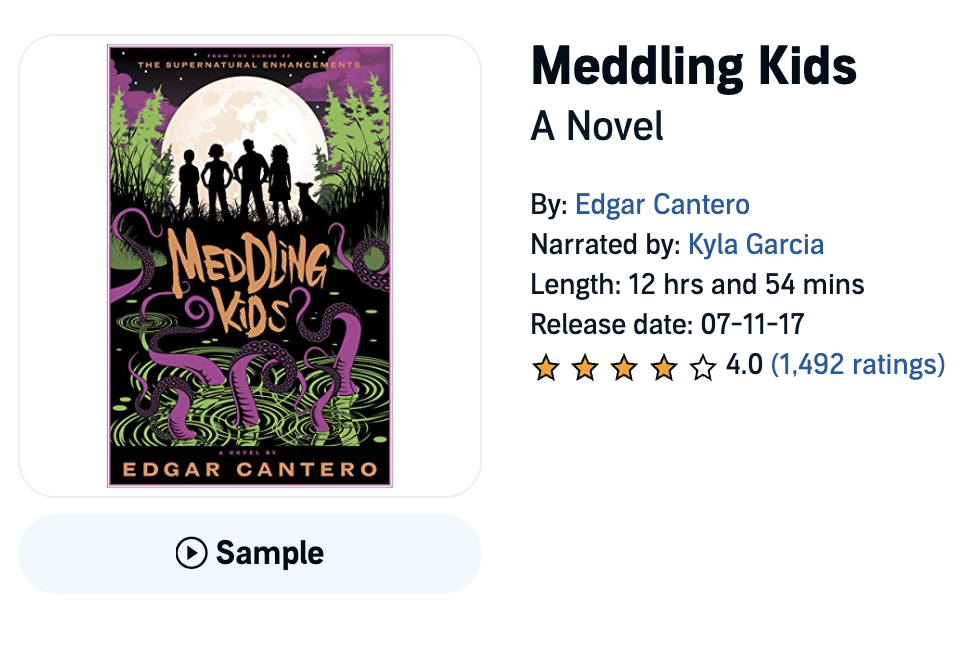
One of my favorite things about Scooby-Doo was that the monsters, ghosts, and ghouls were never real. It was always just some creep in a costume, usually undertaking some ridiculously convoluted plot to fulfill their capitalist desires. When the more recent Scooby-Doo cartoons and movies came out, I was disappointed to see that there were real monsters involved. The creators seemed to lose track of the whole purpose behind the originals. That being said, if the monsters have to be real for the purpose of the story, Edgar Cantero gets it right.

Meddling Kids takes those teen mystery stories we loved as children–at least I did–and pays homage to them while also playing tongue-in-cheek with the tropes. The Hardy Boys, Nancy Drew, and Scooby-Doo are blended together in this story, with a healthy dose of H. P. Lovecraft thrown into the mix.

Thirteen years after the Blyton Summer Detective Club solved their final mystery, the awful truth behind that caper rears its ugly head, forcing the surviving members to question whether they’d gotten it right after all. Sure, they’d apprehended a crazy old man in an absurd costume, and they’d gone on with their lives. But what if there was something more lurking beneath the surface? What if there was some unspeakable horror operating behind the scenes at Sleepy Lake? And did their proximity to something truly not-of-this-world leave a mark on the children that haunts them into adulthood?

This is where the story begins. From there it’s a humorous and heartfelt tribute to characters that bear a strong–and entirely intentional–resemblance to the ones Cantero created for the book. The mystery behind the mystery provides ample opportunity for (often calamitous) investigations, red herrings, and the emergence of a new bad guy who makes all their previously tackled foes seem like child’s play. It’s a good thing the young detectives are now young adults because what they’re forced to face is something no child is prepared to confront.

Kyla Garcia’s narration is excellent and conveys the humor and horror of the story as well as one could hope.

Monochrome Noir: A Gathering Storm by Jack Wells

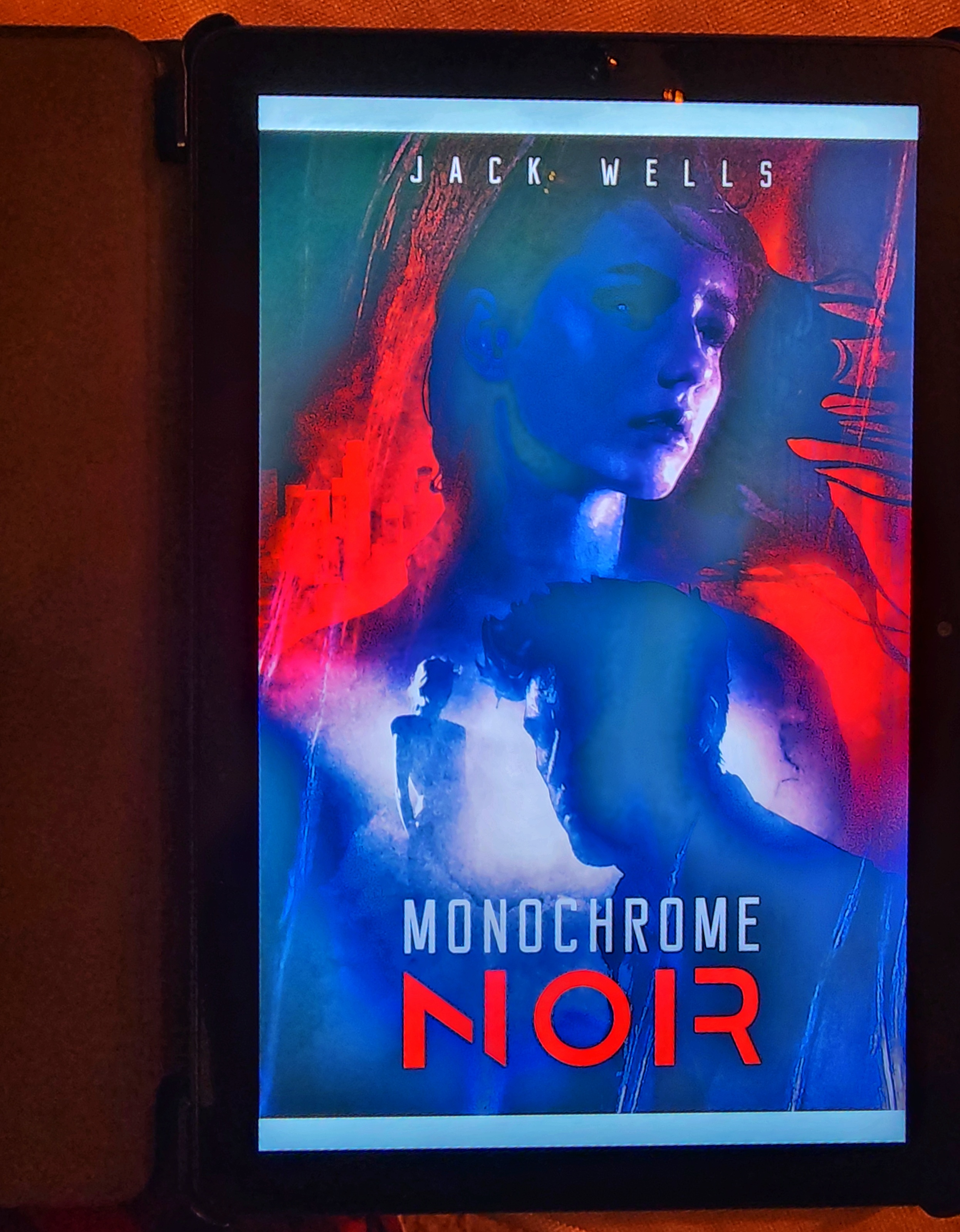
Monochrome Noir: Book 1 (A Gathering Storm) introduces us to a world just like our own, but where everything is black and white, and color is of such priceless rarity that people will kill to own items that have been imbued by those who have the gift to bring color to life in the monochromatic items of everyday life.

When a strange and grisly series of killings begins, private detective Henry Hardcastle is hired by a mysterious woman with secrets to keep, and a deeply personal stake in the resolution of these terrible murders. As Henry struggles to navigate a world that isn’t quite what he believed it to be, a young woman, Charlie Grant is struggling with her own nightmare. As their independent journeys for understanding spiral around the central crux of the deranged killer stalking Angel City, we’re forced to wonder if they can fill in pieces of the puzzle for one another if they’re able to come together before one or both of them winds up dead.

Jack Wells does a fantastic job of building a world that’s as captivating as it is unreal, populating this world with characters sure to appeal to readers from a wide variety of tastes, and breathing new life into the hardboiled detective genre many of us adored when we were younger–and some of us never stopped adoring.

This is only Part 1 of the four book series, so there’s much more to come if you manage to weather the gathering storm.

All the Sinners Bleed by S. A. Cosby, Narrated by Adam Lazarre-White

With All the Sinners Bleed, S. A. Cosby further cements himself–in my mind at least–as one of the greatest living authors writing today. His characters breathe from the page, forcing themselves to feel as real to the reader as they are to the man writing them. This novel is no exception.

Sheriff Titus Crown is the first black sheriff in a Virginia county where racism is still alive and well, as it is in far too many places in the real world. A former FBI agent haunted by the traumatic events of his past, Sheriff Crown is thrust into the midst of a horrific nightmare of child torture and murder when a young man kills a well-loved high school teacher in broad daylight before being shot by deputies. The investigation unveils monstrous secrets hiding beneath the surface of a small town, connected with an evangelical church…as the latent tension and bigotry within the community come to a boil while a monster roams free, hidden in plain sight.

There’s humor, horror, drama, and suspense alike within this story, as with all of Cosby’s books. The narrative is as heartbreaking as it is thrilling, and the fleshed-out family dynamics for Sheriff Crown are so true-to-life as to feel like we’re learning about a real man facing impossible odds.

The narration provided by Adam Lazarre-White is as spectacular as always, and I sincerely hope he continues as the voice attached to Cosby’s novels.

Travel By Bullet by John Scalzi, Narrated by Zachary Quinto

Travel By Bullet returns fans to John Scalzi’s The Dispatcher series following a pandemic that isn’t altogether too dissimilar to the one we’ve experienced in the real world. Unlike the real world, Tony Valdez and other dispatchers like him have had more work than they can handle, as grieving families insist on postponing the inevitable for loved ones hooked up to machines. Unfortunately, resetting only goes so far, and it won’t repair the damage done by the sickness itself. It’s a bleak and depressing scenario we find ourselves experiencing through Tony’s perspective.
When a friend is rushed to the hospital, begging Tony to let him die, it triggers a series of events that brings Tony to the attention of wealthy and powerful figures with secrets they’ll do anything to keep under wraps.
This installment continues Scalzi’s trend of combining the alternate reality science fiction of The Dispatcher series with an old-fashioned dose of noir that blends perfectly. The overarching mystery is satisfying and sufficiently convoluted, especially impressive considering the relatively short length of the story.
I particularly liked the concept behind the title of this installment of the series. The premise of utilizing the reset in that way seems both obvious and strangely horrific.
As with the previous two volumes, Zachary Quinto’s narration is superb, lending Tony a uniquely nuanced personality and bringing the other characters (many familiar faces from previous glimpses into the world of The Dispatcher) to life. I hope that Scalzi continues writing these tales and that Quinto continues narrating them because, like Scalzi’s seamless combination of genres, it’s a perfect blend.

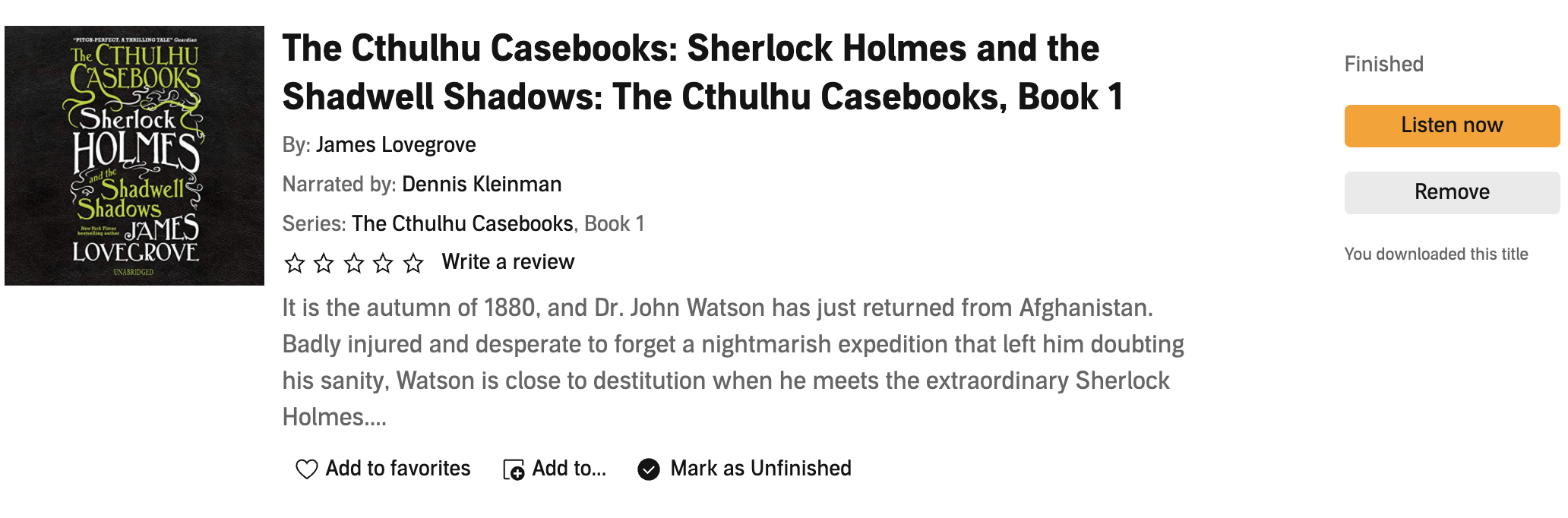
Sherlock Holmes and the Shadwell Shadows by James Lovegrove, Narrated by Dennis Kleinman

James Lovegrove writes himself into the narrative with The Cthulhu Casebooks, in a fictionalized account of his own life in the preface to this tale. As a distant relation to the former H.P. Lovecraft, a parcel finds its way to him upon the passing of another member of the Lovecraft family.
Contained within is a trilogy of manuscripts penned by Dr. John Watson, confidant and partner of Sherlock Holmes. In the tale that unfolds, we learn that the meeting of Watson and Holmes did not transpire as we’ve come to believe. Additionally, further elements of Watson’s previously available documentation of the cases he and Holmes investigated have been fictionalized to protect the world from forbidden knowledge of things best left unknown.
From the deserts and mountains of Afghanistan to long-forgotten catacombs beneath London, a global tale of unspeakable horror emerges. Upon meeting one another, Holmes and Watson find themselves in pursuit of answers to a rash of ritualistic deaths occurring during the new moon. What they discover will leave the pair, as well as other familiar characters from the Holmes’ archives, changed in ways never hinted at within the released accounts from Watson.
All-in-all, this was a worthwhile mixture of the Lovecraftian mythos and the characters developed by Sir Arthur Conan Doyle. The writing style emulates Doyle’s prose surprisingly well, and the insertion of creatures like Nyarlathotep and Cthulhu into the narrative was performed seamlessly. The story itself didn’t impress me quite as much as I’d hoped, but it was decent enough to nudge me toward checking out the additional two volumes in this series.
Dennis Kleinman’s narration of Watson was quite fantastic, as was his performance of Holmes’ dialogue. Sadly, the other characters felt perhaps a bit less set apart from the background. This is not to say that they weren’t distinct enough to tell them apart, because he managed that quite well, just that they weren’t brought to life in quite the same way the two protagonists were.

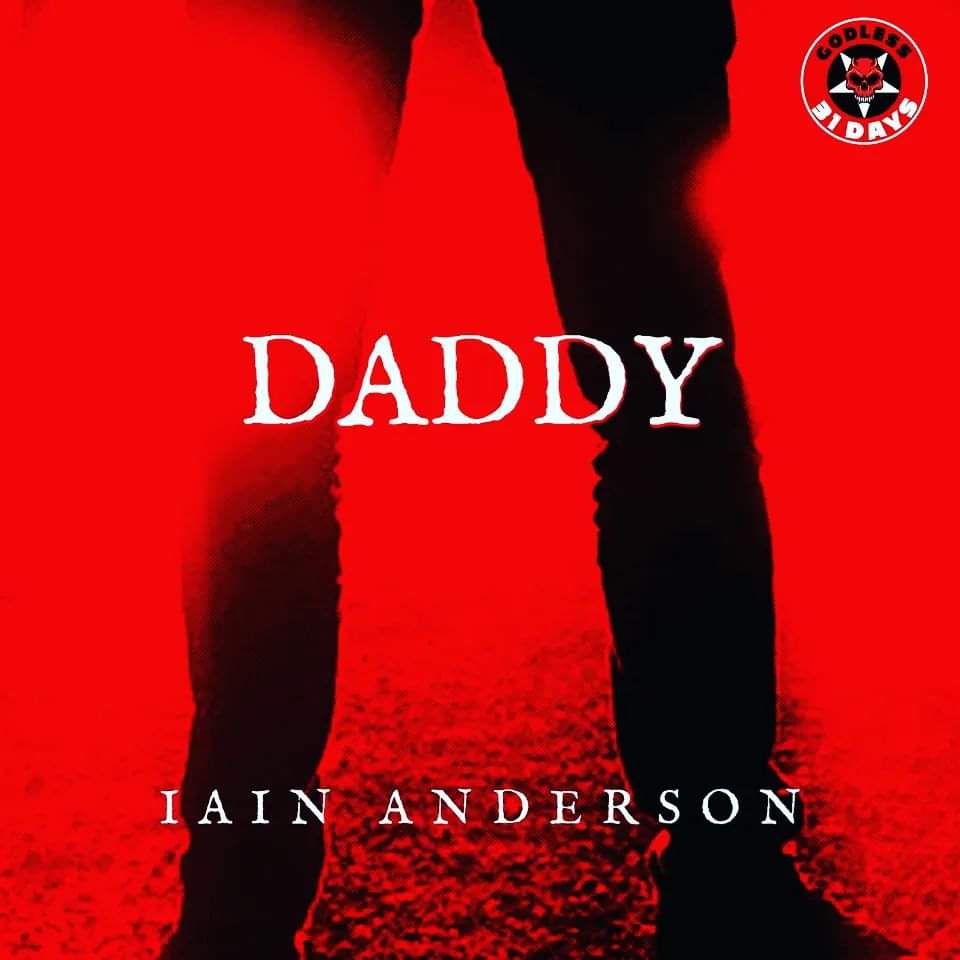
Daddy by Iain Anderson

Iain Anderson’s Daddy was as surprising as it was captivating, keeping the reader–in this case, me–guessing until just before the shocking pivot in the narrative.
Lauren is kidnapped and she’s certain it’s the work of a brutal murderer the press has dubbed The Callendar Man. Forced into a small, dark shed, Lauren soon learns she isn’t alone in the confined space.
This story has something for everyone. We have a father’s love. There’s a sinister string of missing people turning up dead in a gruesome fashion. And, finally, we have the mystery of who or what is in the shed with Lauren.
Iain Anderson might just answer the question that’s been plaguing you your whole life. Who’s your daddy?

Daddy is the Day Four release for the 31 Days of Godless event celebrating October 2021 at http://www.godless.com and you can obtain this story for yourself by going to the website or by downloading the app. The link is below:

Daddy by Iain Anderson

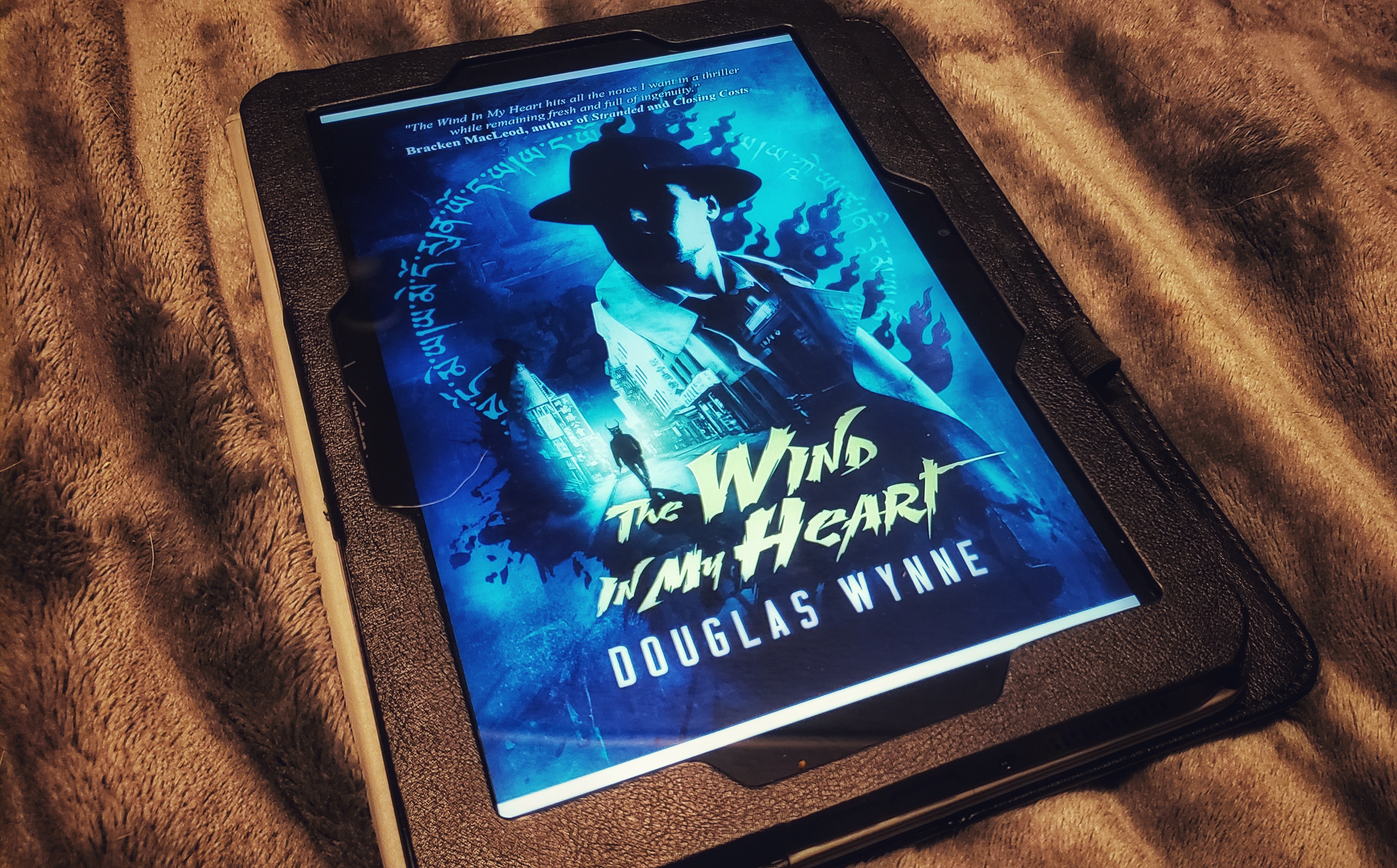
The Wind In My Heart by Douglas Wynne

Douglas Wynne knows how to craft a captivating tale. The Wind In My Heart–while taking place in the 1990s–hearkens back to the hard-boiled detective stories of authors like Dashiell Hammett and Raymond Chandler. For being a couple of generations removed from the anti-hero protagonists of those books, Miles Landry wouldn’t be out of place at all. Of course, it helps the aesthetic that this takes place in New York’s Chinatown.
Blending this combination of an old school detective noir with Eastern philosophy–in the Tibetan crisis-conscious New York of the early 1990s–creates an enchanting sort of mandala in literary form. Threads of the story circle back around, creating new patterns and surprising twists as the narrative takes shape and arrives at a final form…before being swept away like sand as you reach the conclusion and set the book aside.
Hired by the monks of a Buddhist community center to investigate what they believe to be a supernaturally perpetrated series of murders, Landry must traverse a dangerous gauntlet between Chinese gangs, the police, and a possible supernatural threat that stands to tear his world apart.
Unlike altogether too many books, there was an unexpected twist to this story…but not one that felt flimsy or poorly crafted. Nothing about Wynne’s book was poorly crafted.

Hummingbird Salamander by Jeff VanderMeer

My first exposure to Jeff VanderMeer was my purchase of City of Saints and Madmen in May of 2006. I was in my mid-20s and exploring more surreal literature; strange fantasies and bizarro being the two genres I was most greedily diving into. Upon reading that peculiar assortment of strange tales and explorations of the fantastic city of Ambergris, I could hardly wait to read more of his work.
I’ve been a fan since that time 15 years ago, and VanderMeer has not disappointed me since.
Hummingbird Salamander is a bit different from his other works, taking place neither in a feverish land of nebulous division between dreams and waking life nor in a future version of our world, transformed by otherworldly forces. Instead, this novel takes place in the here and now, though perhaps not quite the way you or I would recognize it in subtle ways.
We are first introduced to a mildly paranoid digital security consultant who serves as our unreliable guide through the events that unfold as she begins her journey to unravel a mystery that remains at least somewhat unclear as you reach the final page. It should be said, that if you go into one of this author’s books expecting clarity and a tidy resolution, you’re probably in the wrong place.
Elements of mystery and layered narratives are far from uncommon within VanderMeer’s work, but this particular story showcases the excellence of the suspense form when lovingly crafted by his mind and hands.
Familiar themes from his work are on vivid display within this narrative, ecological concerns, curious uncertainties relating to identity and the self, and suggestions that what is real might not be quite so clear as we commonly understand it to be.

The Mind Is a Razor Blade by Max Booth III

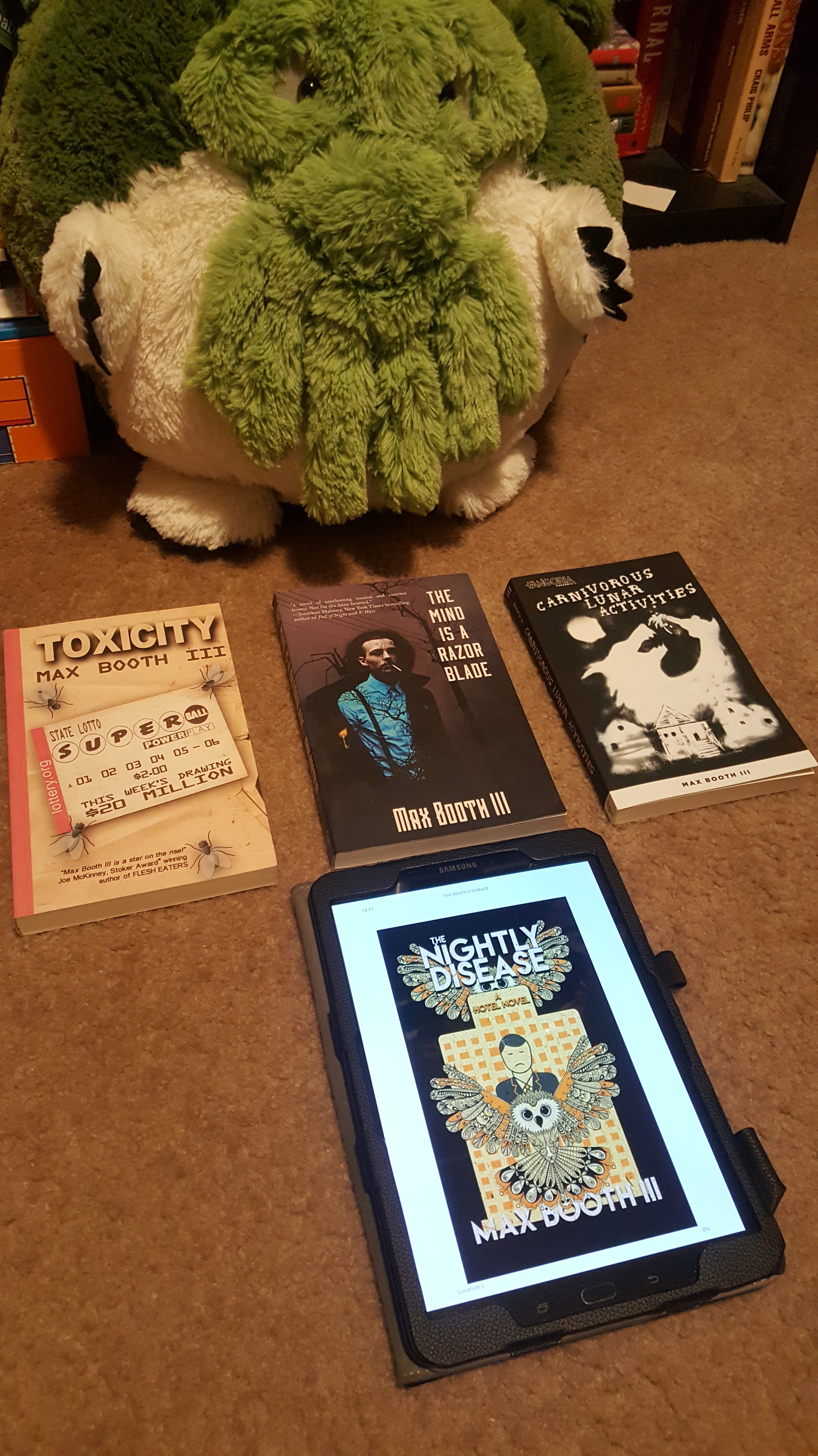
This review was originally written in the summer of 2015. As you can probably tell from the picture above–as well as other, more recent reviews–I’m a bit of a fan of this particular author.

I went into The Mind Is a Razor Blade by Max Booth III without any expectations and no knowledge of the plot beyond what the back cover provided.
It starts off sporadic and disorienting, perfectly conveying the state of mind of our protagonist, the very definition of an unreliable narrator.
A man wakes up naked in a river with a corpse nearby and no idea who he is, who the corpse is, or how either of them got there. In the first few minutes of reading the book our protagonist has stolen a coat from a corpse, shot a man numerous times, and made a stumbling but successful escape from the police.
Believe it or not, the story gets crazier from there on out. As our protagonist begins getting a marginally better grasp on who he is and what is going on the narrative simply becomes more bizarre and disturbing along the way, keeping the narrator on his toes (and, by extension, the reader as well).
Through the protagonist, we become unwilling tourists through a city driven mad by drug use, organized crime that crosses into the supernatural while exhibiting the hallmarks of a cult, and inhuman creatures that hunt for organs from the populace…also, there are spiders, lots of spiders. In the midst of all of this, there is also redemption and at the core a sense that love can transcend even the most horrific experiences.
This book contained all of the best elements of noir, horror, a sort of perverse humor, and surrealism. If you’re a fan of the movie Dark City or the book John Dies At the End, this is definitely something you might want to check out.