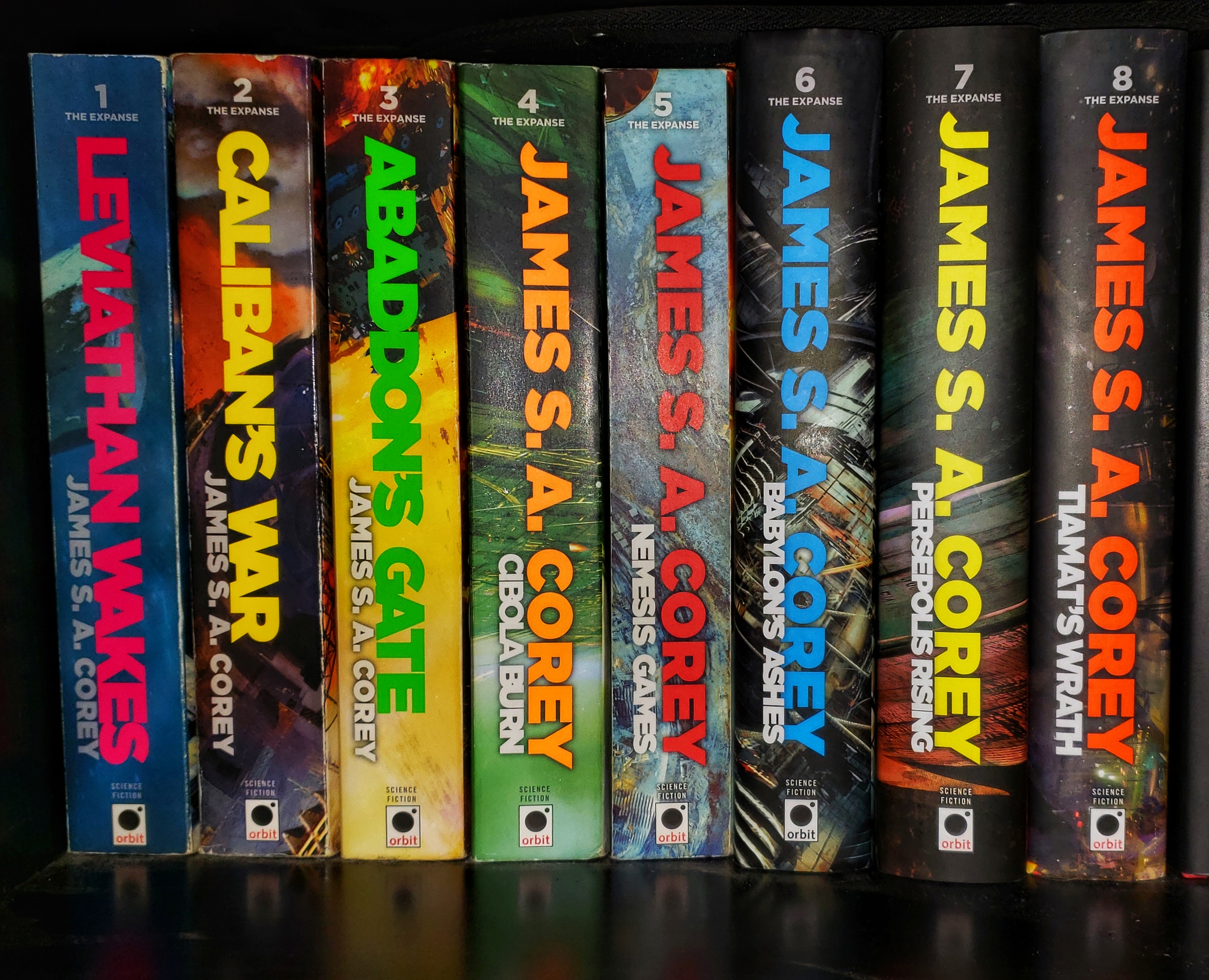
Leviathan Wakes by James S.A. Corey (Daniel Abraham & Ty Franck)

This review was originally written in early 2016

Leviathan Wakes is, without a doubt, the beginning of something amazing. I have the next two books in the series and I am looking forward to reading those as well as the additional novels I don’t own yet.
I owned this book for about three years without ever picking it up from my book shelf (I had pretty much forgotten about it) and I may have continued to neglect it were it not for The Expanse being produced by SyFy. Sadly, I watched the first season of the series before reading this novel and I don’t like doing that…but I don’t feel like it was detrimental in any way. I’d like to discuss a couple of the differences for those who have only either read the book or seen the television show before I do anything else.
There are some pretty dramatic differences between the book and the series, the biggest being that the first season ends about 3/5 of the way through the narrative of the first novel, which is something I truly hope SyFy addresses with the second season since there is a lot going on in that third act of the story.
The other major difference between the book and the television series is that we aren’t introduced to the political environment and maneuvering taking place on Earth in the novel, though I appreciate that additional subplot from the show and actually kind of wish it had been part of the book.
Beyond that, the differences are really quite minimal, some characters who don’t quite line up between the two mediums (either because of descriptions that don’t match up with the casting for the series or because the personalities/interactions are just a little bit off) and a couple of plot points that play out a touch differently or occasionally in different sequence…but those aren’t as troubling as they could be.
Written by James S.A. Corey (a fictional person, really the collaboration between Daniel Abraham and Ty Franck), this is one hell of an ambitious novel, successfully weaving space opera, militaristic science fiction, and noir mystery into an exciting, intense, and sometimes even scary tapestry.
The stated goal of the authors was to fill in the gap that is almost always present where science fiction is concerned. Typically we either end up with near-future cyberpunk or dystopian stories or distant future space operas and the like taking place after we have spread throughout the galaxy or even the universe itself. This book (and presumably the whole series) provides the reader with a suitably rich and detailed vision of what we have between those intervals, during the time when we are still colonizing our own solar system and only just considering setting our sights further into what we have beyond our galactic neighborhood.
The interactions between Miller and Holden (as well as their separate storylines) are fantastic and well-written enough that the two protagonists really do provide vastly different lenses through which the same events are being experienced. We see a lot of that in The Expanse, but there is a lot of subtext that gets lost in translation between the two mediums.
After reading this book I am determined to pick up some of Daniel Abraham’s fantasy novels, which I might have ended up doing anyhow. The man is an excellent author and Ty Franck clearly learned a thing or two while working for George R.R. Martin where grand, sweeping narratives and visceral (almost punishing) inevitability in narratives are concerned.
Whether you have already seen The Expanse or simply want to read an excellent science fiction novel, I have to recommend reading Leviathan Wakes.
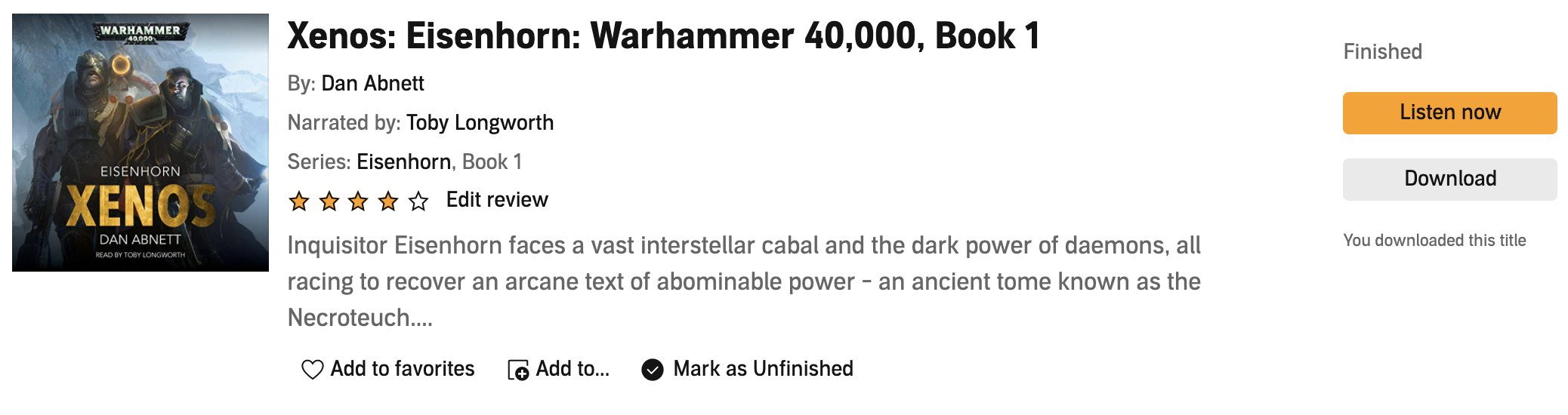
Eisenhorn Book One: Xenos by Dan Abnett

When people think of Warhammer 40K, it’s often in terms of large-scale warfare and military maneuvers/strategy. The tabletop game and the video games have often been more focused on those elements of the Warhammer 40K universe, so it makes sense that this is the thing first coming to mind. We all first imagine the indomitable space marine in their hulking power armor wielding a chain weapon or some absurdly massive firearm.
Eisenhorn: Xenos by Dan Abnett provides us with a more intimate, character-driven exploration of the Warhammer 40K universe, and it’s a great thing. Following Inquisitor Gregor Eisenhorn as he seeks to unravel the convoluted threads of a mystery involving ruling families, rogue traders, alien species, and Chaos Marines is an exciting ride indeed. With dire consequences looming on the horizon if Eisenhorn fails in his mission, we feel the tension all too vividly.
The narration from Toby Longworth for the audiobook edition is amazing as he brings to life the character of Gregor Eisenhorn as well as his compatriots and antagonists. An already captivating narrative is made all the more gripping with the harsh tones and grave articulation of this narrator.

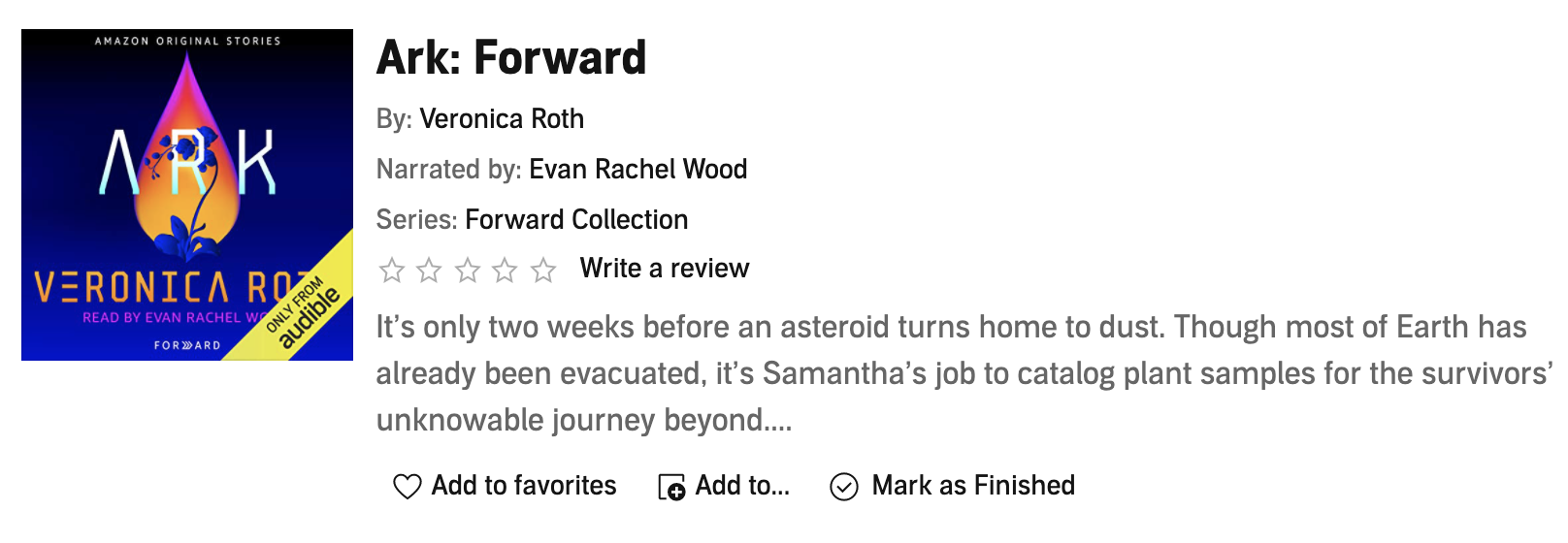
Ark by Veronica Roth: Narrated by Evan Rachel Wood

Veronica Roth’s Ark, her contribution to the Forward collection, is perhaps the most emotive and well-developed character study of the things I’ve read from her. I enjoyed the Divergent series as an adult, enough so that I was disappointed the movies never completed the story even as the movie adaptations managed to disappoint in the liberties taken with the narrative. In only a small handful of pages (under two hours of audiobook), Roth succeeded in capturing a particularly satisfying, somber snapshot of the world weeks away from an unavoidable apocalypse.

As an asteroid approaches the planet, sure to make it uninhabitable for humanity, we join Samantha and a small group of orphan scientists in Svalbard, Norway where they are cataloging and collecting biological samples of as much plant life as can be salvaged. A similar project is simultaneously taking place in Australia, focused on animal life. These small pockets of humanity are all that remain on an evacuated Earth. The rest of the human population had already left aboard generation ships, while those dedicated to the flora and fauna catalog risk everything by remaining until only a matter of a few weeks until impact. As the time approaches to say goodbye, we manage to feel some small amount of the desolation and loss through the quality of Roth’s storytelling.

Evan Rachel Wood’s narration is spectacular. Her voice easily capturing the interwoven tone of sadness and hope of this short tale. I’d honestly love to hear her narrating more audiobooks. She’s got a terrific range and capacity to bring characters to life.

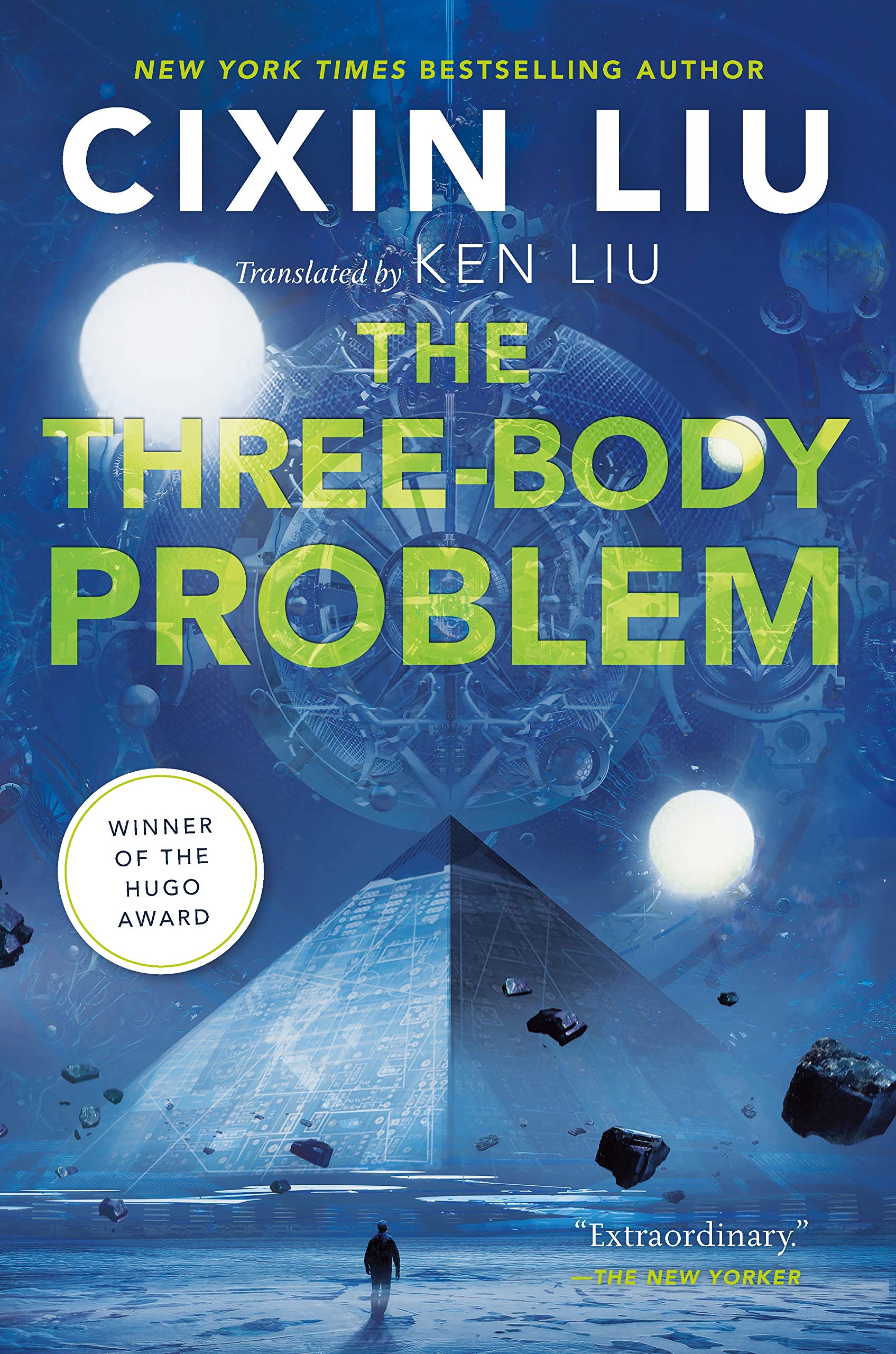
The Three-Body Problem by Liu Cixin

I’m copying over some reviews of titles I’d written up in 2018 and earlier, just in case these titles are new for other people.

Liu Cixin is an author I wish I could be more familiar with. The Three-Body Problem was a positively stunning piece of hard science fiction with a profound hint of the fantastic still built on extrapolation.
I don’t know what is lost in the translation from Chinese into English, but I find it difficult to believe that it could have been more well-written if it had been written originally in English. I suspect that this is equal parts the quality of the original material and the caliber of the translator. From what I have read it appears that the second volume in the trilogy has a different translator while the final volume is translated by the same man who expertly converted The Three-Body Problem into English. Sadly, though the second volume is available now, I have to wait until later this year before the third book is released in English.
This novel begins during the nightmare of The Cultural Revolution spearheaded by Chairman Mao and a good deal of the narrative focuses on the anti-intellectual and anti-progress philosophy that was imposed upon the whole culture during that time period beginning in the 1960s and continuing for a couple of decades after that. It is interesting, to say the least, to have a perspective on that period provided by someone who grew up through it as the author had.
From there it grows into a frankly captivating and disturbing first contact narrative that unfolds in a rather unexpected way. I can’t say much without giving altogether too much away, but I can’t recommend this book enough for anyone who enjoys science fiction or simply enjoys science and wants a fictional template through which certain concepts can be expressed and better visualized.
I look forward to the second novel and wish that I could look forward to reading the third book much sooner than it is going to be available to those of us who can’t read a Chinese dialect.

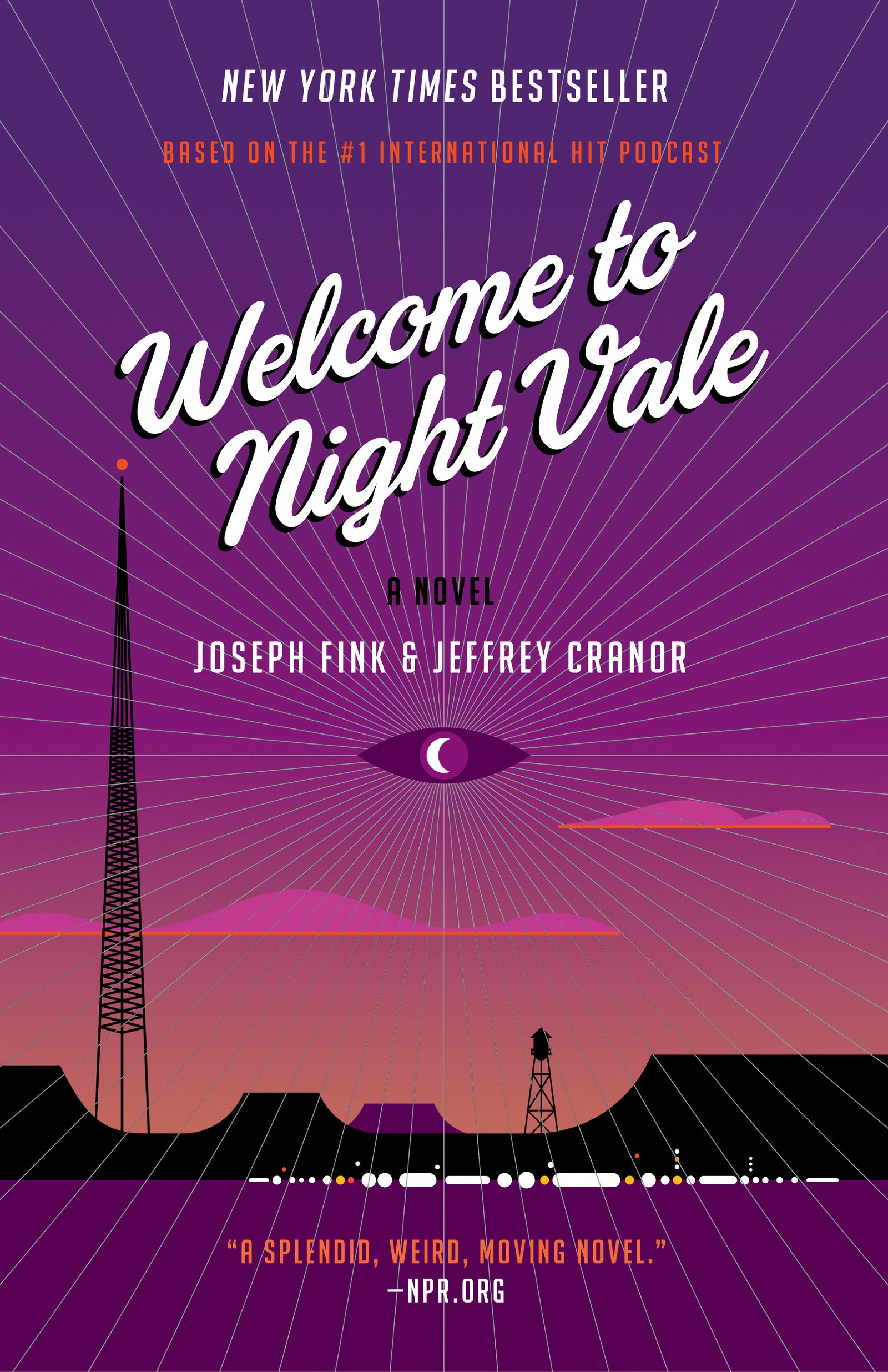
Welcome To Night Vale by Joseph Fink & Jeffrey Cranor

I’m copying over some reviews of titles I’d written up in 2018 and earlier, just in case these titles are new for other people.

Welcome To Night Vale by Joseph Fink and Jeffrey Cranor is definitely an interesting read, especially if your tastes lean toward the absurd and surreal.
It ranks up there with Douglas Adams (think Dirk Gently rather than Hitchhiker’s Guide) and David Wong, but with a bit less cohesion and rationality behind the narrative and the setting. That sounds like a bad thing, but it really isn’t…it’s refreshing to read something so ridiculous that still manages to be captivating and entertaining, because that is something a great many authors just can’t pull off.
Throughout this novel, none of the absurdity and randomness ends up feeling like it’s there just to be there or simply to categorize the story as being bizarre or strange. Somehow the authors manage to make it all feel like it furthers the plot, and there is one of those…a plot.
Reading this book makes me want to listen to more of the podcast that started it all, maybe from the beginning through the present (which would likely take up more time than I really want to invest). It’s a statement about the quality of the book that I would actually want to spend more time visiting the fictional, semi-lucid nightmare town that is Night Vale and hopefully they will opt to write another novel or two so that I don’t have to immerse myself in the podcast.
As long as I don’t have to visit the library to read them, I’ll be ok.

The Dark Forest by Liu Cixin

I’m copying over some reviews of titles I’d written up in 2018 and earlier, just in case these titles are new for other people.

Liu Cixin crafted a thoroughly fantastic and stunning follow-up to The Three-Body Problem with The Dark Forest. The tension from the final chapters of the first novel carried over well into the sequel. The Dark Forest excels in portraying a worldwide reaction to the certain knowledge that an advanced alien species had successfully cut us off from advanced scientific inquiry (by making it impossible for us to study anything at the quantum level) in order to keep us weak in preparation for the massive fleet that they had sent our way to take over our planet and escape the inevitable destruction of their own.
Just like the first novel, the development of fully realized characters is superb, and the exploration of our evolving and devolving society during the couple of centuries after doomsday begins looming on the horizon is spectacular.
The most striking element of The Dark Forest is in the application of the title itself as an ominous response to the Fermi Paradox. The concept that we aren’t seeing evidence of alien civilizations because they are applying game theory to any other potential life in the universe is an interesting one. To announce one’s existence to anyone else in the dark forest of our universe presents the very real risk that anyone receiving the announcement might be aggressive or induce aggressive response from one who isn’t simply because they might assume that you might be. It’s a sincerely horrifying prospect that there could be numerous civilizations out there who are just acting prudently in not broadcasting their presence and that there are other civilizations who might validate that concern by being a threat to any other life they might encounter. It’s really fascinating to think of it that way. I certainly didn’t think of that when I was writing my paper on the Fermi Paradox when I was in college, and I wish I had.
The only problem I can think of with this book is that there seems to be a minor shift in tone and style from the first novel, but that could easily be due to there being a different translator involved with this volume. It’ll be interesting to read the third book to see if that’s the case, since it is translated by the same man as the first one.
I honestly don’t know where the third book might take me, because this one seemed to be such a perfect place to end the story…but I can hardly wait until the English translation is released later this year.

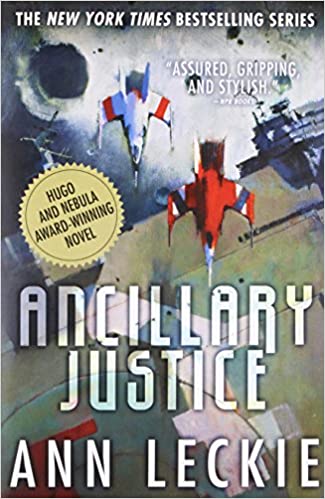
Ancillary Justice by Ann Leckie

I’m copying over some reviews of titles I’d written up in 2018 and earlier, just in case these titles are new for other people.

I had to make it more than halfway through the next book in my pile of books to-be-read before I felt like really analyzing Ancillary Justice by Ann Leckie. It was a lot to process in a reasonably small novel.
The story follows a protagonist that is the final remaining aspect of a massive ship-based militaristic AI, confined to a human shell. While the ship was still “alive” and operational, these human shells with minds replaced by the AI were known as ancillaries, essentially tools of the ship to use in place of soldiers and other functionaries. The author handles the character with a consistency that is admirable as the story jumps back and forth in time to build up the back story while unveiling the main narrative as it progresses toward an intense climax.
At heart it’s a story about revenge and an exploration of consciousness (human and AI alike)…but there is much more to it than just those two superficial elements. Redemption, colonialism, human nature, and war are all placed under the lens while the non-human protagonist pursues her/its objective. We, as readers, get introduced to a massive (gender-neutral, in which everyone is referred to by feminine pronouns) empire spanning numerous star systems, led by a tyrannical individual who has cloned herself into numerous ancillaries as well, to become a distributed consciousness spread across the galaxy…but within whom there is a fracture, and the leader is working against herself in subtle and not so subtle ways to undermine the opposing side. Just typing that was confusing, and it says a great deal about the quality of the author that it isn’t disorienting within the book.
I have to read the rest of the series to know for sure, but based on this first novel of the trilogy, Leckie has certainly cemented herself as being one of the most original and talented minds recently working within the science fiction genre.

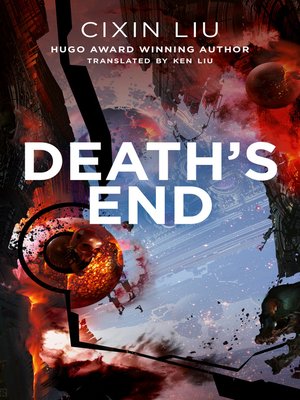
Death’s End by Liu Cixin

I’m copying over some reviews of titles I’d written up in 2018 and earlier, just in case these titles are new for other people.

Liu Cixin really tackles a lot of heavy material with Death’s End, starting approximately when The Dark Forest did in our near future and running billions of years into the future…jumping forward sporadically as the protagonist is awakened from hibernation to participate in or witness universe shaping events.
Human nature, sociology, game theory, and dimensional physics all play a major role in shaping a narrative that delves far deeper into this possible future for the human race than the previous two novels in the trilogy. What’s most surprising is just how deftly it’s all woven together, and that is even more surprising when taking into consideration that it was translated into English while maintaining coherence and literary quality.
While at times almost disorienting, this book was an absolutely necessary conclusion to the trilogy that began with The Three-Body Problem.

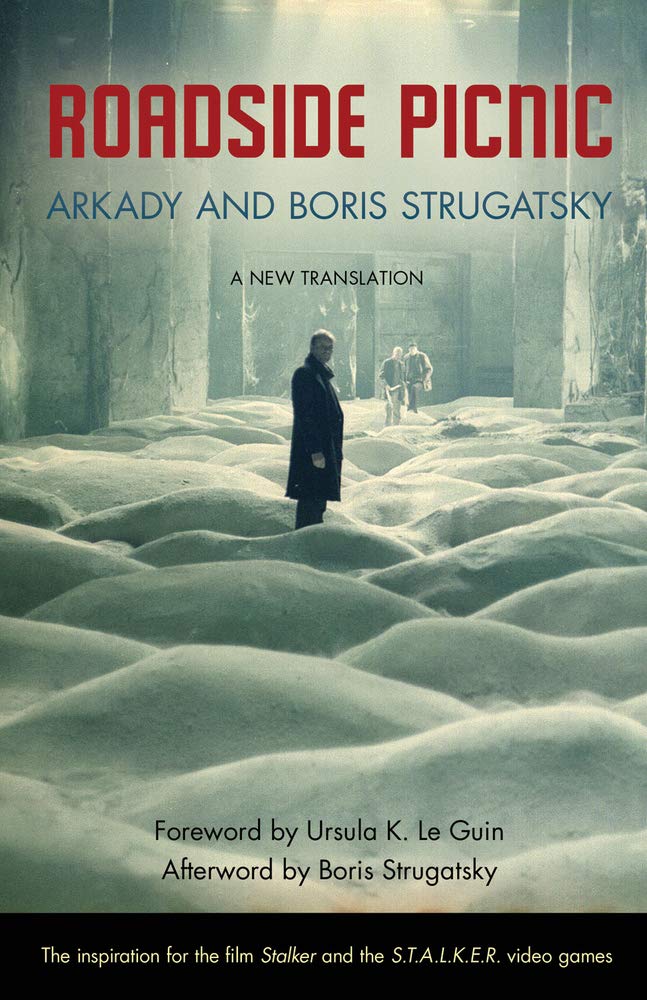
Roadside Picnic by Arkady & Boris Strugastky

I’m copying over some reviews of titles I’d written up in 2018 and earlier, just in case these titles are new for other people.

I’m glad that we have a solid English translation of Arkady and Boris Strugatsky’s Roadside Picnic. This is a book that people really should be reading, if only because there’s a perspective to it that we rarely see in science fiction or literature in general.
While this may be a science fiction novel, taking place a number of years after first contact that involved no contact at all, the narrative is more akin to horror than anything else.
Aliens arrived on Earth, landing in a handful of seemingly random locations and then left shortly thereafter without any attempt to interact with us. What they left behind in their landing locations were bizarre, hazardous, and toxic zones where people like our protagonist would illegally venture with the purpose of risking their lives to collect items of alien manufacture that could be sold to scientific institutes for study or private collectors for bragging rights. The odds of surviving these trips into the zone were slim and anyone who made it out was changed by the experience.
This is where the novel begins, the context surrounding a story that is equal parts inspirational and terrifying, disorienting and straightforward. This book should be considered not only a fantastic sample of Cold War era Russian science fiction but also an example of surreal horror at its finest.

Interstellar Dad by Jeff Beesler

The author has a knack for crafting a story that is entertaining and exciting, while not taking itself too seriously (even though there’s quite a bit serious about the conditions when we first encounter our protagonist). Finishing this first book of the series, even without knowing it’s part of a larger series, you just know that this is a story that will continue past the final page…even if the author hadn’t chosen to continue…and that says something about the three-dimensionality of the characters an author is writing when you know that they are still going on and doing things after you close the book (or turn off your Kindle, whichever the case may be).